The Supreme Court on Monday upheld a Mississippi law that allows properly postmarked ballots received up to five days after Election Day to still be counted. Donald Trump didn’t take the news well.
Donald Trump reacted to a rare Supreme Court loss on Monday with a social media rant and a renewed call on the Senate to pass a voter suppression bill that would eliminate most voting by mail.
Earlier in the day, the court had ruled in a narrow 5-4 decision, in which Chief Justice John Roberts and Justice Amy Coney Barrett sided with their three liberal colleagues, that properly postmarked mail-in ballots arriving after Election Day must be counted.
Stating that the Founding Fathers had realized that writing election laws covering any possible future scenario posed a major challenge and therefore “decided that ‘a discretionary power over elections’ needed to be lodged ‘somewhere,’” Barrett wrote for the majority that “suffice it to say, that power was not lodged in this Court.”
She noted that statutes defining Election Day “say nothing about ballot receipt,” and declared that “we cannot add to the words Congress chose.”
As a result, the court upheld a Mississippi law granting a grace period of five days for ballots postmarked by Election Day.
Trump, who has been on a warpath against mail-in voting, which he blames for his 2020 election loss that he still fails to accept, took to social media shortly afterwards to call the decision a “tremendous loss.”
The president used the opportunity to demand that the Senate pass the SAVE America Act, which would impose new voter ID and proof of citizenship requirements on Americans, millions of whom would not be able to meet them even though they are eligible by law to vote.
In addition, the legislation would also ban almost all types of mail-in voting.
Making up a non-existent threat of a “powerful Communist Movement” in the US that, according to the president, is “more dangerous than World War I, World War II, Pearl Harbor, or September 11th,” he called on Republican senators opposed to passing the bill and/or eliminating the filibuster to do so to bend to his will in light of the decision.
Even though the Supreme Court ruled against him, Trump’s allegations of “election fraud” — which he has never been able to back up with any kind of evidence — and the GOP’s subsequent efforts to help him undermine democracy, bled into Barrett’s decision.
“Election fraud and its appearance are serious issues. Like other such issues, however, they must be addressed through the democratic process,” Barrett wrote. “The election-day statutes are proof of concept: When voting on different days in different States sparked allegations of fraud, Congress set a nationally uniform deadline for voting. If varied deadlines for ballot receipt similarly call for a national solution, the American people must choose it through their elected representatives.”
Unfortunately, many of those representatives, i.e., most Republicans, are now adherents of Trump’s Big Lie. This means that, whether out of ignorance or political calculation, they are willing to help the president change election laws in a way that they hope will give them an advantage.
Therefore, this narrow ruling, while important, is merely a reprieve as Trump’s assault on democracy continues.
Klaus Marre Klaus Marre, a former congressional reporter, is a senior editor for US politics at WhoWhatWhy. He writes regularly here, and you can also follow him on Bluesky and Substack.
Last week, New York City voters turned the city into Mamdani Land. Longtime incumbent Democrats were defeated by more progressive challengers. The huge DSA-backed election wins offered a sharp contrast with San Francisco, where the left is faltering politically. But while San Francisco has never had a DSA mayor, is New York City really more progressive?
We think not. Here’s why.
SF’s Stronger Tenant Protections
I see the core definition of “progressive” as supporting policies that allow low-income, working-class and middle-class people to live in a city. A city can pass progressive laws for transit, parks and public safety but if its housing prices prevent the non-affluent from living there it is not progressive.
I described in Generation Priced Out how even under progressive New York City mayor Bill de Blasio tenants in vulnerable communities like Crown Heights faced displacement and gentrification. Tenants were threatened with the loss of their homes under circumstances where San Francisco’s laws would protect them. New York City still maintains a loophole for renovation evictions that do not happen in San Francisco. Tens of thousands of New York City tenants are impacted.
Non-affluent tenants remain in San Francisco because the city has the strongest rent control and just cause eviction laws of any major city. New York City still has a way to go.
Mayor Mamdani recognizes that tenants need greater protections. He created a Mayor’s Office to Protect Tenants and appointed Cea Weaver as its first Director. Weaver was the Crown Heights organizer featured in my book. She is a tireless and savvy advocate for tenants. Backed by the mayor, she will make a huge difference.
Mamdani’s New York City has already begun ncreasing tenant protections. Last Thursday the Rent Guidelines Board froze rents on one and two year rent stabilized leases. It was an historic victory for New York City tenants. Sumathy Kumar, the executive director of New York State Tenant Bloc, told the popular news site Hell Gate that “Mamdani ‘popularized the call’ for a rent freeze. He took up the call that tenants had been making for a really long time, and exposed thousands, millions of people to it.’”
San Francisco also better protects SRO tenants. On May 21, 2026 it was reported that longtime SRO tenants in a Bowery hotel were being forced out by illegal demolitions and renovations. San Francisco has not seen a similar pattern of conduct since the mid-1980’s.
According to the story:
Over the past decade, the number of SRO units in Lower Manhattan—and specifically on the Bowery—have […] plummeted. There was the former Sunshine Hotel at 245 Bowery, which now houses a cocktail bar and office spaces, and the Whitehouse, at 340 Bowery, which has been converted into a micro-boutique hotel. SROs are endangered partly because landlords have found new ways to evict tenants and convert their buildings into properties they can rent out at market rates. If a tenant vacates the unit, the landlord may rent it to transient hotel guests at whatever price they set.”
I spent years getting laws passed and filing lawsuits for the Tenderloin Housing Clinic to protect San Francisco’s supply of residential SRO’s and SRO tenants. In San Francisco, legal hotel conversions must give lifetime leases to existing tenants.
San Francisco doesn’t allow residential SRO’s to become boutique hotels without meeting very steep conversion requirements. Which is how San Francisco maintained its residential hotel stock whereas New York City has not.
SF Allows Local Ballot Measures
San Francisco’s strong, progressive tenant protection laws were primarily passed by voters. Giving voters a chance to set policy may be the best example of San Francisco offering a more progressive version of democracy than New York City. New York City prevents voters from gathering signatures for local initiatives.
Ballot measures have made San Francisco a more inclusive city. And a more progressive city. Voters raised the city’s minimum wage, expanded free child care and earmarked hundreds of millions of dollars to address homelessness. It was voters who put a cap on unrestricted downtown development with Prop M in 1986.
The ability to circumvent politicians and go directly to voters has been a driving force behind a more democratic and progressive San Francisco. But San Francisco “moderates” are now trying to limit voter-initiated ballot measures. They claim to want to address an allegedly overcrowded ballot. The real goal is to choke off a vehicle for progressive policies. One that New York City has sorely lacked.
Electing Politicians vs. Passing Laws
New York City easily outpaces San Francisco when it comes to electing self-proclaimed progressive mayors. Labor-backed Bill de Blasio was elected in 2013 with over 73% of the vote. Despite constant media attacks on his leadership, the left-wing de Blasio was re-elected in 2017 with over 66%.
The only reason moderate Eric Adams won in 2022 was the left’s failure to field a strong consensus candidate. When they remedied this in 2025, Zohran Mamdani got slightly over 50% of the vote in a three-way race.
San Francisco has not elected a self-identified progressive mayor since Art Agnos in 1987. Matt Gonzalez would have given San Francisco a Green Party mayor but narrowly lost to Newsom in a 2003 runoff despite being massively outspent.
Mayors Willie Brown and Ed Lee backed many progressive laws and policies. In most cities their policies would have placed them solidly in the progressive camp. But in San Francisco neither were considered “progressive.” Nor was Gavin Newsom, despite opening the door for marriage equality.
San Francisco’s initiative process has brought progressive change without “progressive” mayors. New York City’s lack of an initiative process has slowed progressive policies despite electing progressive mayors.
Where NYC is More Progressive
Ironically, one area where New York City is more progressive than San Francisco is in its network of bike lanes. And that was brought about by Mayor Michael Bloomberg, not a progressive.
To be clear, Bloomberg’s greatest legacy as mayor was upzoning neighborhoods to facilitate displacement and gentrification while downzoning affluent neighborhoods. But he fully backed Janette Sadik-Khan’s creation of a top-notch bicycling infrastructure.
Bloomberg also promoted New York City’s far superior use of public spaces. Compare New York City’s incredibly active Bryant Park to San Francisco’s far less busy Civic Center Park. Both have a history of being dominated by public drug use. But since being cleared Bryant Park is regularly filled with people and Civic Center Park is not.
New York City also gets credit for a vastly superior subway system, network of public pools and many high quality public parks. This progressive infrastructure goes back to the New Deal.
The contrast between New York City’s Mayor Mamdani and San Francisco Mayor Daniel Lurie is striking. But for now, when it comes to city policies and laws, San Francisco is more progressive.
Randy Shaw is the Editor of Beyond Chron and the Director of San Francisco’s Tenderloin Housing Clinic, which publishes Beyond Chron. Shaw’s new book is the revised and updated, The Tenderloin: Sex, Crime and Resistance in the Heart of San Francisco. His prior books include Generation Priced Out: Who Gets to Live in the New Urban America. The Activist’s Handbook: Winning Social Change in the 21st Century, and Beyond the Fields: Cesar Chavez, the UFW and the Struggle for Justice in the 21st Century.
Connect with a local PFLAG chapter. With over 360 local chapters, PFLAG works to build supportive networks of support, education, and advocacy for LGBTQ+ youth in communities across the US. Learn more here.
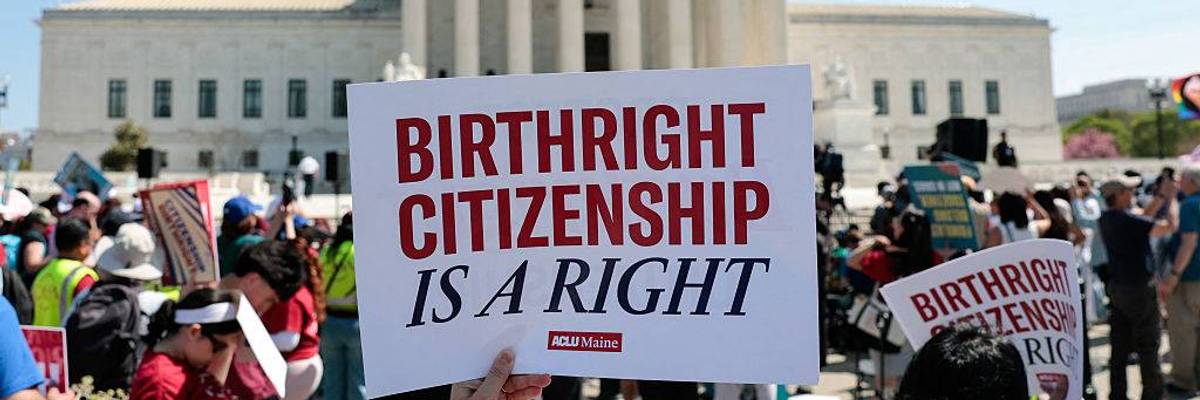
Demonstrators rally in support of birthright citizenship outside the US Supreme Court in Washington, DC on April 1, 2026.
(Photo by Kent Nishimura/AFP via Getty Images)
“Birthright citizenship is protected today. But the workers whose children depend on it still face deportation, worksite raids, and an administration that has made clear it will use every tool available to make immigrant workers afraid, isolated, and stripped of their rights,” said one campaigner.
The US Supreme Court on Tuesday struck down President Donald Trump’s executive order that sought to deny automatic citizenship to children born in the United States to undocumented parents, preserving 150 years of birthright citizenship under the 14th Amendment and dealing a major blow to the administration’s xenophobic agenda.
“Children born in the United States to parents unlawfully or temporarily present are ‘subject to the jurisdiction’ of the United States and are citizens at birth under the 14th Amendment’s citizenship clause,” the high court held in Trump v. Barbara.
The 6-3 decision roundly rejected an executive order issued by Trump on the first day of his second term that sought to deny US citizenship for babies born in the United States to parents who are either unlawfully in the United States or legally living in the country on temporary visas.
Every lower court rejected the order. Just three days after its issuance, US District Judge John Coughenour, an appointee of former President Ronald Reagan, blasted it as “blatantly unconstitutional.”
“Citizenship, then and now, was the right to have rights—to freely participate in our political community. The framers of the 14th Amendment extended that promise to ‘every free-born person in this land,’” Chief Justice John Roberts wrote for the court. “We keep that promise today.”
Roberts was joined in the majority by Justices Sonia Sotomayor, Elena Kagan, Amy Coney Barrett, and Ketanji Brown Jackson, with Justice Brett Kavanaugh writing a separate concurring opinion agreeing that Trump’s executive order was unlawful but basing his reasoning on federal immigration law rather than the 14th Amendment.
“As revealed by the court’s opinion with its detailed account of history and precedent, and by the weighty and thoughtful dissents, the constitutional issue is far more complicated than the statutory issue,” Kavanaugh wrote.
“This is one of the most important decisions in the history of the court, and in my judgment, the court has made a serious mistake,” Alito wrote in his dissent. “As interpreted by the court today, the 14th Amendment confers citizenship on virtually everyone who happens to be born in this country, including the children of ‘birth tourists,’ women who come here solely for the purpose of giving birth to a child and then promptly return home.”
Alito further argued that the 14th Amendment “confers citizenship on only those children who, at birth, owe allegiance solely to this country.”
In a 91-page dissent more than three times longer than Roberts’ opinion, Thomas wrote that “the court adds to the sad history of the 14th Amendment, which was designed and understood to secure equal rights for the freed Blacks but has instead been repurposed for political projects that the Reconstruction Congress did not support.”
Trump took to his Truth Social network to lament, “The Supreme Court upheld Birthright Citizenship, which is too bad for our Country, but we can easily make it up in Congress through Legislation, with the support of the President, that has now been determined during this process.”
“No long and unwieldy Constitutional Amendment is necessary!” he added. “Congress should start TODAY to work on ending expensive and unfair to our Country, Birthright Citizenship. They will have my Complete and Total Support!”
Stephen Miller, Trump’s xenophobic deputy chief of staff, seethed on X that Trump v. Barbara is “one of the most destructive and outrageous decisions in the long history of the Supreme Court.”
“American citizenship is not the birthright of the world,” the white nationalist added. “It belongs only and solely to Americans. No provision of the Constitution can be read to require our national self-obliteration.”
Defenders of birthright citizenship and the Constitution welcomed the ruling.
“The Supreme Court affirmed what we know in our hearts and in our communities: The 14th Amendment extends the promise of citizenship to everyone born in the US Immigrants belong,” Congresswoman Delia C. Ramirez (D-Ill.), a birthright citizen, said on Bluesky. “No one can deny that immigrants today are also the inheritors of the promise of America—just like so many of my colleagues’ ancestors were.”
Congresswoman Ilhan Omar (D-Minn.), a former refugee from Somalia, said on social media: “The Supreme Court just upheld birthright citizenship, blocking Trump’s attempt to dismantle the 14th Amendment and strip away a constitutional guarantee. If you were born here, you are an American citizen. The Constitution is clear. No one can change that.”
American Immigration Council senior fellow Aaron Reichlin-Melnick called the decision “the easiest of layups possible.”
Thomas Wolf, director of democracy initiatives at the Brennan Center for Justice at New York University School of Law, said that “the court could not have defensibly ruled any differently.”
“The 14th Amendment guaranteed citizenship to everyone born here over 150 years ago,” he added. “The Supreme Court affirmed that 20 years later in Wong Kim Ark.”
ACLU national legal director Cecilia Wang, a birthright citizen who argued the case before the Supreme Court, said the decision “reaffirms a fundamental American promise—if you are born here, you are a citizen. A president cannot change the Constitution by executive fiat.”
Neidi Dominguez, executive director of the multiracial advocacy group Organized Power in Numbers, said that “today the Supreme Court reaffirmed a constitutional right that should never have been in question.”
“Birthright citizenship was guaranteed through the passage of the 14th Amendment after the Civil War, when formerly enslaved Africans and their allies fought to access equal rights and affirm that children born in the United States have citizenship regardless of where their parents come from,” she noted. “That right survives today.”
“But let us be clear about what happened here,” Dominguez continued. “The Trump administration tried to narrow the definition of citizenship and the access to the rights that come with it, and even this Supreme Court disagreed. This is a real relief, and it is welcome. It is also the bare minimum.”
“The same court that today defended birthright citizenship last week stripped legal protections from more than 350,000 Haitian and Syrian workers with [temporary protected status] and opened the door to doing the same to up to 1.3 million people,” she said. “Earlier this term, it cleared the way for mass layoffs of tens of thousands of federal workers. Working people are not safe because one constitutional right survived. They are fighting on every front.”
“Birthright citizenship is protected today. But the workers whose children depend on it still face deportation, worksite raids, and an administration that has made clear it will use every tool available to make immigrant workers afraid, isolated, and stripped of their rights,” Dominguez added. “Employers cannot stay silent while the workers they depend on are stripped of their rights one ruling at a time. We are not done fighting.”
Virginia Kase Solomón, president and CEO of the pro-democracy group Common Cause, issued a statement saying, “While we welcome the court finally upholding a constitutional amendment ratified nearly two centuries ago, upholding the law is no cause for celebration, it is a requirement.”
“Let today be a stark reminder that this court continues to systematically dismantle voting protections for Black and brown communities, tilting the scales of justice toward a dark era where a wealthy, privileged few dictate the rules for the rest of us,” she added. “Today may be a brief victory for the rule of law, but our fight to protect our multiracial democracy continues.”
Wolf at the Brennan Center said that “today’s ruling is the right one amid an avalanche of Supreme Court opinions undermining our democracy.”
“In just the past few weeks alone, the court further undermined the Voting Rights Act, encouraged more aggressive partisan gerrymandering, dangerously expanded presidential power over federal agencies, and further depleted protections for immigrants,” he noted. “This ruling does not make up for all the damage the court has done this term.”
On Tuesday, the court also ruled that states may ban transgender girls from participating in sports at schools receiving public funding.
Our work is licensed under Creative Commons (CC BY-NC-ND 3.0). Feel free to republish and share widely.
President Donald Trump, center, with Vice President JD Vance to his left, and Secretary of State Marco Rubio to his right, arrives for a Board of Peace meeting at the U.S. Institute of Peace, February 19, 2026, in Washington. Credit: Mark Schiefelbein/AP Photo
On Saturday, The Guardian published a leaked draft memo that would give Trump’s so-called “Board of Peace” and its contractors in Gaza blanket legal immunity from any charges of wrongdoing. The draft language would also let the organization obtain public property in Gaza “free of charge.” This is only the latest example of the crass power grab in Trump’s Gaza peace plan, which U.S. representatives strong-armed the U.N. Security Council into endorsing back in November 2025.
Meanwhile, on June 18, Hillary Rodham Clinton published an absolutely bizarre op-ed piece in the Financial Times endorsing Trump’s Board of Peace and its grand plans for Gaza. The op-ed was titled “The World May Not Like Trump’s Gaza Plan—but There Is No Alternative.”
Neither article has gotten much attention in U.S. media.
Clinton wrote, “There is no alternative framework waiting in the wings. No rival coalition is quietly preparing a more viable proposal. The 20-point plan is not the one many of us would have drafted, but it remains the only framework backed by sufficient leverage, political engagement and potential resources to move the parties towards implementation.”
Say what? This is total malarkey. There had better be alternatives.
Trump’s Gaza design, a real estate grab masquerading as a peace plan and economic reconstruction, can move forward only in the context of total Israeli domination of Gaza and victory over Hamas and Hezbollah, goals that look less likely by the day. The Board of Peace epitomizes Trump’s corrupt conflation of his family financial interests with U.S. foreign policy.
Clinton went on: “The Board of Peace and the plan contain elements many governments dislike or disagree with. Some are uneasy with the political sequencing, sceptical of provisions on Palestinian governance and representation, or wary of placing trust in an American-led framework at a moment when confidence in U.S. leadership has eroded. Many are understandably sceptical of an approach so closely associated with Donald Trump.”
Well, yes!
She concluded, “Yet if even I, an implacable opponent of President Trump, can accept that this is the best option in a terrible situation, then surely others can too?”
With a different control structure, some of the elements of the 20-point plan do make sense, especially the rebuilding of infrastructure and other economic development—but not as a Trump family business. Moreover, any legitimate redevelopment of Gaza needs a substantial role for Palestinians, and as long as Benjamin Netanyahu is prime minister, that is a nonstarter. Even a post-Netanyahu government would likely resist.
Why on earth would Clinton, savaged in 2016 by Trump, who keeps trashing both her husband and the president, Barack Obama, whom she served as secretary of state, now be carrying water for him? And why now, when the entire Trump design for achieving regional hegemony by annihilating Iran has imploded?
The structure of the Board of Peace underscores the sheer corruption. Trump is “Chairman for Life,” even after he leaves the presidency. Other key members of the executive board are close-in Trump aides and cronies: son-in-law Jared Kushner, real estate and golfing buddy (and part-time failed diplomat) Steve Witkoff, Secretary of State Marco Rubio, and Chief of Staff Susie Wiles, among others. The only non-Trumpie is former British prime minister and world-class opportunist Tony Blair.
Should we have any doubt that Hillary Clinton is doing someone a favor, to be called in at a later date, in what novelist Tom Wolfe memorably called the Favor Bank?
My guess would be Tony Blair, who stands to gain if the Gaza plan goes forward. Blair is close to the Clintons and has been a regular speaker at their events. Trump’s enterprises, mixing official business and family businesses, are only more brazen versions of a model ventured by the Clintons in the Clinton Global Initiative and Blair’s Institute for Global Change, which made both families rich.
As Democrats try to contain Trump and pose compelling alternatives, too many cynical voters conclude, “They all do it.” Softer corruption gives Trump cover for more overt corruption.
Before you go.
I hope that you found this article interesting and thought-provoking. The reason we’re able to publish stories like this — free of programmatic ads and never behind a paywall — is because readers like you step up to support our work.
The Prospect doesn’t answer to advertisers or billionaire owners. We answer to you and to our commitment to pursuing the truth, wherever that leads us.
Independent, reader-supported journalism is critical at a time when the free press is under assault.
If you believe this kind of reporting should exist and remain free to read, we hope you’ll consider chipping in. Every contribution, however modest, makes a real difference.
Robert Kuttner is co-founder and co-editor of The American Prospect, and professor at Brandeis University’s Heller School. His latest book is Notes for Next Time: Surviving Tyranny, Redeeming America. Follow Bob at his site, robertkuttner.com, and on Twitter. More by Robert Kuttner
A bill to update the antitrust laws in the nation’s most populous state faces a critical legislative hearing this week. At a time when California is among the states being relied upon as a substitute for proper antitrust enforcement, which is moribund at the federal level thanks to Trump administration corruption, advocates say the state must have a full suite of tools to succeed.
Monied interests are working diligently to stop the bill, but it gained important momentum late last week when a key senator signed on. The office of state Sen. Ben Allen, who is running for statewide office to become California’s insurance commissioner, told the Prospect that “the Senator is very likely going to be supporting the bill.” Allen was one of a handful of Senate Judiciary Committee Democrats whose position on the bill was uncertain as of last week.
Allen is roommates in Sacramento with Sen. Henry Stern; they represent nearby districts in Southern California and often vote in concert. Stern has also been considered a swing vote on the legislation. His office did not respond to a request from the Prospect for clarification.
There are 13 members on the committee, 11 Democrats and 2 Republicans. If Allen and Stern support the bill, it likely has enough votes to get out of the committee. Sen. Scott Wiener, who is running for Congress from San Francisco, previously told the Prospect he would support it, and five other Democrats are expected yes votes, with three others undecided, including the chair, Sen. Tom Umberg. As chair, however, Umberg could influence several committee members with his recommendation, so the outcome remains uncertain.
Neither Umberg’s office nor the offices of Akilah Weber Pierson and Angelique Ashby, who are also considered swing votes, responded to requests for comment.
THE BILL, KNOWN AS THE COMPETE ACT (AB 1776), will get heard in the Judiciary Committee on Tuesday. It would fix a defect in the state’s antitrust law, the Cartwright Act: namely, that it does not cover single-firm conduct. Currently, the law can only be applied to coordinated conduct by multiple firms to monopolize an industry. But the new language affirms that “it is unlawful for one or more persons” to “unreasonably restrain trade” or “monopolize or monopsonize, attempt to monopolize or monopsonize, maintain a monopoly or monopsony, or combine or conspire with another person to monopolize or monopsonize any part of trade or commerce.” Given that the quintessential monopoly is a single firm, it’s a logical update.
Assembly Majority Leader Cecilia Aguiar-Curry introduced the update in February, which tracks closely the recommendations of the California Law Revision Commission, which assists the legislature with ideas for updating legislation in the state. The CLRC recommendation to add a single-firm conduct provision came after years of study and testimony.
Restrictions on single-firm conduct would allow individual would-be monopolists to be sued under state law. That would include Silicon Valley–based tech firms like Google, Apple, and Meta, all of which have faced monopolization cases at the federal level; Google has been found guilty of monopolization twice. Real estate firms like algorithmic price coordinator RealPage, grocers with local footprints like Kroger and Albertsons (which tried to merge in 2024), home insurance companies colluding to deny fire coverage in the state, and Hollywood studios that could be scrutinized over tying together distribution and production would be at greater risk from a souped-up Cartwright Act.
The COMPETE Act passed the State Assembly easily in May, but the Senate Judiciary Committee has been seen as a location for corporate interests to make a stand. The committee is considered more moderate than the state Senate as a whole.
The California Chamber of Commerce released a letter to Umberg last week with 106 co-signers, lambasting the COMPETE Act as unnecessary, claiming it would sow confusion, chill lawful conduct, and “increase litigation and impose significant cost on consumers as well as all businesses operating in California.” CalChamber is calling AB 1776 a “cost driver” bill, a new category they have been using to group together legislation in an age of inflation. Historically, bills designated “job killers” by CalChamber have died in the state legislature; the cost driver epithet is a similar play.
An analysis of the co-signers to the CalChamber letter tells a somewhat different story than their argument that it puts all businesses at risk, however. Eleven of the co-signers are trade associations for the tech industry, fourteen represent agriculture and food retail, nine represent real estate interests, seven represent finance and insurance, five represent hospitality and entertainment, and another nine represent health care, life sciences, transportation, and manufacturing. These are among the most concentrated industries in the economy.
The talking points in the opposition letter reference activities unique to those industries. It cites “reward programs offered by hotels and airlines,” “discounts provided by pharmaceutical companies,” pharmaceutical and technology patents, and movie studio distribution practices. This aligns with the pharmaceutical industry’s stated claims that new treatments and clinical trials will have to be scrapped if the bill goes through.
“The technology, real estate, health care, and airline sectors represented in the opposition coalition have the most direct and prominent recent antitrust exposure relevant to what AB 1776 would expand liability for,” according to Lee Hepner, senior legal counsel with the American Economic Liberties Project.
Close to four dozen local chambers of commerce and business councils also signed on in opposition. But those groups are made up of small-business memberships who are often in combat with larger firms attempting to monopolize their markets. In addition, numerous small-business groups (including the National Small Business Advocacy Council, American Independent Business Alliance, and Small Business Majority) and local business councils (the state’s Black Chamber of Commerce and local chambers in Los Angeles, San Francisco, San Diego, Stanislaus, Sierra, Sonoma, San Gabriel Valley, Richmond, and the High Desert) are in support.
The Prospect asked CalChamber how it made sure its position reflected the views of its membership. Spokesperson John Myers replied that members “can join policy committees that review issues such as this one” and “are consulted in a variety of ways” during the legislative session.
BIG-MONEY LOBBYISTS HAVE ALREADY added amendments into AB 1776, including exemptions for small businesses and requirements to provide evidence of market power in any liability cases. Predictably, CalChamber has said that the amendments only add uncertainty and continue to put all businesses in litigation risk.
Umberg has endorsed other antitrust bills in the past, including the law that passed last year banning algorithmic price-fixing. He did object to the BASED Act, a separate antitrust bill brought by Sen. Wiener this year that would have prevented self-preferencing by technology platforms. But BASED didn’t have the imprimatur of the state Law Review Commission, which is rarely rejected by the legislature.
The bill has emerged just as California’s attorney general Rob Bonta has led a coalition of state enforcers using federal antitrust laws to fight consolidation on multiple fronts. This has become necessary because the federal government has committed ritual suicide on its antitrust enforcement agencies. Just last week, the new acting head of the Justice Department Antitrust Division, Stanley Woodward, told staffers that he preferred not to go to trial on any case.
The state coalition has picked up the slack. It successfully prosecuted Ticketmaster, which was found guilty of monopolization in federal court. It has blocked a television station merger between conglomerates Nexstar and Tegna. And Bonta is expected to lead a challenge to the merger between entertainment studios Paramount and Warner Bros. Discovery. (One wrinkle: the private-sector lawyer that the states hired to win the Ticketmaster case, Jeffrey Kessler, has been hired by Paramount.)
Bonta has not spoken out about the COMPETE Act, though advocates and other officials in California have been working to obtain his support, sources tell the Prospect. Bonta’s office did not respond to a request for comment.
If the COMPETE Act makes it through the Senate Judiciary Committee, it would likely get to the governor’s desk. Gavin Newsom has fallen in line with CalChamber and other business groups in the past, and he’s currently fighting a billionaire tax proposal whose top opponent is Google co-founder Sergey Brin, who would likely have a problem with a stronger state antitrust law as well.
But Newsom, who is expected to run for president in 2028, has been making several moves in the antitrust space. He asked for increased funding for enforcement amid the more prominent role of state attorneys general. And this week, former Consumer Financial Protection Bureau director Rohit Chopra begins work in Sacramento as a Newsom appointee, running a new consumer protection agency in the state. Perhaps political ambition can work for the good of Californians this time.
Before you go.
I hope that you found this article interesting and thought-provoking. The reason we’re able to publish stories like this — free of programmatic ads and never behind a paywall — is because readers like you step up to support our work.
The Prospect doesn’t answer to advertisers or billionaire owners. We answer to you and to our commitment to pursuing the truth, wherever that leads us.
Independent, reader-supported journalism is critical at a time when the free press is under assault.
If you believe this kind of reporting should exist and remain free to read, we hope you’ll consider chipping in. Every contribution, however modest, makes a real difference.
David Dayen is the executive editor of The American Prospect. He is the author of Monopolized: Life in the Age of Corporate Power and Chain of Title: How Three Ordinary Americans Uncovered Wall Street’s Great Foreclosure Fraud. He co-hosts the podcast Organized Money with Matt Stoller. He can be reached on Signal at ddayen.90. More by David Dayen
Rahm Emanuel, U.S. ambassador to Japan, attends a photo op with Prime Minister Fumio Kishida and congressional leaders before Kishida addressed a joint meeting of Congress on Thursday, April 11, 2022. Tom Williams/CQ-Roll Call, Inc via Getty Images
It’s simply taken for granted in US legacy media that “left-wing/progressive” electeds are driven by rigid ideology while centrists are motivated by cold, calculated, and semi-scientific concern with How To Defeat Republicans. This is a premise basically no one in our media challenges. It is asserted as pure dogma that “centrist” or “moderate” Democrats are only “centrist” or “moderate” because they are forced to be by electoral realities, and thus every position they advance is not the end result of donor pressure or class interest, but a good-faith, totally organic demand from purple-area voters they must channel if they want to “take back Congress.”
Never is this dynamic more evident in media coverage than after the left-wing flank of the party has the kind of electoral success they saw this past Tuesday, when self-identified Democratic Socialist candidates scored major victories in New York City and state office. Immediately, before the votes were even counted, corporate media rushed to take the predictable angle, “Does electing far left-ideologues undermine Democrats’ ability to win in November,” because it’s simply taken for granted that left-wing policy perspectives are mutually exclusive with “electability.”
Leading the charge was, as always, the New York Times. “Democrats find themselves squeezed by competing forces,” the paper lamented. “The party’s leaders in Washington are pushing for moderate candidates who they hope will be competitive in states and areas that have been inhospitable to Democrats in recent years. But primary voters in New York and other recent contests are moving in the opposite direction, increasingly turning to progressives and even socialists who excite the base.”
It’s simply taken for granted that left-wing policy perspectives are mutually exclusive with “electability.”
Note how the NYT presents a completely false dichotomy: taking back Congress from Republicans vs. progressives and socialists winning primaries. These are the two options and they are, we are told, in tension. There’s no data cited to support this, no studies linked to; the article just asserts casual dogma, then moves on to debate how Democrats will manage this supposed conflict between its base and the desire to be “competitive in states and areas that have been inhospitable to Democrats in recent years.” To do this they turn to alleged “party leaders” who are presented not as ideologues in their own right, or conflicted, corporate-funded mouthpieces, but entirely good-faith strategists simply concerned with winning. The “moderate” sources are:
Neera Tanden, who is presented as someone who has “served in the last three Democratic administrations and is now the president of the Center for American Progress (CAP), one of the party’s leading think tanks.” What isn’t mentioned is that CAP has historically been funded by major corporations, billionaire donors, and foreign dictatorships, but Tanden stopped disclosing CAP’s donors so it’s anyone’s guess who floats them presently.
Tré Easton, who is presented as “a Democratic strategist at the Searchlight Institute, a Democratic think tank.” What isn’t mentioned is Searchlight was founded explicitly to combat the left flank of the party and is, according to a different NYT article, funded by “a roster of billionaire donors highlighted by Stephen Mandel, a hedge fund manager, and Eric Laufer, a real estate investor.”
Jaime Harrison, who is presented as “a South Carolinian who served as chairman of the Democratic National Committee during Joseph R. Biden Jr.’s presidency.” What isn’t mentioned is that Harrison is a longtime former lobbyist for corporate America—namely Bank of America, Wells Fargo, Wallmart, BP America, Boeing, and Lockheed Martin.
Yet none of these billionaire and corporate-backed sources are presented as potentially conflicted or motivated by their own conservative ideology. Their overarching worldview—a worldview that also happens to handsomely fund their entire careers—that capitalism and Israel are fundamentally good and worth defending is ignored and, instead, they’re simply presented as Concerned Democrats worried about potential electoral vulnerabilities. Why isn’t their capitalist ideology mentioned in a story that centers the ideology of socialism? Why are they presented as Having Concerns while Democratic Socialists are painted as indifferent or even hostile to taking back Congress?
Also left unmentioned is that these “party leaders” and their allies in Congress, like House Minority Leader Hakeem Jeffries and Senate Minority Leader Chuck Schumer, routinely adopt positions that are unpopular with the independent voters they’re allegedly motivated to win over.
CAP, Jeffries, and Schumer support economic and military aid to Israel despite the fact that only 31% of independent voters support continued military backing of Israel and 43% oppose it. Forty-eight percent of all voters think the US is too supportive of Israel, while 38% think the US support of Israel is about right.
CAP, Jeffries, and Schumer do not support Medicare for All* despite 71% of independents supporting it and only 19% opposing it.
CAP, Jeffries, and Schumer do not support free college for all Americans despite 70% of independents supporting it.
If these “moderates” are Simply Concerned With Winning in Purple America why do they not adopt these broadly popular positions? Why no mention of potential ulterior motives for the “concerns” from a party leadership defined by their lockstep support for Israel. Rather than being toxic to the Democrats’ brand, it’s clear Party Leadership’s issue with this slate of explicitly anti-zionist (or at least Israel-critical) candidates is ideological. Jeffries was the largest recipient of pro-Israel money out of 435 voting members in the House last election cycle (and, it’s worth noting, despite running in a non-competive primary and general), and Schumer has explicitly said his “job” is to “keep the left pro-Israel.” Why isn’t this mentioned when discussing potential motives for why leadership have “concerns” with Tuesday’s election results?
GET FEARLESS, AD-FREE, UNCOMPROMISING REAL NEWS IN YOUR INBOXSign up
The DSA and Democratic Party have roughly the same negatives, but only one is scandalized and painted as fringe.
Which “House Democrats” were anxious? The article only cites four—Josh Gottheimer, Gregory Meeks, Tom Suozzi, and Vicente Gonzalez—or 1.8% of House Democrats, which seems to be sufficient enough to represent “House Democrats” to CNN’s editors. But, of course, “House Democrats” have no known uniform position because no one surveyed the remaining 98.2%. CNN’s Harry Enten, citing DSA’s net -27 favorables with the public in general, did a separate breathless segment accepting the framing that the Democratic Socialist of America were unpopular with the mainstream and Republicans are now “licking their chops” to tie the Democratic party to the DSA’s toxic brand. The segment fails to mention that, in the very same Marquette poll he cites, the Democratic Party has -25 favorables, which is within the margin of error and effectively the same level of popularity. In other words: the DSA and Democratic Party have roughly the same negatives, but only one is scandalized and painted as fringe.
Again, the default, existing power structure is naturalized and seen as broadly popular when it’s anything but, whereas anyone disrupting the established, overtly capitalist order is viewed as unconcerned with The Realities of Winning Elections. A premise that, again, has zero empirical basis. This same dynamic has been seen in several media interviews over the past few days:
A WARNING FOR DEMOCRATS…@melissadderosa says progressive politics could face challenges in general elections across purple and red areas. pic.twitter.com/0lwvDOB7Yl
Their primary evidence for this alleged toxicity is Republicans signaling they will make hay over it. Of course they’re going to say this, but it’s not objective proof of anything. Democrats could barely contain their excitement in taking on Trump in both 2016 and 2024, to the extent that Hillary Clinton attempted to support Trump’s camp during the Republican primary, and we all know how that turned out.
Time and again, those who have gotten rich and powerful off the corporatist Democratic order, who led the party as it lost to Trump twice, are presented simply as savvy and concerned loyal partisans agnostic to ideology or conflicts of interests. Except they’re anything but. Rather than starting from the assumption that everyone involved wants to win office and just has different ideological visions and theories for how this is achieved, it’s taken for granted that only one wing of the party has an ideology and is inherently hostile to the realities of “taking back Congress” while the “moderate” wing is post-ideological, post-conflict of interest and is simply calling balls and strikes about the Realities of Middle America. The most popular, fourth most popular, and fifth most popular active politicians in the United States are self-identified Democratic Socialists. But listening to the New York Times and CNN you would have no idea. Instead, one would be under the distinct impression that Americans are crying out for the charisma and charm of Tom Suozzi and Rahm Emanuel.
*Jeffries technically came out in support of Medicare For All when it was trendy to do so in 2019 but has not mentioned it once in the past seven years.
As Elon Musk continues to claim that “not a single” child has died as a result of his foreign aid cuts at the beginning of the second Trump administration, journalists—including ones who witnessed the consequences of the policy firsthand—are correcting the record.
Since being called out by Rep. Ro Khanna (D-Calif.), who cited a journal’s projection that 4.5 million children under 5 could die by 2030 as a result of the Department of Government Efficiency’s (DOGE) sudden termination of most of the United States Agency for International Development’s (USAID) programs—including an 88% cut to children’s health aid awards—last year, the newly minted trillionaire has repeatedly asserted that the claim that he is responsible for the deaths of kids is “a total lie.”
“There is not even a single dead child!” Musk wrote on his social media platform X last Monday. “If there were, it would be worldwide headline news!”
Multiple journalists have been quick to respond that, in fact, the deaths of children and other people directly attributed to the termination of USAID programs by the agency he headed have been widely documented by major news outlets.
“Independent analyses estimate that your actions to dismantle USAID and drastically reduce lifesaving foreign aid have already killed 700,000 people,” wrote Atul Gawande, the former USAID global health chief and longtime New Yorker writer, who cited models from Boston University epidemiologist Brooke Nichols.
MIDNIGHT DEADLINE
The only way Common Dreams’ people-powered media model can survive is with the support of readers like you. Will you become a sustaining monthly donor today to keep our progressive, nonprofit journalism alive?
In a lengthy thread posted on Thursday, Gawande cited nearly two-dozen examples in which news outlets named people who died as a direct result of cuts to health programs they relied upon, including:
Nyagoa, the 1-year-old daughter of Nyajime Duop, who died of cholera after the International Rescue Committee’s mobile health team stopped coming to her village in South Sudan after its grant was terminated, according to a December report from ProPublica. Save the Children said last year that it was forced to either shutter or scale back care at its 27 child clinics in Akobo County, in South Sudan’s Jonglei state. In April 2025, amid a cholera outbreak, the group reported that five children died while walking three hours to the nearest clinic after the one near them closed, which was reported by The Associated Press.
5-year-old Suza Kenyaba in the Democratic Republic of the Congo, who died on February 19 after shipment of an anti-malaria drug that had already been purchased was left stranded in a distribution warehouse after payments to contractors were frozen by the US government, according to The Washington Post. There were more than 600 malaria deaths in the DRC’s Haut-Katanga province in the first six months of 2025, more than the total number in 2024. The Post found that 95% of USAID malaria medication shipments in the first six months of 2025 were either delayed or did not arrive at all.
11-year-old Paciencia in Mozambique died after the case worker handling her treatment for HIV was abruptly laid off along with most others, hospitals ran out of the US-funded antiretroviral drugs she relied upon, and she was given the wrong medication after the data clerks who managed patient information were laid off, according to the South African publication Spotlight. The National Association for Self-Sustained Development (ANDA), the US-funded group that handled this HIV treatment, found that at least 16 children died between January and June 2025 in the province of Manica, many more than they had seen before the cuts.
These are just a few of the numerous other examples cited by Gawande, who added that part of the reason verifying deaths has been challenging is that DOGE’s cuts also “destroyed” USAID’s data and auditing systems, which meant that figures and overall mortality effects would take another year to fully tally.
However, he said he and a team of reporters had already compiled individual reports of more than 1,200 people whose deaths can be directly attributed to the cuts.
Even after being presented with direct evidence to the contrary, Musk continued to insist on Sunday that critics of his cuts to USAID “cannot cite a single name of someone who died out of the ‘millions’ they falsely claim have died. Not a single name!”
New York Times columnist Nicholas Kristof, whose reporting on the impacts of the sudden aid cuts was a finalist for a Pulitzer Prize, responded that he could give Musk a list of “many, many names of people who have died because of your aid cuts.”He listed the names of just a few of the people whose cases he had witnessed firsthand, which are recounted in greater depth in his reports. As Kristoff wrote:
Yamah Freeman was a [21-year-old] woman who died in childbirth because you stopped paying for the diesel for ambulances in her part of Liberia. I talked to her parents and sister in their village.
Gbessey Kiadu, age 1, died of malaria because of your cuts in Liberia. I talked to his mom in her village.
Ibrahim Koroma, an infant, died of AIDS in Sierra Leone after you interrupted HIV supplies. I talked to health workers who cared for him.
Achol Deng was an 8-year-old girl with HIV in South Sudan who died when you cut funding for the health care worker who provided her medicines. I talked to him.
“I could go on and on,” Kristof continued, “In almost every village you go to in South Sudan, Uganda, Liberia, Sierra Leone or other countries I reported in, you find people dying because of aid cuts.”
He issued a “challenge” to Musk: “Come with me on a reporting trip, and we’ll talk to these moms and dads, and you’ll see the dying children themselves. I think if you see the kids whose lives are at stake, maybe you’ll change your mind.”
Our work is licensed under Creative Commons (CC BY-NC-ND 3.0). Feel free to republish and share widely.
Absentee ballots are prepared to be mailed at the Wake County Board of Elections on September 17, 2024 in Raleigh, North Carolina.
(Photo by Allison Joyce/Getty Images)
“At a time when the Roberts Court has too often made it harder for Americans to exercise their rights, today’s decision is an important and welcome exception.”
In a surprise blow to President Donald Trump’s intensifying assault on democracy in the lead-up to the November midterms, the US Supreme Courtruled Monday that states can decide to count ballots received after Election Day as long as they were postmarked in time.
Although the high court’s right-wing supermajority has handed Trump various victories over his two terms, Chief Justice John Roberts and Justice Amy Coney Barrett joined the court’s three liberals for the 5-4 decision, which was welcomed by advocates for Americans with disabilities, military families, the elderly, and others who choose to vote by mail.
While over half of US states allow at least some ballots received after Election Day to be counted, in Watson v. Republican National Committee, the RNC challenged a Mississippi law that requires ballots to be postmarked on or before the date of the election and received by the registrar no more than five business days afterward.
Following oral arguments in March, the ideologically split majority found that “nothing in the federal election day statutes requires ballots to be received by Election Day,” with Barrett—one of three justices appointed by Trump—delivering the majority opinion. She stressed that “we cannot add to the words Congress chose.”
In a statement cheering the decision, Danielle Lang, vice president for voting rights and rule of law at Campaign Legal Center, which filed an amicus brief in this case with Protect Democracy, said that “all voters, no matter how they cast their ballot, deserve the freedom to make their voices heard. This is a cornerstone of American democracy. And access to vote-by-mail, along with early voting and in-person voting, makes our democracy stronger by expanding access to the ballot for more voters.”
MIDNIGHT DEADLINE
The only way Common Dreams’ people-powered media model can survive is with the support of readers like you. Will you become a sustaining monthly donor today to keep our progressive, nonprofit journalism alive?
Robert Weiner, the Voting Rights Project director at the Lawyers’ Committee for Civil Rights Under Law—which also submitted an amicus brief in this case and is suing over Trump’s executive order on mail-in voting—celebrated that the ruling “rejects yet another attempt to prevent eligible voters from casting their votes and having them counted.”
“Our democracy is stronger when more people, not less, can participate,” declared Weiner, encouraging all US voters to “check the rules in your state,” and anyone voting absentee “to mail their ballots early and confirm they were received.”
Retired Amb. Norm Eisen, co-founder and executive chair of Democracy Defenders Fund, which filed an amicus brief on behalf of the League of United Latin American Citizens, said that “this ruling respects state authority over election administration and prevents needless confusion for voters and election officials. At a time when the Roberts Court has too often made it harder for Americans to exercise their rights, today’s decision is an important and welcome exception.”
US Marine Corps veteran and Vet Voice Foundation CEO Janessa Goldbeck called the decision “a victory for every American who follows the rules, mails their ballot on time, and deserves to have their vote counted,” while also highlighting that absentee voting is common among troops and their families.
“For service members stationed around the world, military spouses, veterans, and other Americans who rely on voting by mail, this ruling recognizes a simple principle: Voters should not lose their voice because of circumstances beyond their control,” Goldbeck said.
As Richard Fiesta, executive director of the Alliance for Retired Americans, pointed out, older voters also often vote by mail. He said that “for generations, states have adopted practical election rules that reflect the realities of mail delivery, protect the right to vote, and meet the needs of their citizens. The court’s decision means that voters in the 14 states that provide a grace period for regular mail ballots, and the 29 states which allow additional time for at least some mail voters, including military and overseas voters, can breathe a little easier.”
“Our alliance members in Mississippi proudly joined this case to defend the constitutional right to vote. We have always maintained that no eligible voter who casts a ballot in a timely manner should have that vote tossed out because of circumstances they cannot control,” he added. “We will continue fighting to protect every eligible voter’s right to have a ballot cast in a timely manner.”
Among the older voters who have recently voted by mail is 80-year-old Trump, noted Common Cause president and CEO Virginia Kase Solomón—who applauded the new ruling as “a victory for voters and for an election system that meets the needs of the people it serves.”
“Now, it’s on Congress to pass long-overdue nationwide protections for voters,” she asserted. “Common Cause will mobilize our one million members to make sure Congress hears voters loud and clear: national voting protections now.”
Republicans narrowly control both chambers of Congress, and Trump continues to pressure lawmakers to approve the Safeguard American Voter Eligibility (SAVE America) Act requiring proof of US citizenship to register and photo ID to vote in federal elections. Given Democratic opposition to the bill and the GOP’s slim Senate majority, passage would require working around the filibuster.
Democratic leaders on Monday joined voting rights advocates in celebrating the Supreme Court’s new ruling but also emphasized that, in the words of Senate Minority Leader Chuck Schumer (D-NY), “as the midterm elections approach, Trump and his allies are working overtime to silence Americans’ votes.”
“Senate Democrats will continue to do everything we can to protect free and fair elections, where everyone’s voice is heard,” he vowed.
Democratic National Committee Chair Ken Martin said that “the DNC is proud to have stood with the state of Mississippi to defeat the RNC’s latest attack on Americans’ voting rights,” and “Trump and Republicans are attacking our elections and trying to rig the system in their favor because they know the American people are ready to reject their chaos and corruption this November.”
He, too, pledged that “the DNC will remain vigilant and use every tool at our disposal to protect every eligible voter’s access to the ballot box.”
Democratic Association of Secretaries of State Chair Cisco Aguilar said that “my attendance at the oral arguments for Watson v. RNC in March was a demonstration of Nevada’s commitment to protecting mail voting and ensuring that every eligible voter can cast a ballot in the way that works best for them.”
“Democratic secretaries of state have repeatedly said that the Constitution is clear: States decide how their elections are run. Today’s ruling shows they were right,” Aguilar continued. “This ruling should also be a warning to the president that the letter of the law still holds weight with the Supreme Court.”
“Despite this win, the right to vote remains more under threat this year than ever before,” he added. “Democratic secretaries of state will continue to be on the frontlines of democracy, fighting to protect the rights of all Americans to legally cast their ballots and have confidence that their votes will be counted.”
Our work is licensed under Creative Commons (CC BY-NC-ND 3.0). Feel free to republish and share widely.
Phonebank for Indivisible endorsed candidate Julie Gonzales (CO-Sen) TONIGHT, Monday, June 29 (7:30pm ET/5:30pm MT). We will be joined by Indivisible’s co-executive director Ezra Levin to help get Gonzales across the finish line before her primary tomorrow. Recent polling has her within striking distance of Sen. Hickenlooper, and each voter we reach will make a difference to ensure Coloradans are represented by a true progressive fighter in the US Senate. Paid for by Indivisible Action. Not authorized by any candidate or candidate committee.
Join the Mass Call to gear up for the Good Trouble Lives On Weekend of Action next Tuesday, July 7 (8pm ET/5pm PT). The GTLO Weekend of Action on July 17-19 honors the legacy of civil rights leader Congressman John Lewis. On next Tuesday’s Mass Call, we’ll discuss how you can organize or attend a local event in your community to continue the fight for civil rights and support one another in exercising our sacred freedom to vote.
Trump Regime Takedown: Every Saturday Saturday, March 7, 2026 12:00 PM 2:00 PM Tesla San Francisco999 Van Ness AvenueSan Francisco, CA, 94109United States (map) Google Calendar ICS Keep democracy alive every Saturday by showing up, taking a stand, and sticking together for the long haul. Standing together is better than standing alone. Let’s get together... Continue reading →
This Sunday’s Town Hall: Announcing This Week’s Progressive Town Hall: Every Sunday at 4pm ET/1pm PT RSVP HERE Join PDA activists online from across the country to discuss the importance of progressives reclaiming the American story from the MAGA right, an issue of heightened importance as we’re now within one... Continue reading →
We protest Heritage Foundation EVERY MONDAY (Join us!!!!) By admin | September 2, 2025 | Uncategorized Cliff Cash Comedy Premiered Jul 26, 2025 Every Monday at The Heritage Foundation 214 Massachusetts Ave. Washington D.C. 4pm protest 6pm pizza Every Friday at Fox News D.C. 400 N. Capitol St. Washington D.C. 4pm protest 6pm pizza We are... Continue reading →
One Million Rising: Strategic Non-Cooperation to Fight Authoritarianism Virtual Event · Hosted by No Kings Time Wednesdays 8 – 9:30pm EDT Location Virtual event Join from anywhere About this event Across the country, authoritarian forces are getting bolder and more dangerous. Trump and his allies are not hiding their agenda: mass deportations,... Continue reading →
THURSDAY, JUNE 29, 2023 AT 2 AM – 4 AM PDT How to create trust in a group? Details Event by Extinction Rebellion Empathy Circles online EMPATHY CAFE Duration: 2 hr Public · Anyone on or off Facebook How to create trust in a group? This is the question that arose in our... Continue reading →
Trump Regime Takedown: Every Saturday Saturday, March 7, 2026 12:00 PM 2:00 PM Tesla San Francisco999 Van Ness AvenueSan Francisco, CA, 94109United States (map) Google Calendar ICS Keep democracy alive every Saturday by showing up, taking a stand, and sticking together for the long haul. Standing together is better than standing alone. Let’s get together... Continue reading →
This Sunday’s Town Hall: Announcing This Week’s Progressive Town Hall: Every Sunday at 4pm ET/1pm PT RSVP HERE Join PDA activists online from across the country to discuss the importance of progressives reclaiming the American story from the MAGA right, an issue of heightened importance as we’re now within one... Continue reading →
We protest Heritage Foundation EVERY MONDAY (Join us!!!!) By admin | September 2, 2025 | Uncategorized Cliff Cash Comedy Premiered Jul 26, 2025 Every Monday at The Heritage Foundation 214 Massachusetts Ave. Washington D.C. 4pm protest 6pm pizza Every Friday at Fox News D.C. 400 N. Capitol St. Washington D.C. 4pm protest 6pm pizza We are... Continue reading →
One Million Rising: Strategic Non-Cooperation to Fight Authoritarianism Virtual Event · Hosted by No Kings Time Wednesdays 8 – 9:30pm EDT Location Virtual event Join from anywhere About this event Across the country, authoritarian forces are getting bolder and more dangerous. Trump and his allies are not hiding their agenda: mass deportations,... Continue reading →
THURSDAY, JUNE 29, 2023 AT 2 AM – 4 AM PDT How to create trust in a group? Details Event by Extinction Rebellion Empathy Circles online EMPATHY CAFE Duration: 2 hr Public · Anyone on or off Facebook How to create trust in a group? This is the question that arose in our... Continue reading →




 by
by 

 by
by