by Randy Shaw on December 8, 2025 (BeyondChron.org)
Mayor Lurie made a smart choice in picking Alan Wong as the new D4 Supervisor. Three factors support a Wong victory in June.
First, Wong is exactly the type of mayoral appointee capable of winning an election. Unlike past appointees that lost—former Mayor Lee’s choices were 0-3 and Mayor Brown had a mixed record—Wong’s election to the Community College Board shows he knows how to run a winning campaign.
Many San Francisco supervisors are first elected to the School Board or Community College Board. Those campaigns teach candidates how to win. Wong fits that profile. He will hit the ground running for the June election (appointees Wong and D2’s Stephen Sherrill first run in June to finish their predecessor’s term and then seek a full term in November).
Second, Wong has a path to victory that mirrors Lurie’s. Lurie benefited from being the most popular second choice vote for rival candidates. Wong currently faces two announced candidates—Natalie Gee and David Lee—with the potential addition of Albert Chow.
Gee will get most progressives first place votes. Chow will be the conservatives top choice. Wong’s work with former D4 Supervisor Gordon Mar positions him to get the vast majority of Gee’s second place votes. The more conservative Chow’s second place votes will go to either Wong or Lee.
It’s hard to see where David Lee gets support. He moved into D4 after losing multiple races in D1 (unlike Engardio, who was redistricted into D4). Conservative voters will go with Chow and may prefer using their second-place votes to enable Wong to defeat Gee.
The third factor boosting Wong’s chances is his announcement that he voted No on Prop K. That position is a prerequisite for a winning D4 campaign.
D4 is Politically Complex
D4 has long been considered the city’s most conservative district. Yet in 2018 voters elected Gordon Mar, a progressive labor activist.
Mar’s election was seen as an aberration. Here’s why.
In 2018 D4 Supervisor Katy Tang was expected to seek re-election. She would have won easily. But Tang surprised the city by pulling out of the race on the eve of the June filing deadline.
Many thought this late announcement was designed to clear the moderate Chinese-American field for Tang’s legislative aide, Jessica Ho. It did clear that field. But it left the politically inexperienced Ho to run against an activist candidate who knew how to win elections after helping his brother Eric win two supervisor terms.
Gordon Mar also had strong backing from organized labor. He attracted sufficient money and field volunteers to win against Ho, who was in over her head in that contest.
Because many saw Mar’s victory as a fluke, in 2022 he was seen as extremely vulnerable. Joel Engardio had a history of losing supervisor races in the adjacent district but was a committed campaigner whose views were thought to be much more aligned with D4 voters.
Engardio knocked on virtually every D4 door. By all accounts he outworked the incumbent. But despite these factors and the perception of D4 as a moderate to conservative district, Engardio only beat Mar by a 51%-49% margin.
Engardio’s victory was the first time an elected incumbent lost re-election since district elections resumed in 2000. But the fact that it was so close sent a message that D4 is not as conservative as many think.
Mar’s narrow defeat has led many to believe that Natalie Gee can win in D4. But unlike Mar, Gee will likely face two strong Chinese-American candidates. Of the three, Wong’s views appear likely to better reflect the district.
Ultimately, that’s why he’s well positioned to win.
<I>Randy Shaw is the Editor of Beyond Chron and the Director of San Francisco’s Tenderloin Housing Clinic, which publishes Beyond Chron. Shaw’s new book is the revised and updated, The Tenderloin: Sex, Crime and Resistance in the Heart of San Francisco. His prior books include Generation Priced Out: Who Gets to Live in the New Urban America. The Activist’s Handbook: Winning Social Change in the 21st Century, and Beyond the Fields: Cesar Chavez, the UFW and the Struggle for Justice in the 21st Century. </I>
by Randy Shaw on December 8, 2025 (BeyondChron.org)
Photo of Family Zoning on SF Planning website
The battle over Mayor Lurie’s Family Zoning Plan is a fight over San Francisco’s future. Backers see the Plan opening the city’s doors to the long priced-out working and middle-class; opponents believe it widens the door to displacement without ensuring greater affordability.
The debate over building housing has long shaped city politics. And last week’s unveiling of a 25-story project on the Marina Safeway—a project Family Zoning could not stop—added fuel to the fire.
San Francisco is more divided over building apartments in single-family home neighborhoods than the Board’s 7-4 passage indicates. Yet the proposed twin towers at the Marina Safeway has unified Mayor Lurie and former Supervisor Peskin in opposition.
I’ve been foreseeing a citywide ballot measure challenging the Family Zoning Plan since it emerged (“Will Lurie’s Family Zoning Plan Divide San Francisco?, September 2). A ballot initiative is the only viable way opponents can rollback the law.
An initiative can unify anti-Family Zoning candidates across districts. It frames the next round of supervisor races around an argument that opponents believe favors them. It’s the only real alternative because the 2026 supervisor elections will not brings eight repeal votes to the Board
I’ve never believed the Plan has the huge negative impacts opponents fear. State law changes (SB 330 and SB79) have already reduced local control over housing development; these laws allow demolitions of rent-control housing and allow multi-unit projects along transit corridors and in many neighborhoods.
But the Plan hits the third-rail of San Francisco housing politics by allowing apartments to be built in neighborhoods that have stopped them for decades. And even though D2 Supervisor Sherrill ensured the Plan would not raise the 40-foot height limit for the Marina Safeway, voters could mistakenly blame the Plan, not state law, for the project.
The Marina project threw a big wrench into the Family Zoning debate. These developers interrupted Mayor Lurie’s well-deserved Family Zoning victory lap. Lurie and his allies will go all out to reduce its height.
The project also could impact the Scott Wiener-Connie Chan congressional race. Wiener’s state density bonus laws preempt local height limits; expect Chan to use the project to win over moderate to conservative Marina voters.
Framing the Debate
Two core arguments drive the Family Zoning Plan.
First, it as an essential strategy for opening San Francisco to those long priced-out. I know this message well. I wrote a book about how San Francisco and other progressive cities fail to build housing (Generation Priced Out: Who Gets to Live in the New Urban America, UC Press).
I describe in the book how the Haight-Ashbury completely gentrified without building any new “luxury” housing. The same is true for Noe Valley, Potrero Hill and other long gentrified neighborhoods. Yet most San Francisco progressives—unlike Zohran Mamdani and other New York City leftists—still believe that not building housing preserves neighborhood “character” and affordability.
Second. backers of the Plan argue that it protects San Francisco from the state mandating far more sweeping upzoning to meet the city’s housing goals. Failure to meet the state’s requirements could also result in the loss of affordable housing funds. Absent the Plan the notorious “Builders Remedy”—a state-imposed upzoning imposed on cities that flout state housing laws—could also come to San Francisco.
Mayor Lurie framed the Plan as avoiding state preemption. Ironically, the Marina Safeway project proves the mayor’s point but politically fuels opponent’s “No Wall on the Waterfront” argument.
Opponents raise two main arguments.
First, they dispute that building market rate housing improves affordability. They say the Plan does not mandate any affordable housing and that by allowing the Plan to demolish rent-controlled duplexes, thousands of currently affordable housing units will be lost.
This rent control exemption issue is curious. Supervisor Melgar’s amendment prevents the Plan from demolishing rent-controlled buildings over two units. But opponents responded to this positive step by claiming rent-controlled duplexes would now be targeted for demolition.
Melgar’s amendment sparked an online fight between the San Francisco Tenants Union (SFTU) and former D5 Supervisor Dean Preston. The SFTU pointed out that rent controlled duplexes could already be demolished under SB 330, the Housing Crisis Act of 2019. Preston insisted that rent-controlled duplexes would now be at greater risk,
But the fact is that for the past six years San Francisco has been powerless to stop the demolition of rent-controlled duplexes. If any have, they must be few since there’s been no stories about them. According to the Planning Department, from 2012-2024 San Francisco only saw 18 units of all housing types demolished per year.
Many if not most duplexes are on lots too small to build larger buildings. San Francisco builders do not find demolishing rent-controlled duplexes to be a sound economic strategy. The tenant protection provisions of state law strongly deter duplex demolitions. Raising fears among tenants in duplexes may be an effective political strategy, but its a false threat.
Family Zoning vs Prop K
Opponents of the Plan see parallels with Prop K, the measure that led to Joel Engardio’s recall. They see pro-Plan supervisors facing voters next year—Sherrill, Wong and Dorsey—as putting their political careers at risk.
But Prop K won the citywide vote. And Engardio’s big problem was that the Sunset Dunes park opened prior to the recall deadline, converting angry drivers into eager petition signers.
Prior to the Marina Safeway announcement, opponents of the Plan lacked a specific project like 1400 Washington to point to. But now the “No Wall on the Waterfront” campaign has a Marina Safeway project that closely resembles the deeply despised Fontana Towers. Built in 1962, opposition to the view-blocking project led to the city reducing heights along the waterfront to 40 feet. It took a state law preempting local zoning to enable the Marina Safeway project.
The Marina Safeway developers handed a huge present to Plan opponents. But I don’t see that project getting built at 25 stories. Mayor Lurie is not going to allow that project to undermine support for his Family Zoning Plan.
San Francisco hasn’t seen a citywide ballot initiative that creates a “which side are you on” feeling in some time. Get ready for a wild 2026 for national, state and San Francisco politics!
<I>Randy Shaw is the Editor of Beyond Chron and the Director of San Francisco’s Tenderloin Housing Clinic, which publishes Beyond Chron. Shaw’s new book is the revised and updated, The Tenderloin: Sex, Crime and Resistance in the Heart of San Francisco. His prior books include Generation Priced Out: Who Gets to Live in the New Urban America. The Activist’s Handbook: Winning Social Change in the 21st Century, and Beyond the Fields: Cesar Chavez, the UFW and the Struggle for Justice in the 21st Century. </I>
by Randy Shaw on December 1, 2025 (Beyond Chron.org)
1993 flyer. What tenants faced prior to the BIC
Five city officials with no connection to tenant groups is trying to eliminate San Francisco’s most vital tenant protection body: the Building Inspection Commission (BIC). Minutes from a recent meeting of the Streamlining Committee reflect the group’s profound ignorance regarding the BIC’s powers and mission. The Streamlining Committee (hereafter “the Committee) does not understand what the BIC does nor, more importantly, what it is supposed to do.
The Committee was created by Prop E in the November 2024 election. Prop E was the reform alternative to Prop D, which sought to eliminate dozens of commissions and strengthen mayoral power. Voters rejected Prop D, favoring Prop E’s plan for a committee to carefully assess what reforms to the commission system were necessary.
Unfortunately, the Prop E committee has ignored input from groups affected by potential changes. As a result, the Board of Supervisors must reject the group’s plan to place a measure on the November ballot eliminating or weakening the BIC.
Tenants Deserve Habitable Dwellings
If Committee members ever read the ballot handbook on the initiative (Prop G) that created the BIC they would know that improving living conditions for tenants drove the measure’s passage. Voters got what they were promised. Prior to the BIC, the downtown-run and politically unaccountable Bureau of Building Inspection (BBI) made housing code enforcement its lowest priority. The BBI failed tenants, landlords, and builders alike.
After the BIC was seated, stronger and far more effective code enforcement procedures were installed in record time. San Francisco went from having one the nation’s worst code enforcement systems to a national model (New York City, Oakland, and Los Angeles consulted me on how to adopt code enforcement procedures based on the San Francisco model).
Under the BIC’s leadership, DBI has never deviated from these successful code enforcement policies to this day. DBI continues targeting bad landlords rather than good ones, which was not the case at the prior BBI.
The BIC has given San Francisco tenants the greatest protection of their living conditions than renters in any other major city in the United States. This is the success this committee wants to dismantle.
Misunderstanding the BIC’s Role
Why do these people think the BIC has failed?
According to former Director Ed Harrington, the BIC “lends itself to graft and corruption.” The retired controller claims the commission “neither adds value to the City nor provides adequate oversight of the Department of Building Inspection.”
Harrington supports eliminating the BIC, “stating it neither adds value to the City nor provides adequate oversight of the Department of Building Inspection. However, he acknowledged uncertainty about where its current functions should be reassigned.”
Why doesn’t Harrington know where BIC’s functions can be reassigned? Because he proposed its elimination without taking the time to learn what the BIC does.
Ed Harrington was the city Controller when Prop G, which I wrote to create the Department of Building Inspection and the BIC, was on the November 1994 ballot. He never asked me about what the BIC does and should do. He was a great Controller but knows nothing about the history of city code enforcement and the BIC’s role in improving it. To this day Harrington has never taken the time to talk to tenant supporters of BIC.
As a controller, Harrington made sure to perform due diligence before reaching conclusions. He has not done so here.
Graft and Corruption?
The Building Inspection Commission was designed to set housing and building policies and to approve department budgets. Its purpose was never focused on eliminating “graft and corruption” because as a commission its members do not have supervisory authority over front line staff.
Ed Harrington knows enough about how San Francisco operates to know that Commissioners are not to blame for a Building Inspector on the take. Or a permit expediter falsifying information. Commissioners do not directly supervise line employees; I believe a city charter provision bars them from doing so.
In thirty years of operation covering tens of thousands of inspections and permits, DBI has seen a handful of corruption cases. It’s also seen a huge number of cases where commission policies have resulted in tenants getting heat, hot water, and other vital services they did not get before the BIC.
Prior to the BIC the city had no Spanish-speaking housing inspectors! Nearly all housing code lawsuits filed by the city attorney were to close illegal in-law apartments!
Absent a commission, slumlords were almost never prosecuted. Why? Because the downtown interests that controlled the then-BBI did not want the agency to pay the city attorney’s office to sue slumlords.
That’s the world without a BIC that Ed Harrington and his colleagues want San Francisco to revive.
It will take all those who care about tenants and social justice to stop them.
The BIC Can Do Better
I disagree with Harrington’s claim that the BIC does not provide adequate oversight of the DBI. But I agree the BIC should be more engaged with DBI leadership. DBI is such a large agency that commissioners must be especially dedicated to their role. It’s why talk of combining the BIC with the Planning Commission makes no sense. A single commission does not have the bandwith to set policies and monitor two large and complex departments with many very different functions.
If Planning and Building Inspection were combined under one commission, the big developer and downtown interests would go back to calling all the shots. Housing code enforcement would once again become the lowest priority, as those benefiting from that action rarely make campaign donations.
The minutes report that Vice Chair Bruss felt that the qualification requirements made appointments of quality DBI commissioners difficult. But these requirements were recently amended by Supervisor Melgar. Melgar’s reforms also shifted power over appointing the DBI Director from the BIC to the mayor.
Bruss at least knows enough to conclude that “BIC is responsible for administering mandatory state building code and regulations, which makes its role distinct.” Committee member Sophie Hayward also expressed support for BIC’s elimination but “remained hesitant without a clear understanding of where its functions would go.”
Critics of the sweeping Prop D in November 2024 felt that it had been drafted without input from the broader public. Voters overwhelmingly agreed.
The Streamlining Committee is now making the same mistake.
<I>Randy Shaw is the Editor of Beyond Chron and the Director of San Francisco’s Tenderloin Housing Clinic, which publishes Beyond Chron. Shaw’s new book is the revised and updated, The Tenderloin: Sex, Crime and Resistance in the Heart of San Francisco. His prior books include Generation Priced Out: Who Gets to Live in the New Urban America. The Activist’s Handbook: Winning Social Change in the 21st Century, and Beyond the Fields: Cesar Chavez, the UFW and the Struggle for Justice in the 21st Century. </I>
In 1982, Phyllis Schlafly, perhaps the most important anti-feminist in American history, debated the radical feminist law professor Catharine MacKinnon. Schlafly believed that sexism was a thing of the past; to her, if women had different roles in society than men, it was due to their distinct talents and inclinations. She herself, she said, had never experienced discrimination.
MacKinnon pointed out that Schlafly, who’d written extensively about defense policy, had wanted a position in Ronald Reagan’s Pentagon. Any man with Schlafly’s considerable accomplishments, MacKinnon argued, would have been given a job. Schlafly had to concede that her feminist foe had a point.
An ambitious woman who is willing to absolve the right of misogyny can go far, but rarely can she achieve the same status as a man. That’s especially true today, in a Republican Party that’s increasingly giving itself over to the most retrograde forms of sexism.
Recently several Republican congresswomen have been complaining, on and off the record, that their party’s leaders, especially Mike Johnson, the House speaker, don’t take them seriously. It started with Representative Marjorie Taylor Greene, a onetime MAGA icon who is resigning next month. “They want women just to go along with whatever they’re doing and basically to stand there, smile and clap with approval, whereas they just have their good old boys club,” she said in September. It turns out she’s not alone in her frustration.
Last week, The Times reported on Republican women in Congress who say that Johnson “failed to listen to them or engage in direct conversations on major political and policy issues,” which they seemed to attribute to his highly patriarchal evangelical Christianity. (He recently said that women, unlike men, are unable to “compartmentalize” their thoughts.)
Feeling sidelined by Johnson, some Republican women are defying him. All but one of the House Republicans who bucked leadership to force a vote on releasing the Epstein files were women. Of the eight Republicans who joined with Democrats in November to try to censure their fellow Republican Cory Mills — who has been accused of threatening his ex with revenge porn — six were women.
Recently, rumors have swirled that Nancy Mace, who is running for governor of South Carolina, could soon follow Greene in quitting the House before the end of her term. Mace has denied this, but her disgruntlement is no secret. On Monday, she wrote in The Times, “Women will never be taken seriously until leadership decides to take us seriously, and I’m no longer holding my breath.”
It’s tempting to roll one’s eyes at women who are shocked, shocked to discover sexism in a political party led by Donald Trump. But it’s a sign of progress that these women are not responding as Schlafly did, demurely accepting their subordinate position within conservatism. They may not all call themselves feminists — though at times Mace has — but they’ve internalized basic feminist assumptions about their entitlement to equal treatment. What they’ve failed to understand, however, is that those aren’t assumptions their party shares.
Much has been made about the rebirth of gutter antisemitism and racism within the conservative movement. There’s been less public alarm about the resurgence of unapologetic misogyny. Last month, there was an uproar over the support that the Heritage Foundation’s president, Kevin Roberts, offered to Tucker Carlson after his softball interview with Nick Fuentes, the influential antisemite. We’ve seen far less backlash to Heritage’s hiring of Scott Yenor, who believes that workplace discrimination against women should be legal, as head of its B. Kenneth Simon Center for American Studies. Among the sort of young men who revel in transgressive antisemitism — which is to say, among much of the conservative movement’s rising generation — calls to repeal women’s right to vote have become commonplace.
Not long ago, most Republicans at least pretended to accept liberal premises about human equality, sometimes even gloating about one-upping Democrats on diversity. In 2008, Republicans tried to capitalize on the disappointment some women felt about Hillary Clinton’s primary loss by putting Sarah Palin on their ticket. There was a moment in 2011 when Michele Bachmann was a leading candidate in the Republican presidential primary race. For years it was almost a truism that the first woman president would probably be a Republican, some steely American version of Margaret Thatcher in high heels and pearls. Republicans didn’t want to raise up women as a group, but they valorized a certain kind of powerful woman, one who disdained feminism and proved through her success that the strong didn’t need it.
Today, however, Republicans are much less defensive about being the party of chest-beating patriarchy. Defense Secretary Pete Hegseth has purged women from the highest ranks of the military. Johnson has attributed school shootings to the “amoral society” wrought by “radical feminism” and the sexual revolution and has said Americans should strive to live by “18th-century values.” Vice President JD Vance is famously contemptuous of women without children.
And the lower levels of the administration are littered with defiant chauvinists. Paul Ingrassia, whom Trump recently made deputy general counsel at the General Services Administration, is probably best known for a leaked email where he referred to his “Nazi streak.” But he also reportedly intervened during a federal investigation on behalf of the misogynist influencer Andrew Tate — who is his former client and has been accused of sex trafficking — after electronic devices belonging to Tate and his brother were seized at the border, and he called opposition to women’s suffrage “very based,” a term of high praise on the right.
There are still plenty of opportunities in the MAGA movement for women who embody Trump’s preferred style of hyper-femininity, espouse traditional gender roles, or both. Indeed, the president’s obsession with aesthetics can open doors for women who might otherwise never have careers in politics. Many Republicans like having beautiful women around, and they appreciate being able to put a feminine face on their culture war crusades. But as some women in the party are realizing, there’s a big difference between being useful and being respected.
The Times is committed to publishing a diversity of letters to the editor. We’d like to hear what you think about this or any of our articles. Here are some tips. And here’s our email: letters@nytimes.com.
An earlier version of this article misspelled the given name of a departing U.S. representative. She is Marjorie Taylor Greene, not Majorie.
When we learn of a mistake, we acknowledge it with a correction. If you spot an error, please let us know at nytnews@nytimes.com.Learn more
Michelle Goldberg has been an Opinion columnist since 2017. She is the author of several books about politics, religion and women’s rights and was part of a team that won a Pulitzer Prize for public service in 2018 for reporting on workplace sexual harassment.
The Third of May 1808 in Madrid (commonly known as The Third of May 1808)[1] and also known, in Spanish, as El tres de mayo de 1808 en Madrid or Los fusilamientos de la montaña del Príncipe Pío,[2] or Los fusilamientos del tres de mayo, is a painting completed in 1814 by the Spanish painter Francisco Goya, now in the Museo del Prado, Madrid. In the work, Goya sought to commemorate Spanish resistance to Napoleon‘s armies during the occupation of Madrid in 1808 at the start of the Peninsular War. Along with its companion piece of the same size, The Second of May 1808 (or The Charge of the Mamelukes), it was commissioned by the provisional government of Spain at Goya’s own suggestion shortly after the ousting of the French occupation and the restoration of King Ferdinand VII.
The painting’s content, presentation, and emotional force secure its status as a ground-breaking, archetypal image of the horrors of war. Although it draws on many sources from both high and popular art, The Third of May marks a clear break from convention. By diverging from the traditions of Christian art and traditional depictions of war, it has no distinct precedent, and is acknowledged as one of the first paintings of the modern era.[3] According to the art historian Kenneth Clark, it is “the first great picture which can be called revolutionary in every sense of the word, in style, in subject, and in intention”.[4]
Napoleon I of France declared himself First Consul of the French Republic on November 10, 1799, and crowned himself Emperor in 1804. Because Spain controlled access to the Mediterranean, the country was politically and strategically important to French interests. The reigning Spanish sovereign, Charles IV, was internationally regarded as ineffectual. Even in his own court he was seen as a “half-wit king who renounces cares of state for the satisfaction of hunting”,[5] and a cuckold unable to control his energetic wife, Maria Luisa of Parma.[6] Napoleon took advantage of the weak king by suggesting the two nations conquer and divide Portugal, with France and Spain each taking a third of the spoils, and the final third going to the Spanish prime minister Manuel de Godoy, along with the title Prince of the Algarve. Godoy was seduced, and accepted the French offer. He failed, however, to grasp Napoleon’s true intentions, and was unaware that his new ally and co-sovereign, the king’s son Ferdinand VII of Spain, was using the invasion merely as a ploy to seize the Spanish parliament and throne. Ferdinand intended not only that Godoy be killed during the impending power struggle, but also that the lives of his own parents be sacrificed.[5]
The Second of May 1808 was completed in 1814, two months before its companion work The Third of May 1808. It depicts the uprising that precipitated the executions of the third of May.
Under the guise of reinforcing the Spanish armies and marching over Lisbon to capture the members of the House of Braganza before the eventual transfer of the Portuguese court to Brazil, 23,000 French troops entered Spain unopposed in November 1807.[7] Even when Napoleon’s intentions became clear the following February, the occupying forces found little resistance apart from isolated actions in disconnected areas, including Zaragoza.[8] Napoleon’s principal commander, Marshal Joachim Murat, believed that Spain would benefit from rulers more progressive and competent than the Bourbons, and Napoleon’s brother Joseph Bonaparte was to be made king.[9] After Napoleon convinced Ferdinand to return Spanish rule to Charles IV, the latter was left with no choice but to abdicate, on March 19, 1808, in favor of Joseph Bonaparte.
Goya’s Manuel Godoy, Duke of Alcudia, Prince of the Peace, 1801. Godoy was prime minister of Spain during the 1808 Napoleonic invasion of Spain.
Although the Spanish people had accepted foreign monarchs in the past, they deeply resented the new French ruler. A French agent in Madrid wrote that “Spain is different. The Spaniards have a noble and generous character, but they have a tendency to ferocity and cannot bear to be treated as a conquered nation. Reduced to despair, they would be prepared to unleash the most terrible and courageous rebellion, and the most vicious excesses.”[10] On May 2, 1808, provoked by news of the planned removal to France of the last members of the Spanish royal family, the people of Madrid rebelled in the Dos de Mayo Uprising. A proclamation issued that day to his troops by Marshal Murat read: “The population of Madrid, led astray, has given itself to revolt and murder. French blood has flowed. It demands vengeance. All those arrested in the uprising, arms in hand, will be shot.”[11] Goya commemorated the uprising in his The Second of May, which depicts a cavalry charge against the rebels in the Puerta del Sol square in the center of Madrid, the site of several hours of fierce combat.[12] Much the better known of the pair, The Third of May illustrates the French reprisals: before dawn the next day hundreds of Spaniards were rounded up and shot, at a number of locations around Madrid. Civilian Spanish opposition persisted as a feature of the ensuing five-year Peninsular War, the first to be called guerrilla war.[9] Irregular Spanish forces considerably aided the Spanish, Portuguese, and British armies jointly led by Arthur Wellesley, who first landed in Portugal in August 1808. By the time of the painting’s conception, the public imagination had made the rioters symbols of heroism and patriotism.[13]
Yo lo vi (I saw it), in The Disasters of War (Los desastres de la guerra, plate 44, c. 1810–1812
Like other Spanish liberals, Goya was placed in a difficult position by the French invasion. He had supported the initial aims of the French Revolution, and hoped for a similar development in Spain. Several of his friends, like the poets Juan Meléndez Valdés and Leandro Fernández de Moratín, were overt Afrancesados, the term for the supporters—collaborators in the view of many—of Joseph Bonaparte.[14] Goya’s 1798 portrait of the French ambassador-turned-commandant Ferdinand Guillemardet betrays a personal admiration.[15][a] Although he maintained his position as court painter, for which an oath of loyalty to Joseph was necessary, Goya had by nature an instinctive dislike of authority.[17] He witnessed the subjugation of his countrymen by the French troops.[18] During these years he painted little, although the experiences of the occupation provided inspiration for drawings that would form the basis for his prints The Disasters of War (Los desastres de la guerra).[15]
In February 1814, after the final expulsion of the French, Goya approached the provisional government with a request to “perpetuate by means of his brush the most notable and heroic actions of our glorious insurrection against the Tyrant of Europe”.[19] His proposal accepted, Goya began work on The Third of May. It is not known whether he had personally witnessed either the rebellion or the reprisals,[12] despite many later attempts to place him at the events of either day.[20]
The painting
Description
The Third of May 1808 is set in the early hours of the morning following the uprising[21] and centers on two masses of men: one a rigidly poised firing squad, the other a disorganized group of captives held at gunpoint. Executioners and victims face each other abruptly across a narrow space; according to Kenneth Clark, “by a stroke of genius [Goya] has contrasted the fierce repetition of the soldiers’ attitudes and the steely line of their rifles, with the crumbling irregularity of their target.”[22] A square lantern situated on the ground between the two groups throws a dramatic light on the scene. The brightest illumination falls on the huddled victims to the left, whose numbers include a monk or friar in prayer.[b] To the immediate right and at the center of the canvas, other condemned figures stand next in line to be shot.[c]
On the right side stands the firing squad, engulfed in shadow and painted as a monolithic unit. Seen nearly from behind, their bayonets and their shako headgear form a relentless and immutable column. Most of the faces of the figures cannot be seen, but the face of the man to the right of the main victim, peeping fearfully towards the soldiers, acts as a repoussoir at the back of the central group. Without distracting from the intensity of the foreground drama, a townscape with a steeple looms in the nocturnal distance,[26] probably including the barracks used by the French.[d] In the background between the hillside and the shakos is a crowd with torches: perhaps onlookers, perhaps more soldiers or victims.
The Second and Third of May are thought to have been intended as parts of a larger series.[27] Written commentary and circumstantial evidence suggest that Goya painted four large canvases memorializing the rebellion of May 1808. In his memoirs of the Royal Academy in 1867, José Caveda wrote of four paintings by Goya of the second of May, and Cristóbal Ferriz—an artist and a collector of Goya—mentioned two other paintings on the theme: a revolt at the royal palace and a defense of artillery barracks.[27] Contemporary prints stand as precedents for such a series. The disappearance of two paintings may indicate official displeasure with the depiction of popular insurrection.[27]
The Disasters of War
Goya‘s No se puede mirar (One cannot look at this) in The Disasters of War (Los desastres de la guerra), c. 1810–1812. This is a very similar composition—though Goya was freer in expression in the prints than the paintings, in which he conformed more to traditional conventions.[28]
Goya’s series of aquatintetchingsThe Disasters of War (Los desastres de la guerra) was not completed until 1820, although most of the prints were made in the period 1810–1814. The album of proofs given by Goya to a friend, however, now in the British Museum, provides many indications of the order in which both the preliminary drawings and the prints themselves were composed.[e] The groups identified as the earliest clearly seem to predate the commission for the two paintings, and include two prints with obviously related compositions (illustrated), as well as I saw this, which is presumably a scene witnessed during Goya’s trip to Saragossa.[30]No se puede mirar (One cannot look at this) is clearly related compositionally and thematically;[31] the female central figure has her arms outstretched, but pointing down, while another figure has his hands clasped in prayer, and several others shield or hide their faces. This time the soldiers are not visible even from behind; only the bayonets of their guns are seen.
Goya‘s Y no hay remedio (And there is no remedy) from “The Disasters of War” (Los desastres de la guerra), c. 1810–1812, prefigures elements of The Third of May.[32]
Y no hay remedio (And it cannot be helped) is another of the early prints, from a slightly later group apparently produced at the height of the war when materials were unobtainable, so that Goya had to destroy the plate of an earlier landscape print to make this and another piece in the Disasters series. It shows a shako-wearing firing squad in the background, this time seen receding in a frontal rather than a rear view.[32]
At first the painting met with mixed reactions from art critics and historians. Artists had previously tended to depict war in the high style of history painting, and Goya’s unheroic description was unusual for the time. According to some early critical opinion the painting was flawed technically: the perspective is flat, or the victims and executioners are standing too close together to be realistic. Although these observations may be strictly correct, Richard Schickel argues that Goya was not striving for academic propriety but rather to strengthen the overall impact of the piece.[34]
The Third of May references a number of earlier works of art, but its power comes from its bluntness rather than its adherence to traditional compositional formulas.[26] Pictorial artifice gives way to the epic portrayal of unvarnished brutality. Even the contemporary Romantic painters—who were also intrigued with subjects of injustice, war, and death—composed their paintings with greater attention to the conventions of beauty, as is evident in later works, such as Théodore Géricault‘s Raft of the Medusa (1818–1819) and Eugène Delacroix‘s 1830 painting Liberty Leading the People.[33]
Detail of the victim’s right hand which shows a stigma—a wound such as Christ suffered when nailed to the cross[35]
The painting is structurally and thematically tied to traditions of martyrdom in Christian art, as exemplified in the dramatic use of chiaroscuro, and the appeal to life juxtaposed with the inevitability of imminent execution.[35] However, Goya’s painting departs from this tradition. Works that depicted violence, such as those by Jusepe de Ribera, feature an artful technique and harmonious composition which anticipate the “crown of martyrdom” for the victim.[36] The man with raised arms at the focal point of the composition has often been compared to a crucified Christ,[37] and a similar pose is sometimes seen in depictions of Christ’s nocturnal Agony in the Garden of Gethsemane.[38] Goya’s figure displays stigmata-like marks on his right hand,[35] while the lantern at the center of the canvas references a traditional attribute of the Roman soldiers who arrested Christ in the garden.[f] Not only is he posed as if in crucifixion, he wears yellow and white: the heraldic colors of the papacy.[39]
Giovanni Battista Tiepolo‘s 1722 St. Bartholomew is a traditional scene of martyrdom, with the saint beseeching God. Goya drew inspiration from the iconography of such violent scenes.
The lantern as a source of illumination in art was widely used by Baroque artists, and perfected by Caravaggio.[40] Traditionally a dramatic light source and the resultant chiaroscuro were used as metaphors for the presence of God. Illumination by torch or candlelight took on religious connotations; but in The Third of May the lantern manifests no such miracle. Rather, it affords light only so that the firing squad may complete its grim work, and provides a stark illumination so that the viewer may bear witness to wanton violence. The traditional role of light in art as a conduit for the spiritual has been subverted.[40]
The victim is as anonymous as his killers. His entreaty is addressed not to God in the manner of traditional painting, but to an unheeding and impersonal firing squad.[35] He is not granted the heroism of individuality, but is merely part of a continuum of victims. Beneath him lies a bloody and disfigured corpse; behind and around him are others who will soon share the same fate. Here, for the first time, according to biographer Fred Licht, nobility in individual martyrdom is replaced by futility and irrelevance, the victimization of mass murder, and anonymity as a hallmark of the modern condition.[39]
The way the painting shows the progress of time is also without precedent in Western art.[39] The death of a blameless victim had typically been presented as a conclusive episode, imbued with the virtue of heroism. The Third of May offers no such cathartic message. Instead, there is a continuous procession of the condemned in a mechanical formalization of murder. The inevitable outcome is seen in the corpse of a man, splayed on the ground in the lower left portion of the work. There is no room left for the sublime; his head and body have been disfigured to a degree that renders resurrection impossible.[33] The victim is portrayed bereft of all aesthetic or spiritual grace. For the rest of the picture the viewer’s eye level is mostly along the central horizontal axis; only here is the perspectival point of view changed, so that the viewer looks down on the mutilated body.[39]
Finally, there is no attempt by the artist to soften the subject’s brutality through technical skill. Method and subject are indivisible. Goya’s procedure is determined less by the mandates of traditional virtuosity than by his intrinsically morbid theme.[41] The brushwork could not be described as pleasing, and the colors are restricted to earth tones and black, punctuated by bright flashes of white and the red blood of the victims. The quality of the pigment itself foreshadows Goya’s later works: a granular solution producing a matte, sandy finish.[42] Few would admire the work for painterly flourishes, such is its horrific force and its lack of theatricality.[41]
Provenance
Charles IV of Spain and His Family, 1800–1801. Although Goya had painted many portraits of the House of Bourbon, they did not consider The Third of May 1808 as “suitable subject matter” for the royal collection.
Despite the work’s commemorative value, no details about its first exhibition are known, and it is not mentioned in any surviving contemporaneous accounts. This lack of commentary may be due to Fernando VII’s preference for neoclassical art,[43] and to the fact that popular revolts of any kind were not regarded as suitable subject matter by the restored Bourbons. A monument to the fallen in the uprising, also commissioned in 1814 by the provisional government, “was stopped by Ferdinand VII, in whose eyes the senators and heroes of the war of independence found small favour, on account of their reforming tendencies”.[44]
According to some accounts, the painting lay in storage for thirty to forty years before being shown to the public.[45] Its mention in an 1834 Prado inventory shows that the painting remained in the possession of the government or monarchy;[27] much of the royal collection had been transferred to the museum upon its opening in 1819. Théophile Gautier mentioned seeing “a massacre” by Goya during a visit to the museum in 1845, and a visitor in 1858 noted it as well, though both accounts refer to the work as depicting the events of the second of May,[27] perhaps because Dos de Mayo continues to be the Spanish name for the whole episode.[g]
In 1867, Goya’s biographer Charles Emile Yriarte considered the painting important enough to warrant its own special exhibition,[27] but it was not until 1872 that The Third of May was listed in the Prado’s published catalog, under the title Scene of the Third of May 1808.[27] Both the Third and Second of May suffered damage in a road accident while being transported by truck to Valencia for safety during the Spanish Civil War,[46] apparently the only time they have left Madrid. Significant paint losses to the left side of the Second of May have been deliberately left unrepaired until the restoration work to both paintings done in 2008 in time for an exhibition marking the bicentennial of the uprising.[47]
In 2009, the Prado selected The Third of May 1808 as one of the museum’s fourteen most important paintings, to be displayed in Google Earth at a resolution of 14,000 megapixels.[48]
Sources
Miguel Gamborino‘s The Assassination of Five Monks from Valencia
The most likely sources for The Third of May were popular imagery, prints, and broadsides. Depictions of firing squads were common in Spanish political imagery during the Napoleonic War,[49] and Goya’s appropriations suggest that he envisaged paintings of heroic scale that would appeal to the general public.[49] Miguel Gamborino’s 1813 devotional print The Assassination of Five Monks from Valencia is thought to have served as a source for Goya’s composition.[50] Points of similarity include a victim in a posture of crucifixion, whose white garment sets him apart from his companions; a tonsured monk with clenched hands who kneels to his left; and an executed corpse lying in the foreground.[51] The geometry of the composition may be an ironic comment on the French painter Jacques-Louis David‘s 1784 work Oath of the Horatii. The outstretched arms of David’s three Roman Horatii in salute are transmuted into the rifles of the firing squad; the upraised arms of the Horatii’s father become the victim’s gesture as he faces his executioners. While David painted his figures’ expressions with a neoclassical luster, Goya’s reply is fashioned from brutal realism.[52] Goya may also have been responding to a painting by Antoine-Jean Gros; the French occupation of Madrid is the subject of Gros’s Capitulation of Madrid, The Fourth of December 1808.[53]
Since his death in 1994, Richard Nixon has refrained from public comments. Today, however, he has broken his silence in a letter from Hell.
Mr. Nixon offered The Borowitz Report the exclusive right to publish the following letter he wrote to Donald Trump on one condition: that his expletives not be deleted.
Donny Boy:
Congratulations: I’m adding you to my enemies list.
It’s not because you’re evil. I usually put evil people on my friends list. Every Thursday, I play bridge with Mao, Stalin, and Kissinger. Mao and Stalin had a moral objection when I brought Henry into the game, but I begged them to give him a chance.
No, it’s not because you’re evil. It’s because you’re so fucking unoriginal.
Hmm, let’s see: a paranoid president commits a shitload of crimes, then abuses his power trying to cover them up. Why does this ring a bell?
You’re lucky I’m dead, asshole, or I’d sue you for plagiarism.
Your sad little Epstein cover-up isn’t an homage to my Watergate cover-up—it’s a fucking reboot. And I don’t appreciate a bloated asswipe like you stealing my IP.
I mean, you ripped off my playbook down to the tiniest details—including your choice of a crooked Attorney General. Do you honestly think if Pam Bondi winds up in jail, that will be a fresh plot twist? Wrong, moron! My boy John Mitchell already did that. (John’s still a good friend, by the way—just last week we went skinny-dipping in Satan’s lake of fire.)
Now, don’t get me wrong—I don’t blame you for wanting to keep the Epstein files under wraps. Beelzebub has a copy of them in his lending library and I read them last night. I’m not easily shocked, but let me say this: you are one sick fuck. There’s stuff in there that would curl Matt Gaetz’s toes.
When this shit gets out, you’re going straight to prison—and not the Canyon Ranch resort where Ghislaine is getting her daily mani-pedis.
Since you’re stealing all my best ideas, I know how you’ll try to save your ass: you’ll whip out your trusty Sharpie and scribble over every word of the Epstein files until they look like something Jackson Pollack did on a bender.
But that won’t work, fuckface. Because whenever there’s a document this spicy, there are bound to be bootlegged copies out there, just waiting to be leaked to some Jew in the media. Remember the Pentagon Papers? Of course not—you can’t even remember your wife’s name.
Let me put it this way: if you think the DOJ has all the copies of the Epstein files in existence, then Pete Hegseth isn’t the only one who’s been drinking on the job. That genius Pam left them sitting on her desk, for fuck’s sake. I’ve seen documents stored more securely in Mar-a-Lago’s public crapper.
So, once the unredacted Epstein files come out—and they will—how do you plan to save your drooping jowly ass? Well, I see you’ve already dipped into my playbook yet again: you picked a vice president so fucking loathsome that he’s impeachment insurance.
That’s what I thought I was doing when I chose Spiro. But then, what do you know, that lowlife scumbag went and got busted accepting paper bags full of cash in the White House basement. The moment he got the boot, I knew I was fucked.
I don’t know what skeletons JD has in his closet. Maybe there’s a video of him in a three-way with a couch and an ottoman. But you’ve got to do everything in your power to make sure that nothing, I repeat, nothing happens to him. Bubble-wrap that fucker.
One last thing, jerkwad: I ran into Epstein the other day at a barbecue. (Satan was mesquite grilling him in a lime cilantro marinade.) In between anguished shrieks, he told me to thank you for that perverted birthday card you gave him. I told him to thank you in person. It won’t be long.
Pledge to get involved in our largest primary campaign ever. We aren’t going to defeat fascism with a politics-as-usual approach. So we’re gearing up for a massive primary program to put forward a new wave of candidates who can win at the ballot box and in the battle to defend democracy. We need door knockers, phonebankers, and savvy online communicators on our side. Sign up, and we’ll be in touch when our program officially launches. Until then, you can learn more about our plans here.
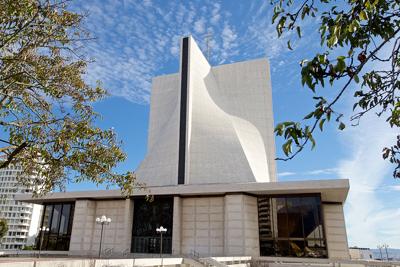
Cathedral of St. Mary of the Assumption, at 111 Gough St., is one of the sites hosting emergency shelter for San Franciscans experiencing homelessness as temperatures plummet over the next four months.Kevin N. Hume/SF Examiner
An annual emergency shelter initiative aimed at providing shelter for those experiencing homelessness in The City during the coldest months of the year is officially operational.
San Francisco’s Interfaith Winter Shelter program commemorated its 37th year on Thursday, with five participating sites opening their doors to those in need on a rotating basis over the next few months. The program, which has been expanding winter shelter capacity since 1989, remains a key resource for the unhoused in a city strapped for shelter beds and affordable housing.
The shelter program, which continues until March 29, 2026, rotates between the Canon Kip Senior Center, St. Mary’s Cathedral, St. Mark’s Lutheran Church, First Unitarian Universalist Church & Center, and the Quaker Meeting House. The number of beds available changes depending on the site, with Canon Kip the smallest at 30 beds, and St. Mary’s the largest at 80.
“Our city will not stand idle when our neighbors need a warm meal and a place to stay,” said Mayor Daniel Lurie during a visit to Canon Kip Senior Center in SoMa on Thursday. “This effort expands our shelter capacity for four months across sites supported by our interfaith leaders.”
Chris Callandrillo, the chief program officer at Episcopal Community Services, an interfaith partner that supports the program, said last year his organization served around 600 guests, providing more than 6,000 hot meals to those who needed it.
“These are not just numbers. These are real people’s lives,” Callandrillo said. “Moreover, the shelter also serves as an access point where people can get connected to the resources and services needed to help them permanently exit homelessness, as well as a hub for social connection to combat isolation, especially during the holidays.”
Daniel Lurie speaks at the opening of the emergency winter shelter as part of the 37th annual Interfaith Winter Shelter program at Canon Kip Senior Center at 705 Natoma St. on Dec. 4, 2025Natalia Gurevich/SF Examiner
Those who stay at the shelter sites are all self-referrals, said Deborah Bouck, a spokesperson for the San Francisco Department of Homelessness and Supportive Housing. While bed availability changes each night starting at 6 p.m., when the sites transition from their daily operations, visitors can hold onto their bed for more than one night.
This changes as the sites rotate, she said, which happens on a monthly-ish basis and is posted online. Guests are informed of the move beforehand.
The program was created in 1989 in response to the growing homelessness crisis in The City and, over the last few decades, the need has increased, said Michael Pappas, the executive director of the San Francisco Interfaith Council.
“Over three decades, I think the greatest disruption was COVID-19,” he said of the global pandemic of March 2020. “I remember at the very beginning of COVID-19, we had to shut it down because the volunteers were preparing our meals … and nobody knew what was going to happen.”
At the end of 2020, when the program was set to resume, St. Mary’s maintained its shelter during the entire four-month stint, as it was the largest site and deemed the safest for congregate shelter.
“It is a labor of love,” Pappas said, of operating the program every year.
While there have been discussions in the past about operating this emergency shelter year-round, he said it would be too much to ask of the participating partners, as each space serves another purpose.
“A lot of them have rental space that they have to give up,” Pappas said, of the additional strain on participating sites caused by operating the program. “They get a stipend from The City, but it’s barely enough to pay for electricity. They’re doing the best that they can, and we’re always looking for new spaces.”
It was just last year that the Quaker community stepped forward and offered its space to the roster, he said.
One of the first guests staying at Canon Kip on Thursday said he found out about the shelter through a flyer at the Gubbio Project, another homelessness resource site in The City.
Gil, who asked to go by his first name to protect his privacy, said he’d been living on the streets since July of 2024, after getting evicted from his home. He’s been working with The City’s Homeless Outreach Team to find permanent housing, but the process got “derailed” during the recent holiday.
“They have good people, their hearts are in the right place,” Gil said. “It’s just about having the resources.”
But while he’s been on wait lists, living on the street has become more of a challenge in recent weeks as the weather has turned, Gil said, as he was recovering from a bout of walking pneumonia.
“I’m thankful that this place is here, that it’s a safety net,” he said. “I really don’t want to stay on the street.”
Americans areconsistentlysaying that the cost of living is their top concern, and health care prices, in particular, are set to soar in 2026 — with employers expected to face the largest price increase in more than a decade. This comes as Americans already spend far more than any other country on health care, despite having some of the worst rates of life expectancy and infant mortality among wealthy nations.
Medicare for All, a policy popularized by Senator Bernie Sanders, would provide all Americans with health care that is free at the point of service, paid for by tax increases.
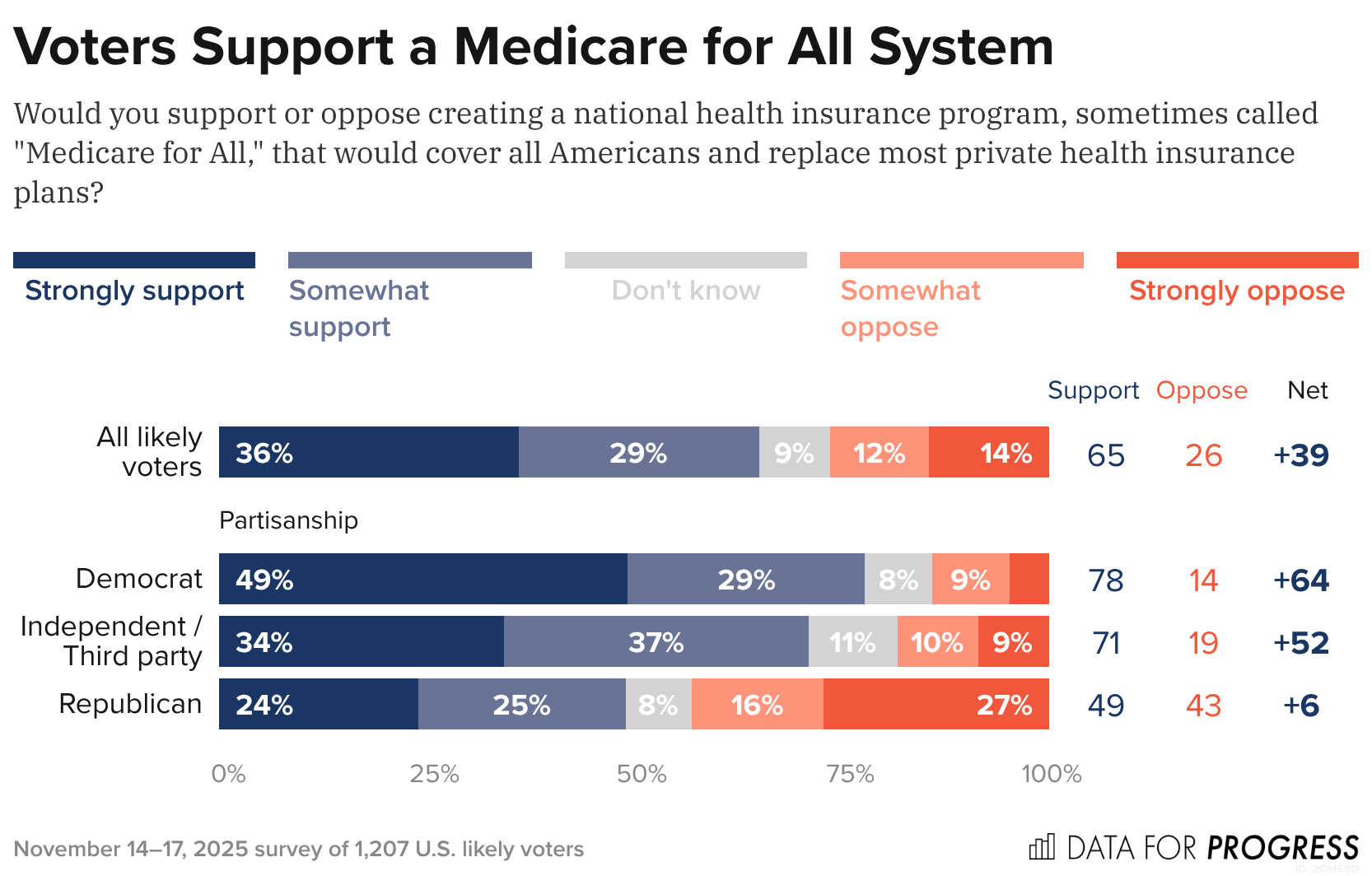
In a new survey, Data for Progress finds that 65% of voters support a Medicare for All system — described as a “national health insurance program…that would cover all Americans and replace most private health insurance plans.” This includes majorities of Democrats (78%) and Independents (71%), and a plurality of Republicans (49%).
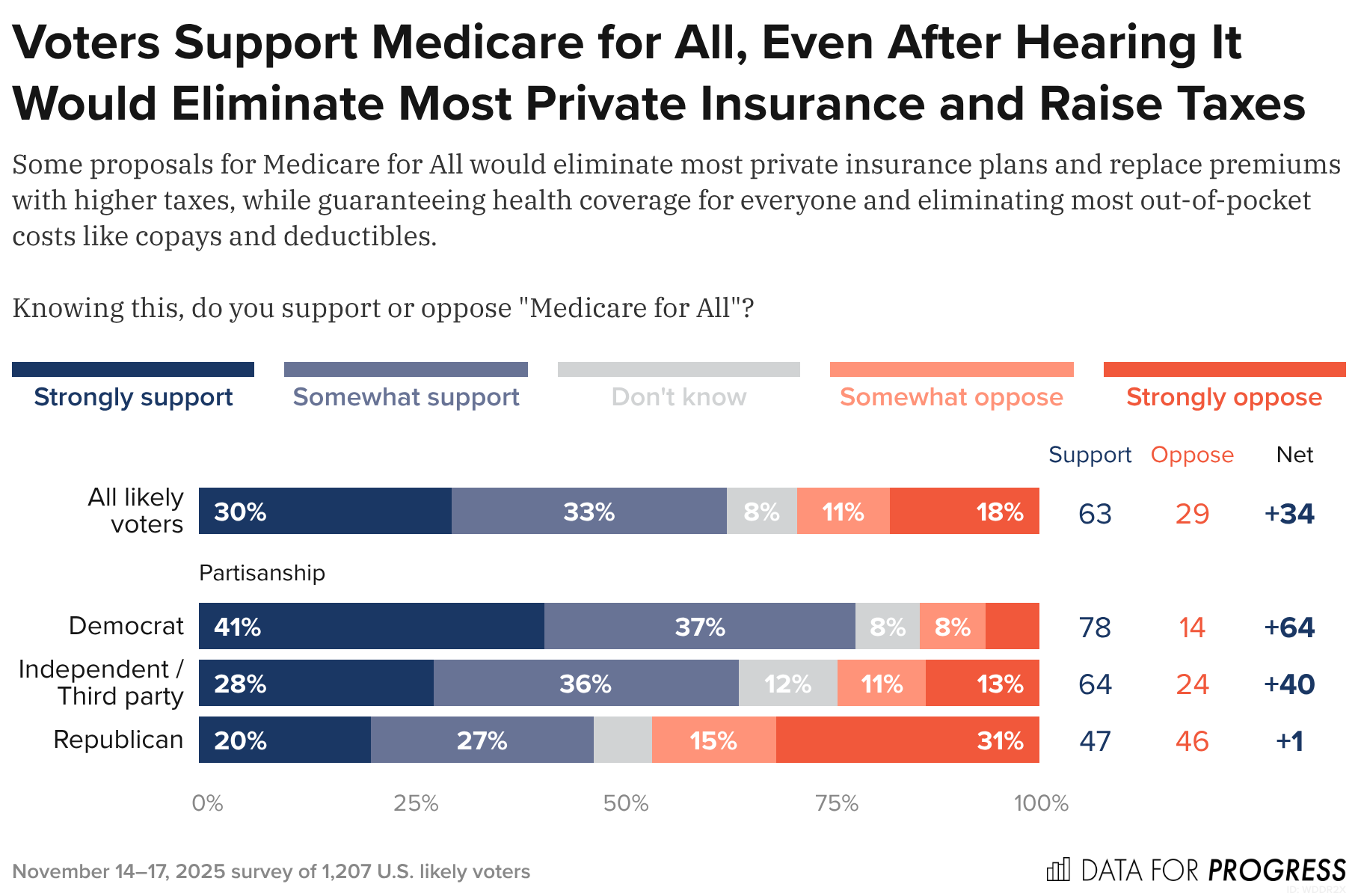
Next, respondents were provided with more details about what a Medicare for All system would entail: that it would “eliminate most private insurance plans and replace premiums with higher taxes, while guaranteeing health coverage for everyone and eliminating most out-of-pocket costs like copays and deductibles.”
After receiving this information, a similar majority of voters (63%) support Medicare for All — including 64% of Independents and a slight plurality of Republicans.
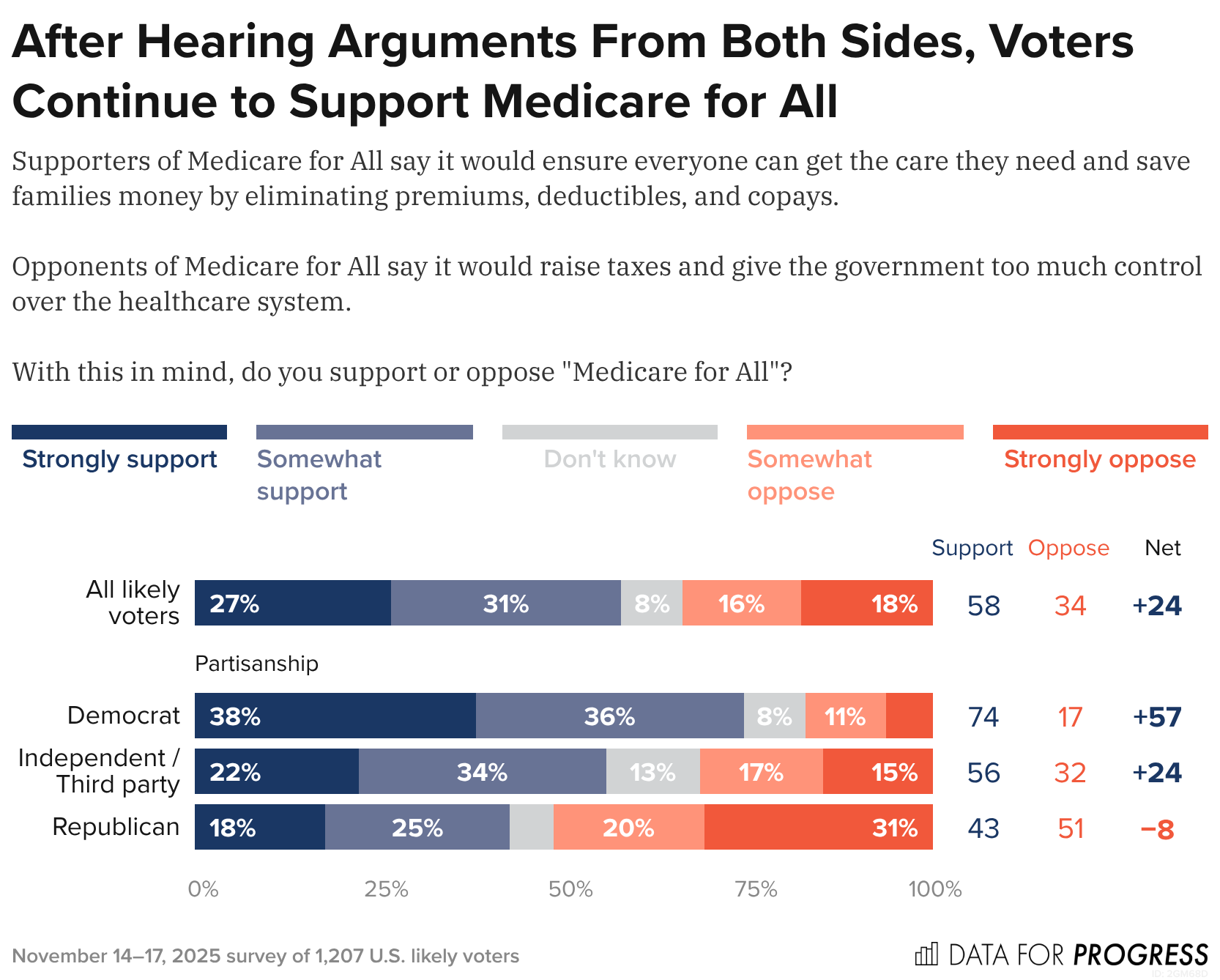
Finally, respondents were provided with arguments from both sides on Medicare for All, with supporters arguing that the policy would ensure everyone can receive the care they need and save families money, and opponents arguing that it would raise taxes and give the government too much control over health care.
After receiving these messages, a majority of voters (58%) say they still support Medicare for All.
Broadly, these findings demonstrate that voters support Medicare for All, even after being informed that it would raise taxes and eliminate most private insurance plans.
Survey Methodology
From November 14 to 17, 2025, Data for Progress conducted a survey of 1,207 U.S. likely voters nationally using web panel respondents. The sample was weighted to be representative of likely voters by age, gender, education, race, geography, and recalled presidential vote. The survey was conducted in English. The margin of error associated with the sample size is ±3 percentage points. Results for subgroups of the sample are subject to increased margins of error. Partisanship reflected in tabulations is based on self-identified party affiliation, not partisan registration. For more information please visit https://dataforprogress.org/our-methodology.
Milk Club Trans Caucus Meeting Date: Tuesday, April 28 Time: 5-7 PM Location and Zoom Link: Meeting info available to members of the Milk Club Trans Caucus. Please reach out to trans@milkclub.org if you would like to join the Milk Club Trans Caucus.
San Francisco Young Democrats meet with SFDems Chair Nancy Tung Wednesday, April 29th | 2pm Location: SC T-160 (third floor of Student Center) Register The San Francisco Young Democrats at SF State are teaming up with SFDems to make sure their voices are heard. Want to get more plugged into San Francisco... Continue reading →
One Million Rising: Strategic Non-Cooperation to Fight Authoritarianism Virtual Event · Hosted by No Kings Time Wednesdays 8 – 9:30pm EDT Location Virtual event Join from anywhere About this event Across the country, authoritarian forces are getting bolder and more dangerous. Trump and his allies are not hiding their agenda: mass deportations,... Continue reading →
THURSDAY, JUNE 29, 2023 AT 2 AM – 4 AM PDT How to create trust in a group? Details Event by Extinction Rebellion Empathy Circles online EMPATHY CAFE Duration: 2 hr Public · Anyone on or off Facebook How to create trust in a group? This is the question that arose in our... Continue reading →
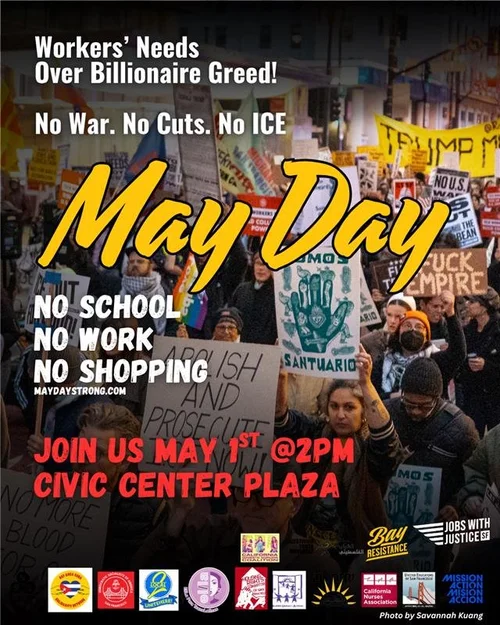
This May 1st, history is calling us into the streets. Our Revolution members are mobilizing for May Day action, joining workers, organizers, union members, students, immigrants, and community allies in a powerful show of solidarity against authoritarianism, corporate greed, and attacks on working people. Across the country, people are rising together... Continue reading →