


Column: SFGATE politics editor Eric Ting evaluates the arguments in defense of Dianne Feinstein
Eric Ting, SFGATE
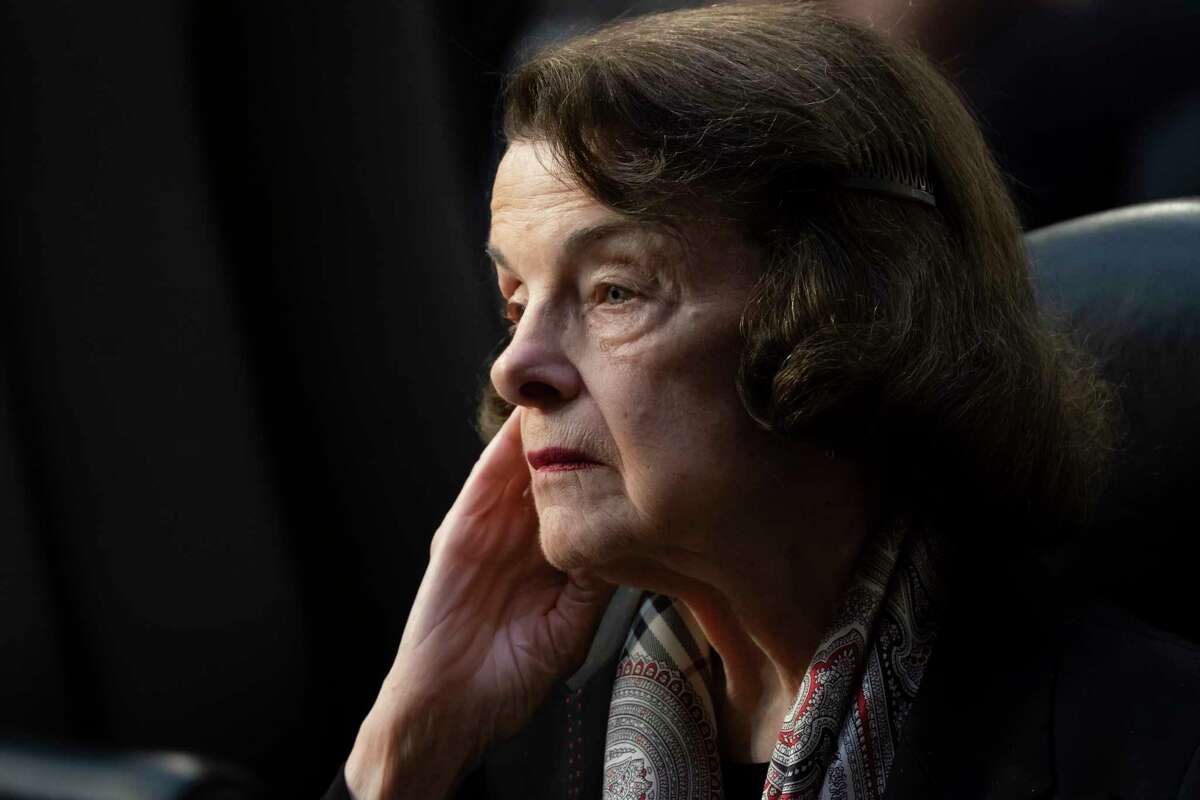
California Sen. Dianne Feinstein is not well.
If she were, she would not have missed more than 70% of the votes taken in the Senate this year thanks to a shingles diagnosis that continues to keep her out of Washington. That prolonged absence — which is actively preventing the Democrats from advancing President Joe Biden’s judicial nominees — has prompted heightened calls for her resignation.
Calls for the 89-year-old senator to step aside are nothing new, as there have been several major reports questioning her mental acuity, and congressional reporters have personally witnessed memory lapses that raise serious concerns about her ability to continue to serve.
What is new, however, is that for the first time, those calls are coming from within Congress, with Bay Area Rep. Ro Khanna becoming the first member of either chamber to call for Feinstein’s resignation. But you can count on one hand the number of Democratic members of the House of Representatives who have joined him, and there have been zero members of the Senate.
“I don’t want to speculate on what others are thinking,” Khanna told SFGATE in an email when asked why he believes that is. “But dozens of members have reached out to me expressing support for what I did.”
Instead, we see several members of Congress — as well as members of the political media — making arguments for why calls for her resignation are unwarranted. To this point, those individuals have made three identifiable arguments: 1) calls for her to resign are sexist, 2) the motives of Khanna and those calling for her ouster are somehow insidious, 3) Feinstein has had a long and storied career and deserves to go out on her own terms.
None of the three arguments are persuasive. Khanna only said publicly what many people in politics say privately: Feinstein, who is not seeking re-election in 2024, simply isn’t up to the task anymore. Pretending otherwise makes a mockery of the political system and further erodes institutional trust. If there is a cogent argument for why Feinstein should remain in office, I have yet to hear it.
Let’s start with the most shallow, vapid and base argument in Feinstein’s defense: that calls for her to step aside are rooted in sexism and should thus be ignored. House Speaker Emerita Nancy Pelosi said two weeks ago, “I’ve never seen them go after a man who was sick in the Senate in that way.”
Let’s just assume — for the sake of argument — that aging or otherwise ailing senators are treated differently based on their gender. We’ll assume that Pennsylvania Democratic Sen. John Fetterman, who was also recently away for an extended period of time, has escaped calls to resign because he’s a man, and not because he set — and followed — a date to return to Congress. We’ll also assume that many of the same people who are calling for Feinstein to resign were fine with Iowa Republican Sen. Chuck Grassley seeking re-election last year at age 89, and would have turned a blind eye to Strom Thurmond struggling to serve at age 100.
Even once these extremely generous assumptions are made, the argument still fails for the simple reason it amounts to arguing that two wrongs make a right.
The most incisive takedown of the sexism argument is a satire from Intelligencer’s Eric Levitz, who sarcastically quips, “It’s heartening to know that my hypothetical daughter will grow up in a country where anyone, regardless of their gender, can spend their 89th year of life struggling to recognize their longtime Senate colleagues, asking witnesses the same questions multiple times in a single hearing, and disenfranchising their constituents in the process instead of reconciling themselves to the cruel facts of mortality and spending more of their remaining time with friends and family.”
The sexism argument is so lacking in rigor that it’s not worth dedicating much more space to beyond one final point: A Republican-appointed federal judge in Texas just tried to ban the abortion pill mifepristone across the country, even in states where abortion remains legal. Legal experts, even those who clerked for conservative judges, have written at length on how the decision is anti-abortion activism masquerading as jurisprudence, and in a Friday decision putting that ruling on hold, none of the Supreme Court’s conservatives defended the decision on the merits. Feinstein’s absence is preventing a Democratic president, who has said he will act to protect reproductive rights where possible, from installing federal judges less inclined to attack abortion. That’s really what’s at stake.
“My focus is the judges,” Khanna wrote in an email. “Republicans have been focused on reshaping the federal judiciary for decades. Democrats need to have that same focus.”
The second argument in defense of Feinstein is that Khanna, who co-chaired Bernie Sanders’ 2020 presidential campaign and endorsed progressive Oakland Rep. Barbara Lee in the 2024 race to succeed Feinstein, is only feigning concerns about the judiciary in an attempt to replace Feinstein with a senator who is more left-wing. A version of this argument is articulated by the Los Angeles Times’ Mark. Z Barabak, a columnist I have long admired, in a piece last week titled, “Lefties never liked Dianne Feinstein. Now they’re trying to hijack a Senate seat.”
Critically, however, Barabak doesn’t actually argue that Feinstein should remain in office. His argument is simply that Khanna and others are trying to “hijack the Senate seat by appointing Lee or some other uber-liberal.” Barabak argues that should Gov. Gavin Newsom, who once vowed to appoint a Black woman to replace Feinstein, need to fill that seat, he should appoint a “caretaker” who does not enter the race against Lee and fellow Reps. Adam Schiff and Katie Porter.
I write this with the utmost respect for Barabak: I am unsure with whom, exactly, he is arguing in that column. Khanna stated before Barabak’s column published that he also wants to see a caretaker appointed to prevent granting Lee, Porter or Schiff an incumbency advantage.
Sure, there are progressive activists and commentators out there who would love nothing more than for Newsom to replace someone much further to the left than Feinstein to sit in that seat for decades. But that’s not the argument Khanna advanced.
Finally, let’s turn to what I believe is the most tenable of the three arguments: that Feinstein is a legend in California politics, and deserves to go out on her own terms. There’s a more nuanced version of this argument that’s been made by Democratic Sens. Amy Klobuchar and John Hickenlooper: that perhaps a month or two from now, if Feinstein’s absence persists, then it would be appropriate for her to step down.
This argument, even in its nuanced form, is deeply reductive of the duties of a United States senator. It assumes Feinstein’s only job is to show up and vote, and that so long as a senator is rubber-stamping their political party’s legislative priorities and judicial nominees, they are serving effectively. A senator must do more than that. Drafting legislation, meaningfully contributing to public hearings, and meeting regularly with relevant stakeholders are requirements for effectively serving the 40 million people Feinstein represents.
While Feinstein’s office insists she’s capable of doing those things, her lack of public appearances, as well as rough moments in committee meetings, raises serious doubts. San Francisco Chronicle columnist Emily Hoeven, another California journalist I hold in extremely high esteem, argued in a recent column titled “It’s too early to call for Dianne Feinstein to resign. But that date is coming up soon,” that “recovery [from shingles] alone is not a reason for resignation,” adding that if questions about Feinstein’s mental acuity are undergirding their calls for her to resign, Khanna and others need to “come right out and say it.” (The Chronicle and SFGATE are both owned by Hearst but have separate newsrooms).
She has a point. When I emailed Khanna and asked whether his “call for her to resign [is] strictly about the shingles hospitalization, or is it also about reports of her fading mental acuity,” he replied, “My call for Senator Feinstein to resign is simply based on her having missed over 70% of the Senate votes taken this year. She has been an icon on issues of gun violence and women’s rights, but she doesn’t have a clear return date and her absence is preventing Democrats from confirming judicial nominees to protect the right to an abortion and other fundamental rights.”
But here’s where I respectfully diverge from Hoeven: Just because Khanna is, for whatever reason, looking at Feinstein’s resignation narrowly through the lens of her shingles hospitalization, it doesn’t mean that we as journalists have to do the same. We are capable of examining all the available evidence regarding Feinstein’s ability to effectively serve the nation’s largest state, and of subsequently making our determination as to whether she should resign.
I, like many others, have grave doubts that Feinstein is capable of serving effectively. I fear that stifling those concerns because lawmakers have yet to publicly raise them fuels criticism that the political media is too cozy with the figures we cover. I also understand the hesitance to raise these fears; aging is an uncomfortable topic, and Feinstein is a legendary figure in California politics with a storied career. I want to emphasize that nothing in this column should be interpreted as criticisms of Barabak and Hoeven — they are outstanding journalists with whom I just happen to disagree on this topic.
Perhaps there is a good argument for why Feinstein should remain in her seat through January 2025. But I struggle to construct an even vaguely compelling one. If such an argument exists, it absolutely has not been articulated in the public record to this point.
Written By Eric Ting
Eric Ting is SFGATE’s politics editor. He is an East Bay native who has a Master’s degree in journalism from Stanford University. Eric did his undergrad at Pomona College, where he majored in politics and minored in economics. Email: eric.ting@sfgate.com