


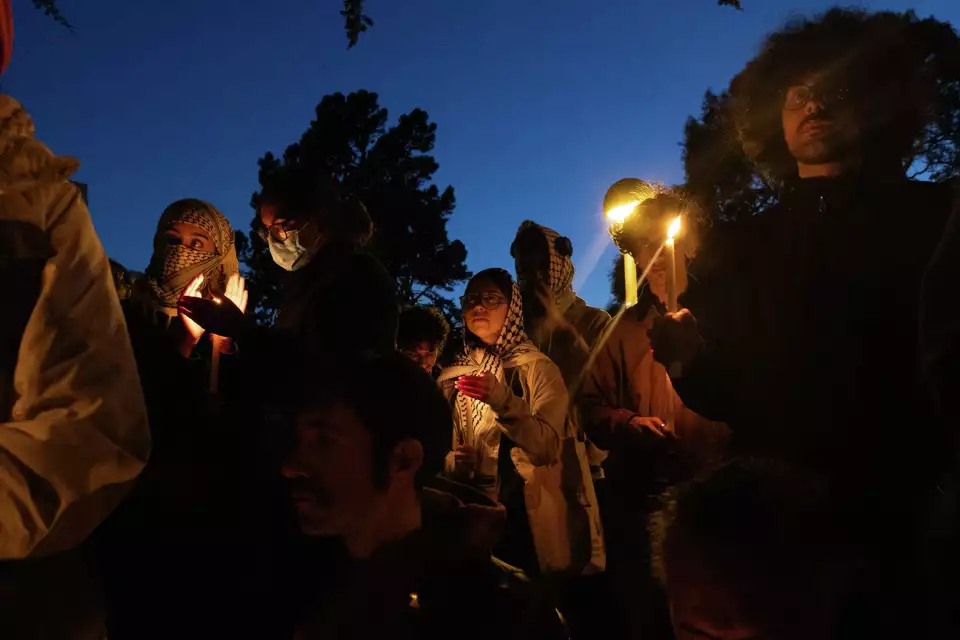
Attendees fill Malcolm X :laza on Monday at San Francisco State University, declaring solidarity with thousands of other students across the country calling for an Israel-Hamas war cease-fire. Photo by Lea Suzuki / San Francisco Chronicle
By Nanette AsimovUpdated April 29, 2024 5:20 p.m. (SFChronicle.com)
As hundreds of San Francisco State students shouted “Intifada!” and “Free! Free! Palestine, from the river to the sea!” on Monday, demonstrators set up a dozen tents in the middle of campus and joined a burgeoning nationwide student movement against Israel’s 6-month-old war in Gaza.
“Five, six, seven, eight, Israel is a terrorist state!” chanted students, many of them wrapped in Palestinian kaffiyeh scarves or surgical masks. “Long live the intifada!” they shouted, referencing the Arabic word for “uprising” that describes both violent attacks and nonviolent protests by Palestinians against Israel.
From a stage on Malcolm X Plaza, pro-Palestinian student leaders declared solidarity with the thousands of other students across the country who are calling for a cease-fire in Gaza.
“We will respect the rights of students to peacefully protest and will work to keep them and the entire campus community safe,” said Bobby King, a campus spokesperson.
“S.F. State students say no to genocide!” declared the president of the General Union of Palestinian Students, who gave her name only as Ziniab, as she addressed perhaps 1,000 students and echoed calls for university leaders to divest from any companies doing business in Israel.
The country’s military has killed more than 34,000 Palestinians in Gaza and bombarded much of the territory with airstrikes. Human rights monitors warn that millions are at risk of starvation. All universities in the territory are gone, students noted. Hamas triggered the war on Oct. 7, when it invaded Israel, killed some 1,200 people and took 250 hostages. Hamas still holds about 100 of them.
California State University’s “complicity is investing billions from student tuition” into companies doing business in Israel, Ziniab declared. “Our outrage is loud and clear!”
To the cheers of students gathered in the plaza, she and other speakers said they were energized by the arrests of more than 100 Columbia University students demonstrators two weeks ago, followed by dozens more arrests at Yale.
Since then, “People’s University for Palestine” encampments have sprung up at Stanford, UC Berkeley, Cal Poly Humboldt and other California campuses.
Students have demanded that administrators — including California State University trustees and the University of California regents — divest from companies doing business with Israel, from Lockheed Martin to McDonald’s.
“Our tuition is being increased, and it’s going toward genocide instead of to better support the students,” said Sara Ouchene, 20, a sophomore majoring in criminal justice studies. “Regardless of how much money they get back (from the investments), at the end of the day, they’re contributing to the loss of human lives.”
Neither CSU nor UC officials have confirmed details about their investments in Israel.
At the San Francisco State rally, Omar Zahzah, an assistant professor in the Arab and Muslim Ethnicities and Diasporas Studies department, told the crowd that the growing movement was about more than stopping the war and divesting from Israel.
“Ultimately, this is a call for the total liberation of Palestine!” he cried, and described Israel as a nation of “settler colonialists.”
Similar calls on campuses across the country have triggered broad debate about whether demands for an end to Zionism — the establishment of Israel as a sanctuary state for Jews — is antisemitic.
One of the many signs students carried on Monday said, “Zionism is racism.” Another read, “Anti-Zionism is not antisemitism.”
As masked students set up about a dozen tents across from Malcolm X Plaza, hundreds more cheered them on with cries of “Intifada! Intifada!”
At Cal Poly Humboldt in Arcata, administrators have shut down the campus as demonstrators occupied a building there for the past week. At UCLA, pro-Palestinian and pro-Israel protesters clashed over the weekend.
Stanford students also have shown their support for divestiture in a vote. With one-third of the total student body participating, ballot results announced on Sunday showed 72% of undergraduates and 74% of graduate students in favor of following the guidelines laid out in the Boycott, Divest and Sanctions movement, calling for the university “to cut and prevent financial ties with the targeted companies and industries, and any academic or corporate partnerships, funding war crimes in Israel.”
Gabbie Baquiran, a business major observing the San Francisco State rally from the sidelines, gave thumbs up to the protesters.
“I think it’s really cool that we’re doing this,” she said. “I’m glad I go to a school where we’re able to do protests and encampments like this.”
Freelancer Jacqueline Munis contributed to this report.
Reach Nanette Asimov: nasimov@sfchronicle.com; Twitter: @NanetteAsimov
April 29, 2024|Updated April 29, 2024 5:20 p.m.
HIGHER EDUCATION REPORTER
Nanette covers California’s public universities – the University of California and California State University – as well as community colleges and private universities. She’s written about sexual misconduct at UC and Stanford, the precarious state of accreditation at City College of San Francisco, and what happens when the UC Berkeley student government discovers a gay rights opponent in its midst. She has exposed a private art college where students rack up massive levels of debt (one student’s topped $400k), and covered audits peering into UC finances, education lawsuits and countless student protests.
But writing about higher education also means getting a look at the brainy creations of students and faculty: Robotic suits that help paralyzed people walk. Online collections of folk songs going back hundreds of years. And innovations touching on everything from virtual reality to baseball.
Nanette is also covering the COVID-19 pandemic and served as health editor during the first six months of the crisis, which quickly ended her brief tenure as interim investigations editor.
Previously, Nanette covered K-12 education. Her stories led to changes in charter school laws, prompted a ban on Scientology in California public schools, and exposed cheating and censorship in testing.
A past president of the Society of Professional Journalists’ Northern California chapter, Nanette has a master’s degree in journalism from Columbia University and a B.A. in sociology from Queens College. She speaks English and Spanish.


