


By Sam Whiting,Reporter Oct 12, 2024 (SFChronicle.com)
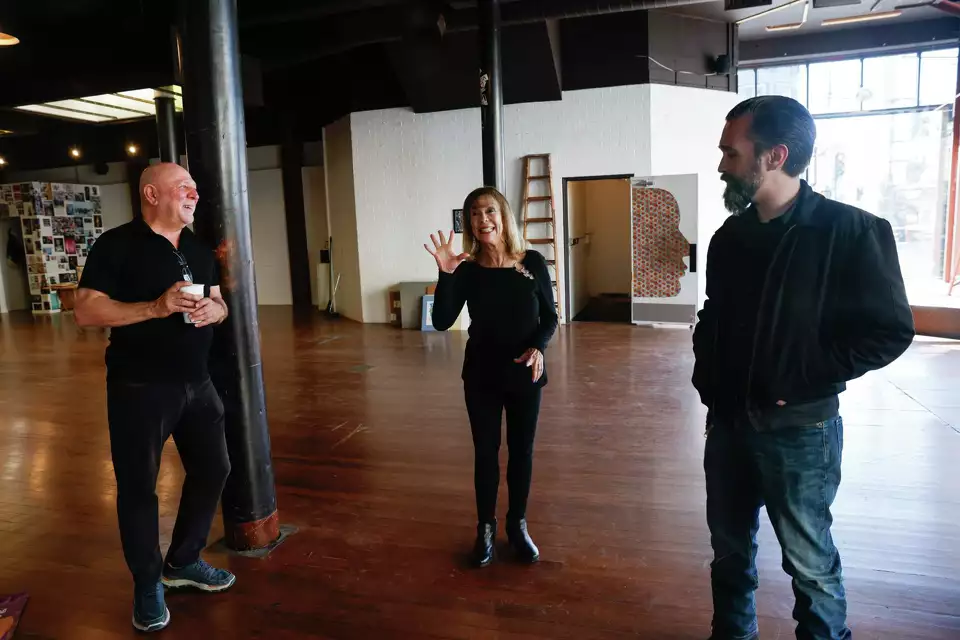
Jerry Cimino, left, co-founder and curator of the Counterculture Museum; Estelle Cimino, center, the museum’s co-founder and executive director; and art director Brandon Loberg talk in the main gallery space on Tuesday in San Francisco. Jerry and Estelle Cimino are the founders of the Beat Museum in North Beach and plan to open the Counterculture Museum next year.Lea Suzuki/The Chronicle
The Counterculture Museum at the intersection of San Francisco’s Haight and Ashbury streets got off to an early and unofficial start this week when curator Jerry Cimino hung a poster of the Human Be-In of 1967 on a white brick wall visible through the picture window of his empty storefront.
Right away tourists were pressed up against the window, so Cimino hung a banner that read “Counterculture Museum Coming Spring 2025.” That excited them so much they started taking pictures of the banner.
And that’s how, as of Tuesday, anticipation was already building for a place that will give context to San Francisco’s most famous corner. Cimino’s plan is to tell the story of Haight-Ashbury in the 1960s in the same way that the Beat Museum tells the story of North Beach in the 1950s.
Cimino can say this with confidence because he operates both attractions, and the Beat has been going for 21 years as a learning hub and bookstore with exhibitions that rely mostly on posters, vintage films, periodicals and ephemera.
In essence, the Counterculture Museum will be a continuation of the Beat Museum, with a special admissions deal offered to people who want to see both.
“The whole intent is to concisely encapsulate how history influences our present and into the future,” said Cimino, who has been nursing the Counterculture Museum idea since before the COVID-19 pandemic.
There have been starts and stops and deals in other neighborhoods that looked perfect until they fell through — all of which is fortuitous, because the ideal location came along only in June, after a clothing store called RVCA folded in a space that was formerly a Gap store.
As proof, museum art director Brandon Loberg grabbed a famous 1967 picture of the Grateful Dead gathered around a Haight-Ashbury signpost, went to the window and held it up to show exactly how that image was framed by photographer Herb Greene .
“From that perspective, seeing the roof lines of Ashbury Street at Haight, tells me we are exactly where we need to be in order to bring these stories to life,” said Loberg.
It is important to note that the Counterculture Museum does not own a vintage print of that picture — nor does it own, as of yet, a single artifact rare and valuable enough to merit display in an art museum. But the term “museum” has a tradition of being loosely defined in San Francisco, an example being the now-defunct Bigfoot, UFO & Loch Ness Monster Museum, which opened in the mid-’90s.
Cimino’s own Beat Museum was open for eight years before he had a single major attraction that was donated, not loaned. That was a 1949 Hudson Commodore that was used in the movie version of “On the Road.” It was the same model as the one Neal Cassady drove.
“You don’t need Jerry Garcia’s guitar, which is worth millions, to tell Jerry Garcia’s story,” said Cimino. “People come to museums to learn and to have experiences and to understand how the items they are looking at relate to their lives.”
Cimino and his wife and business partner, Estelle, are counting on that, because they have a 15-year lease on 4,600 square feet — a space one-third larger than the Beat Museum. The Counterculture Museum is being operated as a nonprofit, and $300,000 has been raised from philanthropy, which is enough to launch the place. City government, through its SF Shines promotion of small businesses, provided a $25,000 grant for architectural and design services.
On Tuesday, Cimino walked into the Relic Vintage boutique two doors down and introduced himself and his idea to proprietor Oran Scott. “You mean like the Beat Museum?” Scott answered, not knowing how accurate he was.
“It’s not a chain store,’’ he told a reporter later, ‘and it will bring people to the neighborhood.’
Across the street, at a gift shop called Haight & Ashbury, Chris Warren said the Counterculture Museum is “focusing on what people come here for. They come for the musical history and to see where the Dead lived, where Janis (Joplin) lived. This will only add interest.”
But the Ciminos see their mission as broader than the Summer of Love. If you are only interested in that, there are perpetually a half dozen people sitting on the corner opposite the museum strumming guitars and reliving it.
Rather, the museum’s exhibition space will be divided into five categories: the Beats, the hippies, civil rights, feminism and LGBTQ+
“Counterculture is more expansive than just the hippies,” said Estelle, executive director of the museum. “It’s anything that goes against the grain of normal.”
But the hippies are what brings people to the Haight, and the Ciminos have a wish list of 100 items they would like for their opening. A poster from writer Ken Kesey’s famous 1966 “Acid Test” at Longshoremen’s Hall, known as the event that kicked off the psychedelic era, is at the top of it.
They are confident that even if the collection is sparse when the museum opens — tentatively March 1, 2025 — it won’t stay that way.
The Beat Museum started with nothing but used books and reprinted photos. Then people started dropping stuff off. There are now more than 10,000 items in the collection and not enough room to show them all. As a result, the basement of the Ciminos’ North Beach home is overflowing.
“There are tens of millions of hippies still out there and they’ve all got stuff in the attic that their kids don’t want,” said Cimino. “We get boxes unexpectedly coming in the mail. Some of it is Beat and some of it is hippie because they are so closely linked.”
Reach Sam Whiting: swhiting@sfchronicle.com
Oct 12, 2024
REPORTER
Sam Whiting has been a staff writer at The San Francisco Chronicle since 1988. He started as a feature writer in the People section, which was anchored by Herb Caen’s column, and has written about people ever since. He is a general assignment reporter with a focus on writing feature-length obituaries. He lives in San Francisco and walks three miles a day on the steep city streets.


