


The day before Alan Elizalde was supposed to finish the first phase of his substance-use treatment program in San Francisco, his attorney received a four-sentence letter.
The 19-year-old, an intake coordinator wrote, was being removed for “behaviors detrimental to the program” and “non-compliance with program rules and expectations.” Elizalde wasn’t “discharged for substance use,” another letter sent five days later added.
Over the six months that he was in the residential program, court records show that Elizalde always appeared for his status hearings, another condition of the plea deal the accused armed robber had accepted in the face of serious felony charges.

Want the latest on the Mission and San Francisco? Sign up for our free daily newsletter below.Sign up
Those charges came after an alleged Jan. 8, 2024 crime spree in which Elizalde allegedly stole an iPhone in downtown San Francisco, attempted to take a Lexus from a 70-year-old, carjacked another person’s BMW, and bought a stolen Hyundai Sonata, all while armed with an unregistered semi-automatic pistol. At the time, he had issues with addiction.
Once in treatment, Judge Patrick Thompson observed at a hearing in late June, Elizalde began “making progress” toward sobriety.
Elizalde acknowledges that he did break the treatment program’s rules. Twice. Cell phones aren’t allowed. Nevertheless, he had one and used it to call his family and check on the woman pregnant with his daughter, he said. And then the final straw: On a friend’s behalf, Elizalde delivered notes to a girl in another unit.
Elizalde was “fraternizing” and “passing letters,” the 19-year-old’s attorney was told. The notes, Elizalde recalled, contained communiques like “What are you doing?” and “How’s your day?”

The teenager’s infractions came with severe consequences. The plea deal he’d agreed to six months earlier had stipulated that if he successfully completed an alternative sentencing program, he would only have to serve five years for a robbery charge. If not, he could be sentenced to 12 years in prison without a trial.
Elizalde’s case — which is unfolding in a city that wants to both get tougher on crime and put substance recovery first — raises questions about how many second chances San Francisco is willing to offer.
To some, it offers a window into how even minor mistakes can upend a “generous” opportunity. To his family and advocates, it calls into question what “justice” should look like.
An alternative sentence
Elizalde, then an 18-year-old high school senior, was arrested on Jan. 8, 2024 for a string of crimes while out on bail, the May 21, 2024 district attorney’s complaint alleges. Just a month earlier, in December 2023, he had been charged with a felony property offense in Solano County.
Police released Elizalde as they conducted an investigation, his attorney Ivan Rodriguez said. Four months later, San Francisco District Attorney Brooke Jenkins charged him with seven felony counts related to robbery, carjacking, and carrying a firearm for the Jan. 8 incidents.
Elizalde faced serious allegations at a time when many San Franciscans wanted to see the city prioritize public safety. Mayoral candidates were running on pledges to get tough on crime. DA Jenkins had reversed an eight-year decline in convictions and halted restorative justice programs for adults.
At the same time, residents confronted with drug use on their sidewalks and in their own families understood the devastating impact of substance-use disorders. Neighbors, politicians, and organizations advocated for a focus on recovery, something Elizalde and his mother are the first to say he needed.
Elizalde started using different substances when he was 16. It was a hard time, he said quietly, and this allowed him to at least feel “numb” from a life of upheaval.
In Elizalde’s 19 years, his family had moved from Martinez, where he was born, to Concord, Pleasant Hill, Richmond, American Canyon, and Fairfield. They lived in some “bad areas,” Elizalde said.
Elizalde was three years old when his father began serving a lengthy prison sentence in 2008, and the following year the family’s house burned down. His mother, Vanessa Ferriera, supported three boys on her own by working at a dental office and a movie theater.
At the time he was arrested for the alleged San Francisco crimes, the family lived in Suisun City and the mother of Elizalde’s first child was pregnant in Vacaville.

When San Francisco Deputy District Attorney Megan Wang offered to refer Elizalde to an alternative sentencing program, the teenager took the opportunity. “I wanted to change my life, change my criminal thinking and my substance abuse,” he said.
Elizalde spoke to Samantha Roberts, a case manager at the DA’s office, about his struggles with addiction. She helped him craft a treatment plan that could be completed in lieu of a trial and prison time, the defense attorney Rodriguez said.
Then, Rodriguez said, the DA’s office reneged on the offer.
Wang, who was hired under Jenkins’ progressive predecessor Chesa Boudin, moved off the case. Rodriguez said that Elliott Brooks, the new deputy district attorney on the case, and her supervisor Amilcar “Butch” Ford, decided that Elizalde would only be allowed to participate in the alternative program if he agreed to go to prison after completion. (Ford was a prominent supporter of Alameda DA Pamela Price’s recall before joining the San Francisco office, and was one of those considered to replace her.)
In San Francisco Superior Court before Judge Thompson, the attorneys came to a new deal in October 2024. Elizalde, who had remained in jail throughout this time, pleaded guilty to second-degree robbery with a firearm, which carries a 12-year sentence.
If he successfully completed the alternative program, came into court for check-ins, and was not arrested again, his 12-year sentence would be reduced to a five-year sentence. If not, he would go straight to prison.
Several legal professionals said they were surprised to hear of a deal that involved both alternative programming and a prison sentence. They suggested the reason could be the severity of the allegations against Elizalde. Three, however, said that inviting someone to get better in treatment and then sending them to prison “makes no sense.”
A chance at recovery
Nevertheless, as agreed, Elizalde began his recovery journey a few days after the Oct. 15 hearing at Billie Holiday, a transitional center in SoMa. He then moved to Harbor Lights, a city-funded treatment program run by the Salvation Army, on Dec. 6, 2024.
Elizalde spent his days attending therapy groups, classes, and Alcoholics and Narcotics Anonymous meetings. He also took frequent urine analysis tests on demand. Still, both Elizalde and the DA’s office reported bumps along the way.
Brooks was notified of “another instance of improper conduct and rule violations” at Harbor Lights on Feb. 11, 2025, according to court documents. It’s unclear what the previous incident that reportedly took place at Billie Holiday had been. The DA’s office declined to comment. But the Feb. 11 incident was Elizalde having an unauthorized cell phone.
Adrian Maldonado, the director of Harbor Lights, let the DA’s case manager know that this was Elizalde’s “last opportunity.” He also noted Elizalde’s desire to see his child — Elizalde said he’d been using his phone to call family — and said he would set up a meeting.
He got two visits with family over the six months he was at Harbor Lights, but that was not enough “for me to mentally go through this program and not want to leave,” Elizalde said.

Still, despite his feelings of isolation, he stuck it out. Then, on June 5, 2025, one day before finishing the first six-month phase of the program, Elizalde said he was confronted with the notes he’d passed along to the other participant. He was immediately kicked out of Harbor Lights.
Rodriguez wrote to the court that the program’s director told him “he would have graduated Mr. Elizalde, but that his superiors wanted Mr. Elizalde discharged.” Maldonado, the director, said he could not speak about a former client without a release.
In court, the DA’s office said it had no issue with the defense’s explanation of Elizalde’s removal for using his cell phone and passing letters.
Elizalde returned home the day of his expulsion, frantic. “He was doing so well,” his stepfather Abel Madrigal remembered. “They had to throw a monkey wrench overnight.”
Seeing his family that night kept him motivated, Elizalde said. “I wasn’t done with my recovery.”
At first, little changed. The following day, on June 6, Rodriguez said, Elizalde checked himself back into the transitional Billie Holiday program he’d started at. Shortly after, he was transferred to Treatment, Recovery, and Prevention, TRP, a residential treatment program managed by Westside Community Services.
But on June 18, with Elizalde still in treatment, the DA filed a motion to sentence him to 12 years in state prison. Prosecutors were sticking to the original plea agreement, and their belief that Elizalde had failed to fulfill it despite their “leniency.”
On June 24, Rodriguez asked the court to allow Elizalde to continue his alternative sentencing program at TRP. “If every person who was participating in a treatment program was punished as such for having setbacks during their recovery, treatment would be impossible,” he wrote.
Elizalde stayed at TRP until June 26, when he was set to return to court.
Starting over
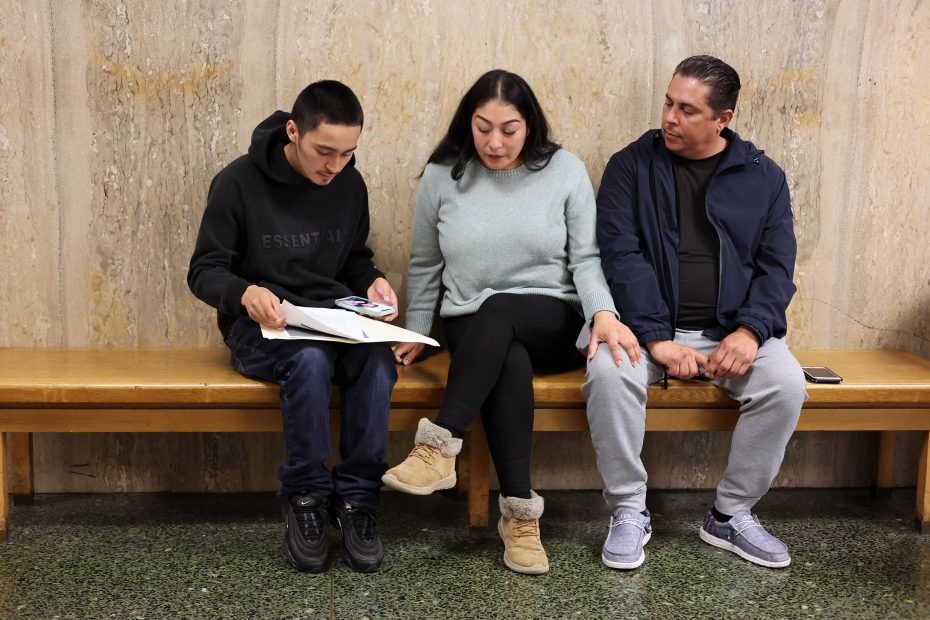
On that day, Elizalde appeared before Judge Thompson in a black hoodie and jeans that hung around his slight frame. After a hearing on the DA’s motion, Elizalde would either return to treatment, go back to jail, or find himself starting over again with the trial process.
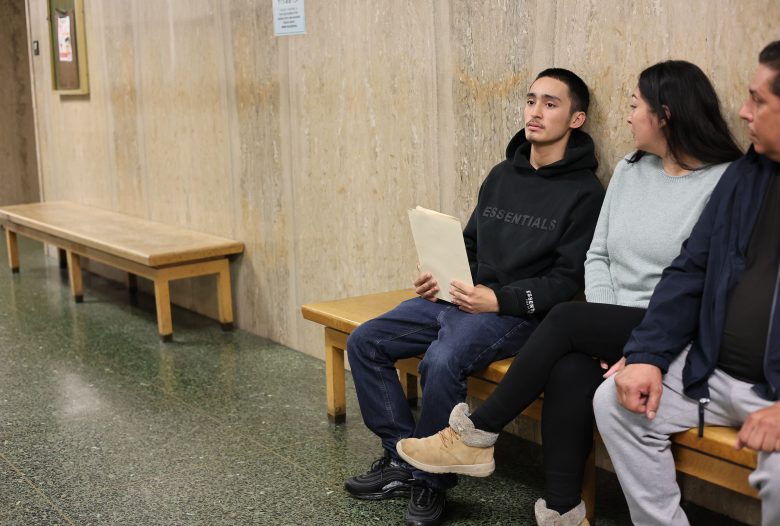
Elizalde’s family awaited a decision in the hallway. Ferriera, his mother, asked for advice on how to breathe, and his stepfather gripped her hand. Elizalde leaned his head against the courthouse marble beside his parents, his eyes red. Then the bailiff signaled for everyone to return to the courtroom.
Judge Thompson denied the DA’s motion to impose a sentence, and said Elizalde had “materially complied” with the “core terms” of his alternative sentencing program. He was not going back to jail. But Elizalde’s initial agreement, which stipulated that he go specifically to Harbor Lights, was withdrawn.
Elizalde, once again, faces seven felony charges. He’s been temporarily released under the supervision of pretrial diversion, which allows him to stay in treatment while awaiting trial or a new plea deal.
If he goes to trial and is convicted on multiple counts this time, he could face a prison sentence far longer than 12 years.
While they wait, his family is struggling to understand what went wrong.
“The system has failed us,” Ferriera said. “Instead of guiding him the correct way, they just keep digging him in the hole.”
LATEST NEWS
In the Tenderloin, Chinese-Venezuelan fusion restaurant offers whole new flavor

Eyevee Woods, free-spirit calling the Mission home, dies at 24

Day 113 at the 16th St. Plaza: A calmer evening as the fog rolls in
ABIGAIL VÂN NEELY
Abigail covers criminal justice, accountability, and behavioral health. She’s originally from New York City, where she was a youth advocate and watched hundreds of arraignments. Now, she enjoys foggy San Francisco mornings with her cat, Sally Carrera. (Yes, the shelter did in fact name the cat after the Porsche from the animated movie Cars.)More by Abigail Vân Neely


