Those of us who care about climate change need to get off the mat and get back to work. There is still much we can do.
By Jonathan Foley
July 10, 2025 (SFChronicle.com)
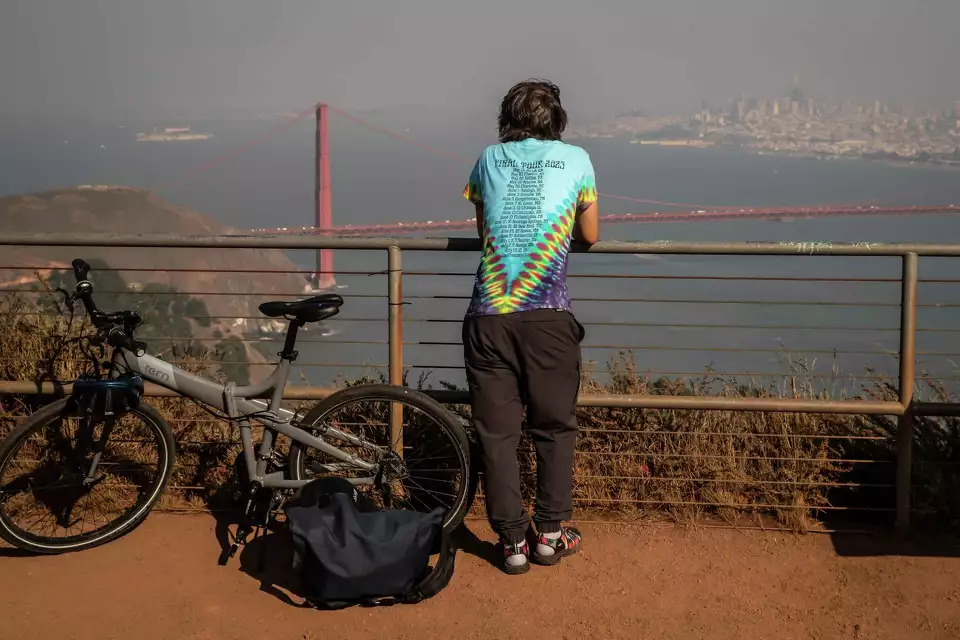
Daisuke Sakagami views San Francisco from the Marin Headlands through the haze of wildfire smoke in 2023. While the U.S. is scaling back its climate action efforts, there are many pathways still available to building a better future.Carlos Avila Gonzalez/S.F. Chronicle
For Americans concerned about climate change, the passage of President Donald Trump’s “big, beautiful bill” is nothing to celebrate. The newly minted budget will essentially take a sledgehammer to the Inflation Reduction Act — the first significant federal action by the United States designed to try to address rising global temperatures.
The legislation, which passed without the vote of a single Democrat, won’t simply hurt our environment; it will hurt the country more broadly. With the stroke of a Sharpie, Trump rolled back critical tax breaks and federal investments that have created good-paying jobs and reduced household energy bills. The Inflation Reduction Act would have gone on to make the electrical grid more reliable, kick-start new technologies and companies, maintain America’s competitive edge, and improve air quality for all Americans.
Dismantling the Inflation Reduction Act was a remarkably shortsighted move, and no one — not Republicans or Democrats, city dwellers or rural inhabitants — will emerge unscathed.
For many of us who have dedicated our careers to fighting climate change, this was a gut punch. But all is not lost.
After Republicans secured passage of Trump’s budget last week, I sent a letter to the staffers at Project Drawdown, a nonprofit dedicated to global climate action where I’m executive director, assuring them that the antidote to fear and worry is action.
In the coming weeks and months, those of us who care about climate change need to get off the mat and get back to work. There is still much we can do. The federal government doesn’t have a monopoly on climate action, and there are many pathways still available to building a better future.
To start, we should focus on the international stage. While decisions made in the United States still matter a great deal, it is not the whole climate ball game. Indeed, over 90% of the world’s emissions are now produced outside the United States. And the atmosphere doesn’t care about national borders.
Fortunately, the rest of the world is not sitting still, and many climate solutions are accelerating in other countries. Whether we look at China, Europe, Latin America or elsewhere, it is clear that the future belongs to clean energy. Solar energy is now the fastest-growing energy source in human history, growing at 20%-30% annually. Fossil fuels’ days are ultimately numbered.
Even in the United States, we can still make tremendous progress.
Yes, the budget bill is all but certain to slow down the move to clean energy in America — and hand a huge economic advantage to China — but it will not stop the transition. The long-term future of energy in the United States, like everywhere else, will ultimately be green.
Solar energy, wind power, battery storage, LED lighting, heat pumps and electric vehicles are getting better, cheaper and easier to build every year. They continue to beat the most optimistic forecasts, every year.
Economics are shifting, and clean energy is gaining momentum over fossil fuels. The smart money is on green energy, which is why investors and businesses continue to put their money there. And clean energy’s competitive advantage is only getting stronger. Clean energy will eventually be an unstoppable force in the market, no matter what “drill, baby, drill” Trump and his fossil fuel bankrollers want.
Looking beyond Washington, we can also leverage the critical role that cities, states and public utility commissions play in advancing climate action. Many states, including California and Minnesota, have been pioneers in clean energy through their ambitious investments and policies. (Minnesota, for example, will require 100% clean electricity by 2040, years ahead of most other states.) This cannot entirely replace federal action, of course, but it still advances critical work on the ground.
In the absence of federal climate leadership, there are other levers to pull and other actors to focus on. That’s how we made progress in the past. The U.S. had its peak fossil fuel use and resulting emissions in 2007. Since then, our greenhouse gas emissions have declined by roughly 20% while our economy has nearly doubled in size. Simply put, we’re not going back to the bad old days.
We should, of course, lament the additional progress we could have made if the Trump administration weren’t undermining science and climate solutions at every turn. However, we can still make meaningful strides on climate change.
For people striving to fight climate change — whether at nonprofits or on their own — the work ahead must look beyond Washington. Cities, states, businesses, investors, philanthropists and others can still do a lot of heavy lifting on climate change, and together, we can move mountains.
While Trump’s actions are a setback, I am confident that we will ultimately prevail. Climate solutions will continue gaining momentum and change the world. It might not unfold as quickly as we want, or in the exact way that feels most logical, but it is inevitable.
As writer William Gibson is credited with saying, “The future is already here. It’s just unevenly distributed.”
Remember: When it comes to stopping climate change and creating a cleaner, more prosperous future for Americans, it’s not game over. It’s game on.
Jonathan Foley is the executive director of Project Drawdown. From 2014 to 2018, he was executive director of the California Academy of Sciences.