


Making the case for impeaching members of the Supreme Court: why the conduct is impeachable, and why penalizing it now matters even without a conviction.
| Christopher Armitage Aug 25, 2026 |
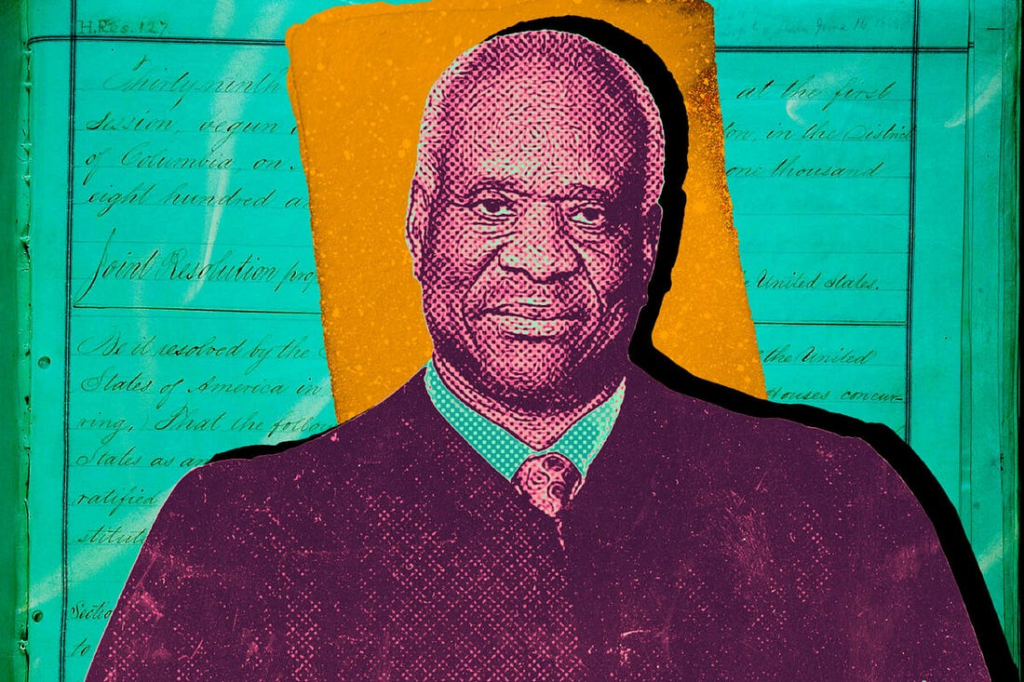
Thomas’ approach of originalism for thee but not for me is catching up to him. Cage Rivera/Rewire News Group/Wikipedia
A note from the author: Following this article, you’ll find the full articles of impeachment we drafted, for anyone who wants to send them to their U.S. House representative and request that they be endorsed and filed.
The U.S. Constitution says a Supreme Court Justice can be impeached for “high crimes and misdemeanors.” That phrase isn’t defined in the Constitution. The Constitution grants the interpretation of high crimes and misdemeanors to the U.S. House of Representatives. Not to SCOTUS. The Court has said as much itself, ruling that impeachment is a political question, rather than a judicial one. To the people’s house. The way that mechanism is assembled feels intentional, and worth note.
We elect the members of that house. We send them there to represent us, and by extension to represent our reading of the Constitution. So the question of whether a Justice’s conduct is a high crime or misdemeanor was never handed to lawyers, or to the Court itself. It comes back to us, through the people we elect.
I learned in the military that if you’re going to raise a problem or ask someone to do something, you should come with the solution. So I learned what the impeachment standard actually is, reviewed his conduct against that standard, and then drafted articles of impeachment against Justice Clarence Thomas for the conduct that met it.
The conduct in question is already common knowledge. Over the last two decades, wealthy benefactors have given Thomas private jet flights, yacht voyages, resort stays, real estate money, tuition payments, and the forgiveness of a $267,230 loan, and he left all of it off the disclosure reports he certified each year. He also voted in cases where his benefactors and his wife held direct interests.
The argument for drafting the articles concerns the conditions every Justice serves under, not just removing him from office. Right now a Justice who takes this kind of money runs little risk of being brought before Congress, put under investigation, and made to answer in public. Impeach Thomas, or open an inquiry into him, and things start changing. And for those concerned that a successful impeachment would just mean his retirement and a Trump-appointed successor: the next appointee, and every Justice currently seated, learns that misconduct will no longer be ignored. We need to create an environment where these justices don’t feel above the law or above consequences.
Articles of impeachment are charging counts, the House’s equivalent of an indictment, and a simple majority of the House can adopt them. The Senate then sits as a court, hears the evidence, and votes on each article separately, with a two-thirds vote required to convict and remove. A separate majority vote can disqualify the person from ever holding federal office again. The Constitution’s standard, treason, bribery, or other high crimes and misdemeanors, has no statutory definition, and the House has never adopted one. Representative Gerald Ford, leading the 1970 attempt to impeach Justice William O. Douglas, gave the definition that has governed in practice ever since: “An impeachable offense is whatever a majority of the House of Representatives considers it to be at a given moment in history.”
Frank Bowman, the University of Missouri law professor whose book is considered the standard modern history of impeachment, traces “high crimes and misdemeanors” to an English phrase that never meant indictable offenses at all, but the kind of serious bad conduct that warranted removal from office. Essentially, the standard for impeachment is not inherently criminal conduct. This is because the House of Representatives alone decides what the conduct is within that phrase, and that’s never been limited to what a prosecutor could charge. Further, the Congressional Research Service states plainly that impeachable conduct reaches serious violations of the public trust that are not necessarily indictable offenses.
So we drafted four articles in the exact form of H. Res. 1031, the resolution the House used to impeach Judge G. Thomas Porteous Jr. in 2010, the last time the Senate voted to convict and remove a judge. Porteous was removed for conduct materially similar to what these articles charge: taking undisclosed things of value from people with business before his court, and making false statements about his own finances. The articles are below, ready to file.
Article I charges willful failure to report gifts and transactions the Ethics in Government Act required him to disclose, on reports he certified as accurate, true, and complete, and the evidence of willfulness comes from Justice Thomas’s own filings: he disclosed Dallas real estate developer Harlan Crow’s gifts through 2003, stopped after the Los Angeles Times wrote about them in 2004, marked “none” for his wife’s income while the Heritage Foundation paid her $686,589 from 2003 to 2007, corrected more than a decade of forms in 2011, and then omitted the 2014 sale of his mother’s house to Crow, the 2018 Koch summit flight, the 2019 Indonesia trip, and the other omissions charged in Article I.
In regards to the undisclosed gifts, and before most of the rest of this record was public, Jeremy Paul, former dean of Northeastern University School of Law, said: “What he did was just so clearly out of bounds that I don’t think there’s any defense of it.”
Article II charges acceptance of things of value from people with interests before the Court, followed by his participation in their matters. Harlan Crow, whose gifts fill Article I, sits on the boards of think tanks whose fellows file briefs in the Court. Federalist Society official Leonard Leo routed $25,000 to Virginia Thomas through Kellyanne Conway’s polling firm with the instruction that the paperwork make “No mention of Ginni, of course,” while Leo’s nonprofit was filing a brief in Shelby County v. Holder; Justice Thomas sat in that case and voted to strike down the heart of the Voting Rights Act. The Koch political network flew him to its donor summit, and when the network’s affiliates brought Loper Bright Enterprises v. Raimondo to overturn the Chevron doctrine, he sat in the case and joined the majority.
Article III charges his participation, in violation of 28 U.S.C. 455, in four cases that grew out of his own wife’s work to overturn the 2020 election. Virginia Thomas texted White House Chief of Staff Mark Meadows 29 times pressing him to reverse the result, emailed Arizona and Wisconsin legislators urging them to substitute their states’ electors, corresponded with John Eastman, the architect of the plan for the Vice President to reject state electors, and attended the January 6 rally at the Ellipse. Her husband sat in cases about that same effort, including Trump v. Thompson, where he cast the lone vote to keep White House records from the Select Committee, and Trump v. United States, the presidential immunity case. He did recuse from Eastman v. Thompson in October 2023, once Eastman’s correspondence with his wife became public, which shows he knew how to apply the statute to matters involving his wife, and applied it selectively.
Article IV charges false and misleading statements about all of the above, made through the Court’s Public Information Office, through his counsel, and in his amended filings, in the same form the House used in Porteous’s fourth article: each statement quoted, followed by “in truth and in fact, as Justice Thomas then well knew,” followed by the records contradicting it.
These are not the first articles drafted against Justice Thomas. Representative Alexandria Ocasio-Cortez introduced a three-article resolution on July 10, 2024, charging one count of failure to disclose gifts, income, and transactions and two counts of refusal to recuse from matters involving his wife’s interests. Hers was the first to put the conduct into articles of impeachment introduced in the House, and the articles here build on it, adding the benefactor-interest count, the false-statements count, the loan forgiveness, the Koch charter flight, and the Senate Judiciary Committee’s December 2024 findings.
So what do we get out of impeachment without conviction? Opening an inquiry gives the House the ability to investigate, with subpoena power. From there:
- The investigation can yield legitimate evidence, some of which could be referred to states that may be interested parties in prosecutions, or to a future administration.
- His conduct goes public, and he testifies under oath, where dishonesty can be prosecuted.
- It pulls him away from his duties and his free time, a material cost.
- It potentially causes reputational harm, where the conduct merits it.
- It changes what a search of his name returns.
- It puts a stink on him that follows him into everything else, and makes other groups less willing to work with him.
A House majority can start it the day it decides to.
The fact is, congressional Democratic representatives are severely limited in their powers and it will stay that way barring a supermajority win by Dems that no serious forecast supports. Although Trump’s disapproval is the worst of either of his terms, his approval across major pollsters remains around 38 percent, because Republican approval of him has stayed near 90 percent throughout both terms. Approval that stable, combined with every variety of election interference now in play, does not indicate a once-in-a-generation landslide as particularly likely. But we still have elected officials in those roles, and there are still meaningful and effective ways for them to fight back regardless of outcome.
The party that holds power now already knows this. The Benghazi committee ran for more than two years, brought no charges, and surfaced Hillary Clinton’s private email server. The 2023 Biden impeachment inquiry produced no articles and kept the President’s family finances in the news for a year.
And in 2024, Republicans impeached Biden’s border chief, a cabinet secretary named Alejandro Mayorkas, over immigration policy. There was no crime; the charge was essentially that he ran the border badly. The House impeached him by one vote. The Senate threw it out immediately, no trial. And Republicans considered it a win anyway, because the goal was never removal, it was a year of border hearings, headlines, and a recorded vote to campaign on. That is the tool working as designed, for the party willing to use it.
Does this set a bad precedent? That precedent is already set. Republicans have spent more than a decade setting it, with a target list that reached the President, the Vice President, six cabinet secretaries, and the director of the FBI, and impeaching Justice Thomas would not create it.
Everyone has a job in this fight, and the people we send to the House are no exception. Their power is reduced, not gone, and there is work to do every day of the week. This is one piece of it. We wrote the articles and made the case for aggressively impeaching every corrupt member of this Court because that is the baseline of what a House representative is for.
Want to learn more? Check out the free library of resources at the bottom of this article. But just so you know, it’s 10 people like yourself, 10 activists per article who subscribe by clicking the button below, that fund all of this. All 3 free books, all 12 booklets, the model legislation, and the 20–40 articles per month.
Don’t let this be the reason you miss a meal or are late on rent.
But if this helps you and you can become a subscriber, you’re one of the 10 that makes it all possible.


