- By Laurance Lem Lee | Special to The Examiner |
- Feb 9, 2023 Updated Feb 15, 2023 (SFExaminer.com)
This month the Board of Supervisors is commencing hearings on the draft plan of the African American Reparations Advisory Committee of the Human Rights Commission. The California Task Force to Study and Develop Reparation Proposals for African Americans released a 500-page interim report in June, with a final report expected July 1. As these two efforts proceed to discussions on reparations, now may be a time to restart consideration of reparations for Americans of Chinese descent, following San Francisco’s recent apology.
San Francisco and U.S. history are full of laws and actions that have harmed many populations. Reconciliation is long past due. African Americans have been and continue to be subject to discrimination and segregation going back to slavery. Japanese Americans, placed in internment camps in World War II, have received a federal apology and reparations.
Restrictive housing covenants in San Francisco neighborhoods and in places across the country have forbidden many groups based on religion or country of origin, including Jews, Italians, Russians, Muslims, Latinos and Asians. Government laws and actions against Jewish, Native Americans, Hispanics, gay, women and other groups have a long history and continue to this day.
Last November, San Francisco supervisors unanimously approved an apology to Chinese Americans for historic harms. Antioch, where a mob destroyed that city’s Chinatown in 1876, was the first California city to issue an apology, in May 2022. San Jose issued an apology in September and Los Angeles did so in October. The California Assembly apologized to Chinese workers in 2009 and Congress apologized for the Chinese Exclusion Act in 2012.
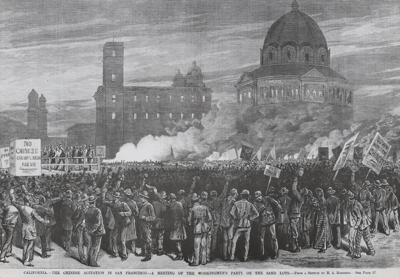
This San Francisco resolution mentioned many of the most sordid events and laws in anti-Chinese American history: the three-day 1877 riot that resulted in four deaths and destruction of many Chinese-owned laundries, the segregated public schools in the 19th century, the federal and local laws against immigration, employment and housing. The resolution stated it sought to be a “teaching moment for the public to move forward towards justice for all.” It further stated that the Board of Supervisors “commits to programs, policies, and investments that can … provide for redress and restoration.”
Chinese Americans represented over one-fifth of The City’s residents in 2020, more than 180,000. How to propose redress for that many people? One idea sponsored by three supervisors, to provide an $118 million equity fund for nonprofits, did not happen.
Reparations for African Americans are explicitly part of the San Francisco and California plans. The San Francisco draft plan’s recommendations focus on economic empowerment, health, education and policy. The California plan has a comprehensive set of preliminary recommendations.
Getting to these drafts for African American reparations took months of hard listening, compromise and careful planning and writing. To get to the next step would take a similar if not bigger effort, with other audiences.
Deceptive claims and poor data practices are part of a pattern depriving S.F. public school students of the math skills they deserve — unlike Long Beach Unified
For African American reparation efforts, many Japanese American and Asian American groups have been steady supporters. One of the nine members of the California Reparations Task Force is Donald Tamaki, a former executive director of the Asian Law Caucus. Seventy-six Japanese American and Asian American groups support a federal reparations commission for African Americans.
Notably few of the Asian American supportive groups are Chinese American. For sure, Chinese Americans are more comfortable with appreciating the need for government apologies. As for reparations and redress in terms of financial assistance or changes in government policy, Chinese Americans may have less familiarity and less comfort.
Perhaps Chinese Americans are watching and waiting to see what the city and state governments will do for African Americans.
Perhaps Chinese Americans can find that the requests for African American redress have direct parallels to ways in which Chinese Americans can seek redress. Many proposals in the San Francisco and California draft plan can be applied to support Americans of Chinese descent. How about a Dream Keeper Initiative for Chinese Americans that could help support in areas of education, job prospects, home ownership and health?
Bill Lee, former San Francisco city administrator and a longtime civil rights advocate, said, “We here are all working on equity. When will we see righting of historic wrongs against Chinese Americans, queer folk, women and others?”
We are living in a time when we are rightfully taking a hard look at our history. How we move forward to redressing such history is a worthwhile trip into the unknown.
Laurance Lem Lee is a second-generation Chinese American, an SFUSD graduate, a small-business owner and a good-government advocate.