


- By Patrick Hoge | Examiner staff writer |
- Dec 9, 2024 (SFExaminer.com)
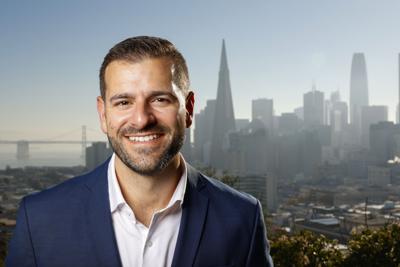
Danny Sauter, who was recently elected supervisor for District 3 in San Francisco’s northeast, grew up in a household where politics and public service were constantly in the background.
Sauter said his father was a labor attorney who represented multiple unions, and his mother was a teacher who ran the community-service program at the local high school and would take him to a soup kitchen with her to volunteer.
That blend of experiences “always oriented me towards being interested in public service,” said Sauter, a nonprofit executive director, community organizer and political moderate by San Francisco standards. His campaign won the backing of moderate forces seeking an aligned majority of supervisors.
Come January, Sauter will get to do the public’s business on a whole new level as a first-time elected official and District 3’s first new supervisor since 2015. His district includes the Financial District — the flagging engine of The City’s economy — in addition to Chinatown, Jackson Square, North Beach, Fisherman’s Wharf, Polk Gulch and Union Square, as well as Russian, Telegraph and Nob hills.
Sauter campaigned on issues such as hiring more first responders for public safety, including both police and dispatchers; making neighborhoods cleaner; building affordable housing; protecting renters; filling vacant storefronts; and reducing homelessness. His stances drew support from some tech-aligned reformists who labeled longtime Supervisor Aaron Peskin an obstructionist on housing.
Sauter — a 36-year-old native of Columbus, Ohio — got his start in private industry, moving to San Francisco after graduating from Miami University in Oxford, Ohio, for his first job, which was at a tech startup where Sauter said he met his future wife.
“The company didn’t work out, but that’s worked out,” Sauter said of his marriage.
Sauter majored in marketing and minored in entrepreneurship and Chinese as an undergraduate, then cofounded a digital marketing agency in North Beach called Bamboo, which he helped run for five years and grow to 58 employees.
In late 2015, however, Sauter said his life took a turn when he became increasingly involved in North Beach Neighbors, a neighborhood organization serving the area where he rents an apartment and for which he served as a board member and past president.
For the group, Sauter led a successful effort to establish a farmers market, which he has run and which typically operates on Saturdays at Greenwich St. and Columbus Ave.
The experience fueled Sauter’s desire to be more widely involved in local affairs, he said. Sauter said setting up the farmers market also demonstrated how difficult it can be to get things done in The City, prompting him to think about cutting red tape and improving municipal services.
Sauter began volunteering for political campaigns, such as Sen. Scott Wiener’s 2016 run for state Senate.
He helped to count and draw attention to the number of vacant stores in the district, organized street cleanups and a volunteer delivery service to support local restaurants during the COVID-19 lockdown, lobbied for more protected bicycle lanes and advocated for more housing as the first housing chair of the San Francisco group of the Sierra Club.
In August of 2019, Sauter left Bamboo, which is now located in Seattle, and became the executive director of Neighborhood Centers Together, a nonprofit that provides support to eight neighborhood centers around The City.
“I left that work with the advertising agency to try and be closer to this world, this world of politics, this world of civic engagement, public service,” Sauter said. “I didn’t exactly know where it would lead me, but I knew I needed to be in this world. It was something I couldn’t shake.”
About the same time, Sauter said, he started taking lessons in Cantonese to better communicate with Asian American residents in District 3, which he has pursued ever since.

Seeing a lack of what he saw as a credible candidate to challenge Supervisor Peskin in the 2020 election, Sauter jumped into the deep end. Although Peskin prevailed, Sauter finished second with 43% of the vote after the final tally of ranked-choice ballots.
This year, Peskin was not on the ballot, as he was termed out after his second consecutive term — his fifth on the board overall — and Sauter beat out two candidates endorsed by Peskin.
After five rounds of ranked-choice voting, Sauter won almost 55% of the vote, or 14,056 votes, compared with 45% for second-place finisher Sharon Lai, who got 11,512 votes.
Sauter’s win came despite a coordinated strategy in the final stretch of the race in which several of his opponents formed alliances to urge voters to place each other’s names above Sauter’s as a second choice.
Among other things, they challenged Sauter’s commitment to police — Sauter said that he opposed increasing police spending in 2020 following a Minneapolis police officer’s murder of George Floyd, highlighting the need for more mental-health and social-worker responders. This election, Sauter insisted that he supported increased police staffing.
Candidate Moe Jamil also portrayed Sauter — a vocal advocate of building more housing, particularly high-density housing on commercial corridors — as someone “bought and paid for by big developers” and questioned Sauter’s commitment to protecting tenants, a concern Sauter rejected. Sauter has argued that embracing urban density will make San Francisco more vibrant and help achieve its climate goals.
Sauter received contributions from a wide array of interests, including real estate and the San Francisco Apartment Association Political Action Committee, as well as prominent tech and venture-capital figures. In all, he raised $429,211, including public financing.
Outside spending in support of Sauter was higher than for any other candidate, coming from two moderate groups: an Abundance Network-sponsored committee that spent $161,877 and a GrowSF committee that spent $70,910, according to city records.
The Abundance Network, a pro-housing organization with tech origins, was instrumental in the moderate takeover of the San Francisco Democratic County Central Committee in the March election, and the committee in turn endorsed Sauter.
Diana Taylor, president of the Barbary Coast Neighborhood Association, said she expected Sauter’s experience supporting small businesses will help attract neighborhood-serving retail in areas such as where she lives just north of downtown, which she said has many vacant storefronts and no functioning commercial corridor.
Taylor said she expected Sauter to elevate community voices versus paid lobbyists, who too often hold inordinate sway in her opinion.
“Danny, as a neighborhood organizer, knows that leveling the playing field is critical to making projects fit in a neighborhood,” she said.

Sauter was optimistic about the future, saying he believes that falling interest rates will energize the economy.
He did not endorse any candidate for mayor but said having a new mayor in Daniel Lurie will help shake off a “stigma” that has settled on The City, which has suffered from negative perceptions fueled by stories in recent years about San Francisco’s problems with crime, commercial vacancies and homelessness.
“There has been a hesitancy to take a chance in San Francisco,” Sauter said. ”A new mayor is an important opportunity for us to go and sell San Francisco again.”
Sauter said he wants to spur action on a variety of fronts, particularly to stimulate a revival of the downtown economy, an area he thinks has not received enough “urgency.” Downtown San Francisco has had record-high office vacancies since the pandemic and the rise of remote work.
“I think everything related to downtown and tourism and hospitality has to be front and center,” said Sauter, who recently met with Lurie and told the mayor-elect the No. 1 thing he wants to work with him on is “everything related to downtown recovery.”
As others have, Sauter said he hopes to see a significant number of office-to-residential conversion projects in underutilized office buildings downtown. Though Mayor London Breed pushed for regulatory changes to facilitate such conversions and voters in March passed a transfer-tax exemption on the sale of converted buildings, there has been no flood of proposals.
“Everyone’s been talking about this for the last few years, but we’re not seeing much action on it — and I want to understand why that is,” he said.
Sauter points to the example of the former Pfizer Inc. headquarters building in midtown Manhattan, which is being converted into apartments as part of what is billed as the largest office-to-residential conversion in the Big Apple’s history.
“We need to figure out why they’re able to do it and why we’re not,” he said.
One thing Sauter said he would like to see is city employees working in person in offices more days per week, which he argued could especially benefit neighborhoods around Civic Center.
“It is an area for The City itself to lead and to say, ‘We’re back in person,’” he said.
In Fisherman’s Wharf, Sauter said some vacant commercial spaces on Bay Street could be replaced with dense housing.

On Washington Square Park, meanwhile, Sauter said he wants to see progress on rebuilding the burned-out shell of an apartment building at 659 Union St., which was gutted by a massive fire in 2018. Proposals to redevelop the property, including a hotel and rooftop restaurant, have stalled.
Sauter said he wants The City to investigate the possibility of buying the site for affordable housing and potentially a North Beach station for the Central Subway, which Sauter — pointing out that a tunnel has already been dug to the site — said he would like to see extended from Chinatown to Fisherman’s Wharf. Precedent for such a purchase exists: The City in 2012 bought property on Stockton Street for the Central Subway’s Chinatown Rose Pak Station, he said.
“One way or another, I want some action on that building,” Sauter said. “I want some movement. I know the neighborhood does. It’s a big hole in the neighborhood.”