


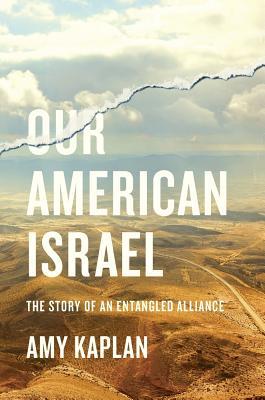
Our American Israel: The Story of an Entangled Alliance
Amy Kaplan
Our American Israel tells the story of how a Jewish state in the Middle East came to resonate profoundly with a broad range of Americans in the twentieth century. Beginning with debates about Zionism after World War II, Israel’s identity has been entangled with America’s belief in its own exceptional nature. Now, in the twenty-first century, Amy Kaplan challenges the associations underlying this special alliance.
Through popular narratives expressed in news media, fiction, and film, a shared sense of identity emerged from the two nations’ histories as settler societies. Americans projected their own origin myths onto Israel: the biblical promised land, the open frontier, the refuge for immigrants, the revolt against colonialism. Israel assumed a mantle of moral authority, based on its image as an “invincible victim,” a nation of intrepid warriors and concentration camp survivors. This paradox persisted long after the Six-Day War, when the United States rallied behind a story of the Israeli David subduing the Arab Goliath. The image of the underdog shattered when Israel invaded Lebanon and Palestinians rose up against the occupation in the 1980s. Israel’s military was strongly censured around the world, including notes of dissent in the United States. Rather than a symbol of justice, Israel became a model of military strength and technological ingenuity.
In America today, Israel’s political realities pose difficult challenges. Turning a critical eye on the turbulent history that bound the two nations together, Kaplan unearths the roots of present controversies that may well divide them in the future.
About the author
Amy Kaplan
Working in the interdisciplinary field of American studies, Amy Kaplan’s scholarship and teaching focus on the culture of imperialism, comparative perspectives on the Americas, prison writing, the American novel, and mourning, memory and war.
A past president of the American Studies Association, Kaplan received her Ph.D. from The Johns Hopkins University, with a specialty in late-nineteenth-century American literature. Her first book was The Social Construction of American Realism (U Chicago P, 1988). She co-edited, with Donald Pease, Cultures of U. S. Imperialism (Duke, 1993). In her book The Anarchy of Empire in the Making of U.S. Culture (Harvard UP 2002) Kaplan shows how imperial expansion abroad–from the US-Mexico War of 1848 to the First World War–profoundly shaped key elements of American culture at home. She has received an NEH Fellowship and the Norman Forster prize for the best essay in American Literature in 1998 for “Manifest Domesticity.” Last year she was a member of the School of Social Science at the Institute for Advanced Study.
A wide-ranging critic of contemporary American culture and policy, Kaplan has published essays on the place of Guantanamo Bay in American history, the discourse of “homeland security” in response to 9/11, analogies between the American and Roman Empires, academic life in Palestine in the Chronicle of Higher Ed, as well as articles on Mark Twain and Herman Melville. She is currently writing a cultural history of American representations of Israel.
(Goodreads.com)


