From Wikipedia, the free encyclopedia
This article is about the 2017 film. For the 1953 event, see Death and state funeral of Joseph Stalin. For other uses, see Death of Stalin (disambiguation).
| THE DEATH OF STALIN | |
|---|---|
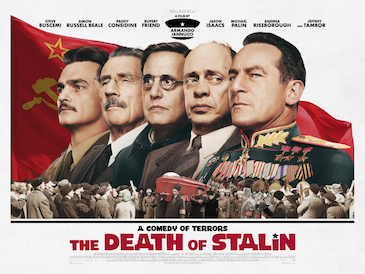
| British theatrical release poster | |
| DIRECTED BY | Armando Iannucci |
| WRITTEN BY | Armando IannucciDavid SchneiderIan MartinPeter Fellows (additional material) |
| SCREENPLAY BY | Fabien Nury |
| BASED ON | La Mort de Staline by Fabien Nury (writer) &Thierry Robin (illustrator) |
| PRODUCED BY | Yann ZenouLaurent ZeitounNicolas Duval AdassovskyKevin Loader |
| STARRING | Steve BuscemiSimon Russell BealePaddy ConsidineRupert FriendJason IsaacsMichael PalinAndrea RiseboroughJeffrey Tambor |
| CINEMATOGRAPHY | Zac Nicholson |
| EDITED BY | Peter Lambert |
| MUSIC BY | Christopher Willis |
| PRODUCTION COMPANIES | GaumontQuad ProductionsMain JourneyFrance 3 CinemaLa Cie CinématographiquePanache ProductionsAFPICanal+Ciné+France TélévisionsTitle Media |
| DISTRIBUTED BY | Entertainment One Films (United Kingdom)Gaumont (France)September Film Distribution (Belgium) |
| RELEASE DATES | 8 September 2017 (TIFF)20 October 2017 (United Kingdom)4 April 2018 (France)18 April 2018 (Belgium) |
| RUNNING TIME | 107 minutes[1] |
| COUNTRIES | FranceUnited KingdomBelgium |
| LANGUAGE | English |
| BUDGET | $13 million[2] |
| BOX OFFICE | $24.6 million[3] |
The Death of Stalin is a 2017 political satire black comedy film written and directed by Armando Iannucci and co-written by David Schneider and Ian Martin with Peter Fellows. Based on the French graphic novel La Mort de Staline (2010–2012), the film depicts the internal social and political power struggle among the members of the Soviet Politburo following the death of leader Joseph Stalin in 1953.
The French-British-Belgian co-production stars an ensemble cast that includes Steve Buscemi, Simon Russell Beale, Paddy Considine, Rupert Friend, Jason Isaacs, Olga Kurylenko, Michael Palin, Andrea Riseborough, Dermot Crowley, Paul Chahidi, Adrian McLoughlin, Paul Whitehouse, and Jeffrey Tambor.
The film premiered on 8 September 2017 at the Toronto International Film Festival. It was released theatrically in the United Kingdom by Entertainment One Films on 20 October 2017, in France by Gaumont on 4 April 2018, and in Belgium by September Film Distribution on 18 April 2018. It received critical acclaim and various accolades, including nominations for two British Academy Film Awards, one of which was for Outstanding British Film, and 13 British Independent Film Awards, four of which it won. There was fierce opposition to the film in Russia, where it was seen as “anti-Russian propaganda”, and it was banned there, as well as in Kyrgyzstan, for allegedly mocking the Soviet Union and its past.[4][5]
Plot
On the night of 1 March 1953, Joseph Stalin calls the Radio Moscow director to demand a recording of the live recital of Mozart‘s Piano Concerto No. 23 soon after its conclusion. The performance was not recorded; not wanting to anger Stalin, the director hurriedly refills the half-empty auditorium, fetches a new conductor to replace the original one, who has passed out, and orders the orchestra to play again. Pianist Maria Yudina initially refuses to perform for the cruel dictator, but ultimately is bribed to comply.
Stalin is hosting a tense, but rowdy, gathering of Central Committee members at his home, the Kuntsevo Dacha. As Foreign Minister Vyacheslav Molotov leaves, NKVD head Lavrentiy Beria reveals to Nikita Khrushchev and Deputy Chairman Georgy Malenkov that Molotov is to be part of the latest purge. When the concert recording arrives, Stalin finds a note Maria slipped in the record sleeve, admonishing Stalin and expressing hope for his death. He reads it, laughs, and suffers a cerebral haemorrhage. Despite hearing him fall, Stalin’s guards do not enter his office, fearful of being punished for disturbing him.
Stalin’s housemaid discovers him unconscious the next morning. The members of the Central Committee each learn about the situation through their own networks and rush to the dacha. Beria, the first to arrive, finds Maria’s note. Once Malenkov, Khrushchev, Lazar Kaganovich, Anastas Mikoyan, and Nikolai Bulganin arrive, the Committee finally decide to send for a team of doctors. Most of the best doctors in Moscow have been arrested for being part of the “Doctors’ plot” and so the doctors who can be found are not impressive. After a brief bout of terminal lucidity, Stalin dies. As the members of the Committee return to Moscow, Beria orders the NKVD to take over the city’s security posts held by the Soviet Army.
Beria and Khrushchev vie for the support of Molotov and Stalin’s children, Svetlana and her unstable, alcoholic brother Vasily. Beria has Molotov removed from the list of those to be rounded up, and has Polina Zhemchuzhina, Molotov’s wife, released from prison. The Committee names Malenkov chairman. A puppet of Beria, Malenkov further exerts control by hijacking Khrushchev’s proposed reforms, such as releasing political prisoners and loosening clerical restrictions. Khrushchev is relegated to planning Stalin’s funeral.
After Beria learns that Khrushchev and Maria are acquainted, he threatens Khrushchev with Maria’s note. To create problems for the NKVD, Khrushchev reverses Beria’s order to halt all transport into Moscow. When 1,500 arriving mourners are killed, the Committee wants to blame junior NKVD officers. Beria angrily dissents, believing that would amount to blaming him, and threatens his colleagues with documents detailing their involvement in various purges.
Irate over the supplanting of the military by the NKVD, Marshal Georgy Zhukov agrees to support Khrushchev in a coup against Beria, provided it occurs after Stalin’s funeral the next day and Khrushchev can get the rest of the Committee on board in time. Khrushchev fails to find time to discuss his plan with Malenkov but he tells everyone else that the decision is unanimous, and they commit themselves. Khrushchev gives Zhukov the greenlight, and the Soviet Army reclaims its posts from the NKVD. Zhukov, assisted by a group of soldiers led by Kiril Moskalenko and Leonid Brezhnev, storms into a meeting of the Committee and arrests Beria.
Malenkov does not intervene and reluctantly signs Beria’s death warrant, horrified at what Beria had done to his victims. At Beria’s emergency trial, Khrushchev accuses him of counter-revolutionary activities, sexual assault, and paedophilia, and immediately declares him guilty after evidence of the final accusation is delivered by the Soviet Army. Beria begs for his life but is summarily shot in the head, and Zhukov has his body burned in the courtyard. Despite Svetlana’s protests, Khrushchev sends her to Vienna, while keeping Vasily in Russia, where he can be watched. He concurs with Kaganovich that Malenkov is too weak to lead. In 1956, Maria is once again performing the Mozart concerto. Having triumphed over other members of the Committee to become the new leader of the Soviet Union, Khrushchev attends. Brezhnev, who will eventually succeed Khrushchev in 1964, eyes Khrushchev from his seat.
More at: ; https://en.wikipedia.org/wiki/The_Death_of_Stalin