Lesson: ALWAYS Put Your Money Where Democracy Is — Create a “Brand Tornado Crisis”

SEP 23, 2025 (davidpepper.substack.com)
The Force is With Us!Subscribe
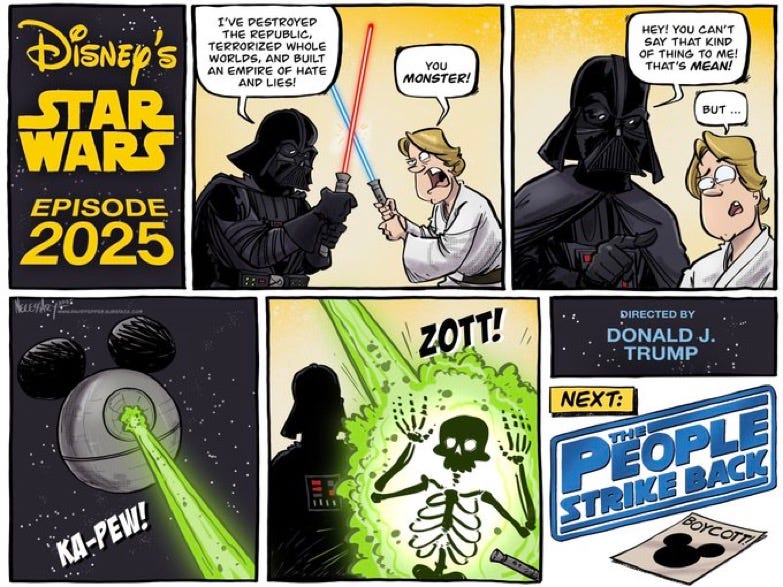
According to Strength in Numbers, “search interest for “Cancel Disney+” has hit an all-time high — even higher than the boycott movements from when Disney “went woke” in 2020-2022. The current Disney boycott is now 4x as large as any over the last 5 years, gauged by search interest.”
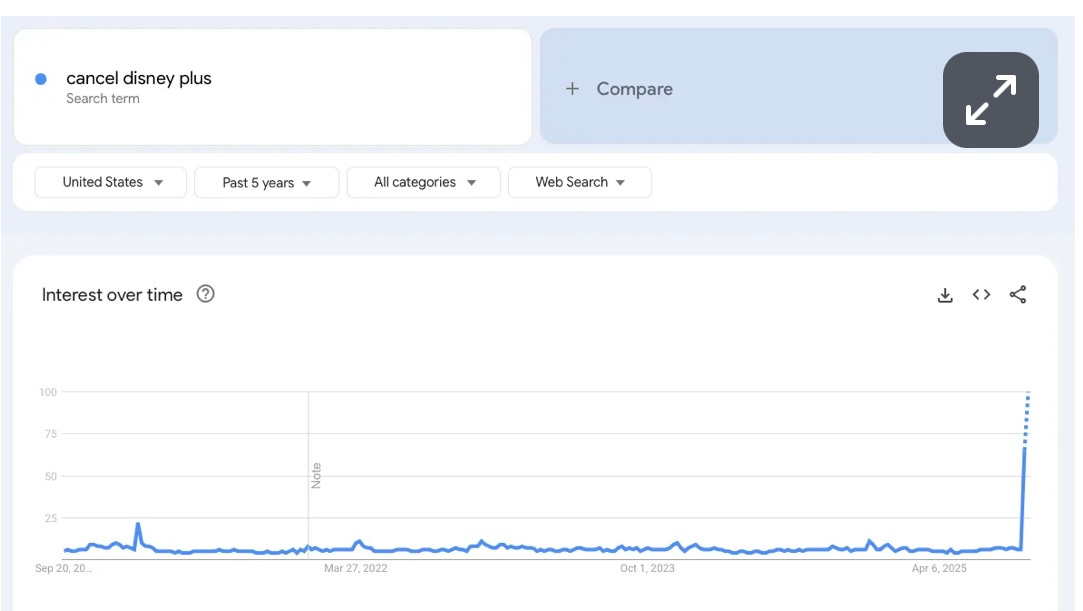
And those searches were just the beginning:

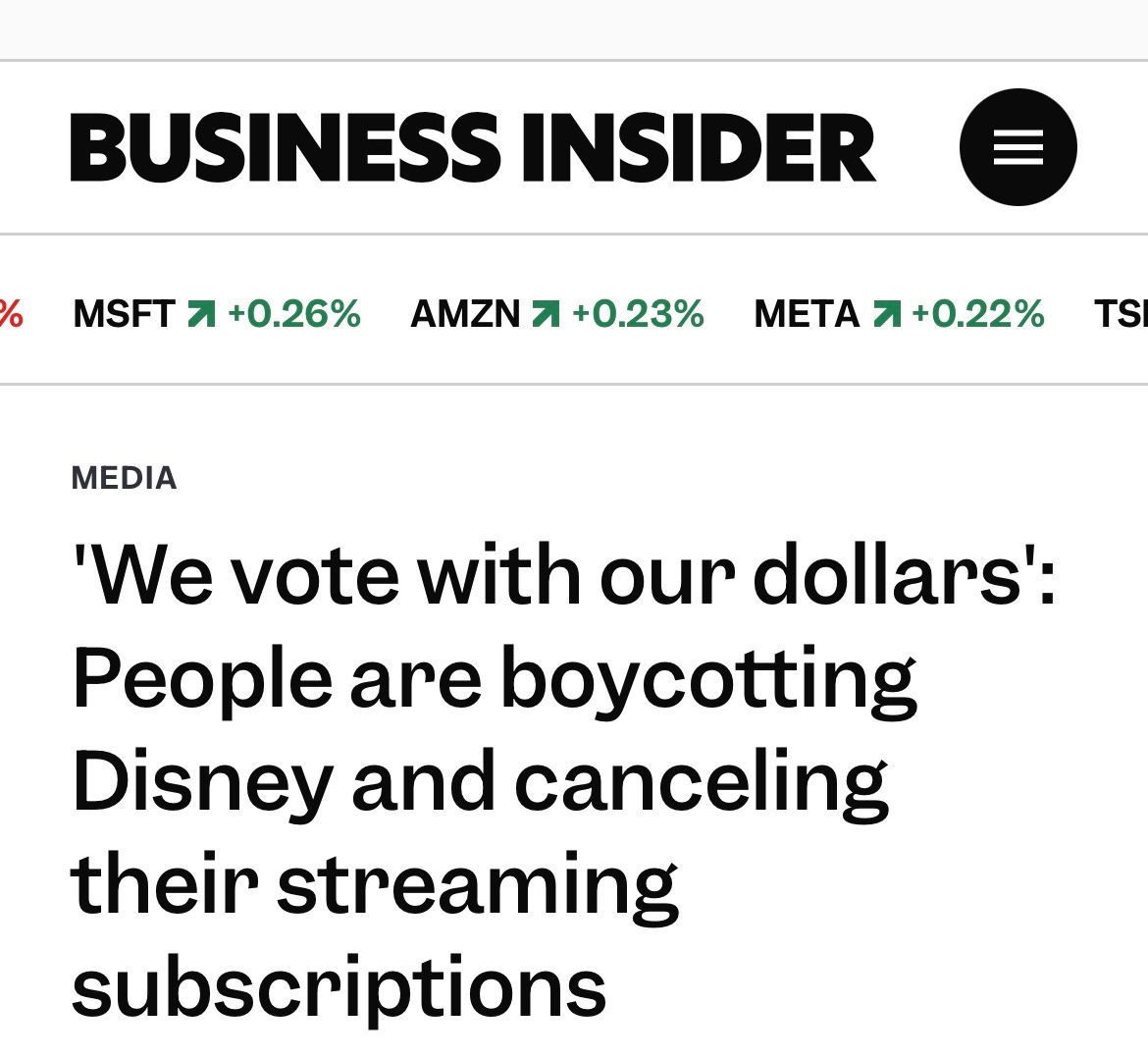
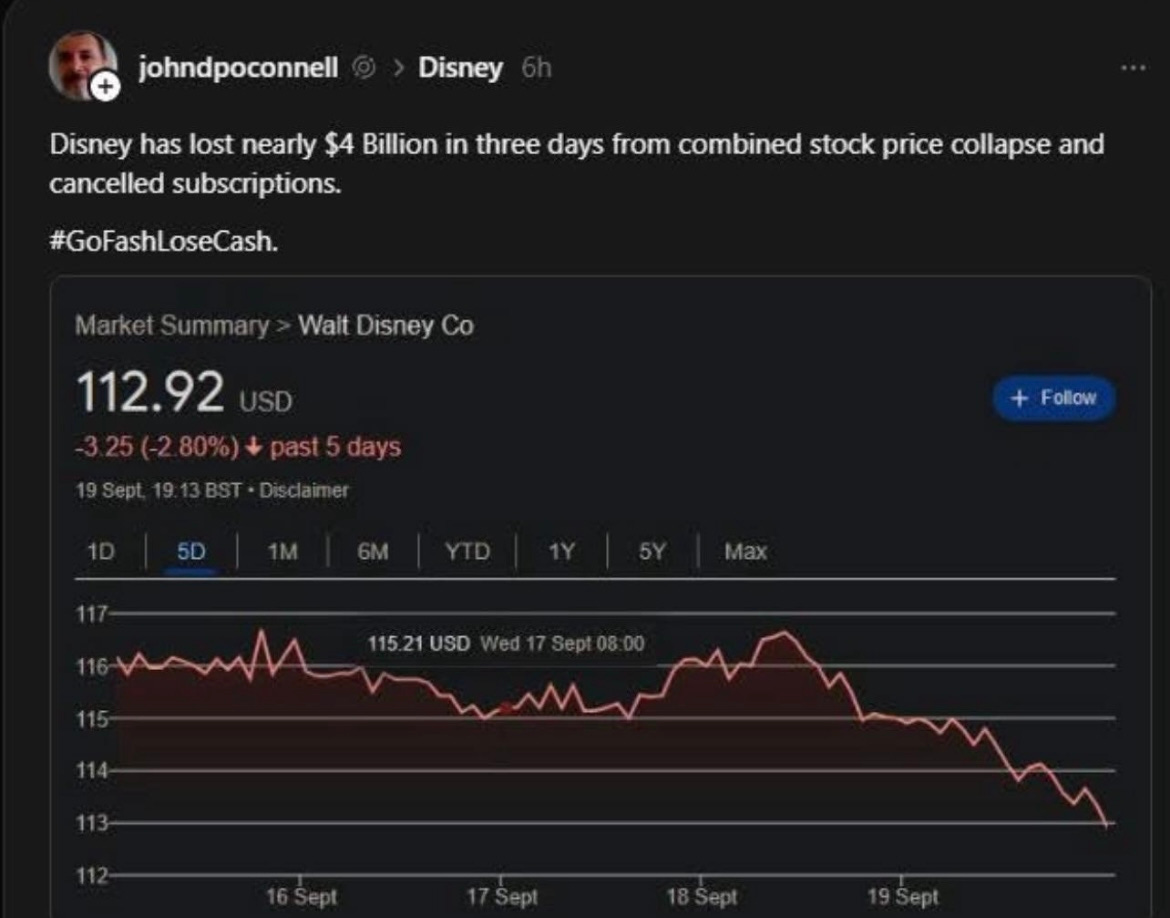
And yesterday, we saw the result of that fierce consumer backlash. Kimmel will be back tonight

This is a perfect example of what I write about in “Saving Democracy”—of putting your/our money where democracy is.
Because as much as Trump wants to bully institutions into doing what he wants, we together are the more powerful force—especially for companies that rely on the American consumer (as opposed to government largesse) to succeed.
The past week has shown that if we, in huge numbers, create strong incentives to behave consistent with democracy (and not against it), we can fight back against Trump’s bullying.
Here’s an excerpt of my explanation:
Let Your Money Do the Talking
Beyond politically calling out the involvement of billionaires and big corporations for attacking our democracy, also call it out where they care even more.
How they make their money—which you can directly impact in how you spend your money.
If Citizens United insists that corporate spending is speech, then make your personal spending part of your speech as well—and be choosy about where you spend it! Do the same as a worker, a colleague, and a member of organizations. (To repeat my refrain, these are all parts of your footprint).
Why does this matter so much? Because we need to align as many incentives as we can for companies and even billionaires to stand with and for democracy and core democratic values.
And that includes economic incentives.
Trump and his allies get this. They spend much of their time—often with brute-force shakedowns—trying to make it economically beneficial for institutions to side with him and against democracy.
We must push in the opposite way. And we can.
In 2024-25, the best example of this is the disastrous collapse of Tesla.
Horrified by Musk’s words and actions, consumers took their ire out on the cars and the company anchoring Musk’s wealth. In the first quarter of 2025, Tesla deliveries fell by 50,000 cars versus the prior year, the largest drop in its history. Tesla sales fell even more precipitously in Europe, where Musk has also been openly embracing far right parties and causes. Sales plummeted 49% in the first two months of 2025 even as overall sales of electric vehicles rose.
This happened organically, with consumers choosing individually not to purchase one. (My family had one on order, and we cancelled it). One poll found that the percentage of US car buyers who “would not consider” buying a Tesla to have nearly doubled—from 17% to 32%—in just four years.
Later, larger protests only made the problem worse for Musk, creating a broad sense across the globe that the brand Tesla stood for far-right extremism. One analyst summarized what happened to Musk and Tesla as a “brand tornado crisis.”
Musk did that mostly to himself, but it took hold. And months into 2025, Musk took steps to reduce his role in the Trump administration and partly blamed the toll his politics were taking on his core business.
Good!
But don’t stop there. When billionaires and big corporate interests are undermining democracy at all levels, we must counter it at all levels as well.
For one example, look at what happened to Disney a few years back [note: this is a different Disney example].
The company invested dollars into extremist Florida legislators; in 2022, those legislators passed an extreme bill (which became known as the “Don’t Say Gay” law); Disney constituents (employees and customers) spoke out against the company for supporting those politicians; Disney spoke out against the bill and suspended political contributions; and then the politicians turned around and punished Disney for having spoken out. And the firestorm continued after that.
It was a painful lesson for Disney, but one all major businesses should learn. Just as with Trump, investing in statehouses that have become Laboratories of Autocracy is a horrible investment.
Especially for companies with a broad-based customer or employee base—one that reflects the diversity and mainstream views of our nation— your investment will lead to laws and politics that attack your own constituents directly, while offending many more. And that means your support of those extremists will also ultimately offend them. Nothing you say to defend your investment will suffice. And when you try to walk it back, you’ll be attacked by the extremists you helped empower.
What’s the solution for companies like Disney?
Get out of the autocracy business! The sooner, the better. Instead, put your money where democracy is.
We all should. And we can all make that happen.
Our Democracy Budget: Putting Our Money Where Democracy Is
There are few more influential parts of our footprints than where we spend our dollars. As contributions to causes, as daily spending, or as longer-term investments. And our collective decisions on how we expend those dollars can make an enormous difference in lifting democracy.
For those who already dedicate some of your hard-earned money to political causes (ie. candidates, parties, etc.), my hope is that once you see that we’re in a battle for democracy itself, you’ll convert your political spending into a “democracy budget.” (For others who haven’t given before, start your “democracy budget” from scratch).
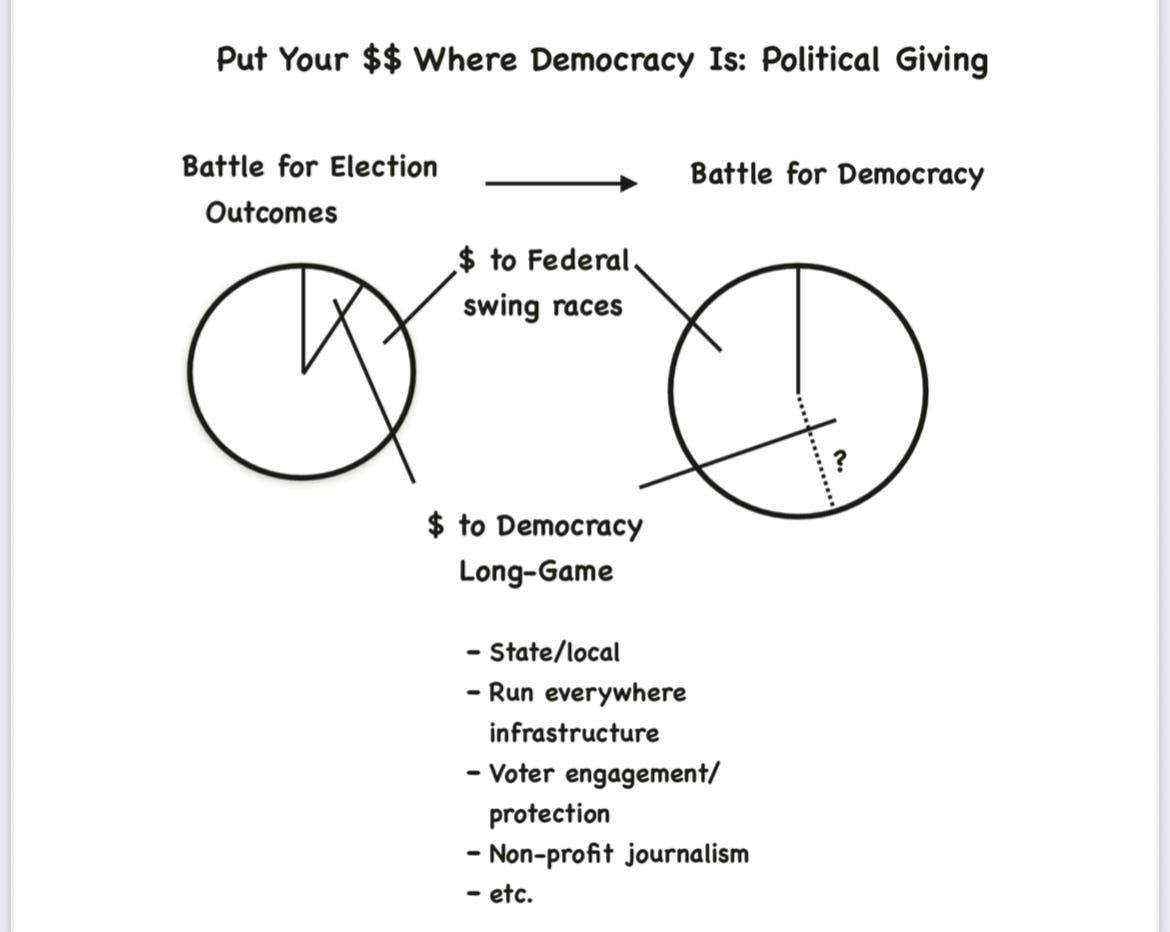
Once you frame it that way, you’ll see that beyond simply giving to federal “swing” candidates every two years, there are numerous other ways to invest dollars as part of a more strategic long game that lifts democracy. So, think through that budget as you would any other. Beyond traditional federal candidate giving (which still matters), consider a mix of options that lift democracy over a longer time-frame (I’ve mentioned many in prior chapters), and budget accordingly. And yes, many of these also are tax-deductible contributions, so your dollars go further.
When you make this shift, also know that a broadening of investment in these directions also shifts the incentive structure of Team D’s political players to adopt a broader pro-democracy approach. (Ie. if there’s only money flowing into swing-state federal races, that’s where most of those working on Team D will inevitably focus).
But beyond the money we intentionally spend on politics, we also need to take a look at all the other money we spend on a daily basis. Because in ways we don’t appreciate, the money we spend as consumers flows downstream into politics far more than even our direct political giving does—three times more, the organization Goods Unite Us estimates.128
So every day, we face a simple choice. We can spend and invest our dollars to lift democracy, or we can spend in a way that funnels dollars into the drive toward autocracy and extremism.
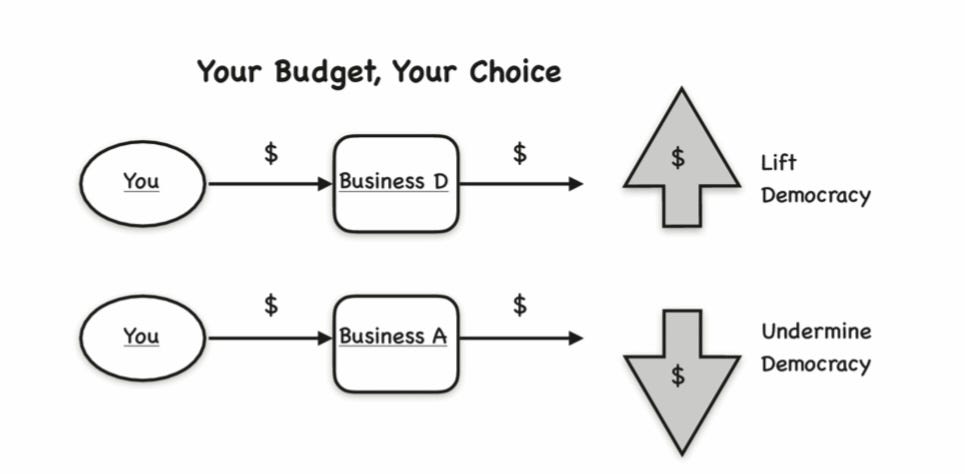
Each of us, in any way we can, should maximize our pro-democracy spending and minimize our extremism spending. Let’s reward those institutions who are doing the right things by democracy; and let’s keep our money out of places that are propping up autocracy and extremism (because that means our money is also propping up extremism). By doing this, as well as communicating those decisions, we can create a broader incentive structure to support democracy. In case this sounds quaint or theoretical, the Tesla and Disney examples show just how powerful that incentive system can be.
How do we do this?
First, individually, we do it little by little, every day. Goods Unite Us analyzes where various companies spend their political dollars—which they derive from your dollars. Citizens for Responsibility and Ethics in Washington (CREW) has tracked which companies gave to politicians who refused to certify the 2020 election, after many had promised not to. Other organizations like Color of Change bring similar transparency, highlighting corporate spending that contributes to extremism and racial discrimination. Some journalists, like Judd Legum, do the same. So take a look at these and other resources (listed at the end of this chapter) as you spend. See if your spending aligns with your political views, and democracy. Adjust accordingly.
As you spend dollars at the local level, remember Vashitta’s work to enlist restaurants to become “voter hubs.” Every time she’d tell me about a new hub doing pro-democracy work, I’d tweet out “thank you,” name the restaurant, and encourage people to frequent that business, eat their great food, and get registered. Do the same thing however you can. Whether it’s a salon like Kim Thomas’s or one of those restaurants, or far bigger enterprises, patronize businesses that are doing the right thing by democracy. Thank them when you do it. For small businesses, in particular, if playing an active role in lifting democracy adds to their customer base, it gives them one more reason to do it. It’s not just good for their customers, but good for business.
On the other hand, if you see that a business you frequent is propping up extremists, take your business elsewhere. And make it clear why you chose to do so. You don’t need your hard-earned dollars boosting extremism, especially when that undermines the other work you do to lift democracy.
Or if you’re asked to give to a nonprofit, ask them if they use their footprint to lift democracy or register those they serve. If they don’t, ask them why not. Encourage them to do it, and say you prefer to give to institutions that also lift democracy. That that’s part of your core mission. Help them see that it should be part of theirs too.
Or if you understand that the dying local media is a major factor in allowing these statehouses to become hotbeds of extremism, invest a few dollars in subscribing to the local paper. Nonprofit journalism is also emerging as a viable alternative in many states—like the Texas Tribune or the Ohio Capital Journal. Nonprofit reporters are bringing sunshine and accountability to statehouses that otherwise would have neither. Put your money where democracy is by supporting these vital institutions. We don’t want them just to tread water—we need them to grow far more robust as traditional newspapers disappear or get gobbled up.
Wherever you can, tie how you spend your dollars to democracy. You don’t need to change everything you do. But each time you spend, ask yourself—are you lifting democracy, or unintentionally investing in its demise?
If saving democracy is part of your core mission, this is a natural extension of that. On the other hand, it makes no sense to spend dollars in a way that undermines all your other pro-democracy work.
If we all do this, it adds up.
Then Scale It Up
Now lift that approach one level higher.
If you’re in a political group, and you take up Rachel Coyle’s advice to include a state legislative focus, add the following project to your list. Take a close look at which corporations, trade groups, and other associations prop up your state’s extremists through their dollars or endorsements. You’ll likely be stunned by what you find.
One of the most egregious examples I cite in Laboratories of Autocracy involves a legislator from Greater Cincinnati named John Becker. This guy comes out of extremist central casting. He wanted to impeach the governor for his science-driven response to COVID; pushed a bill mandating a physiologically impossible surgery to “correct” life-threatening ectopic pregnancies; wrote that Ohio should withdraw from the United States; and opined that the 14th Amendment should not be recognized. And so much more.
Batsh!t crazy stuff, right? A true extremist.
Well, over his four terms, Becker was endorsed by the Ohio Chamber of Commerce, the Ohio Society of CPAs, the Cincinnati Area Board of Realtors, and was honored as a “Friend of Agriculture” by the Ohio Farm Bureau. So, in layman’s terms, we have everyday accountants, businesses, farmers, and realtors all propping up an extremist. Even the Ohio State Medical Association endorsed him—a guy trying to force doctors to perform an impossible surgery on Ohio women whose lives are in danger!
As Disney did, these groups consider endorsing extremists like Becker to be business as usual. But we need to call it out for what it is—unacceptable! And just as Disney did, every one of them should hear loudly that mainstream Ohioans will no longer let it continue without pushback. Your advocacy group should make all that highly public and crystal clear.
Even better, each group should hear from its own members about it. The Chamber should hear from its business members, which means employees and customers should say something to those members. The Realtors should hear from realtors. The Farm Bureau should hear from farmers. The CPAs should hear from accountants. And the Medical Association should hear from doctors, nurses, and others in healthcare. And any businesses that support the likes of Becker should hear from customers, clients, depositors, shareholders, and employees that their support for an extremist is seen and not appreciated.
This all means that you should look into the footprints of every member of your advocacy group to see how each might carry that message through as many of these influential channels as possible.
Not every effort will reach the scale of what’s happened to Tesla. Even a small amount of noise can change outcomes. The protests against Disney were not all that big, as the number of employees who “walked out” in protest was in the hundreds. But their action drew enough unwanted attention to spur Disney leadership to reverse its indefensible support of extremists.
Your group can have the same effect, especially if you use your collective footprints.
We need to create a new normal: no more supporting anti-democracy extremists. No more investing in autocracy. And make clear that customers, workers, and constituents are watching, acting, and spending their dollars accordingly.
Help make that happen in your individual decisions, and help make that happen as part of the groups you’re in….
Get out of the autocracy business. Put your money where democracy is.
Do it yourself in your day-to-day spending. And if you work for a business large or small, advocate for ways that it can do the same. You’ll be part of an ever-growing movement.
Harness the power of groups to create incentives to invest in democracy. Make it clear that you’re watching and rewarding the businesses and business groups that are doing so.
If enough of us do it, we build the social proof that almost everyone’s doing it. Of course, certain companies will still invest in the extremists. But let’s set a goal that they become the rare exception and not the norm. Let the MyPillows of the world be the only ones left in the autocracy business.
And now, Kevin’s Commentary
– by Kevin Necessary
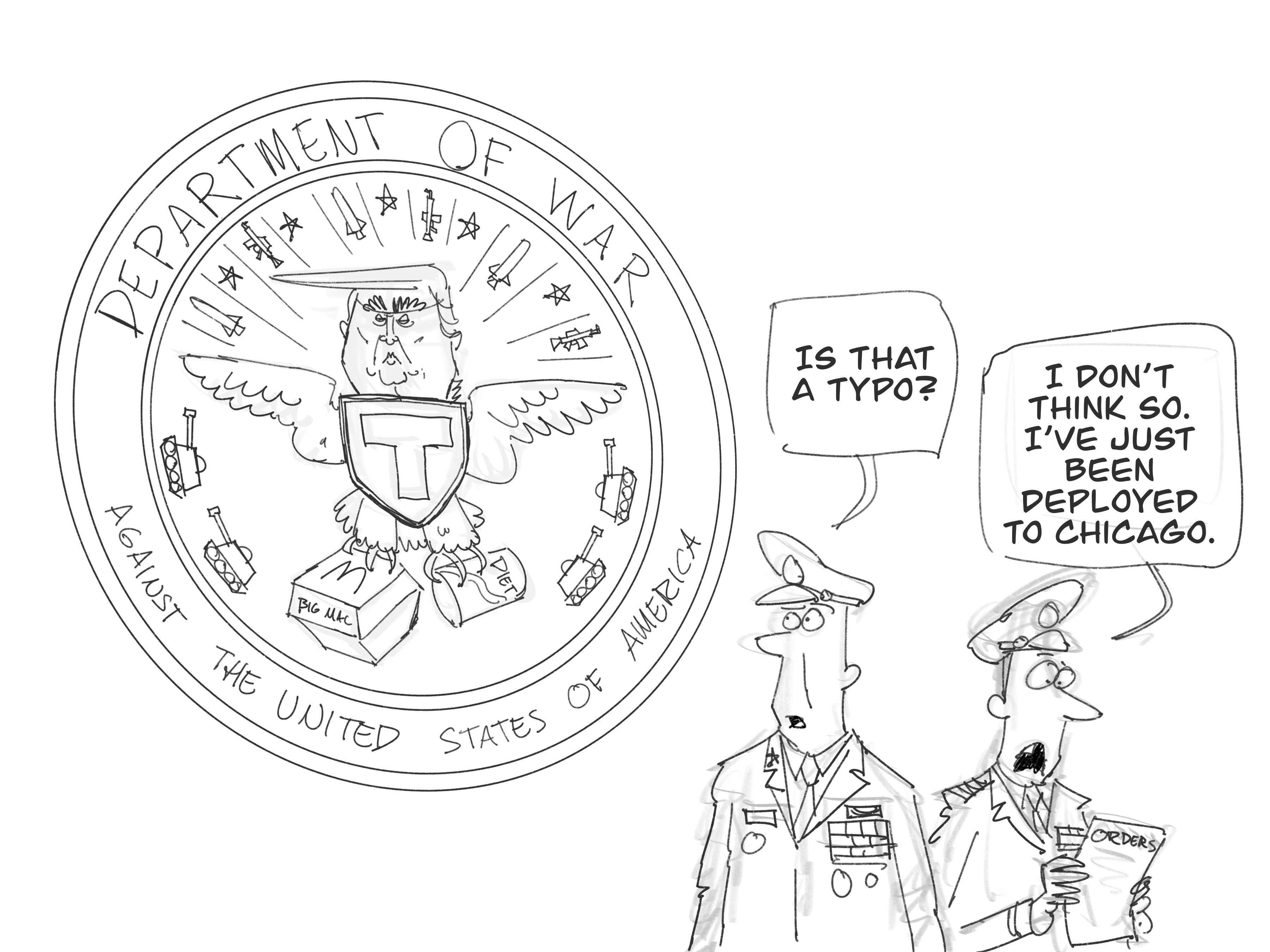
Welcome back, friends, to another behind the scenes look at my cartooning process. Let’s check our color swatches and check out last time’s rough sketches.
So you may have noticed I didn’t have a cartoon last week. Whereas I normally draw my Pepperspectives cartoons on Mondays, last Monday I was traveling home after spending five days at the Association of American Editorial Cartoonists convention in North Bethesda, Maryland.
I joined the AAEC in 2016 after I was hired by a Cincinnati TV station to be their full-time editorial cartoonist, and attended my first convention that fall. The AAEC is a professional organization dedicated to supporting cartoonists, promoting editorial cartooning as a whole, and protecting the First Amendment and freedom of speech.
As we’re all unfortunately aware, the world today is drastically different than it was nine years ago….