


By Joe Garofoli, Political Columnist March 31, 2026 (SFChronicle.com)
Gift Article
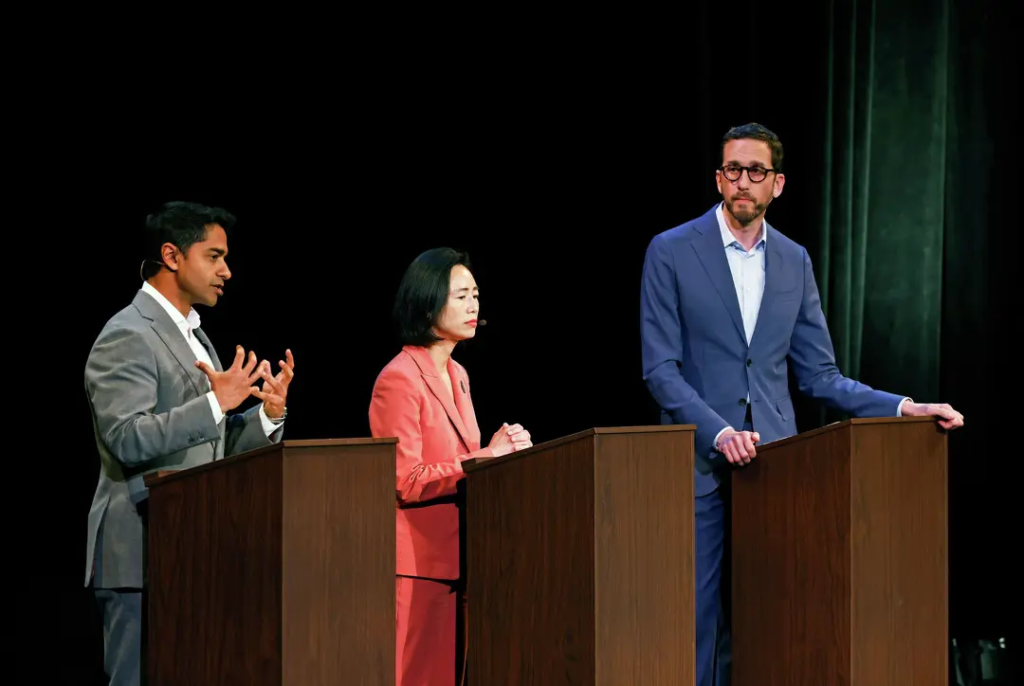
Candidates for San Francisco’s Congressional District 11 seat, from left, Saikat Chakrabarti, Connie Chan and Scott Wiener debate at the Sydney Goldstein Theater in San Francisco on Tuesday. Carlos Avila Gonzalez/S.F. Chronicle
The top three Democratic candidates vying to succeed Speaker Emerita Nancy Pelosi in Congress share broad agreement on most issues, but an hourlong debate Tuesday highlighted the differences that may decide the race.
San Francisco Supervisor Connie Chan, former congressional aide Saikat Chakrabarti and state Sen. Scott Wiener differ on how they’d approach the job, which is up for grabs for the first time in decades.
Chakrabarti, who was chief of staff to Rep. Alexandria Ocasio-Cortez, isn’t just running for Congress, the wealthy former tech company engineer said he’s running as part of a movement — candidates aiming to replace establishment Democrats with more progressive candidates intent on changing the system.
He sees himself as part of a wave of Democrats that is the culmination of a movement that started with the 2016 presidential run of Vermont independent Sen. Bernie Sanders. Chakrabarti worked on Sanders’ presidential campaign that year before running Ocasio-Cortez’s campaign that upset a top Democrat. He later served briefly as her chief of staff and helped write the Green New Deal environmental legislation.
“We don’t have a Democratic Party that fights,” Chakrabarti said, “and yes, I’m running to change the Democratic Party and that’s going to ruffle some feathers. So if you want someone who’s going to get along, to go along, then I’m not your guy. But if you want someone who’s going to go there and change the party, that’s what I’m offering.”
Wiener touted legislation he has spearheaded to make it easier to build housing and to regulate ICE as a sign of someone who could build coalitions to pass progressive legislation. He predicted Democrats would win back the House this year and the White House in 2028, but said it wouldn’t be enough to win. Democrats had to root out the reason why voters turned to Trump by showing that the government could solve the high cost of housing, health care and energy.
“These are all policy problems that government can fix. It hasn’t done it. I am the only candidate in this race who has a track record of actually delivering things and building the coalitions to do it. Talk is not enough,” Wiener said.
Chan touted her work on the Board of Supervisors in securing funds to insulate the city from the impact of Republican-crafted cuts to health care and other safety net services. Chan, who immigrated to San Francisco as a teenager from Taiwan, urged voters to send an immigrant to Congress to represent the city to “deliver a working-people’s agenda in Washington.”
The candidates differ slightly on U.S. policy on Israel.
Wiener said he would “not support the sale of offensive arms to Israel. I will not support funding for the destruction of Palestinian communities.”
Chakrabarti said the U.S. “should not be funding Israel’s military at all. Offensive or defensive weapons can be used for offensive weapons.”
The evening was peppered with references to ads that have been filling screens in recent weeks.
Wiener — and independent committees supporting him — have been pounding Chakrabarti for not being invested in San Francisco. In 2018, Chakrabarti purchased a $1.8 million home in Maryland, and signed documents listing it as his primary residence. Politico reported that Chakrabarti voted in San Francisco in 2010, then again in 2020, but not in between.
A pro-Wiener independent expenditure group called Abundant Future, whose funders include cryptocurrency billionaire Chris Larsen, Y Combinator CEO Garry Tan and Yelp CEO Jeremy Stoppelman, has been sending mailers to district homes that mimic a postcard with Chakrabarti’s image on it, saying, “Saikat Chakrabarti sends Greetings from Maryland.”
Chakrabarti pushed back Tuesday, saying he does not live in Maryland, and “the big problem is that (the ads are) being funded by cryptobillionaires, by tech VCs.”
But Chakrabarti’s challenge is more than his voting record or his residence. According to his own internal polling, only 55% of voters know him, compared to 92% that have an opinion of Wiener and 64% who know Chan.
Chan has racked up endorsements — including nods from the San Francisco Labor Council, National Nurses United and the California Teachers Association — but has struggled to raise money. She has raised $174,384 through the end of 2025, the most recent financial disclosure period, far less than Wiener ($2.7 million) or Chakrabarti, a centimillionaire who is largely funding his own campaign after being an early engineer at Stripe, an online payment company. He has loaned his campaign $1.5 million.
Chakrabarti criticized Wiener for not supporting a proposed state tax on billionaires, saying he was afraid of crossing his donors. (Chakrabarti and Chan support the tax.)
Wiener retorted that Chakrabarti “has spent more of his tech hedge fund money than everyone else combined, including outside campaigns.”
Wiener and Chan tiptoed slightly when asked where they disagreed with Pelosi over her nearly 40 years in office. Wiener said he would focus more on housing and AI policy that holds Big Tech accountable. Chan promised to focus more on immigration reform. Chakrabarti said he respected Pelosi’s pioneering work to get funding to treat the HIV/AIDS epidemic when she was first elected but said he differed with her in his support for Medicare for all and disagreed with her support of the nation’s military budget.
Each would be a “first” if elected. Wiener would be the first openly gay person to represent San Francisco in the House. Chan, who was born in Hong Kong and immigrated to San Francisco at age 13, would be the first person of Asian descent to represent San Francisco, which has a population that’s more than 30% Asian. Chakrabarti, the child of Indian immigrants, would be the first Indian American to hold the position.
Supporters of one Democratic candidate who was not invited to the debate, former Republican Marie Hurabiell, the director of the local moderate group ConnectedSF, protested her exclusion outside the debate. Hurabiell, whom President Donald Trump appointed to the Presidio Trust Board of Directors, has pledged to advocate for child care subsidies for low- and middle-income families, for a temporary $250-a-month boost in Social Security payments, and for cutting regulations to spur housing development.
March 31, 2026
Senior Political Writer
Joe Garofoli is the San Francisco Chronicle’s senior political writer, covering national and state politics. He has worked at The Chronicle since 2000 and in Bay Area journalism since 1992, when he left the Milwaukee Journal. He is the host of “It’s All Political,” The Chronicle’s political podcast. Catch it here: bit.ly/2LSAUjA
He has won numerous awards and covered everything from fashion to the Jeffrey Dahmer serial killings to two Olympic Games to his own vasectomy — which he discussed on NPR’s “Talk of the Nation” after being told he couldn’t say the word “balls” on the air. He regularly appears on Bay Area radio and TV talking politics and is available to entertain at bar mitzvahs and First Communions. He is a graduate of Northwestern University and a proud native of Pittsburgh. Go Steelers!


