By Joe Garofoli, Political Columnist April 5, 2026 (SFChronicle.com)
Gift Article
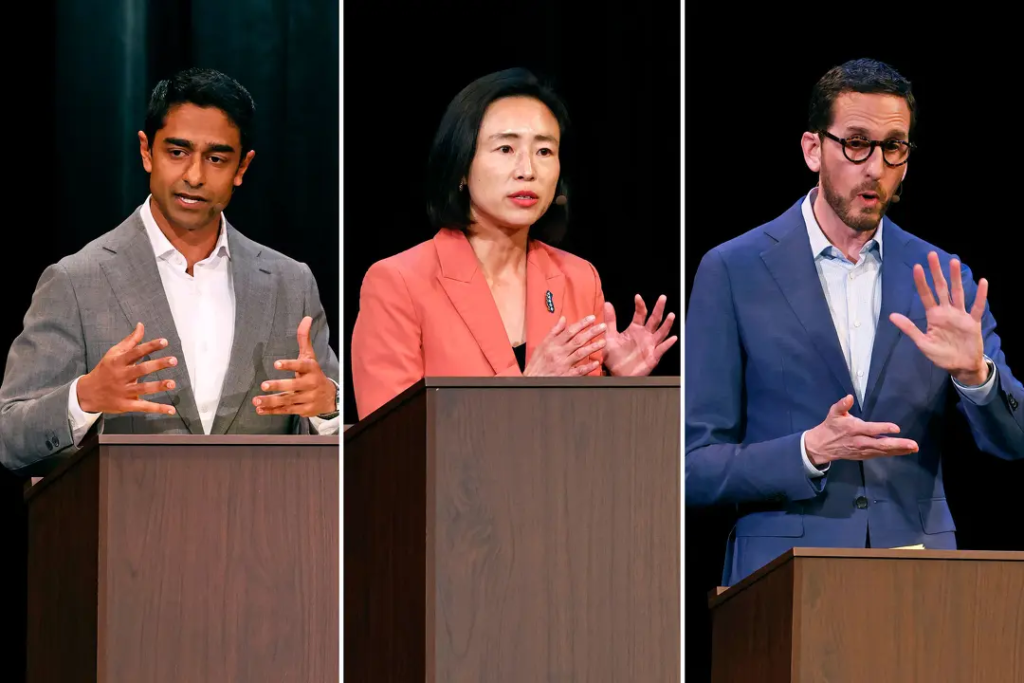
Saikat Chakrabarti, from left, promises to take on established Democrats while Connie Chan, center, and Scott Wiener would more often work within the party structure if elected.Carlos Avila Gonzalez/S.F. Chronicle
The top three Democrats running to succeed Nancy Pelosi largely agree on the main issues, but differ stylistically on how they would approach the job.
The question for voters is: How much do you want your next House member to focus on changing the system — and taking on their fellow Democrats?
Saikat Chakrabarti saw that approach succeed while chief of staff to Rep. Alexandria Ocasio-Cortez, D-N.Y. Like his former boss, Chakrabarti plans to challenge Democratic leadership by capturing media attention to push the party to take on corporate interests.
State Sen. Scott Wiener envisions doing “what I’ve always done,” whether it be as a rookie San Francisco supervisor or a newbie state legislator who had “never been in the Capitol before.” He’s a grinder.
“I learn the institution, and know how to deliver on housing, on health care, reducing people’s cost of living, sticking up for immigrant communities and LGBTQ people,” Wiener said Thursday at a candidate forum in Chinatown. Shortly after he was elected to the Legislature in 2016, he took on parts of organized labor — a major Democratic Party constituency — when he authored Senate Bill 35, which required local governments to streamline approval of some projects if the city hasn’t met its state-mandated housing targets. A 2023 analysis from the Terner Center for Housing Innovation found that the measure led to the approval of 18,000 units statewide.
“That’s what I’ve always done. I don’t just talk, I don’t just say nice-sounding things. I actually deliver, and that’s what I will do in Washington,” Wiener said.
San Francisco Supervisor Connie Chan falls somewhere in the middle of that spectrum. She points to how she “fought corporate Democrats on a local level,” notably in winning her supervisorial races over candidates funded by wealthy centrists, but adds that “I also am an institutionalist on the Board of Supervisors in that I’m a stickler to the rules.”
Chakrabarti’s pitch to voters requires them to make a leap of faith: That the centimillionaire former Stripe engineer who has never been elected to office will be able to land in Washington and kneecap the establishment. He maintains that taking on the calcified element there, and its corporate benefactors, is the only way to achieve long-term change.
“You have just a lot of pressure in D.C. to go along, to get along, to build up your career. Because the way it normally works is you go there, you say yes to leadership. You spend 40 years to climb up the ranks, and that’s why nothing changes,” Chakrabarti said.
He wants to change that dynamic.
Chakrabarti sees himself as part of a group of like-minded left-leaning candidates around the country who will “go to Congress together and fight against not just Republicans but corporate money and a corrupt Democratic establishment as well, to make real change happen,” he said.
But what if those fellow travelers that Chakrabarti envisions joining him in Congress don’t win? Given their outsider positions, most face uphill climbs.
One candidate, veteran and union leader Dan Osborn, running as an independent for a Senate seat in Nebraska, is in a statistical dead heat with incumbent Republican Pete Ricketts, scion to a wealthy family in a state that Donald Trump carried by 20 points. Osborn is hardly a sure thing.
Neither is Abdul El-Sayed, who is running for a Senate seat in Michigan. A poll last month showed him in second place in the state’s Democratic primary. Same goes for another potential Chakrabarti comrade, Utah state Sen. Nate Blouin, who is running second in that state’s House primary, according to a March Data for Progress poll, 13 points behind the leading Democrat.
Chakrabarti shrugged off the possibility that he may be traveling with a smaller posse to Washington, contending that “there’s also people inside Congress right now that I can organize with,” and pointed to progressive South Bay Democratic Rep. Ro Khanna teaming with Thomas Massie, R-Ky., to rally a bipartisan congressional majority to force the release of the Epstein files.
He also pointed to Ocasio-Cortez, for whom he served as chief of staff for several months shortly after she upset top House Democratic Rep. Joe Crowley.
Ocasio-Cortez “went in there by herself,” he said, captured media attention, including joining 200 young environmental activists from the Sunrise Movement in a 2018 sit-in in Pelosi’s office, and forced the Green New Deal, which Chakrabarti helped write, onto the agendas of the 2020 Democratic presidential candidates. Years later, then-President Joe Biden incorporated many elements of the proposal into his Inflation Reduction Act in 2022 and the Infrastructure Investment and Jobs Act (President Donald Trump’s budget, backed by the Republican-led Congress, eliminated many of those investments last year). Chakrabarti also worked as a top technology aide to independent Vermont Sen. Bernie Sanders’ 2016 presidential campaign.
However, despite Chakrabarti regularly mentioning his affiliations with Ocasio-Cortez and Sanders on the campaign trail, neither has endorsed him. Neither responded to requests for comment.
Chakrabarti told me he is “going through the process” of asking for their endorsements.
“I have a good relationship with AOC, but everyone has their own political process they go through for endorsements, and they’re huge national figures,” Chakrabarti said. “I believe that even without any endorsements, we’re definitely gonna get through the primary in this race, and we are going to be able to win the general. I think this is a change election, and I’m running as a change candidate.”
Yet even Chakrabarti’s internal polls show that he is trailing Wiener by 12 points. Voters receive their June 2 primary ballots in early May.
Chakrabarti said that he’ll keep his aggressive philosophy even if he wins and his compatriots in other states don’t. “You can fight as an individual,” he said.
“It’s just a different style of doing politics. Backroom dealing is not a way to get anything done inside Congress. It’s completely gridlocked. The way to get stuff changed there is you have to capture national attention, use that as political leverage on the inside, and then use that to build political capital and win on fights, especially ones where there’s a lot of consensus on what to do,” he said.
But first, Chakrabarti will have to convince voters to make that leap of faith that he’s the one to marshal that consensus.
April 5, 2026
Senior Political Writer
Joe Garofoli is the San Francisco Chronicle’s senior political writer, covering national and state politics. He has worked at The Chronicle since 2000 and in Bay Area journalism since 1992, when he left the Milwaukee Journal. He is the host of “It’s All Political,” The Chronicle’s political podcast. Catch it here: bit.ly/2LSAUjA
He has won numerous awards and covered everything from fashion to the Jeffrey Dahmer serial killings to two Olympic Games to his own vasectomy — which he discussed on NPR’s “Talk of the Nation” after being told he couldn’t say the word “balls” on the air. He regularly appears on Bay Area radio and TV talking politics and is available to entertain at bar mitzvahs and First Communions. He is a graduate of Northwestern University and a proud native of Pittsburgh. Go Steelers!