


By Sarah Brager, Staff Writer Aug 22, 2026
Gift Article (SFChronicle.com)
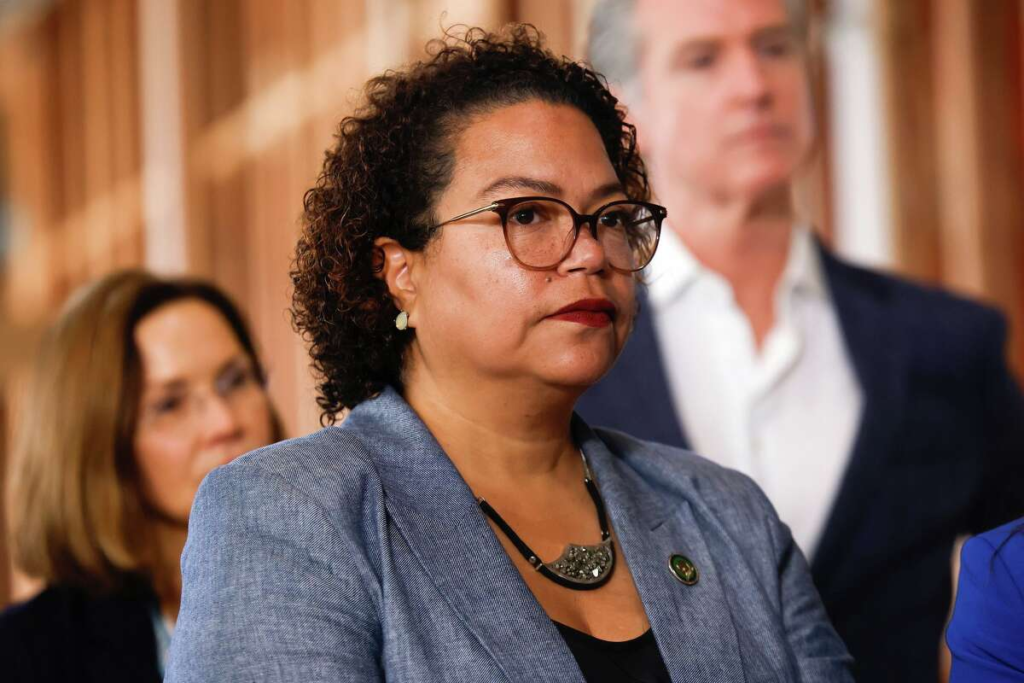
Assembly Member Mia Bonta attends a press conference alongside Gov. Gavin Newsom and California Health and Human Services Secretary Kim Johnson on March 2.Jessica Christian/S.F. Chronicle
Immigration nonprofit workers gained state protections from doxxing and targeted harassment after Gov. Gavin Newsom on Saturday signed a bill that expanded California’s Safe at Home program to include them.
Newsom signed Assembly Bill 2624 into law after months of vitriolic attacks from Republicans in California and Washington falsely claimed the legislation would obstruct journalists from uncovering fraud. Assembly Member Carl DeMaio, R-San Diego, an outspoken conservative lawmaker, nicknamed the bill the “Stop Nick Shirley Act,” a claim the right-wing online provocateur and other Republicans quickly seized on.
Assembly Member Mia Bonta, D-Alameda, introduced the bill in February after hearing reports of increased threats and harassment against immigration services providers. Newsom said in early February that Somali daycare providers in San Diego were “under siege” following Shirley’s arrival in the community to shoot content after viral videos he’d produced about Minnesota went viral.
The bill cleared the state Senate on Tuesday and passed the Assembly on Wednesday.
Effective Oct. 1, 2027, the new law expands a decades-long state program that shields the addresses of domestic violence survivors, elder abuse victims, and reproductive and gender-affirming healthcare workers.
“Our immigrant service providers are living in fear because of extremists looking to demonize the work that they do and the populations they serve,” Bonta said in a statement Saturday. “That is an intolerable consequence of the anti-immigrant rhetoric that exists right now.”
The Safe at Home program, in place since 1999, offers substitute mailing addresses to individuals who are particularly vulnerable to targeted attacks and violent threats. Saturday’s signing narrowly expands eligibility to include employees at nonprofits that serve people navigating the immigration system.
In April, testimony before the Assembly Privacy Committee revealed a surge of threats against the nonprofit workers, including hate calls and stalking.
“They were looking for me and ended up in my mother’s home,” Angelica Salas, executive director of the Coalition for Humane Immigrant Rights, told the committee. “There’s so many of my colleagues where individuals have shown up to their home, who have been threatened, and this is not just our organization, but many others.”
Bonta’s bill was considered uncontroversial until early April when DeMaio claimed it would intimidate people “trying to shine light on bad behavior,” referring to Shirley, a prominent YouTuber whose content includes following immigrant workers in blue cities and accusing them of committing fraud.
The bill even garnered attention in the U.S. Senate last month when Sen. Ashley Moody, R-Fla., referenced the “Stop Nick Shirley Act” in California, saying it should be called the “Protect Fraudsters Act.”
Bonta said in her statement Saturday the law does not conflate the press with the doxxing targeted by the Safe at Home program.
Individuals who are eligible for the Safe at Home program must apply through the secretary of state and document that they — or the organization they work for — have faced threats, harassment or violence within the past year. Once certified, the participants receive a substitute address that state and local agencies must accept in place of their real home, school or place of work, according to Bonta’s office.
Immigration nonprofits are eligible to apply beginning next October.
“I’m proud that with the signing of this bill California is rejecting that, even when people try to make us feel that the political cost of supporting immigrant communities is too high,” she added.
Aug 22, 2026
Staff Writer
Sarah Brager is a Hearst Fellow covering breaking news. Prior to joining the San Francisco Chronicle, she spent a year reporting hyperlocal news in Houston for Community Impact. Originally from the Austin area, her work has appeared in Texas Monthly, the Austin American-Statesman and on the radio for the Texas Standard/KUT News. Sarah graduated from the University of Texas at Austin, where she studied journalism and public policy.
How to reach Sarah
Email Sarah.Brager@hearst.com