


a Bigger Vision Films Nov 29, 2022
Documentary touts housing first as solution to homelessness
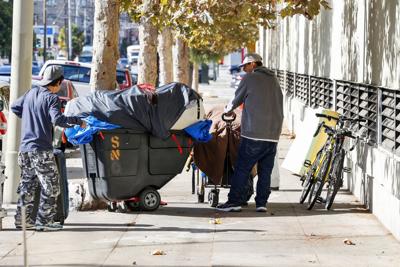

Local housing and homelessness organizations hosted a screening of a new documentary at UCSF on Tuesday, highlighting the causes and effects of homelessness and the different strategies used to address the crisis in cities across the country.
Don Sawyer and Tim Hashko, the filmmakers behind “Beyond the Bridge: A Solution to Homelessness,” traversed the nation, speaking with local officials, policymakers, advocates, and people currently or formerly unhoused.
The film is a follow-up to Sawyer’s 2015 documentary, “Under the Bridge: The Criminalization of Homelessness,” which focused on a tent encampment in Indianapolis.
Tuesday’s screening was followed by a panel of speakers that included licensed clinicians, homelessness advocates, and housing legal experts.
The film asserts that a housing-first strategy, in tandem with support services, is the most effective method of reducing homelessness in large cities. That strategy — which coincided with reductions in homelessness in cities such as Milwaukee and Houston — is still met with resistance in other parts of the country due to bureaucratic challenges, cost and other roadblocks.
Such obstacles are not unique to San Francisco, said Tramecia Garner, the executive director of Swords to Plowshares, an organization that helps place veterans in affordable housing.
“It is very challenging to build housing in San Francisco,” Garner said. “We’ve done a number of new housing projects that have taken at least five, eight years, sometimes 10, to make it happen.”
There are several factors in San Francisco that create those challenges, the panelists said, including negative narratives around the population that needs affordable housing, building requirements in California, and high rental costs in The City.
“We don’t have a problem with a lack of sufficient housing,” said Ora Prochovnick, the director of litigation and policy at the Eviction Defense Collaborative. “We have a lack of sufficient affordable housing … 80% of the evictions we defend are for non-payment of rent because the rent is too damn high.”
But even taking those issues into account, the solution is far less complicated than it needs to be, they argued.
“As it was stated over and over and over again in this documentary by people who have massively reduced homelessness, it’s a very simple equation: housing and resources together equals less homelessness,” said Whit Guerrero, a member of the San Francisco Homelessness Oversight Commission.
Housing — particularly affordable housing — is a pressing issue in The City. Last week, Mayor Daniel Lurie announced several new initiatives aimed at addressing the high rental costs in San Francisco and the rising tide of evictions.
They included expanding investment in the Tenant Right to Council program by an additional $3 million to provide full legal representation to hundreds of households that previously received only partial representation in their eviction cases, along with providing $27 million in local funding to cover households with expiring federal housing vouchers.
Lurie also allotted $1 million for a rights-education campaign to provide more informational outreach to renters and landlords about what their legal protections and responsibilities are, and he introduced an ordinance drafted by Supervisor Jackie Fielder that would provide further protections against eviction.
“San Francisco is in a rent emergency,” Lurie said at the Board of Supervisors meeting Tuesday.
“When San Franciscans sit down at the kitchen table at night, many are asking if they can still afford to live,” he said. “Rents are rising faster here than anywhere else in the country. We’re on track for the most evictions in nearly a decade, and with so few homes vacant and available for rent, people who lose their homes are struggling to find somewhere to go.”
Supervisor Danny Sauter introduced legislation Tuesday that would protect renters from exorbitant rent hikes by capping them at 10% annually until 2029.
Lurie said The City will also be focusing on building more housing, easing the permitting requirements for converting office spaces into housing. He said 300 such units are “in the pipeline.”
Lurie’s administration has prioritized recovery and treatment efforts in recent months, approving a new ordinance passed by the Board of Supervisors this summer that requires all new city-funded permanent supportive housing to be drug-free, with residents facing eviction otherwise.
That measure was met with opposition from housing and health-care advocates, who said that it goes against the state’s current standard of harm reduction in permanent supportive housing.
Shavonne Allen, an advocate for housing and substance-use recovery who is formerly unhoused, told The Examiner after watching the screening of “Beyond the Bridge” that she agreed with the housing-first approach.
That’s what worked for her, she said, when she was struggling with an addiction to heroin.
“There were outreach people that met me from Rams Peer Support, and I was eventually housed through a permanent supportive housing voucher,” Allen said. “That was where I was able to get stabilized.”
She said that once she felt stable in her living situation, she was comfortable finally seeking out other resources in the community that put her on the path to recovery.
Now, Allen is a participant in the San Francisco Department of Public Health’s Living Proof campaign, which highlights people’s addiction journeys in advertisements around The City.
She said that housing is what most people in her situation need. She said people who are experiencing mental-health challenges or processing other trauma might not have the capacity to accept help before they’re in safe places.
“Housing first with services are very important,” Allen said. “I feel like if we can bring back that message and help people understand that, maybe we would have some more success.”
“We’re in a battle right now between recovery first and housing first, and they don’t have to be pitted against each other,” she said.
Dennis McCauley, who is also formerly unhoused, said he struggled with substance-use issues before being offered housing through Swords to Plowshares. He said it was his second time watching the film, and that the housing-first model resonated with him as well.
“How are you supposed to get clean if you’re in a dirty living situation?” McCauley said.