Take Action by joining the All of US Nationwide Mobilization on June 27th, 2026. Join or Host an event near you(Events are being added so keep checking back or consider hosting one near you.)
Republicans have gotten away with it four times now, in a big way. Each time it was because Democrats didn’t realize — until it was too late — the crimes the GOP was willing to perpetrate just to seize and hold power.
This time, for the first time since 1968, it may be different.
In August of 1968, President Lyndon Johnson and Vice President Hubert Humphrey negotiated an end to the Vietnam War with both the North and South Vietnamese. Humphrey was running against Richard Nixon for president in that year’s election and planned to announce the deal in September or early October. He was running ahead and would’ve easily won the presidency with the peace deal.
Unfortunately, Nixon learned of the deal. His people reached out to the corrupt South Vietnamese administration and promised them riches if they’d refuse to go to Paris and sign the peace deal as planned. The FBI had been wiretapping the South Vietnamese and intercepted one of the conversations and handed it over to LBJ.
President Johnson called Everett Dirksen, the head of the Senate Republicans, and pointed out that Nixon was trying to “commit treason.” Dirksen agreed and promised that he’d reach out to Nixon to try to stop it. He failed, and Nixon went ahead and sabotaged the peace deal, leading to another ~24,000 American and ~400,000+ Vietnamese deaths before Jerry Ford ended the war in 1975.
Johnson told Dirksen that he didn’t want Americans to know that Nixon was committing treason to become president because he was afraid it’d shatter our faith in the American system; Dirksen agreed, and the secret went to their graves, only to be revealed to the public 25 years later when the LBJ library published the audiotapes of their conversations.
If Democrats had known, they could have shown up in the streets and stopped Nixon, but LBJ didn’t think there was enough time (he was probably right; Nixon would have just denied it and claimed it was a political hit job, fake news). So Nixon became president and, with his appointments of justices Harry Blackmun and Lewis Powell to the Supreme Court making it majority Republican for the first time since the 1930s, changed the course of American history.
Then it happened again.
In November, 1979, Iranian “students” took the US Embassy and its staff hostage. Two months later, Abolhassan Bani-Sadr was elected prime minister of Iran on a platform of “release the hostages and normalize relations with the United States.” President Jimmy Carter reached out to Bani-Sadr and the two of them began the process of organizing the release of the hostages.
As Bani-Sadr later told The Christian Science Monitor after he fled to America, that year Ronald Reagan was running against Carter for the White House and his campaign reached out to the mullahs, who were the real power base in Iran, and offered them a deal. They had all this US-manufactured military hardware the Shah had bought and they desperately needed spare parts and compatible missiles; Reagan would help cement the power of the radical new regime by selling them the weaponry they needed if they’d just help him become president by hanging onto the hostages until after the election.
Carter and Bani-Sadr knew the mullahs had suddenly turned against releasing the hostages but didn’t learn until 1981 that it was because the Reagan campaign had committed treason to humiliate Carter and win the 1980 election. Reagan became president, illegally sold the Iranians weapons for the next five years (Iran/Contra), and used the money to illegally fund neofascists in Central America. He then declared war on unions, cut taxes on the morbidly rich, cut education funding, and flipped us out of the New Deal that had built the American middle class, leading straight to today’s widespread poverty and oligarchy.
The hostages were released by the mullahs on January 20, 1981 when Reagan put his hand on the bible to be sworn into office — to the minute — by way of sealing the deal.
If Democrats had known before the election, they could have shown up in the streets and stopped Reagan, but nobody learned even the rough details for a year, and it wasn’t until former Texas Lt. Governor Ben Barnes made his confession to The New York Times in 2023 that we finally got solid confirmation from an American source. Reagan’s treason and 1980 election theft, then 43 years in the past, became a one-day story.
And then it happened again.
In 2000, Bill Clinton’s Vice President, Al Gore, was running against Texas Governor George W. Bush and the election was such a squeaker that it all came down to one state: Florida. Which was then run by George’s brother, Governor Jeb Bush.
Jeb ordered his Secretary of State (and the Florida head of George Bush for President) Katherine Harris to obtain a list of mostly-Black and Hispanic felons from George’s Texas penal system and run it against the Florida voter roll. The result was at least 10,000 — and by some estimates as many as 70,000 — mostly Black voters purged from the Florida voter list and unable to vote.
As a result, George W. Bush won Florida — and the presidency — by 537 votes. George’s father’s appointee to the Supreme Court, Clarence Thomas (whose wife was taking interviews for positions in George’s White House), was the deciding vote on the US Supreme Court to ignore/violate the 10th Amendment and stop the recount ordered by the Florida Supreme Court (which would have revealed how Jeb/Harris had rigged the election).
If Democrats had known at the time, they could have shown up in the streets and stopped Bush, but nobody learned even the rough details of the GOP election rigging for several months when BBC reporter Greg Palast broke the story to an international audience and, a year later, a recount done by a group of newspapers found that Gore would, indeed, have won the recount.
All of which brings us to today.
Trump is openly trying to rig this fall’s election, as multiple mainstream outlets have documented. He’s put “election deniers” willing to commit crimes against democracy into critical positions, crippled the two offices in the Executive branch responsible for election integrity, ordered the Post Office to refuse to carry ballots in Democratic-run states with mail-in voting, is positioning ICE agents to intimidate voters, launched a national gerrymandering campaign, and has a handful of other threatened sleazy actions.
Republicans want to outlaw married women voting if they haven’t gone before a judge to change their last names (the SAVE Act), and Trump is trying to build a national voter database — in defiance of the Constitution — so he can help Red states with Blue cities purge their Democratic voters.
Unlike with Nixon, Reagan, or Bush, however, this time we know. We can see this coming. They’re doing much of it right out in the open. And that’s a huge advantage that we all must prepare for.
If it’s true that Trump became president in 2016, as Robert Mueller’s investigation found, because of major help from Putin, then the last legitimately elected Republican president who didn’t commit or at least flirt with treason was Dwight D. Eisenhower (1953-1961).
By coincidence, he was also the last Republican president to reject the influence of America’s oligarchs and instead kept the top 90% income tax rate on oligarchs and actually worked to increase union membership and expand Social Security.
So, get ready. We know in advance at least some of the dirty tricks they’re going to try to pull. Musk and Zuck spinning their social media outlets; Fox, CBS, and CNN under oligarch’s thumbs; ICE disruption; seized ballots; corrupted mail; and now realistic, highly deceptive AI-generated Republican deepfakes are already appearing in the Texas senatorial election.
It’s going to get worse — these guys are now legitimately afraid of suffering the same fate as Nixon’s Attorney General John Mitchell (who went to prison) — but, once again, this time we can see it coming.
In a potential boon to San Francisco Supervisor Connie Chan’s congressional campaign, centimillionaire Saikat Chakrabarti has endorsed her candidacy and is converting his campaign committee to support her against state Sen. Scott Wiener in the race to succeed U.S. Rep. Nancy Pelosi, a Chakrabarti spokesperson said.
Chakrabarti — who finished behind Chan in the June 2 primary election despite having loaned or contributed nearly $10 million of his own money to his campaign — changed the name of his election campaign committee to the SF Solidarity PAC, an independent-expenditure committee, according to federal filings.
The former candidate had made offers to about 220 campaign employees who could work on Chan’s behalf as part of the independent effort, said spokesperson Nate Albee.
“What it comes down to for Saikat is about changing the direction of the Democratic Party,” Albee said. “As it currently stands, the party has been co-opted by corporations.”
Chan has committed to not taking money from corporate political-action committees, among other entities.
Chan campaign spokesperson Julie Edwards provided a statement in which Chan said she welcomed Chakrabarti’s endorsement.
“Together, we can stand up to corporate power and bring the voices of working families to Washington,” said Chan, who was first elected supervisor in 2020.
With almost all of the ballots from the election counted Monday, Wiener — a former San Francisco supervisor and a state legislator of nearly 10 years — won first place, with 95,720 votes, or 40.73%. Pelosi’s 11th Congressional District covers all but a southern chunk of The City.
Chan — who got Pelosi’s coveted endorsement on May 18, late in the primary race — came in second place with 69,823 votes, or 29.71%. Chakrabarti came in third with 41,990 votes, or 17.87%.
The results showed Wiener was dominant in most of The City, but Chan was particularly strong in the heavily Asian American Richmond and Sunset districts, according to data on the website Election Map.
Although Chakrabarti leveled far more broadsides against Wiener ahead of the primary election, Wiener campaign spokesperson Joe Arellano provided a statement Monday pointing out that Chakrabarti had criticized Chan on the stump.
Although he’s trying to become the first Republican to win the office in more than 50 years, he’s touting his expertise over party ties
“Now he’s endorsing her?” Arellano said. “This is the cynical politics that voters hate.”
“Connie Chan has built a career on blocking housing and affordability for young people — the same voters Saikat claimed to speak for,” Arellano said. “With this move, it’s clear that Saikat never cared about what’s best for San Francisco. He was only in the race to stroke his massive ego.”
Both Chan and Wiener have been highlighting endorsements, with Wiener recently issuing a press release touting the fact that six of The City’s 11 supervisors, among others, have backed him.
Charkrabarti is a progressive activist who made a fortune as an early software engineer at the payments company Stripe. He loaned or contributed at least $9.9 million of the $10.3 million his campaign raised in the leadup to the election.
He paid some canvassers as much as $45 per hour, and his campaign said it built “one of the largest field operations in recent San Francisco history,” knocking on nearly a half-million doors as part of “a grassroots movement.”
Chan bested Chakrabarti in the primary despite declaring her candidacy relatively late, on Nov. 20, and had raised about $700,000 by the time of the election. Wiener raised about $4 million.
Chan’s campaign posted a video Sunday evening on social media featuring Chakrabarti bequeathing his endorsement while the two sat at a table at Joe’s Ice Cream in the Richmond district.
A co-founder of economic-policy think tank New Consensus, Chakrabarti said he and Chan agreed on “the most important issue right now, which is that if we actually want to create a society that works for working people, we have to break the stranglehold of corporate money in Washington.”
Chan responded, “Not only we have to break that stronghold, the corporate stronghold, but we also need to make sure we have progressive taxation, that billionaires and their corporations pay their fair share.”
Chakrabarti praised Chan for supporting “a wealth tax on the ultra rich, and you’ve been really clear that you’re going to stop sending endless bombs abroad, spending billions on wars and on genocides, and instead invest that back home here in housing, health care, and education.”
“We look forward to working together to make sure we stop [President] Donald Trump’s $1.5 trillion on war and making sure that money we bring that back and to invest in health care and public education,” Chan said.
Are you are a San Francisco voter glad that the June campaigns are finally over? Enjoy the brief break. The November campaigns are already in high gear and the Wiener-Chan congressional race could trigger three hotly contested special elections in 2027.
Here’s our breakdown of the likely contests.
State Senate/D1 Supervisor
If Connie Chan wins, a special election will be held for her D1 seat. Mayor Lurie will pick Chan’s replacement. The appointee will then face a Special Election.
The mayor will assuredly appoint a moderate supervisor who would be part of Team Lurie. We’d see the same combination of Lurie’s endorsement and the influx of Big Money we saw in Alan Wong’s D4 race D1 voters would probably see even more of Lurie on the campaign trail, as no moderate has won D1 since district elections returned in 2000.
Scott Wiener led the field in June. If he moves on to Congress, Assembly member Matt Haney plans to run for Wiener’s seat. Haney would face Christine Pelosi, who has already announced plans to run when Wiener’s term expires in 2028. His elevation to Congress would move Pelosi’s race to 2027.
Haney v. Pelosi
A Haney-Pelosi State Senate race would cover all of San Francisco.
I confirmed Haney’s State Senate plans with multiple sources because I assumed he would be happy to stay in the Assembly until 2034. Haney has never lost an election. He was elected to the School Board in 2012, the D6 Supervisor’s seat in 2018 and the Assembly in 2022.
Haney didn’t just defeat former Supervisor David Campos in the April 2022 Special Election; he trounced the progressive Campos 63%-37%. This was in the Assembly district that covers most of the city’s progressive electorate.
Haney offers a record of political success against a candidate who has never faced voters. That would normally lead to a Haney walkover. But Christine Pelosi is not a normal candidate.
Pelosi’s strength goes beyond being the daughter of the city’s most popular emeritus politician. She has carved out her own support among labor and progressive groups through years of work with the California Democratic Party.
A lack of name recognition often holds first-time candidates back; it’s not a problem for Christine Pelosi.
If Wiener wins and a Haney-Pelosi special election happens, the contest will dominate San Francisco politics. It will be a true “which side are you on” moment for the city’s progressives. I see most going with Pelosi, particularly given how much Nancy Pelosi is helping Connie Chan.
If Haney Wins: The Assembly Special Election
If Haney defeats Pelosi there will have to be a special election to fill his Assembly seat. Board President Rafael Mandelman has long made it clear he plans to run for Haney’s seat if it is vacated. Mandelman has an Assembly campaign website and his campaign kickoff occurs on June 17.
Mandelman is termed out in November. So he can freely campaign for another office. The same is not true for a candidate that multiple sources have told me is set to run against Mandelman —D5 Supervisor Bilal Mahmood.
If it seems odd that Mahmood would run for Assembly before serving a full term as supervisor, that’s precisely what Haney did. Voters did not mind. The special Assembly election would likely not occur until November 2027.
So while the November 2026 elections have tremendous national significance, San Francisco voters could find themselves even busier with elections between Democrats in 2027.
It’s also possible that a special election to replace D9 Supervisor Jackie Fielder could occur in 2027. Reports have her leaving office soon, with the special election more likely this November.
Local political consultants could see 2027 as a banner year. The same is true for those who write about political campaigns.
Randy Shaw is the Editor of Beyond Chron and the Director of San Francisco’s Tenderloin Housing Clinic, which publishes Beyond Chron. Shaw’s new book is the revised and updated, The Tenderloin: Sex, Crime and Resistance in the Heart of San Francisco. His prior books include Generation Priced Out: Who Gets to Live in the New Urban America. The Activist’s Handbook: Winning Social Change in the 21st Century, and Beyond the Fields: Cesar Chavez, the UFW and the Struggle for Justice in the 21st Century.
Public Citizen is taking legal action to stop the Trump regime from weaponizing the United States Postal Service and preventing eligible voters from voting.
Here’s a bit of history for anyone who wasn’t getting our emails during Donald Trump’s first term:
In July of 2020, the Republican mega-donor that Trump had installed as postmaster general announced a bunch of changes that resulted in substantial mail delays.
All across the country — in small towns and big cities alike — folks went days or even weeks without mail service. They missed out on birthday cards and graduation announcements, letters from family members serving overseas, magazine subscriptions, and much, much more.
People also missed even more important mail, like benefit checks and essential medicines.
And because the changes were made during the pandemic, when more voters were relying on mail-in voting, the delays threatened to prevent timely delivery of untold numbers of ballots.
Public Citizen — representing the NAACP and co-counseling with the NAACP Legal Defense and Educational Fund — sued.
In that lawsuit, we made the case that the service disruptions instituted by Trump’s handpicked postmaster general should be suspended to restore prompt, reliable mail delivery and to ensure priority status for mail-in ballots (as had been the practice in past years).
As a result of our lawsuit — including a preliminary injunction and emergency motions we fought for — the service disruptions were put on hold and there were minimal delays with mail-in ballots throughout the elections that November.
We pressed forward with the lawsuit. In December of 2021, the Postal Service agreed to a series of critical measures to safeguard the delivery of mail-in ballots through the 2028 general election.
That brings us to this year.
On March 31, Trump — who wrongly believes that mail-in voting is rife with fraud (it is not) and inherently unfavorable for Republican candidates (also not) — issued an executive order directing the USPS to implement ludicrous rules for mail-in ballots that would disenfranchise countless eligible voters.
In essence, Trump wants the Postal Service to act as some kind of “election gatekeeper,” deciding who it will and will not deliver ballots to. This plan violates both the law and the settlement in our case.
So we have returned to that lawsuit, asking the court to enforce the settlement — which, again, the USPS agreed to and which requires it to prioritize the timely delivery of election mail to all voters without exception.
As Allison Zieve, the head of the legal team here at Public Citizen, put it, “Voting is fundamental to democracy. That the Trump administration would direct the Postal Service to adopt measures to impede voters from casting their ballots is shameful. And that the Postal Service would allow itself to be used for political purposes to advance the president’s irrational objection to mail-in voting is unlawful and contrary to the commitments it made to settle our lawsuit.”
We’ll keep you updated on how this case — and all of our lawsuits against the Trump regime — are going.
Together, real estate investment trusts (REITs) AvalonBay Communities and Equity Residential own more than 180,000 apartments nationwide, with another 20,000 under development. Were these two companies banks or broadcast networks or grocery stores, their merger would face mandatory review by federal regulators. But long-standing loopholes exempt real estate mergers from antitrust scrutiny—even as concerns mount about the consolidation of housing in the hands of large investors.
Equity Residential and AvalonBay are among dozens of investors that have already been accused of acting as a “cartel” to inflate rents during the pandemic, costing tenants billions. Just weeks before the two companies announced their planned merger in May, Equity Residential agreed to pay $56 million to resolve a class action antitrust lawsuit brought by renters. The company denied wrongdoing but also agreed to refrain from sharing private pricing data with RealPage, the tech company facilitating the alleged price-fixing conspiracy. AvalonBay still faces antitrust and consumer fraud claims involving RealPage, brought by the Washington, D.C., attorney general.
While the RealPage scandal thrust a novel antitrust issue—collusion by algorithm—into the spotlight, anti-monopoly advocates warn that ordinary mergers between rival firms remain a time-tested strategy to squeeze consumers.
“Instead of drawing on your number one competitor’s comps to set your prices, you just buy your competitor,” says Renee Tapp, an assistant professor of planning at the University of North Carolina who researches concentration in the rental market. In public comments to federal antitrust enforcement agencies submitted last month, Tapp called for stricter scrutiny of real estate mergers.
For decades, federal policy has effectively encouraged consolidation in the housing market.
Through a sweeping analysis of nationwide property data, Tapp discovered that the merger between Equity Residential and AvalonBay will create effective monopolies in at least seven communities, potentially handing the new company more power to hike rents and trample tenant rights.
That could look something like what played out in East Palo Alto, California, after Equity Residential gained ownership of more than half of the city’s multifamily rental housing market in 2011.
In subsequent months, Equity Residential sent tenants more than 1,000 “pay or quit” notices, many of them seeking rents higher than the maximum allowable under the city’s rent control regulations. The company’s representatives then began working behind the scenes to challenge enforcement of those regulations, even briefly wrangling a vice chair seat on the city’s rent stabilization board.
Monopolies in rental housing have “the same effect as any other monopoly—only in this case, it’s monopolization of something that’s a human right,” says Margaret McBride, a managing attorney at Community Legal Services of East Palo Alto, where she worked with Equity Residential tenants facing evictions and increased fees.
“People don’t have an option to pick up and go somewhere else that’s still close to their family or their kids’ schools or their jobs,” she continues. “So they’re just stuck with a landlord who’s not respecting their rights.”
FOR DECADES, FEDERAL POLICY HASeffectively encouraged consolidation in the housing market, including through mortgage giants Fannie Mae and Freddie Mac’s post-2008 fire sales of foreclosed homes to investors.
But with some two-thirds of renters now struggling to afford basic needs, cracking down on corporate landlords makes for good politics. A rare bipartisan effort under way in Congress aims to stop Wall Street landlords from continuing to gobble up single-family homes, following a January executive order that also directed federal agencies to combat speculation and anti-competitive behavior in the single-family rental market.
Foreclosed houses are not the only properties in Wall Street landlords’ portfolios, however. Some three million apartments—about 1 in 8 nationwide—are now owned by private equity firms, according to an analysis by the Private Equity Stakeholder Project.
“Corporate landlords are invested in all sorts of housing beyond just single-family homes, and we desperately need federal policy interventions that address that reality,” says Sam Garin, the group’s senior communications coordinator.
Credit: Pavlo Gonchar/SOPA Images/Sipa USA via AP Images
The standard refrain from those corporate landlords—along with neoclassical economists and liberal policy wonks—is that even the largest firms still own just a small percentage of properties, leaving them with little power to set prices.
That’s true enough, if you look nationwide. But housing markets are inherently local, and recent empirical research suggests that when ownership is concentrated at the neighborhood level, landlords also enjoy considerable power to set rents—even without the help of price-fixing.
Through a flurry of mergers since the 2008 financial crisis and the establishment of rental real estate as an asset class, Wall Street landlords have been able to “leverage their market power to extract greater surplus from renters,” according to a 2023 study published in The Review of Financial Studies.
IF EQUITY RESIDENTIAL AND AVALONBAY merge, just how much market power would the new, combined company have?
To estimate that, Tapp examined the 25 real estate submarkets where both companies are already operating and compared their pre- and post-merger market share. She found that in seven of those submarkets, the new entity’s market share would exceed 30 percent—the threshold at which a merger is presumed to have anti-competitive effects, according to a landmark 1963 Supreme Court ruling.
In subsequent decades, federal courts abandoned that standard as antitrust enforcement waned. But the 30 percent benchmark was revived in 2023, when the Department of Justice (DOJ) and Federal Trade Commission (FTC) issued new merger guidelines as part of a more aggressive anti-monopoly agenda under President Joe Biden.
The 2023 guidelines—which are still in effect—consider both how much a merger would increase concentration and the total market share afterward. By both of those measures, according to Tapp, the seven submarkets she identified meet the threshold for antitrust scrutiny. Future acquisitions could easily put at least five other submarkets above that threshold, and Tapp says her estimates are likely conservative, given that she only examined existing properties in markets where both companies are already operating.
“In my mind this is irrefutable,” Tapp says. “This meets the definition of a monopolistic market, according to the FTC and DOJ’s own guidelines.”
AvalonBay did not respond to a request for comment.
Marty McKenna, a spokesperson for Equity Residential, said in a statement that one of the merger’s goals is “providing residents more choices and building more units.” He added that in markets where the two companies operate, their combined footprint represents less than 2 percent of available rental units.
McKenna did not respond to questions about how the company defines a “market” or the merger’s potential anti-competitive effects on the seven submarkets identified in Tapp’s property data analysis, including Los Angeles’ Little Tokyo.
IN LOS ANGELES, IT’S ALREADY DIFFICULT to find an apartment not owned by a corporate landlord, says tenant Alicia Yu.
Yu moved into a studio apartment owned by Equity Residential in 2024, immediately after living in a two-bedroom owned by AvalonBay. Yu had hoped the downgrade would cut her housing costs, but while her base rent has gone down, she says monthly fees charged by Equity Residential have soared—including a $100 parking fee that she claims wasn’t disclosed during her property tour, as well as variable building utility fees that add at least another $100 each month on top of her individual utility bills.
The news of a merger between her current and former landlords, which Yu received by e-mail last month, was alarming. Tenants in her building are already contending with maintenance issues like “constantly broken” elevators, Yu says, and she worries the problems will worsen if her landlords know that tenants effectively have nowhere else to go.
“To think of them getting even larger and managing even more properties—we’re going to be such a small speck in their brains,” Yu says. “They’re able to get away with overlooking these things that to them are very small and minute, but to us, we’re experiencing them on a daily basis.”
Equity Residential and AvalonBay share a business model built on nickel-and-diming tenants, according to Alex Ferrer, an organizer with the Debt Collective, a national organization that has fought to cancel billions in student and medical debt.
Equity Residential and AvalonBay share a business model built on nickel-and-diming tenants.
The group is now taking on the growing problem of “rent debt,” as tenants increasingly find themselves hounded by collection agencies, even after evictions, over unpaid balances inflated by myriad fees.
Last fall, Ferrer helped launch a reporting tool that tenants can use to dispute rent debts owed to corporate landlords, particularly those based on potentially abusive or deceptive practices. More than 100 AvalonBay and 60 Equity Residential tenants used the tool last year, allowing Ferrer to identify patterns, such as bathtub “reglazing fees” regularly tacked on by both companies after move-out.
Equity Residential’s billionaire co-founder, Sam Zell, was an early proselytizer for boosting revenue by charging tenants junk fees on top of rent. It quickly became a mainstay strategy of corporate landlords: In 2024, the FTC reached a $48 million settlement with the rental giant Invitation Homes over undisclosed, mandatory fees that were costing renters more than $1,700 annually, according to the agency.
Federal judges have already struck down Equity Residential’s up-front “amenity fee” in Massachusetts and its 5 percent late fee in California. But new fees have taken their place. Both Equity Residential and AvalonBay currently charge tenants monthly surcharges based on the “ratio utility billing system” (RUBS) used in Yu’s building.
RUBS subdivides building-wide utility usage according to an opaque formula that tenants aren’t privy to, raising suspicions that landlords are using the system to disguise rent increases and circumvent rent control laws in states like California. Equity Residential reported earning more than $100 million from RUBS fees in 2025.
Last year, the Debt Collective and the Los Angeles Tenants Union began organizing with Equity Residential tenants against gratuitous fees, aggressive evictions, and other practices the groups believe will intensify if the firm controls even more of the market.
“The junk fees, RUBS, all these things are part of their business strategy, which relies on their ability to impose unfavorable contract terms,” Ferrer says.
Ferrer also notes that in recent years, the two landlords have also spent millions to defeat the expansion of rent control and other pro-tenant ballot measures in California. “They’re financing that with their monopoly power,” he says.
ANTITRUST REGULATORS LARGELY IGNORE the rental market, thanks in part to the explicit exemption of rental property acquisition from premerger review, a key enforcement tool established in 1976. The real estate loophole has been in place ever since, but there’s a chance that could soon change: The FTC and DOJ are currently considering improvements to the review process, including elimination of the exemptions for rental investment properties and REITs.
There’s a catch though: The agencies are undertaking a new rulemaking process because, earlier this year, a Texas federal court struck down new premerger review requirements finalized during the Biden administration, which drew a legal challenge from the Chamber of Commerce and other business groups.
Laurel Kilgour, research manager for the anti-monopoly watchdog American Economic Liberties Project, says that while the possibility of eliminating real estate exemptions is “a silver lining,” the prospect of the agencies going back to square one is concerning. The longer rulemaking takes, she says, “the more [merger] transactions that are going through without sufficient scrutiny.”
Meanwhile, real estate lobby groups remain staunchly opposed to stronger regulatory scrutiny. In a comment submitted to the federal agencies, Nareit, a trade group that represents REITs including Equity Residential and AvalonBay, argued that real estate transactions remain “unlikely to violate the antitrust laws,” adding that the group is “unaware of any relevant geography that is highly concentrated by owner.”
Nareit did not respond to a request for comment on Tapp’s finding that a merger between Equity Residential and AvalonBay would create at least seven highly concentrated submarkets.
During a May conference call about the merger, Equity Residential President Mark Parrell told analysts that while the merger wouldn’t be subject to an antitrust review, the company was preparing for a “PR battle.”
Should the deal be approved by stockholders later this year, the companies say they expect to save $175 million in costs within the next 18 months.
While Parrell told participants that the deal was “not about getting bigger just to be bigger,” he noted that Equity Residential and AvalonBay had already successfully teamed up to acquire tens of thousands of apartments from the bankrupt Lehman brothers—a 2011 deal that, along with the purchase of 1,800 foreclosed units from Wells Fargo, put Equity Residential in control of more than half of East Palo Alto’s apartments.
Preschool teacher Javanni Brown was living in one of those apartments when, while her husband was out of work, she found herself late on rent.
Brown’s existing lease stipulated a small late fee—which she paid, along with her full rent, four days after the grace period, according to a class action lawsuit later filed against the company.
But when her balance due continued to increase in subsequent months, Brown learned that the late fee had increased—and that the company was also “stacking” new late fees on top of past unpaid ones, both allegedly without notice to tenants.
“I said, ‘Wait a minute, that doesn’t make any sense, because that kind of practice doesn’t let people actually come up for air,’” she recalls.
A federal judge ultimately struck down Equity’s late-fee policy, which charged tenants the greater of 5 percent or $50, as an unlawful business practice under California law. Equity agreed to a $43 million settlement, and some 200,000 California tenants who were charged late fees are set to receive restitution this year. But the legal process took more than a decade.
In states like California, where the merger might have outsize impact for tenants in some local markets, state attorneys general have the power to bring their own actions, even in the absence of federal enforcement, notes Kilgour.
That wouldn’t be dissimilar to the coalition of six attorneys general that joined a federal action to successfully halt the merger of Kroger and Albertsons grocery stores, Kilgour says, but “this is an even stronger overlap of geographies.”
Rather than leaving the ball in the Trump administration’s court, says Ferrer, action to stop the merger could also represent “a populist political opportunity for Democrats … to protect renters by taking on actors that are very powerful and incredibly unpopular.”
Rebecca Burns is the housing editor at In These Times and an award-winning investigative reporter whose work has appeared in Business Insider, the Chicago Reader, The Intercept, ProPublica Illinois, and other outlets. More by Rebecca Burns
State Sen. Scott Wiener and writer Ezra Klein, who popularized the ‘Abundance’ movement. The ‘Abundance’ agenda the tech lords are talking about is scary. Photo via Facebook.
Their manifesto makes clear that leaders like Zack Rosen, a founder of California Yimby, think that powerful elites should be shaping policy, not the rest of us. Their dismissal of grassroots democracy is stunning:
Small dollar internet fundraising makes politics dumber. The old gatekeepers were political professionals who could count cards; small dollar donors today are amateurs yanking the handles of ActBlue slot machines.
A few Silicon Valley titans have funded this new group to the tune of between $40 million and $260 million—a year. That money is going directly into local and state politics, including in San Francisco.
From the Prospect:
All this money, unsurprisingly, has generated some success. The documents credit abundance organizations with having “Flipped San Francisco Democratic Party, Flipped San Francisco Board of Supervisors … [and] Flipped Santa Monica City Council.” The ousting of former district attorney Chesa Boudin in 2022 is celebrated in Rosen’s pitch as “a major accomplishment.”
Oh, and state Sen. Scott Wiener and his allies are a central part:
We built our San Francisco operation with Scott Weiner’s policy and political team: Maggie Muir: Ours and Scott’s political consultant. Todd David: Ours and Scott’s S.F. political director. … Annie Fryman: Ours and Scott’s former Land-Use policy leader. Andres Powers: Ours and Scotts and Breed’s former Director of Policy. Jeff Cretan: Ours and Scotts and Breed’s former Spokesperson We helped organize the Moderate faction that has taken power in the city alongside NorCal Carpenters, Neighbors, GrowSF, and SFYIMBYs.
The story is all over the Internet and some social media. It’s missing from the pages of the New York Times, the San Francisco Chronicle (which really should cover a hometown story) and most of the rest of the US media.
It is the clearest evidence to date of what some of us have been saying for a long time: Big Tech, with the help of Big Real Estate, are installing their political allies in local government and using vast sums of money to defeat progressive ballot measures and candidates.
One thing is missing from the Prospect story, and it’s critical: These folks don’t just want to have their friends of the Board of Supes. They have a far-reaching political agenda, and they are willing to spend whatever it takes to make that agenda the law of the land.
Sponsored link
It goes way, way beyond changing local zoning laws.
Let’s start with Rosen’s analysis of US history.
He talks of how the industrial elites made the US much better before and after World War II:
Industrial leaders were key to this work. Practitioners who figured out how scale industry were needed to help retrofit modern management systems to government, and replace the agrarian era institutions of “courts and parties” with a modernized government that could support an industrialized civilization. Civil service finally brought professionalized management to government, the efficiency movement brought in bookkeeping and inventory management etc. Most importantly, the progressive movement scaled power only when industrialists brought their financial and social capital to bear on the institutional problems blocking progress.
More:
For the left it was a quick fall from the sudden assassinations of JFK and MLK, to the disaster of Vietnam, to the embarrassment of Watergate that took the heart out of government. From there, the left took the downslope of NIMBYism post-riots and sealed our cities in amber, and fled urban cores for the suburbs on federal subsidy; housing was made illegal, and urban public education systems were abdicated. Proceduralist kudzu overgrew the gears of government.
The idea that the left made housing “illegal” is simply untrue. Read this excellent history of San Francisco zoning by Fernando Marti, and you will learn that much of the “downzoning” that the Yimbys complain about was sponsored in the early days (1920) by racists, and in 1978, a consequential moment, by the likes of then-Sup. Dianne Feinstein, who by no means could possibly be considered a “leftist.”
Much of the political establishment, from Dianne Feinstein on down, supported the 1978 rezoning. It wasn’t just realtors and property value neighborhood associations who advocated for height and density limits. On the East Side, many community-based organizers — fighting both urban renewal and the federal “Model Cities” programs — looked to rezoning for the possibility of stemming displacement by limiting demolitions. And small business owners looked to the zoning code as a way to prevent the encroachment of banks and restaurants that were causing increasing commercial rents and pushing out the small groceries and hardware stores from the neighborhoods.
And Rosen misses perhaps the most critical point in the history of post-War America: The very rich were, indeed, interested in philanthropy, which this generation of billionaires mostly is not. But there weren’t that many very rich—because FDR realized in 1932 that if the nation didn’t address economic inequality, he could be facing a revolution.
By 1935, the top marginal tax rate went from about 20 percent to 62 percent. In 1945, it was 81 percent. In 1953, it went up to 90 percent. That paid for the New Deal, and later, things the Abundance Agenda claims to want, like the interstate highway system and the University of California, where for years tuition was free.
It also prevented massive wealth accumulation that would destroy the middle class and undermine democracy.
It lasted until the Reagan Era.
According to the RAND Corporation, if the tax rates today were the same as 1975, the bottom 90 percent would have an additional $70 trillion.
That, more than zoning, explains homelessness, housing costs, poverty, poor outcomes from public education, and so much else Rosen’s crew complains about.
But nowhere, nowhere, does the Abundance Agenda address in even a passing way the existential crisis of economic inequality. The donors to this operation have no interest in giving up even a tiny bit of their wealth for the good of society; that’s why the oppose every single tax measure that progressives try to promote.
I asked Wiener once why he wouldn’t push legislation to allow a local income tax in San Francisco. “I wouldn’t even consider it,” he said. “It would never even get out of committee.”
So what do these folks want? It’s hardly a secret.
Dean Preston, when he was running for supervisor, suggested that the Technorati are pissed that there are poor and working-class people in this city. “They have a vision,” he says in this YouTube video from his 2024 campaign.
They are trying to eliminate affordable housing, abolish rent control, fundamentally libertarian, eliminate taxes on the wealthy, that only market force drive housing in San Francisco. They deeply resent the idea of government intervention for people in need … we taxed the hell out of them during the pandemic.”
Their complaint is not the stuff that’s not working. Their rage is a billionaire backlash against things that were working during a global pandemic. We housed thousands of people who were homeless. We taxed the rich and generated tens of millions of dollars and helped 20,000 San Franciscans. We banned evictions. We provided free unconditional health care regardless of your immigration status. We had a federal government that invested in us, but we also taxed the rich to pay for it.
That’s why Big Tech spent so much money to get rid of Preston.
The Abundance Agenda is somewhere between libertarian and neo-liberal, meaning that its adherents believe that private markets and private capital should be left alone and that government should exist to make life easier for the elites. The idea that wealth will “trickle down” goes back to the days of Ronald Reagan, who followed the philosophy of Milton Friedman; we have 50 years of data showing that doesn’t work.
In 1971, the US Chamber of Commerce hired a corporate lawyer named Lewis Powell, who would later go on to be a Supreme Court justice, to write a memo on the state of business in the country. The Powell Memo urged corporate America to mobilize big money to fight back against the consumer and environmental groups and create a corporate-political lobbying machine.
It led to the end of the New Deal and the election of Reagan, and the start of the collapse of the American Dream.
It’s happening again, right here in San Francisco.
We ignore the Abundance Agenda at our peril.
48 Hills welcomes comments in the form of letters to the editor, which you can submit here. We also invite you to join the conversation on our Facebook, Twitter, and Instagram.
Tim Redmond has been a political and investigative reporter in San Francisco for more than 30 years. He spent much of that time as executive editor of the Bay Guardian. He is the founder of 48hills.
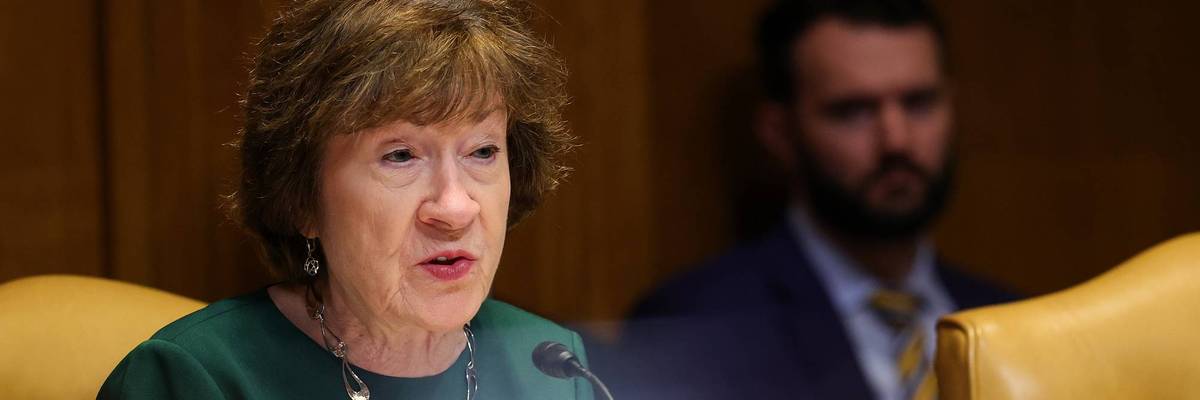
US Senate Appropriations Committee Chair Sen. Susan Collins (R-Maine) speaks during a hearing on April 22, 2026 in Washington, DC,
(Photo by Anna Moneymaker/Getty Images)
The Maine Democrat has said that “in the years since Roe was overturned, Susan Collins has done everything she can to skirt responsibility and avoid accountability—from skipping hearings to avoiding town halls at all costs.”
After Maine’s Republican Sen. Susan Collins told a reporter on Tuesday that she does not regret voting to confirm US Supreme Court Justice Brett Kavanaugh, despite the resulting reversal of Roe v. Wade, her Democratic challenger Graham Platner had a two-word response: “You should.”
Noting that this is the five-term senator’s first reelection campaign since the Dobbs v. Jackson Women’s Health Organizationdecision overturned Roe, a journalist from News Center Maine asked Collins whether she regrets voting for Kavanaugh—who was accused of sexual misconduct during the confirmation process.
“I do not regret that vote,” Collins said of confirming the right-wing justice, while also claiming that “I do disagree with Justice Kavanaugh’s vote” in the Dobbs case.
NEWS CENTER MAINE: This is the first reelection campaign that you're run since the Supreme Court overturned Roe v. Wade. I was hoping you could talk to me a little bit about your vote to confirm Kavanaugh and whether you regret that?
Collins then tried to pivot, highlighting her votes for liberal justices and saying that the Dobbs decision “has not had an impact on the state of Maine,” without mentioning that Democrats control both chambers of the state Legislature and the governor’s seat.
Also responding to the video of Collins on social media Tuesday, Lauren French of the Senate Majority PAC, a political action committee dedicated to electing a Democratic majority in the chamber, said: “Unsurprising. Collins’ abysmal abortion record goes far beyond Kavanaugh and Roe.”
“She voted to confirm at least 19 anti-abortion Cabinet nominees and 43 anti-abortion federal judges, including nominees who explicitly support fetal personhood and called birth control ‘abortifacients,’” French highlighted. “And just days after the Dobbs draft leak, Collins cast the deciding vote against the Women’s Health Protection Act—a bill that would have codified Roe into law.”
Throughout his campaign, Platner has repeatedly called out Collins for backing Kavanaugh, who has sided with the high court’s right-wing supermajority on a range of issues, from abortion to voting rights. After an April decision with massive implications for future elections, he said: “Don’t piss on our boots and tell us it’s raining: Under their bullshit legalese, the far-right Supreme Court gutted the Voting Rights Act today. Another disastrous decision brought to you by the court Susan Collins built, one terrible confirmation vote after another.”
The following month, Platner took aim at the senator for not attending Senate Health, Education, Labor, and Pensions Committee hearings on reproductive healthcare, including abortion, post-Dobbs, declaring that “in the years since Roe was overturned, Susan Collins has done everything she can to skirt responsibility and avoid accountability—from skipping hearings to avoiding town halls at all costs.”
“In November, Susan Collins will learn she can only run and hide from her damaging votes for so long. Because whether she knows it or not—her charade is over,” added the oyster farmer and combat veteran, who has discussed his family’s fertility struggles and the high costs of treatments during the campaign.
Platner’s campaign has focused on not only how Collins has made life harder for Mainers and people across the country, but also his support for policies that would benefit the working class and challenge the oligarchs as well as the politicians they fund—including his Republican opponent, whose reelection bid has been backed by nearly 100 billionaires and their spouses.
As Common Dreams reported earlier Tuesday, amid a wave of new state-level restrictions after Dobbs, reproductive rights advocates have emphasized the economic impact of abortion bans—which, according to a new analysis by the Institute for Women’s Policy Research, cost the US economy over $140 billion annually.
The Dobbs decisions and many others from the current court have fueled calls for change. Platner has argued that if his party reclaims control of Congress in the November midterms, there is a “compelling case” to impeach at least two justices—an apparent swipe at Clarence Thomas and Samuel Alito, right-wing ideologues who have faced ethics scandals in recent years.
Platner has further called for expanding the high court the next time Democrats control Congress and the White House—and stressed that in order to do so, “we need to elect people to the Senate who want to wield power like that, who understand that power matters, that it’s real and you can use it.”
Our work is licensed under Creative Commons (CC BY-NC-ND 3.0). Feel free to republish and share widely.






 by
by