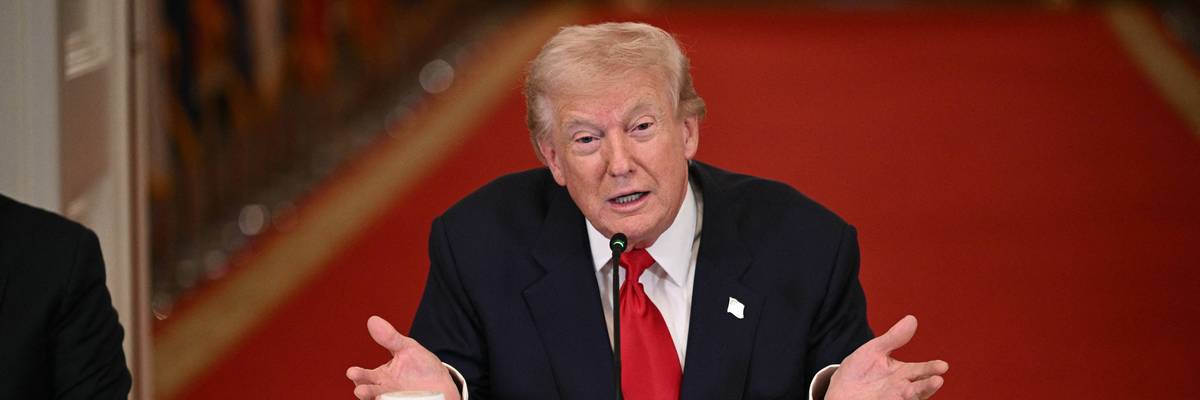
US President Donald Trump speaks during a roundtable to “save college sports” in the East Room of the White House in Washington, DC, on March 6, 2026.
(Photo by Brendan Smialowski / AFP via Getty Images)
The fundraiser comes as a recent study from the Federal Reserve Bank of New York showed food insecurity in the US has reached its highest levels since the Covid-19 pandemic.
A super political action committee created to support Donald Trump is preparing to hold a big-money fundraiser at the president’s Virginia golf course that will charge attendees $1 million each.
As reported by NBC News, MAGA, Inc. will host the $1 million-per-plate event at the Trump National Golf Club Washington DC on the day before the president is set to host Ultimate Fighting Championship (UFC) events at the White House as part of his 80th birthday celebration.
“The fundraiser is at least the sixth such $1 million-per-person event held by Trump-aligned groups for the midterm elections,” reported NBC News. “Republicans at nearly all levels hold a significant midterm cash advantage over Democrats, who expect to be outpaced financially in many key House and Senate races.”
Lisa Gilbert, co-president of Public Citizen, linked the ritzy fundraiser to Trump’s economic policies that have primarily benefited the wealthiest Americans at the expense of the working class.
“The comingling of 250th anniversary events, Trump’s UFC fight, and a $1 million per-plate fundraiser on Trump’s own birthday,” Gilbert said, “gives corporate interests and wealthy donors not just an ultimate fight—but the ultimate opportunity to pay tribute to the president. Rather than celebrate our nation’s anniversary in the bipartisan manner directed by Congress, the Trump administration has directed public money and public property to politicized events.”
“Major corporations, such as Chevron, Exxon, MasterCard, and many more,” Gilbert added, “should be ashamed to be associated with this corrupt spectacle.”
The fundraiser comes as a recent study from the Federal Reserve Bank of New York showed food insecurity in the US has reached its highest levels since the Covid-19pandemic.
The New York Fed researchers said their study found “a remarkable increase in food insecurity, particularly among lower-educated and lower-income households and households with young children,” as well as “a contemporaneous increase in pessimism among the same groups, along with a sharp decline in job-finding expectations.”
The researchers noted that “while many households are doing fine and economic activity overall has been expanding at a solid pace,” there are large numbers of people “facing high levels of economic insecurity and financial strain,” which has resulted in plunging overall consumer sentiment.
Our work is licensed under Creative Commons (CC BY-NC-ND 3.0). Feel free to republish and share widely.
A poster attacking Elon Musk’s wealth in a world of large-scale hunger is displayed on a bus shelter on June 11, 2026 in Tottenham, England.
(Photo by Leon Neal/Getty Images)
“The level of wealth that Mr. Musk has reached requires human exploitation, wage theft, wage suppression, anti-competitive markets, monopolistic control, price collusion, inadequate tax systems, and corruption.”
Elon Musk’s net worth surged past $1 trillion on Friday as SpaceX—the rocket company he founded and controls—made its debut on the public market, prompting global revulsion and calls for an aggressive wealth tax to rein in out-of-control inequality.
“Musk became the world’s first trillionaire because our tax system shields the wealth of the ultra-wealthy from taxation while requiring working to people pay taxes on every paycheck,” said Igor Volsky, director of the Tax the Greedy Billionaires Campaign. “Today’s milestone should serve as a wake-up call to us all.”
“Unless we plan to cede control and agency over our future to a handful of ultra-wealthy individuals, lawmakers must pursue bold tax policies that actually meet this moment—not just slowing the accumulation of extreme wealth, but reversing it,” Volsky added. “That means passing taxes on billionaire wealth ambitious enough to make the ultra-wealthy less wealthy, reduce the stranglehold they have over our economy and democracy, and restore the ideal that no one in America gets to buy their way to unchecked power.”
Reuters reported Friday that “most of Musk’s wealth now rests with SpaceX, where he holds a stake worth roughly $866 billion.”
“Along with Tesla and the rest of his properties, his net worth will exceed $1.1 trillion when the stock begins trading Friday,” Reuters noted. “The tally includes stock components that would vest over time.”
While Musk’s on-paper fortune could drop below the trillion-dollar mark if SpaceX’s stock price drops below $135 per share—which is highly possible, as experts argue the company’s valuation is absurd—campaigners said Friday that the milestone is an appalling product of a society that has allowed the mega-rich to dictate policy, funneling immense wealth to the very top while millions worldwide face hunger, violent displacement, and preventable disease. Oxfam has estimated that just a 10% tax on Musk’s fortune could lift 800 million people above the extreme poverty line.
“Eighty-six of Americans are worried about the price of food. Elon Musk is a trillionaire. These two things are deeply, inherently connected,” said Erica Payne, founder and president of the advocacy group Patriotic Millionaires. “The level of wealth that Mr. Musk has reached requires human exploitation, wage theft, wage suppression, anti-competitive markets, monopolistic control, price collusion, inadequate tax systems, and corruption. Mostly inadequate tax systems and corruption.”
Musk’s companies, including SpaceX, have relied heavily on and benefited massively from government contracts, subsidies, and research, while paying minimal taxes.
The New York Timesreported last year that SpaceX “has most likely paid little to no federal income taxes since its founding in 2002 and has privately told investors that it may never have to pay any, according to internal company documents.” As for Tesla, the Institute on Taxation and Economic Policy found earlier this year that the company “avoided almost all federal income tax on over $12 billion of US income over the past three years.”
Musk, whose immense wealth is largely stock appreciation that is not taxed in the US unless shares are sold, paid nothing in federal income taxes in 2018, according to ProPublica. “Between 2014 and 2018, he had a true tax rate of 3.27%,” the investigative outlet noted.
Writer Elizabeth Spiers argued Friday that “trillionaires shouldn’t exist,” noting in a column for The Nation that “as Musk’s wealth multiplies, he continues to prosper on the public dime.”
“Musk’s cosmic-scale wealth-hoarding is particularly abhorrent when you place it against the backdrop of how much damage he’s done,” wrote Spiers. “It’s hard to quantify the scale of destruction and deprivation that he will never personally be held accountable for. How do you value the lives of the hundreds of thousands of people who have died since Musk, in his words, gleefully ‘fed [USAID] into the woodchipper’? How do you value the lives of people who will die because DOGEcut major biomedical research funding?”
“Musk has enriched himself via a rigged investment economy ensuring that those with the most contribute the least—or in many cases, nothing at all,” Spiers added.
Our work is licensed under Creative Commons (CC BY-NC-ND 3.0). Feel free to republish and share widely.
Identifying vehicles ICE may be using to snatch students or their parents off the streets isn’t in the normal job description of the superintendent of a school district. However, as Brenda Lewis found out, these are not normal times.
This is the second article in a four-part series investigating the impact of Operation Metro Surge on Minnesota schools and students. You can find the first here and the next installment tomorrow.
Superintendent Brenda Lewis of Fridley Public Schools near Minneapolis never expected to find herself a leader in the resistance against ICE. But after Renee Good, a local mom, was killed by an immigration enforcement agent in January, and one of Lewis’s teachers was pulled over and held at gunpoint just hours later, the superintendent was spurred into action.
That teacher, who is an American citizen, was first tailgated and later followed for several miles. When Lewis found out what happened, something shifted in her mind.
“I was trying to understand the motivation around it, but then you are also in this mode of ‘Hey, we have to keep our children, our students, our family safe, our staff safe,’” she told WhoWhatWhy.
One of the reasons she felt the need to do something is that Fridley, an inner-ring suburb of Minneapolis, has a large population of Somali immigrants — one of the groups the Trump administration vowed to especially target as part of its “Operation Metro Surge.” This resulted in many students missing classes, which culminated in more than a third of students being absent from their classrooms in the week after Good’s deadly shooting.
Starting in mid-January, Lewis gave Fridley students the option to participate in their classes remotely for the winter quarter. More than 400 out of 2,800 students chose to take advantage of the opportunity. To protect those who still came to school, the superintendent arranged for district-wide patrol duty which took place during arrival and dismissal times until the end of February.
Lewis found herself spending most of her waking hours managing the crisis. In the mornings, she went on patrol, during which she shared information about suspicious vehicles that could be ICE, did walkabouts at each school, and addressed situations involving students or faculty members.
In what would ordinarily be her lunch break, Lewis contacted food delivery pantries working in the schools, and she checked in with students who were learning virtually to find out if they were absent due to ICE interference, whether direct or indirect. Some students chose to remain at home in order to stay safe, and some had been detained or deported by federal agents.
At the end of each school day, Lewis would go back on patrol duty to ensure that everyone — students and faculty alike — got home safely. Later in the evening, she would speak at press conferences and testify on behalf of the Minneapolis school community, revealing the shocking stories that detailed why ICE needed to stay out of schools. Finally, the superintendent would end her evening by updating her board members, staff, and families on the events of the day and communicating messages of reassurance.
At the peak of ICE’s engagement in Minneapolis, she went to the Minnesota State Capitol in St. Paul to speak on behalf of her schools at Gov. Tim Walz’s (D) press conference on February 3.
“Their presence is harming children, it is disrupting learning and it’s eroding trust. I will continue to be transparent, I will continue to speak up. And I am asking urgently for action,” Lewis said at the event. “Get ICE out of schools, out of our parking lots and out of our bus stops. Our children deserve to feel safe when they come to school. This is not political, this is all of our responsibility.”
The following morning, Lewis was reminded of how serious the situation had become. A mother was followed by two ICE vehicles as she tried to bring her child to school; she sat in the parking lot until she felt safe to drive again. Her child saw the whole thing. Another mother was followed by ICE as she took her three-year-old child to daycare. At yet another school, six ICE vehicles circled the roundabout during morning drop-off, and agents heckled the principal and staff. Crossing guards were scared because they didn’t know what to do, and children were blocked from crossing the street as ICE recorded the entire encounter. Lewis later calculated that all these events took place in the same 15-minute time span.
“It’s not my job to interfere with ICE operations,” Lewis told WhoWhatWhy in March. “However, it is my job to ensure that ICE does not interfere with school district operations.”
And interfere they did.
According to Lewis, at the beginning of the 2025–2026 academic year, Fridley Public Schools had been on track to continue its trajectory of growth in literacy and math. This was a big deal considering how Fridley schools are so heavily populated with children of immigrants. However, due to the upheaval caused by ICE, a significant number of these students missed attending school during the winter months.
“We still will continue, we’ve just taken some backsliding,” Lewis said.
The Two Types of Trauma Children Carried Through Metro Surge
According to Katie Lingras, an associate professor with the University of Minnesota’s Department of Psychiatry & Behavioral Sciences, there are two types of kids who were impacted by ICE: those who were directly affected, and those who were indirectly affected.
The children who were directly affected were the ones who feared being deported themselves, had family members detained, or who were separated from their families because they were deported by ICE.
The kids from families most at risk of ICE encounters generally stayed away from school and hid in their homes. These kids are the most impacted by this experience, but they can also be the most resilient.
“There’s lots of skills and characteristics that families can build that can get kids through hard times,” said Lingras, who specializes in early childhood mental health and trauma.
She noted that kids in the Minneapolis–St. Paul area specifically have witnessed a series of stressful events over the past seven years, ranging from the pandemic and the protests in the wake of George Floyd’s murder to the Annunciation Catholic School shooting, which took place a few months before ICE was deployed to the city.
“Each and every one of those can trigger all of those same types of feelings of fear and grief,” Lingras said. “And then you take that foundation and add on this, this kind of lawless show of power among federal law enforcement officers, and this intentional cruelty, this intentional fear-inducing behavior. And it’s a lot for all of these kids to manage.”
She also said that many kids were indirectly affected by ICE, such as the elementary classes that didn’t have playground recess throughout the winter due to fear for the students’ safety, or the children who saw armed and masked ICE agents around town everywhere they went.
There was no safe place in Minneapolis that was “ICE free.”
“The most challenging thing was that there was not really an area you could avoid — you know, ‘I wanna keep my kids sheltered and safe from this, so we’re not gonna go to x place,’” Lingras said.
The Fallout Continued Long After the Surge Ended
The staff at Fridley Public Schools did their best to track if students moved out of state, self-deported, or were forcibly deported or detained by ICE. But Lewis noted that she only knows for sure that a student’s residency status has changed when a member of their family communicates with her or school staff. Although the virtual learning program Lewis helped maintain kept the school district stabilized during the height of the surge, the superintendent believes it’s going to take another five years for the district as a whole to get their missed learning time back.
A laminated flyer stapled to a utility pole in South Minneapolis, MN, which reads “ICE Kidnapped Our Neighbor Here” on January 26, 2026. Photo credit: Chad Davis / Flickr (CC BY 4.0)
While in the midst of the mass ICE raids, Lewis missed the simplicities of an abundantly filled school, such as classrooms with children sitting at every desk or table, crowded hallways during passing periods, and loud lunchrooms with students engaged in conversation.
“I will never again complain about overcrowding in a hallway,” she said. “I felt what that’s like when 400 of our kids are remote learning and 122 of our kids aren’t with us that were with us in December.”
When WhoWhatWhy spoke with Lewis, she said it had been a long time since she’s sent a message about an issue other than ICE.
In the early spring, however, some of her district’s students started coming back to school. The superintendent believes the experience of losing and then seeing friends of her own kids return has been “renewing.” She was always relieved when her children told her excitedly, “So-and-so’s back, Mom!”
In the next article, you’ll learn about two middle school teachers in Columbia Heights who organized meal deliveries for community members in hiding and worked to minimize the trauma experienced by their young students.
This story was written by a member of our Mentor Apprentice Program (MAP). It gives aspiring journalists an opportunity to hone their craft while covering national and international news under the tutelage of seasoned reporters and editors. You can learn more about the MAP and how you can support our efforts to safeguard the future of journalism here.
LA mayoral candidate Nithya Raman at her primary election night party at Boomtown Brewery on June 2, 2026, in Los Angeles. Photo: Gina Ferrazi/Los Angeles Times via Getty Images
The surprising and divisive mayoral campaign of right-wing reality TV star Spencer Pratt came to an end on Monday, when Los Angeles City Councilmember Nithya Raman, a member of the Democratic Socialists of America, claimed her spot on the general election ballot against incumbent Mayor Karen Bass.
The second-place finish for Raman means that in the coming months, Bass will have to grapple with a challenger from her left. The incumbent mayor’s establishment bonafides at once lend her a strong political apparatus and make her the object of voter frustration. Raman, meanwhile, will face an uphill battle against the entrenched Democratic machine, which helped Bass easily secure a first-place finish. The embrace of mail-in voting by Angelenos slowly turned the tide for Raman, who initially trailed Pratt when polls closed last Tuesday.
Under California’s nonpartisan, open primary system, all viable candidates stood for the same June election — putting Pratt, a Republican, in the same primary as the heavily Democratic field. The top two advance to a runoff in November, meaning Los Angeles voters will choose between two Democrats in the general election ballot.
The emergence of Pratt, who rode a wave of outside conservative funding, prompted an intense debate among the city’s left on how to vote in the open primary. Rae Huang entered the race early on a progressive platform of strident police accountability measures, free and fast buses, and public housing. Raman, a city councilmember, decided to run at the last moment, with polls quickly showing she had a clearer path to a November runoff to fend off Pratt. Huang and her supporters insisted that she had the bolder leftist vision for the city, while Raman’s backers accused the Huang campaign of splitting the left amid a real threat from Pratt. The left is now faced with the task of repairing its fractures ahead of the November runoff.
Following Zohran Mamdani’s successful run for mayor in New York City, pundits were quick to ponder whether Los Angeles might be having its own Mamdani moment. But closer watchers of LA politics have been asking whether a different New York import could improve elections in the nation’s second biggest city: ranked-choice voting.
A ranked-choice voting system allows voters to rank candidates in order of preference. The system often leads to opponents with similar platforms and voter bases to cross-endorse, as was the case with Mamdani and his fellow progressive opponent Brad Lander, which helped stave off the more conservative-leaning former New York Gov. Andrew Cuomo. In the LA race, ranked choice would have allowed Raman and Huang to forge a similar alliance without compromising their positions and cooling the fierce debates among their supporters.
“We’ve heard lots of voters that they are voting strategically, they try and follow the polls instead of supporting their real favorite — that’s the narrative that I think ranked-choice voting would solve,” said Rachel Hutchinson, deputy director of research and policy at FairVote, a nonprofit that is pushing for ranked-choice voting across the U.S., including in Los Angeles, where City Council has until June 26 to decide whether to place a measure on the November ballot that would implement the system in future elections.
“Not only do people not have to drop out, but they can actually act civilly toward each other, especially if they share an ideology or they represent a similar community,” Hutchinson continued. “Voters under this system would feel more empowered to vote their conscience because they can still support their candidate.”
Raman joined the LA City Council as part of a wing of left-leaning victories that shifted the city’s political calculus, and has cast herself as a pragmatic leader with an eye for policy. But she faced challenges garnering support from the left amid accusations of flip-flopping and cozying up to entrenched local power. Despite running on defunding the police in 2020 as the first member of the Democratic Socialists of America elected to the council, Raman repeatedly voted to expand the Los Angeles Police Department budget, although she has pushed back on plans to expand the force. In 2024, Raman accepted an endorsement from Zionist group Democrats for Israel–Los Angeles, which opposed a ceasefire in Gaza, for which she was widely rebuked and even censured by DSA–LA.
Even though Raman and Huang are both DSA members, the local chapter declined to reopen the endorsement process for them. Raman’s three DSA colleagues on the City Council opted to endorse Bass.
Bass focused much of her fire on attacking Raman, despite arguably having the biggest ideological disagreements with Pratt. Bass and Raman were once allies: Bass campaigned for Raman in 2024, and Raman supported Bass in her previous mayoral race. But once Raman launched her last-minute campaign, Bass criticized her for claiming to be an outsider with no control over the current issues plaguing the city, despite Raman having spent years in City Hall.
On Monday, the local publication LA Material released a text message Bass sent Raman shortly after the latter filed to run; it contained only a tweet announcing Raman’s filing and a woman shrugging emoji.
We’re independent of corporate interests — and powered by members. Join us.
Bass’s tenure as mayor has been rife with controversy, particularly over her handling of the deadly 2025 Pacific Palisades fire. The mayor was in Ghana attending an embassy party when the fire broke out, and she returned home the following day, with her city and reputation in tatters. Bass’s office has also been criticized for watering down an after-action report on the Palisades fire, including allegations that she scrubbed the most damning findings about the city’s shortcomings in responding to the blaze.
Her supporters are quick to point out that the Santa Ana winds, and not Bass, fueled the intense fire. And in fact, President Donald Trump, who endorsed Pratt, also shares blame for the slow recovery effort. The president and Republicans in Congress have declined to release the $34 billion in Federal Emergency Management Agency aid requested by California Gov. Gavin Newsom for assisting fire survivors.
The controversy over the fires largely fueled the campaign of third-place finisher Pratt, a former television star on “The Hills” who has never worked in politics and is best known for getting into public spats with his female co-stars. He centered his pitch on his anger at Bass’s handling of the Palisades fire — which consumed his home as well as thousands of others — as well as his disdain for the city’s homeless population, whom he called “bums” and “zombies” and argued should be arrested en masse.
Housing experts told The Intercept that Pratt’s assertions were completely divorced from reality. But they pointed out that the lack of significant progress on the issue of homelessness in Los Angeles under Bass has emboldened figures like Pratt to swoop in and spread misinformation and dangerous propaganda.
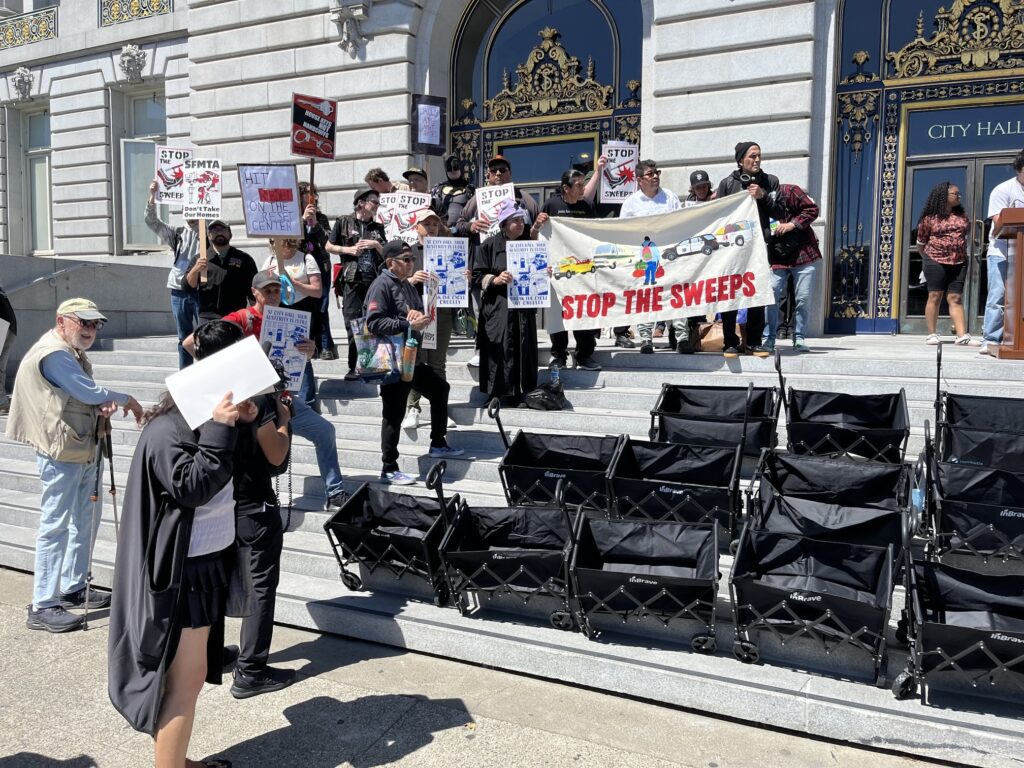
On Tuesday, dozens of people gathered on the steps of City Hall to call attention to the Lurie Administration’s moves to criminalize homelessness. The administration is closing shelters, cutting down on Permanent Supportive Housing, and redirecting resources to law-enforcement.
“He could take the money he’s spending on criminalization and spend it on housing,” Kema Straker, a harm-reduction specialist at the Coalition on Homelessness, said.
The Coalition on Homelessness held a rally and handed out carts for people to carry their meager possessions.
Speaker after speaker talked about the brutality of life on the streets and the lasting harm of the sweeps. “This city in not trying to solve homelessness,” said Apple Cronk, who lived on the streets for eight years. “They just want to erase visible poverty from rich neighborhoods and business corridors.”
The reality, Cronk said, is that police are expensive, and using teams of cops to roust the unhoused is both cruel and a waste of money.
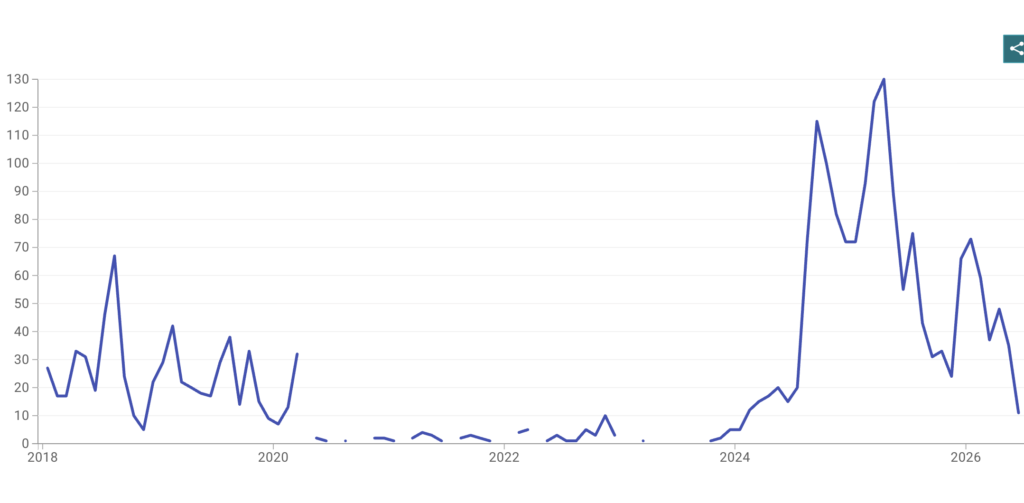
This chart shows the increase in arrests for “public lodging” since Lurie took office. These are unhoused people who are taken to county jail, at great expense. SFPD date
It was just one of what will be a series of demonstrations over the next few weeks as activists from a wide range of organizations protest Lurie’s budget proposal, which diverts massive resources from social services and health care to law enforcement.
The People’s Budget Coalition has compiled a detailed list of all the pending cuts—and it’s alarming. Some 300 city employees have already lost their jobs, and hundreds more vacant positions won’t be filled. That’s just the start: Since nonprofits provide many city services, and those contracts are facing deep cuts, somewhere between 500 and 1,000 nonprofit workers will likely lose their jobs, Anya Worley-Ziegmann, coalition coordinator, told me.
Here’s a detailed list, but let’s just look at a few of the most glaring examples:
The Department of Public Health will lose a total of $62 million. Overall, homelessness prevention and solutions will lose $14.7 million. HIV services will lose $4.5 million.
The little things will make a huge difference:
Glide Foundation loses its Workforce Navigator program:
GLIDE’s Workforce Navigator provides one-on-one and group support to clients engaging in workforce readiness, job placement, and career development services. Based in the Tenderloin/SOMA; 105 community members will lose services and 1 worker will lose their job.
Senior and Disability Action will lose its Homecare Advocacy Contract: Homecare Advocacy Contract: This program covers our Healthcare Action Team and our In-Home Care Stakeholder Workgroup, both of which involve leadership development and organizing for the protection and expansion of homecare programs so seniors and disabled people can live independently in the community. 2 workers will lose their jobs.
The Department of the Environment is, for all practical purposes, gone: SF Environment’s General Fund Support has been cut by 80% since FY 22-23. SFE’s GFS supports Climate Action Plan implementation, the Climate Equity Hub, EV charging installation, and biodiversity and habitat restoration. Launched in April 2024 by SFE, health professionals, contractors, and industry and community partners, the Climate Equity Hub provides technical assistance, education, and workforce development services that support citywide electrification.
This is a 40% cut to the entire department – of which only a small part is dedicated to achieving all CAP goals. That small part will be almost 100% wiped out and all progress, benefitting frontline communities in particular, will stop.
HOMEY loses $281,000 that went for Case management, life skills and job readiness development, food support, outreach, and job training to support families and Transitional Aged Youth, as well as formerly incarcerated individuals. This program has served 92 low-income, immigrant, Latinx families and youth will be impacted. 2 FTE potential layoffs.
The Southeast Geriatric Clinic will close:
Southeast Mission Geriatric Clinic w/UCSF: This clinic serves approximately 200 seniors per year with 8.75 FTE (11 staff) providing specialized geriatric and behavioral health services in the Mission. Closure will require seniors to transition to other clinics, risking disruption in care for a medically vulnerable population.
The SF AIDS Foundation loses a key harm-reduction program: Mobile Safe Supplies Access: This partnership between SF AIDS Foundation and Harm Reduction Therapy Center provides outdoor health supplies that reduce HIV transmission and support San Francisco’s Getting to Zero commitments. The cut would eliminate this service entirely, limiting access to sterile syringes and other health supplies for people who use drugs.
The list goes on and on.
So does the misinformation.
My social media feeds are filled with posts that say San Francisco’s budget is “bloated,” that the city spends more per-capita than most other city, and that there must be terrible mismanagement here.
There is, indeed, mismanagement and waste in San Francisco. There is no such thing as a $16 billion budget, in the public sector or the private sector, that doesn’t have some waste. (A friend who worked for a prominent US business for many years, including in management, told me once that he was proud he never fired anyone: “This is a big corporation, and we can always find something for someone to do to keep their job, even if they aren’t really good at anything.” His reviews always cited his exceptional management skills.)
But that’s not the point. Let’s look at some comments:
San Francisco’s government is bringing in a staggering $20,000 to $24,000 per capita, with an annual budget of roughly $16 billion spread across a population of around 750,000 to 830,000 residents. This per-capita government revenue and spending is among the highest in the country, dwarfing the figures of other major municipalities. Yet despite that we have a close to a billion deficit. How is that possible? Perhaps we have an issue of mismanagement?
I have heard this argument many times before. Joe Eskenazi, who now works for Mission Local, did a long piece in 2010 saying the SF was the worst run city in the US, citing the per-capita costs of public services.
I worked with an intern who had extensive background in economics, and we proved him largely wrong. I have reprinted my Bay Guardian story below. Then we all went on Forum and debated it.
Good times.
Some important points on the cost of local government: SF is a city and county, the only one in CA, so handles two types of government expenses. We have both a sheriff and a police department; no other city in California pays for both. You get arrested in the city of LA, the LA County sheriff holds you in jail; the LA County district attorney prosecutes you. The LA County public defender takes your case. None of that is in the LA City budget.
People who live in Berkeley and Oakland take AC Transit to get around. AC Transit is a distinct agency, with its own board and budget. That doesn’t show up in the budget of Alameda County’s cities. In SF, Muni is entirely a city and county agency, and every penny it costs is in the city budget.
We run a massive public hospital and a skilled nursing facility; both bring in much of their budget from Medicare and insurance, but the full cost—not adjusted for revenue, that’s another line—is still in the city “budget.”
We run an airport, that costs the taxpayers nothing; the full $1.5 billion budget is paid for by the airlines. But it’s still in the city “budget.”
Philadelphia is also a city and county, with an airport (run by a separate authority—not in the city budget) and a robust transit system (run by the Southeast Pennsylvania Transit Authority, so full cost is not in the Philly city budget).
New York has two airports, under the budget of the Port Authority of New York—not in the city budget.
You get the point: For a lot of technical reasons, San Francisco counts as part of its budget a lot of things that other cities provide, but that aren’t in the municipal fund.
We have to pay city workers well, or we wouldn’t have any: Three tech booms embraced by two generations of mayors have driven up the cost of living so high that teachers, cops, firefighters and other crucial workers can’t live here on “ordinary” civil service pay. Meanwhile, 60 billionaires live here and pay the city very little in taxes (thanks to Prop. 13, many pay only a tiny fraction of the worth of their homes in property taxes.)
If you actually do the math, and I have done this, when you remove SFO, the Port, SF General’s Medicare funding, etc., SF’s budget per capita is about the same as most large cities.
Meanwhile, San Francisco has, with about the same money as other large cities, taken on a lot of things that the federal government used to fund, like affordable housing, HIV services, public health for indigent people, and public education. (The SF Public Schools are not in the city budget, nor is City College, but the city’s General Fund gives money to both.)
You want to look at “waste?” The most overpaid city employees are not providing social services. They are cops and deputy sheriffs, making so much money on overtime that it’s hard to believe they could possibly work that money hours.
So the budget is not about waste and bloat; it’s about priorities. Lurie wants cops and “clean” streets to serve the technorati, not the working people who live here.
Here, since the web links went down when the former owners closed the Bay Guardian, is the text of our story from 2010:
The truth about San Francisco’s budget
Guess what? SF actually spends about what other big cities do
By Melanie Ruiz and Tim Redmond
“San Francisco,” SF Weekly recently proclaimed, “is arguably the worst-run big city in America.” That’s a hell of a claim — the levels of corruption and mismanagement in urban America are legendary. But the Weekly‘s Benjamin Wachs and Joe Eskenazi set out to prove their case — with a series of mostly anecdotal points that looked at the usual targets: Nonprofits. Unions. And one senior Newsom administration staffer who pretty much everyone agrees was a horrible manager.
We were tempted to just let it go. Sure, there’s plenty of incompetence and waste in the Newsom administration. There’s a need for more accountability in some of the nonprofits that get city money. The police union got too big a raise in 2007.
That pattern also exists in a lot of other big cities. You wanna make a big headline by claiming SF is the very worst? Whatever.
But the heart of the Weekly‘s factual analysis was a chart that purports to show that San Francisco spends vastly more per capita than other “comparable” cities. That’s a claim we hear all the time, one that the more conservative political forces constantly use to argue against higher taxes (and in favor of big spending cuts). So it’s worth exploring a little further. Because when you look at all the facts, the Weekly analysis is just wrong.
Comparing cities is a complex task — urban areas in America are governed in very different ways. You can’t, for example, compare San Francisco to any other city in California because San Francisco is the only combined city and county. Get arrested in Berkeley, and the Alameda County sheriff locks you up, the Alameda County district attorney prosecutes you, the Alameda County public defender takes your case, and the Alameda County courts adjudicate it. And if you win, you ride home on AC Transit — a separate system that isn’t in the budget of either the city or the county.
In San Francisco, all those things are in the same city budget.
But Wachs and Eskenazi decided to get beyond that. “Any time someone tries to point out that San Francisco has serious systemic problems, the response (from the Mayor’s Office, from city bureaucrats, and sometimes even from city activists) is that ‘San Francisco is both a city and a county,’ as if that explained everything,” Wachs told us in an e-mail. ”So the comparison was already being made as part of the city’s defense: San Francisco is a city-county, and what appear to be systemic problems are actually just features of being a city-county.
“We proved that isn’t the case: San Francisco’s per capita spending is significantly out of line even when compared to other large city-counties.”
Actually, it’s more than just the city-county distinction. The large cities-counties SFWeekly chose are so dramatically different in the services they do — and don’t — provide that the comparison comes close to being meaningless. Ken Bruce, a partner in the Harvey Rose Accountancy Firm, which serves as San Francisco’s budget analyst and does similar work in other cities, is no fan of wasteful spending. But he told us he wasn’t impressed with the Weekly chart: “I have yet to see a rigorous analysis done comparing San Francisco to other cities,” he said.
And the way the Weekly added up the numbers was, at best, misleading.
For starters, San Francisco runs (and includes in its city budget) an airport, port, public transit system, county hospital, and skilled nursing facility (Laguna Honda), for a total of more than $2 billion. None of the comparison cities do all those things. Or rather, some do those same things — but they aren’t in the local budget.
In Philadelphia, for example, the public transit system is a regional agency. Philly chips in $63 million from its general fund to help the Southeast Pennsylvania Transit Authority (SEPTA). SF pays almost three times that much to run its own Muni, because the overhead costs are included in the local budget. Philly taxpayers spend much more than $63 million on SEPTA — it just comes out of a different budget and funding stream, so it isn’t in the figures the Weekly used. Denver’s transit system is regional too, and thus not in the city-county budget.
In Indianapolis, the city transit system, Indygo, is far less complicated than ours. Jenny Brown, a spokesperson for Indygo, told us she was amazed her city was being compared to San Francisco: “Our transit system is not in the same league as yours,” she said.
Philadelphia also does not pay for a county hospital or include its port or airport in its budget. Neither does Denver.
There’s also a difference in most municipalities between the general fund (locally allocated spending) and the total budget, which includes federal and state money, self-sustaining departments,etc. In Philadelphia that’s a big distinction — more than $3 billion a year — but the Weekly compared Philly’s general fund to SF’s total budget (something Wachs admitted to us was his mistake).
So we took this a step further. First, in Chart A, we compare apples to apples — general funds to general funds. It turns out SF and Philly are relatively close in per capita spending. Then we adjusted the budgets to account for the fact that SF includes in its budget a lot of services other cities and counties budget somewhere else. That makes all the comparison cities a lot closer.
But can you really compare San Francisco — with its diverse and complex population and urban problems — to Indianapolis or Nashville? Even Denver? If even the folks in Indianapolis think that’s kind of bogus, we figured we could do better. So we set out to find some cities that make a more fair comparison. We included Philadelphia, but added Los Angeles and Chicago (New York, by the way, is so big, so complex, and has so many counties, boroughs, and budget items, that it’s not fair to compare that city to any other — even though is would help our case). To account for the city-county issue, we added to the L.A. and Chicago city budgets a percentage of the L.A. County and Cook County, Ill. spending equal to each city’s percentage of the county population. (Not a perfect yardstick, but pretty close).
As Chart C shows, all four big cities are within about 30 percent of each other in terms of per capita spending.
But there’s another big factor — cost of living. The vast majority of the budgets of these cities goes to employee pay and benefits — and it stands to reason that a city with a higher cost of living would have to pay its employees more. And San Francisco has by far the highest cost of living (according to the latest figures from the Council for Community and Economic Research’s ACCRA Cost of Living Index) of all the cities in this chart.
So we adjusted per capita spending by the cost of living index (SF = 169, L.A. 145.4; Philadelphia, 124.1; and Chicago, 110.8) and discovered that in fact all four big cities spend roughly the same per capita — although San Francisco spends the least.
So is San Francisco a service-rich city (like L.A., Philadelphia, and Chicago)? Absolutely. Is SF’s spending far out of whack with what other similar municipalities spend? No, not at all. All things considered, it’s a little low.
PS:The Weekly spent much of its article attacking the lack of accountability in the city’s $500 million’ worth of nonprofit spending. That’s a huge issue, but oddly, the Weekly didn’t quote a single person who supports the system San Francisco uses to distribute services through nonprofits.
We’ve been critical of many individual nonprofits, and some are over-funded, wasteful, and of dubious value. But overall, as labor activist Robert Haaland told us: “The fact that an individual nonprofit isn’t performing up to standard doesn’t mean that the services aren’t needed.”
And there are many who say the San Francisco model is, in fact, a national standard. Margaret Brodkin, former director of the Mayor’s Office for Children, Youth, and Families, helped develop the current system of nonprofit accountability in that office. She has been invited to speak all over the country about the standards and data system they developed. “Others have replicated the data system we had in place. It’s held up as a national model, the data system as well as the standards,” she explained.
So it’s not so simple — and to use a few anecdotes and some inaccurate and misleading figures to call San Francisco the worst managed city in the nation is, well, a bit of a stretch. To say the least.
48 Hills welcomes comments in the form of letters to the editor, which you can submit here. We also invite you to join the conversation on our Facebook, Twitter, and Instagram.
Tim Redmond has been a political and investigative reporter in San Francisco for more than 30 years. He spent much of that time as executive editor of the Bay Guardian. He is the founder of 48hills.
US President Donald Trump, joined by Republican lawmakers, signs the so-called One Big Beautiful Bill Act into law at the White House in Washington, DC on July 4, 2025.
(Photo by Eric Lee/Getty Images)
“The result,” said the author of a new Public Citizen analysis, “is a self-reinforcing loop where corporate cash buys policy, and policy pays cash back.”
Eighty-eight corporations that paid no federal income tax last year spent roughly $852 million on US campaign contributions and lobbying during recent election cycles, a report published Thursday revealed.
The report, “The Current Price of Zero,” was authored by Eileen O’Grady, a researcher at Public Citizen’s Congress Watch division. The publication draws upon an analysis published in April by the Institute on Taxation and Economic Policy (ITEP) showing that at least 88 of the nation’s largest companies paid no federal corporate income tax in fiscal year 2025, despite reporting combined US pretax income of around $105 billion.
“Using data from OpenSecrets, which compiles and publishes campaign finance and lobbying data, we found that from the 2020 election cycle through the 2024 cycle, these 88 companies have spent nearly $852 million on lobbying and campaign contributions,” O’Grady wrote. “We highlight the companies that spent the most money on lobbying, hired the most lobbyists, lobbied specifically on tax issues, and contributed the most cash to political campaigns.”
The federal corporate income tax rate is 21%, indicating that the 88 companies in the report dodged a combined $22.1 billion in taxes last year. Additionally, they received $4.7 billion in tax rebates, bringing their total tax breaks to approximately $26.7 billion.
“The largest and richest corporations in the country are paying zero in federal income tax, and that is a slap in the face to the American taxpayers who are struggling to afford necessities like groceries and healthcare,”O’Grady said in a statement.
“Meanwhile, these companies are spending money that could have gone to the public good on lobbying for even more special advantages and tax breaks,” she added. “In this backwards, cash-fueled system, the deck is being stacked ever higher in favor of corporations, and against working people.”
The report’s key findings include:
The 88 corporations that paid no federal corporate income tax in 2025 spent $712 million on lobbying and $140 million on campaign contributions over the last three election cycles;
Comparing the taxes the corporations saved against the cost of their political spending, they collectively made a 3,000% return on investment;
Coinbase Global spent the most of any company—$89 million—followed by CVS Health ($66 million), Honeywell International ($56 million), American Electric Power ($47 million), and Duke Energy ($35 million);
On average each year, these companies together have sent 1,119 lobbyists to influence the federal government, including on tax issues and legislation that changed the tax code in favor of corporate giveaways; and
Since the beginning of 2025, these companies have collectively laid off at least 21,200 workers and announced plans to lay off thousands more.
“Our findings suggest that while Republicans lawmakers rewrote the tax code to enshrine massive giveaways to wealthy corporations, those same corporate tax dodgers poured millions into lobbying and political campaigns that yielded further tax breaks, which in turn has bankrolled even more political influence,” O’Grady wrote. “The result is a self-reinforcing loop where corporate cash buys policy, and policy pays cash back.”
The report singles out two related pieces of legislation—President Donald Trump’s 2017 Tax Cuts and Jobs Act, and the so-called One Big Beautiful Bill Act (OBBBA), signed into law by Trump last July 4—which enabled “several common strategies the companies used to get tax breaks and rebates.”
“The most commonly used corporate tax giveaway, accelerated depreciation, enabled more than half of the companies to collectively avoid $11.4 billion in taxes by allowing them to write off capital investments immediately,” O’Grady noted.
“In addition, a tax break supercharged under the Big Ugly Law allowed more than 30 companies to immediately write off research and development expenses, which alone netted them at least $4.4 billion in savings,” she added, using a common liberal epithet for the OBBBA.
Since the US Supreme Court’s 2010 Citizens United v. Federal Election Commission ruling—which affirmed that political spending by corporations, nonprofit organizations, labor unions, and other groups is a form of free speech protected by the First Amendment—nearly $20 billion has been spent on US presidential elections and more than $53 billion on congressional races, according to data compiled by OpenSecrets. Spending on 2024 congressional races was double 2010 levels, while presidential campaign contributions were more than 50% higher in 2024 than in 2008, the last election before Citizens United.
Ultrawealthy and corporate megadonors played a critical role in Trump’s 2024 victory. Fossil fuel interests spent more than $445 million during the 2024 election cycle on campaign donations, lobbying, and other efforts to elect Trump and his Republican allies, plus pass policies that benefit their climate-wrecking businesses. Artificial intelligence and cryptocurrency are fast emerging as some of the most prolific lobbyists. Trump and Republicans in Congress have promoted policies and legislation boosting these sectors and shielding them from government regulation.
Elon Musk—the CEO of Tesla and SpaceX and majority owner of X who could soon become the world’s first trillionaire—is the most prominent of the numerous Trump donors who have been rewarded with Cabinet nominations and other key appointments in “an administration dominated by billionaires and corporate interests,” as Americans for Tax Fairness executive director David Kass described it.
O’Grady wrote that “corporate tax dodgers spend lavishly on lobbying and campaign contributions that feed into more tax breaks, which in turn fund even more political spending on policies that serve to pad corporate profits—and the cycle continues.”
To remedy this, the report asserts: “It is imperative that Congress undo the Republican tax giveaways to corporations like bonus depreciation and research and development write-offs. In addition, the corporate rate must be increased to at least the 35% rate that stood before the 2017 law.”
“Corporations should not be able to deduct multimillion-dollar bonuses. And Congress must prevent multinational corporations from avoiding taxes by booking profits in offshore subsidiaries by equalizing the domestic and international tax rates,” the publication concludes. “With these and other reforms to our tax code, our nation could have more than enough revenue to breinvest in American communities and make life more affordable for everyone. It’s time to finally put people over corporate profits.”
Our work is licensed under Creative Commons (CC BY-NC-ND 3.0). Feel free to republish and share widely.
Our President holds up a chart showing that if you stood up the Lincoln Memorial reflecting pool on its side, it would be taller than the Empire State Building! (GregPalast.com)
The Real News Network Jun 9, 2026 Israeli military forces captured the latest convoy of humanitarian aid ships sailing to Gaza with the Global Sumud Flotilla (GSM) between late April and mid-May. Activists who were imprisoned by Israel for days and eventually deported have reported harrowing treatment by their captors, including targeted torture, abuse, broken bones, unauthorized injections of undisclosed substances, and sexual violence by Israeli soldiers. We speak with a panel of freed GSM participants—Thiago Ávila, Catríona Graham, and Ariadne Telles—about what they saw and endured, and about the successes, defeats, and future of the movement to break Israel’s siege on Gaza. Hosted by: Maximillian Alvarez Studio Production / Post Production: David Hebden
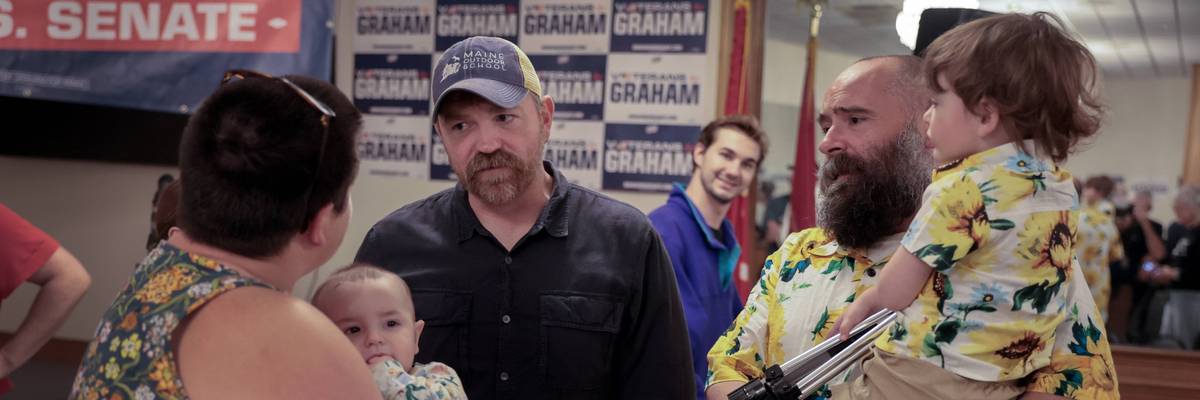
US Senate candidate from Maine Graham Platner speaks to attendees during a campaign event at the Veterans of Foreign Wars Post 6859 on May 17, 2026 in Portland, Maine.
(Photo by Joe Raedle/Getty Images)
The president has been convicted of 34 felony counts of falsifying documents as well as being found guilty of fraud, sexual abuse, and defamation. While in office he’s given massive tax giveaways to billionaires, opened the gates for corporate polluters, and made enriching himself and his family a top priority.
Four months after President Donald Trump’s name reportedly appeared over a million times in long-hidden files related to his former friend, convicted sexual predator Jeffrey Epstein, and weeks after one analysis warned that his foreign aid cuts will likely kill 9 million people by the end of the decade, the president announced Wednesday that he’d identified the politician who is “probably” the worst person to ever run for public office.
In the Oval Office, Trump declared Democratic US Senate candidate Graham Platner, whom Maine primary voters chose to run in the general election by more than a 52% margin, a “thug” and a “cheap, no-good person,” adding that he is “worse than any human being that’s ever run for office, probably.”
“Nobody’s ever had a record like that… This guy’s got a rap sheet, I’ve never seen anything like it,” said the president as he lied about Platner, who has no criminal record.
Trump, meanwhile, was convicted of 34 felony counts of falsifying business records in 2024. A New York judge also ordered Trump to pay a $450 million civil penalty over financial fraud that year, and in 2023, a jury found him liable for sexually abusing and defaming columnist E. Jean Carroll. More than two dozen women have accused the president of sexual misconduct.
Trump on Platner: "I watched that thug that's up in Maine. He's a thug. And they're trying to make excuses for him. I mean, he's worse than any human being that's ever run for office probably…And you'll have Schumer, he'll go crazy over this or that or Epstein…He's a thug." pic.twitter.com/I9k1MXZOUD
Trump, who has openly bragged about sexually assaulting women and reportedly committed adultery numerous times during his three marriages, was likely referring to controversies that made headlines after Platner, a combat veteran and oyster farmer, launched his campaign last year with a focus on taxing billionaires, expanding Medicare to the entire population, and ending US wars.
During his two terms in office, Trump has been rebuked for his allegiance to corporate interests, giving massive tax breaks to billionaires and powerful industries, undermining labor protections, launching wars of choice overseas, attacking public education, and gutting public health and environmental protection efforts.
Recently, a former campaign staffer told news outlets that Platner’s wife had confided in her about messages Platner sent to other women early in their marriage. The candidate’s former girlfriend, a right-wing operative, also accused him of being physically aggressive during their relationship. Earlier controversies centered on a tattoo that critics said resembled a Nazi symbol and posts he wrote on Reddit in the years after his military service.
Despite the months of criticism and news stories regarding Platner’s past, with 91% of votes reported as of Wednesday afternoon, he won the support of more than 71% of Democratic primary voters, with many saying they connected with his strong focus on issues affecting working people and that he had taken accountability for his previous actions.
While attacking Platner on Wednesday, Trump brought up the Epstein scandal, saying Democratic lawmakers “go crazy” over his association with the financier, who died in prison while awaiting a trial on sex-trafficking minors and who was convicted in 2008 of soliciting prostitution with a minor.
As Trump hurled insults at Platner, also calling him “an outright pig,” the Democratic candidate released an ad taking aim at “the Epstein class,” saying that “the only thing the DC establishment can agree on is a love of Jeffrey Epstein—and a hatred of me.”
The only thing the DC establishment can agree on is a love of Jeffrey Epstein — and a hatred of me.
Together, we will take back our government from the Epstein class.
— Graham Platner for Senate (@grahamformaine) June 10, 2026
Earlier, the Democratic candidate and so-called “thug” posted a video on social media of a volunteer activity he was taking part in on the morning after the election in Bar Harbor.
“This morning, I’m doing very important things, which is riding on the bike bus,” said Platner, evidently taking time off from being what Trump has also referred to as a “major sleaze bag.”
“The community gets together and helps ride with all of the kids who want to ride their bikes to school, and so it’s safe and fun,” he explained.
— Graham Platner for Senate (@grahamformaine) June 10, 2026
“Honestly, it’s exactly the thing that we need a lot more of in this country,” said Platner, “which is people coming together and realizing that their neighbors are good people, and everybody just wants to help each other out. It’s the message we need to take into our politics, which is why we won last night.”
Our work is licensed under Creative Commons (CC BY-NC-ND 3.0). Feel free to republish and share widely.