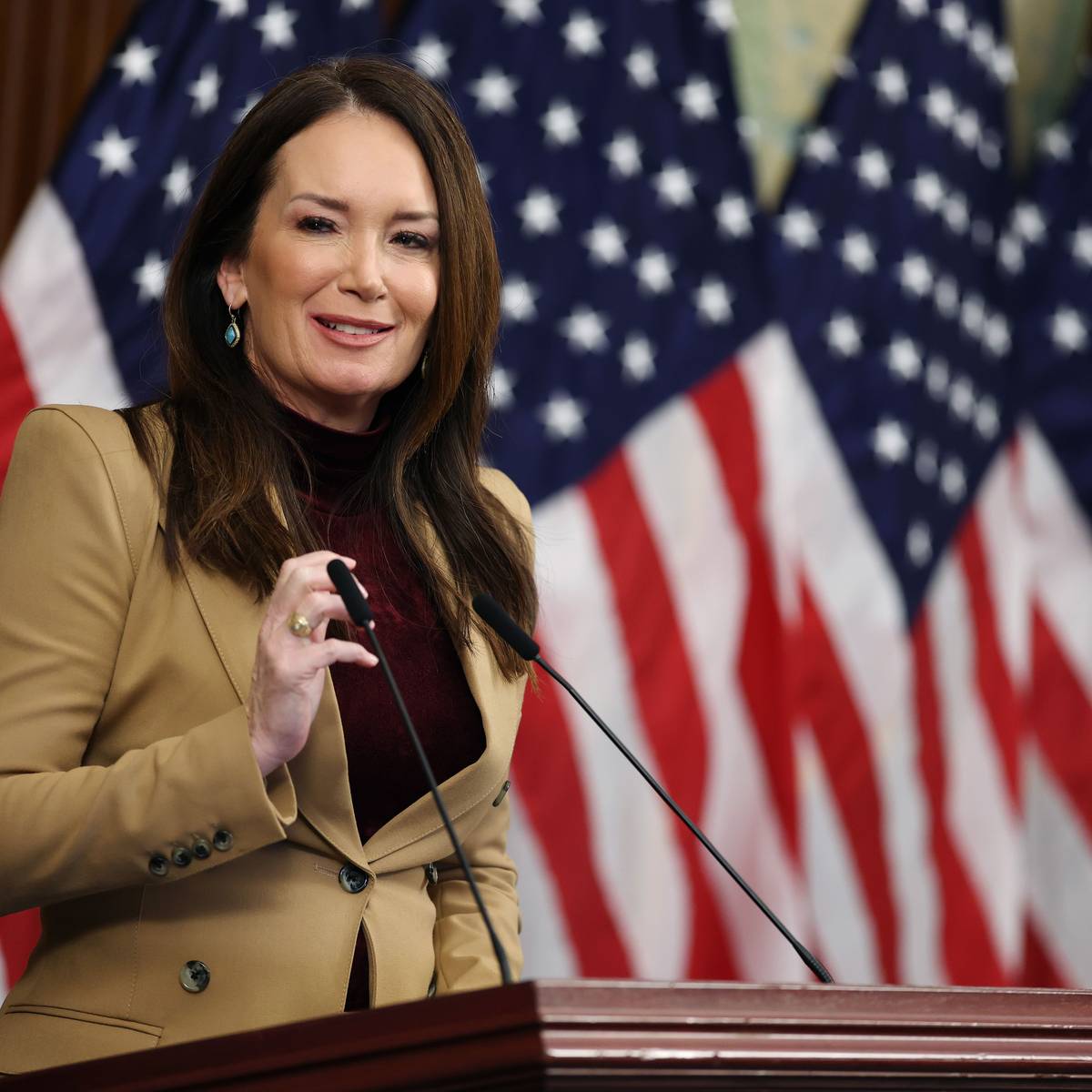
The head of the US Department of Agriculture on Wednesday falsely told senators that “no one was kicked off” the Supplemental Nutrition Assistance Program, claiming that the millions of people—including many children—who have lost federal nutrition assistance in recent months were no longer eligible for aid or decided not to apply for it.
USDA Secretary Brooke Rollins declared that “no one in Washington or in America wants to see a family go hungry,” but insisted that anyone who is no longer receiving SNAP benefits has “chosen not to reapply or they’re an able-bodied adult that can either work for 20 hours a week or volunteer.”
Rollins’ testimony conflicts with a growing number of anecdotal reports and expert analyses showing that families across the United States are losing SNAP benefits at the fastest rate in decades. The Center on Budget and Policy Priorities (CBPP) estimates that at least 700,000 children have lost SNAP since President Donald Trump signed into law a Republican budget package last summer, enacting the largest-ever cuts to the federal nutrition program.
Rollins: No one was kicked off of SNAP. If they are not on SNAP, they have chosen not to reapply or they are an able bodied adult that can work. pic.twitter.com/eaiVO9XRwb
“Did 700,000 children simply not apply?” Rachel Sabella, director of the No Kid Hungry New York campaign, asked in response to Rollins’ remarks.
Katie Bergh, a CBPP policy analyst, pointed to recent reporting by NBC News, which spoke to a mother of two in Arizona who said her “benefits stopped without warning three months ago” after the state began implementing new eligibility requirements included in the Republican budget law.
“It’s been really hard,” the mother said. “We’ve been going to food banks every week… We’re eating less, we’re eating more frozen stuff.”
Rollins, a multimillionaire, has openly celebrated the massive and rapid decline in SNAP participation during Trump’s second White House term, claiming that the roughly 4 million people who have been “moved” off the program are closer to realizing “the American dream”—even as hunger grows to levels not seen since the height of the Covid-19pandemic.
“This is a celebration of work and the dignity of work,” Rollins told senators on Wednesday.
But CBPP concluded in an analysis released in late April that the “dramatic” loss of SNAP benefits across the country “cannot be explained by a rapid improvement in people’s economic well-being or reduced need for help affording food.”
“Labor force data show that the unemployment rate was flat between July 2025 and March 2026, the most recent data available,” the think tank observed. “A more likely explanation for why people are losing access to food assistance is that states are now facing new challenges as they respond to the cuts in [the Republican budget law]—the largest in the program’s history.”
Our work is licensed under Creative Commons (CC BY-NC-ND 3.0). Feel free to republish and share widely.
California insurance commissioner candidate Jane Kim delivers remarks during the California Democratic Party convention in San Francisco on February 21, 2026.
(Photo by Yalonda M. James/San Francisco Chronicle via Getty Images)
“If the Democratic Party wants to beat Republicans and win back a majority in November, they need to listen to their voters and usher in a new generation of fighters.”
Progressive candidates have swept to victory against establishment opponents in Democratic primary races across the US, including on Tuesday, as voters turn out in support of working-class champions who have spurned corporate money and vowed to pursue transformative change at the national, state, and local levels.
The Working Families Party (WFP) celebrated a five-for-five sweep for the US House candidates it backed in California primaries, as Mai Vang, Connie Chan, Aisha Wahab, Randy Villegas, and Angela Gonzales-Torres each advanced to the November general election. As Common Dreams reported, Villegas—who is running to unseat incumbent Rep. David Valadao (R-Calif.)—advanced despite the Democratic Congressional Campaign Committee’s intervention in support of his opponent Jasmeet Bains, a corporate Democrat.
WFP noted that the wins in California followed upset victories by Chris Rabb in Pennsylvania’s 3rd Congressional District and Analilia Mejia in New Jersey’s 11th District.
“Voters are seeing through the bullshit and voting for candidates who aren’t in the pocket of billionaires and corporate interests,” Ravi Mangla, WFP’s national press secretary, said in a statement. “In New Jersey, Pennsylvania, and now California, WFP candidates have defied the odds and won shock victories over do-nothing corporate Democrats. We’re electing a new generation of leaders who won’t put up with being pushed around by billionaire elites.”
Politico reported that other Sanders-backed candidates in US congressional races “include Adam Hamawy and Analilia Mejia in New Jersey, Sam Forstag in Montana, Brian Poindexter in Ohio, and Bob Brooks in a key Pennsylvania swing district.”
“The senator’s support has been instrumental in powering unknown candidates to major wins this cycle, a demonstration of just how much political influence the 84-year-old progressive leader still commands,” Politico noted.
Justice Democrats, the grassroots group working to replace corporate Democrats with progressives across the country, is celebrating primary wins by Jane Kim, who is running to serve as California’s insurance commissioner, and Mai Vang, who is vying to represent California’s 7th Congressional District in the US House.
As of this writing, Vang has received more votes in the jungle primary than incumbent Rep. Doris Matsui (D-Calif.).
“Sacramento is ready to move on from the corporate dynasty that has represented it for 50 years and elect a true working class champion to fight for their families in Washington,” said Alexandra Rojas, the executive director of Justice Democrats. “Mai represents the Sacramento being left behind by Doris Matsui and the promise of representation that fights the corporations raising our prices and ICE contractors enabling our communities to be terrorized—instead of cashing their checks.”
“If the Democratic Party wants to beat Republicans and win back a majority in November,” Rojas added, “they need to listen to their voters and usher in a new generation of fighters like Mai, to excite our base and lead this party forward.”
Impact Justice, a leading expert in prison food, is championing innovative improvements. Its work is captured in the 2026 James Beard Award-nominated book “Eating Behind Bars.”
An incarcerated man at California State Prison Solano holds a fresh pear distributed through the Harvest of the Month program led by Impact Justice in partnership with the UC Nutrition Policy Institute. Credit: Evett Kilmartin courtesy of Impact Justice
It was a throwaway comment, sparking unusual recognition of a throwaway topic for most Americans when discussing nutrition.
Impact Justice founder Alex Busansky was at a two-day Bay Area event in December 2017 put on by a funder of his Oakland-based nonprofit. Someone from Food Corp., a national nonprofit working for better food in middle schools, said during her presentation that some school lunches were worse than a meal in prison,” Busanky said.
An idea started percolating in his head. Busansky approached her afterward and asked what she knew about prison food. She didn’t know anything. Neither did he, though he’d been to prisons through his regular social justice work.
“I talked to her and went back to my hotel room and got on Google,” Busansky said. “I saw no one was doing much research on prison food.”
He called his national campaign people and connected them with the woman from Food Corp., to find out more about their work.
That call was like splitting the first intellectual atoms of a nine-year chain reaction at Impact Justice, exploding into a 2026 James Beard Foundation award nominee for books covering food issues and advocacy. The award winner will be announced June 13 in a ceremony in Chicago.
“Prisoners are purposely out of sight and out of mind,” said Yusuf, Impact Justice’s vice president of innovation programs. “If people saw prisons more often, it would be a bigger part of the discussion.”
The group’s interest began with a search for previous research on prison nutrition.
It didn’t exist, so they did their own.
Two years of research produced what they called the first national study of prison food. Their 2020 report, “Eating Behind Bars” made Impact Justice the leading national expert on prison food.
Eating Behind Bars, published in 2025, is nominated for a 2026 James Beard Award for best book on food issues and advocacy. Credit: Impact Justice
Released in 2025, the book was a natural extension of the report, with additional research and solutions.
Most of the focus was on state facilities, where the highest number of the nation’s incarcerated people live. From interviews with former prisoners, their families and friends, and current and former corrections officers, the authors discovered mealtimes are one of the most traumatic and humiliating aspects of incarceration.
Prisoners are no different than any human looking to food for comfort and sustenance, the authors say. What inmates are served is often unrecognizable slop, bereft of nutrition, in favor of ultra-processed meals high in sugar and sodium that favor shelf life over nutritional content.
Prison food is heavy on carbohydrates meant to merely meet caloric standards, which vary, depending on the jurisdiction. The authors said prisoners rarely get fresh fruits or vegetables, even in industrial-scale prison farms.
Much of the unpalatable food ends up in the trash, as prisoners would rather go hungry than try eating prison food. The results are malnutrition and an estimated 300,000 tons of food waste annually.
In the report, former prisoners described finding maggots, body parts of rats, or cockroaches in their food.
The authors said correctional facilities control mealtimes and food access — as well as the food itself — as a form of punishment. They single out something called “the loaf,” a disgusting mash of incompatible foods presented as a meal.
“The book isn’t laying out radical ideas,” said Busansky, the president and founder of Impact Justice. “Prisoners are people with the same hopes, wants and desires as the rest of us.”
Inside the vertical farm at Camille Griffin Graham Correctional Institution, part of Impact Justice’s Growing Justice partnership with AmplifiedAg and the South Carolina Department of Corrections. Credit: South Carolina Department of Corrections courtesy of Impact Justice
Of formerly incarcerated people Impact Justice surveyed, 75% said they were served rotten or spoiled food in prison. More than 90% said they didn’t receive enough food to feel full.
Most of the country’s roughly 2 million prisoners came from low-income areas often described as “food deserts,” where access to fresh produce is limited. The food available in food deserts is often heavily processed and bought just to fill stomachs.
Yusuf said prisons are an opportunity for the government to educate the incarcerated — most of whom will be released and need to make food choices for themselves an their families — about nutrition and establish healthy habits.
“When individuals are in prisons, they are under state care; the state is responsible for them,” Yusuf said. “The decisions (prisoners) make are controlled by the state. We’re just talking about simple, healthy, everyday food.”
Busansky said prison food quality is a government choice. In 2024, California spent $4.20 a day on three meals for adult prisoners. By comparison, San Diego public schools spent $3.91 per child for usually one meal.
“We know how to feed people at scale – the military, schools, hospitals – and we do it well,” Busansky said. “We don’t have a constituency that fights for prisoners … We have people in prison who haven’t experienced the taste of a strawberry in 17 years.”
Busansky said there’s plenty of anecdotal evidence that “what you eat affects your behavior.”
“We don’t think about the consequences of what happens in prisons,” Busansky said. “I know how I feel after a bad meal. Now multiply that by meal after meal, day after day.”
Bad nutrition also leads to more health problems like heart disease and diabetes, resulting in higher medical expenses for the state.
“Each year in prison shaves two years off someone’s life,” Yusuf said. “It’s an important factor.”
The book’s first part lays out the problem. The second discusses remedies.
“The book is different than the report,” Yusuf said. “It really focuses on solutions. Most of the solutions are new.”
The group immediately began forming alliances with other organizations to help.
“Once you take the veil off something to people, they can’t unsee it,” Yusuf said. “They engage with the project, and they want to know how they can help.”
Impact Justice’s Growing Justice initiative in California and South Carolina builds vertical farms inside women’s prisons to produce nutritious leafy greens and train women in indoor farming.
The organization has also created programs like Harvest of the Month, a partnership with regional food hubs, UC Berkeley’s Nutrition Policy Institute, and the California Department of Corrections and Rehabilitation.
The program has delivered more than 600,000 pounds of fresh produce to about 90,000 incarcerated people since 2023.
Busansky said some prison systems, like California’s, are open to new ideas.
“There’s an openness to the conversation,” Busansky said. “It’s usually about the funding, doing something they’ve never done before.”
Impact Justice trains former prisoners to be food justice advocates in their communities and started a Chefs in Prisons program in Maine, which trains prisoners in culinary arts while creating better food for inmates. The model is catching on in other states.
“The majority of people incarcerated are parents,” Busansky said. “If you teach them about the benefits of nutritional food, that has an effect on generations.”
“We ask people to do something, now that you have the information,” Yusuf said. “We can’t forget about the people we don’t always see.”
Tony Hicks is an East Bay native who spent 22 years working for Bay Area News Group, covering crime, education and the city of Berkeley. He also worked in the features department of the Contra Costa Times,… More by Tony Hicks
From Citizens United to Trump-era oligarchy, the billionaire takeover of American politics seemed unstoppable. Then Hawaii found a way to strike at the heart of the system…
Against all odds and massive dark money, Graham Platner won. And won big.
The oyster farmer and Marine Corps veteran who turned a long-shot run into a movement just took the Democratic nomination to challenge Susan Collins for her Senate seat in Maine, and he did it the hard way, the clean way, the way that’s supposed to be impossible in this age of unlimited corporate and billionaire money.
He out-raised a sitting governor backed by the entire party establishment and their corporate funders, he packed arenas with Fighting Oligarchy rallies alongside Bernie Sanders, and he built the whole thing out of small-dollar donations from working Mainers rather than checks from corporate political action committees.
He’s been a sharp critic of AIPAC and the river of industry cash that flows through our politics, and he’s pledged to keep that money out of his campaign.
Now look at the woman he’s running against. Susan Collins is the chair of the Senate Appropriations Committee, which means she sits atop the federal spending faucet for defense contractors, pharmaceutical companies, banks, and agribusiness, and wouldn’t you know it, those are exactly the industries pouring money into her reelection.
The single largest organized source of cash in her campaign is AIPAC, the pro-Netanyahu lobby that bundled more than half a million dollars for her in a single filing period and accounted for nearly a fifth of everything she raised last year.
It’s a nonprofit corporation working on behalf of a foreign government’s leader’s agenda, doing in American elections exactly what Citizens United made legal when Stevens’ dissent pointed out the decision “would have given Tokyo Rose” a voice in US elections during WWII.
Roughly ninety-five percent of Collins’ money comes from outside Maine. And when Blackstone CEO Stephen Schwarzman dropped two million dollars into a pro-Collins super PAC in the summer of 2025, she voted the very next day to advance Trump’s tax bill, stuffed with giveaways to the private equity industry that had just paid to keep her in office. That’s the whole transaction, in miniature, right there in the open.
If you want to see the same machine running at full industrial scale, just watch what Donald Trump and his sons have been doing for the past year and a half.
— A Reynolds tobacco subsidiary gave five million dollars to a Trump super PAC, and five days later the FDA cleared fruit and candy flavored vapes for the American market, with Trump’s own FDA commissioner resigning rather than sign off on addicting kids.
— Bayer and Monsanto wanted protection from the tens of thousands of cancer victims suing them over Roundup, so Trump handed them a February executive order granting glyphosate producers immunity from lawsuits, then sent his own lawyers to the Supreme Court to argue Bayer’s case. And the saddest part of that one is Bob Kennedy, the lawyer who once won nearly $300 million suing Monsanto over Roundup and built his whole brand calling glyphosate a cancer-causing poison, as Health Secretary rolled over and praised the bought-and-paid-for order as “putting America first,” betraying the very people who trusted him.
— Crypto financier Justin Sun poured something like ninety million dollars into Trump family crypto ventures, and the SEC promptly paused and dropped its fraud case against him, part of a pattern in which the agency walked away from roughly sixty percent of its crypto enforcement after those firms donated to the inauguration.
— Big Oil executives gathered at Mar-a-Lago in 2024, where Trump asked them for a billion dollars and promised to gut Biden’s climate rules in return, a promise he’s since kept by killing wind, solar, and EV incentives, opening federal lands to drilling, and even paying a French company nearly a billion of your tax dollars to cancel offshore wind farms.
— And Tim Cook handed Trump a personal million-dollar inauguration check and a slab of gold, and walked away with tariff exemptions worth billions to Apple while the rest of the country pays the price at the cash register.
Every one of those deals is sleazy, and every one of them is also perfectly legal, and the reason they’re legal is a Supreme Court decision that I’d argue is the single most corrupt ruling in the history of the Court.
In 2010, in Citizens United, five Republican-appointed justices declared that corporations have a constitutional right to spend unlimited money influencing our elections, building on a 1978 case written by Lewis Powell himself (of Powell Memo infamy) called Bellotti that had first cracked the door open.
This, despite the fact that the word “corporation” does not even appear in the Constitution.
In that five-to-four ruling every vote in the majority was a deciding vote, and one of those five was Clarence Thomas, who for decades had been quietly pocketing gifts, luxury trips, private jet and yacht rides, and tuition payments from Harlan Crow, the Texas billionaire whose Dallas mansion famously houses a collection of Nazi memorabilia including two Hitler paintings and a signed copy of Mein Kampf.
Just weeks before the Citizens United ruling, Crow even helped fund a dark money group co-founded by Thomas’s own wife. The man who cast a deciding vote to legalize secret corporate money in our elections was himself bought-and-paid-for, and he never considered recusing himself for a second.
For fifteen years now, we’ve been told there’s nothing to be done about this short of a constitutional amendment, and every attempt at one has died at Republican hands in Congress. But a handful of states have now found a crack in the wall, and it’s so elegant it’s almost funny.
Hawaii just became the first state in the nation to redefine what a corporation even is. States are the entities that charter corporations and grant them their powers in the first place, so Hawaii simply rewrote the definition to say that a corporation operating in the state does not have the power to spend money influencing elections or ballot measures.
It’s not regulation, it’s redefinition, which is the brainchild of Tom Moore at the Center for American Progress, and the beauty of it is that the Supreme Court has held for two hundred years that defining the abilities and powers of corporations is a matter of state law the federal courts have no business touching.
Hawaii didn’t overturn Citizens United: it just made the ruling meaningless inside its borders, where every dollar spent on an election will now have to come from a human being. Montana is gathering signatures to put the same idea on their November ballot, with a measure that would take effect even sooner than Hawaii’s, and at least fourteen states, including New York and California, are today considering versions of their own.
There are limitations to this approach: redefining corporate power at the state level won’t stop the billionaires. It won’t stop Harlan Crow or Elon Musk or the oil and crypto and pharma tycoons who spend as individuals, because they’re flesh-and-blood people, not corporate charters, and reaching them still requires either overturning Citizens United through a constitutional amendment or changing the composition of the Court that handed it down.
But it’s a real start, and just as importantly it drags the whole rotten arrangement back into the daylight, forcing Americans to look at what Thomas and Roberts and the rest of the corrupt Republicans on the Supreme Court did to us and our democracy, and ask why we ever let corporations buy our government in the first place.
I’ve spent a good chunk of my life writing and broadcasting about how we got here, and in my new book, Who Killed the American Dream, I trace this entire catastrophe back past Citizens United, back past Bellotti, all the way to an 1886 Supreme Court headnote, written not by a justice but by a court reporter, that falsely declared corporations to be persons under the Fourteenth Amendment and threw us to the mercy of the oligarchs. The book lays out the other solutions, too, the ones that reach the billionaires and not just the corporations.
The biggest, most critical crisis for America that Citizens United caused is that the oligarchy it produced isn’t a stable form of government: it’s a transitional one, as I lay out in The Hidden History of American Oligarchy.
When a tiny class of the very rich — billionaires, corporations, or both — captures the machinery of the state, as they’ve now done in the Trump White House and across the entire Republican Party, the people eventually figure it out and rebel as we’re seeing today with the No Kings and other protests.
At that point, the oligarchs are left with only two choices. They can back down and let the country become less corrupt, the way America did during the Progressive Era and the New Deal, or they can come down with what Democratic President Grover Cleveland, warning Congress about corporate power back in 1888, called an “iron heel,” crushing the opposition rather than loosening their grip.
That second path is the one that Trump’s mentor, Vladimir Putin, chose. Russia had become an oligarchy in the neoliberal chaos of the 1990s, and when Putin took over he gave the Russian oligarchs a simple bargain: keep your billions, pay me off, and don’t challenge anything I do. When billionaire Mikhail Khodorkovsky crossed that line, Putin destroyed him, seizing his oil company and locking him away for a decade.
That’s the fork in the road we’re approaching, and it’s why what Hawaii just did is so much bigger than just Hawaii.
The Hawaii-style fix doesn’t require Congress, it requires your statehouse, which means your own state representative and state senator are the people who can make this happen where you live.
Look them up and contact them at openstates.org, and tell them in plain words that you want them to do what Hawaii did and what Montana is about to do, and to redefine corporate power so that only human beings can spend money in your state’s elections.
Make sure you and everyone you know is registered and ready to vote at vote.org, because the same ballot box that elects a Platner can pass these measures. If you’re in Montana, go find the signature drive and sign it.
And on the federal side, the road to actually overturning all of Citizens United, call your senators and representative through the Capitol Switchboard at 202-224-3121 and tell them to back a constitutional amendment and meaningful Supreme Court reform.
None of this current state of corruption fixes itself: it requires citizen action, or the special interests and billionaires will prevail. So, share this piece with the people in your life who’ve given up believing anything can be done about the money, because something finally can, and forward it to the friend who thinks corruption is just like the weather, something about which nothing can be done.
Support independent journalism at the Hartmann Report so we can keep dragging this into the light. The oligarchs are counting on you to believe the game is rigged forever. Hawaii just proved it isn’t.
House Speaker Mike Johnson (R-La.) speaks during a news conference on March 17, 2026.
(Photo by Bill Clark/CQ-Roll Call, Inc. via Getty Images)
“MAGA Mike Johnson won’t show the American people his secret plan to eliminate Social Security because he knows Republican policies are wildly unpopular.”
Social Security’s trustees said in their annual report released Tuesday that the New Deal program will be unable to pay out full benefits by the end of 2032—a quarter earlier than projected last year—in the absence of congressional action, a finding that advocates said underscores the destructive impact of President Donald Trump’s policy agenda and the need to make the rich finally pay their fair share into the system.
“This is the first Social Security trustees report that begins to take Donald Trump’s second term policies into account: A tax bill that largely benefited the wealthy, economy-wrecking tariffs, a needless war with Iran, and hostility to immigrants,” said Nancy Altman, the president of Social Security Works. “All of these have reduced the amount of money going into Social Security, weakening the system’s finances.”
The trustees report was released a day after House Speaker Mike Johnson (R-La.) declared in a radio show appearance that “entitlement programs like Medicare, Medicaid, and things like Social Security” need to be “adjusted and fixed,” which critics say is euphemistic language for benefit cuts, given past GOP proposals such as raising the retirement age.
Johnson said the GOP intends to release a new Social Security plan “next year,” without providing any details.
The Democratic Congressional Campaign Committee (DCCC), House Democrats’ campaign arm, immediately pressed Johnson, suggesting he’s delaying Republican plans for Social Security and Medicare until after the 2026 midterms to avoid consequences at the ballot box.
“MAGA Mike Johnson won’t show the American people his secret plan to eliminate Social Security because he knows Republican policies are wildly unpopular and will be resoundingly rejected by the American people in November,” said Justin Chermol, a DCCC spokesperson.
The new trustees report projects that Social Security’s Old-Age and Survivors Insurance will be able to pay out full benefits “until the fourth quarter of 2032, one quarter earlier than projected last year.”
“At that time, the fund’s reserves will become depleted and continuing program income will be sufficient to pay 78% of total scheduled benefits,” the trustees said.
Max Richtman, president and CEO of the National Committee to Preserve Social Security and Medicare (NCPSSM), stressed that the new projection “does not mean that Social Security is going ‘bankrupt’ or ‘broke.’”
“Nor does the trustees report mean that benefits must be cutto maintain the program’s fiscal health,” said Richtman. “It would be grossly unfair to ask beneficiaries on fixed incomes to bear the cost of strengthening Social Security. While conservatives favor benefit cuts (such as raising the retirement age, means testing, or reduced COLAs), we advocate for revenue-side solutions where the wealthy pay their fair share.”
Specifically, NCPSSM and other progressive advocacy groups and lawmakers have called for raising the Social Security’s payroll tax cap, which currently exempts annual income above $184,500 from the program’s dedicated payroll levy.
Richtman said that lifting the payroll tax cap and “subjecting some of high earners’ investment income to Social Security taxes” would keep the program solvent “well beyond the 2030s.” He noted that Democratic lawmakers have introduced legislation to shore up Social Security’s finances by taxing the rich, but the bills have gone nowhere in the Republican-controlled Congress.
In a joint statement issued in response to the trustees report, Reps. John Larson (D-Conn.), Richard Neal (D-Mass.), and Lloyd Doggett (D-Texas) said that “instead of joining Democrats to protect and enhance” Medicare and Social Security, “Donald Trump and Republicans are busy sabotaging them.”
“After DOGE took a wrecking ball to the Social Security Administration under false pretenses, all Americans got were slashed customer service and their most personal data put at risk—without a penny saved,” the Democrats said. “Combined with their sole legislative achievement pricing millions out of coverage and putting Medicare on the chopping block, there is no greater threat to Americans’ wellbeing than Republican governance.”
Our work is licensed under Creative Commons (CC BY-NC-ND 3.0). Feel free to republish and share widely.
Cattle are herded in a stable on June 5, 2026 in Hamilton, Texas. US Secretary of Agriculture Brooke Rollins has confirmed the detection of the New World screwworm—a parasitic fly whose larvae feed on the living tissue of warm-blooded animals—in a cow in Zavala County, Texas.
(Photo by Brandon Bell/Getty Images)
“This has nothing to do with Joe Biden,” one senator said, “but Trump and DOGE definitely screwed our cattle industry.”
The Trump administration has emphasized in recent days that the New World screwworm infection found in a calf in Texas did not pose a threat to the United States’ larger cattle herd, which is at its lowest point in 75 years due largely to drought conditions—but the US Department of Agriculture is now acknowledging that cases of the parasite have been found outside the Texas containment zone and as far away as in New Mexico, as Republican officials attempt to blame the Biden administration for the outbreak.
While Democratic lawmakers are among those connecting the arrival of screwworm—a flesh-eating bug that feeds off the living tissue of warm-blooded animals and had been eradicated in the US in 1966—to cuts by President Donald Trump’s Department of Government Efficiency (DOGE) that specifically targeted screwworm monitoring programs, Agriculture Secretary Brooke Rollins doubled down on claims that an “open border policy” under the Biden administration was to blame.
“This does trace back to the last administration and the open border policy, and the movement of millions of people and their animals up from South America through Central America,” said Rollins with certainty on Monday.
As David Dayen explained at The American Prospect Tuesday, former President Joe Biden placed a ban on bison, horse, and cattle imports from Mexico in 2024, which Trump lifted in February 2025. At the same time, DOGE, under the leadership of Trump megadonor and tech billionaire Elon Musk, cut screwworm monitoring efforts and animal disease control and prevention efforts, slashing 1,300 employees from USDA’s Animal and Plant Health Inspection Service.
Rollins did reinstate the live import ban last May as screwworm cases were rising in Mexico and began funding prevention programs in Texas. But a $600 million facility for breeding sterile screwworm flies—a key component of successful eradication efforts—is not scheduled to be completed until late next year, and sterile flies that have been dispersed from a facility that opened in February at Moore Air Force Base in South Texas only amount to “about one one-hundredth of what it would take each week to eradicate the pest,” Dayen wrote.
He also noted that Rollins has attempted to blame Biden—who has not been in office since January 2025—despite the fact that the total average lifespan of a screwworm fly is 21 days.
“The more likely explanation is that an administration with an antipathy to government ignored government’s purpose until it was too late,” wrote Dayen.
The USDA established a 12-mile quarantine area around the affected area last week when the case was detected in South Texas, but on Monday the agency said another case had been found in Gillespie County, over 100 miles from where the initial case was reported.
A dog was also found to be infested in Lea County, New Mexico, more than 400 miles away.
The parasite is not expected to affect food safety, as it feeds on living tissue, but the outbreak raises concerns about rising beef prices, which are already high due to the low volume of cattle in the US. The high prices of fertilizer and fuel due to the war in Iran, and of equipment and repairs due to Trump’s tariff policy, have also put a strain on the cattle industry.
“The cattle producer in the US has already been under extreme financial stress,” Joe Maxwell, president of Farm Action Fund and a farmer in Missouri, told The American Prospect. “This is serious, the screwworm outbreak. But it’s even more serious because of the financial position they were already under.”
In response to Rollins’ claims, Sen. Patty Murray (D-Wash.) said Tuesday: “Let’s be clear about what happened: DOGE cut the programs and staff that tracked dangerous outbreaks like screwworm.”
“So this has nothing to do with Joe Biden,” she said, “but Trump and DOGE definitely screwed our cattle industry.”
Our work is licensed under Creative Commons (CC BY-NC-ND 3.0). Feel free to republish and share widely.
ChatGPT: If by “Raman” you mean Nithya Raman and by “Mamdani” you mean Zohran Mamdani, I’d say: yes and no.
In the broad political sense, Raman is probably the closest thing Los Angeles has to a Mamdani figure:
Both have ties to the Democratic Socialists of America.
Both emerged as insurgent candidates challenging more established Democratic figures.
Both emphasize affordability, tenants’ rights, and making city government more responsive to ordinary residents.
Both appeal to younger, progressive voters and many people frustrated with the status quo.
But there are important differences.
Mamdani is more ideologically explicit. He openly embraces democratic socialism and has advanced bold proposals such as fare-free buses and publicly owned grocery stores.
Raman is more pragmatic and technocratic. She is an urban planner by training and has often focused on the mechanics of governance: speeding housing production, reforming permitting, strengthening tenant protections, and improving homelessness policy.
Housing is where Raman stands out. She has strong ties to the YIMBY (“Yes In My Backyard”) movement and has been more willing than many progressives to support increased housing construction, including private development.
The political environments differ. New York has a comparatively strong mayoralty; Los Angeles gives more power to the City Council. So even if their philosophies overlapped perfectly, they would govern differently.
So my answer would be:
Raman is the Mamdani of L.A. in the sense that she represents a generational, progressive challenge to the Democratic establishment. But she is not simply “Mamdani West.” She is generally more incremental, more policy-focused, and more aligned with California’s pro-housing YIMBY politics.
Whether that distinction is a virtue or a drawback depends largely on what one is looking for in a mayor. Some supporters see Raman as a more practical version of Mamdani; some critics think she lacks his ideological clarity and charisma; others think the comparison itself obscures the fact that Los Angeles and New York face very different problems.
This article appears in the June 2026 issue of The American Prospect magazine.If you’d like to receive our next issue in your mailbox, please subscribe here.
In its more than two centuries of existence, the Democratic Party has, from time to time, demonstrated that it knows how to do politics. This may be one of those moments.
Credit: Illustration by Jordan Awan
As historian Michael Kazin has demonstrated in his party history, What It Took to Win, Democratic successes have mainly resulted from advocacy for the economic interests of the working and middle classes, and against opponents who champion the interests of the rich. When Democrats fail, it’s often because they’re reluctant, or simply opposed, to advocate against the domination of big money, which also weakens their standing as working-class champions.
The most politically successful Democrat in history is surely Franklin Roosevelt, who led the Democrats to an unequaled victory in 1936. Since taking office in 1933, Roosevelt had put millions of unemployed Americans to work on public works projects and signed into law both Social Security and the National Labor Relations Act, which created workers’ right to collective bargaining.
Those achievements spawned a furious counterreaction from some of the nation’s wealthiest, most particularly the du Pont family, who held controlling interest in the nation’s largest corporation, General Motors. The du Ponts and their allies created the American Liberty League, drawing into their ranks some business leaders who’d figured prominently in the pre-Roosevelt, largely laissez-faire Democratic Party, and mounting an anti–New Deal propaganda barrage that dwarfed in magnitude and intensity anything that the official Republican Party put on display.
Roosevelt clearly understood that the Liberty Leaguers were a perfect foil. Business leaders in general were at an all-time nadir in public esteem, with Wall Street’s unregulated speculation having caused the 1929 crash, with corporate chiefs’ massive layoffs having caused record unemployment, and with the Liberty League having attacked the administration’s most popular programs. In a speech accepting his nomination at the Democrats’ 1936 convention, Roosevelt went after their attacks on democracy. “These economic royalists complain that we seek to overthrow the institutions of America,” he said. “What they really complain of is that we seek to take away their power.”
In his final pre-election speech that year, to a thunderous crowd in Madison Square Garden, Roosevelt doubled down. “We know now that government by organized money is just as dangerous as government by organized mob,” he told those in the arena and listeners to the national radio broadcast. “Never before in all our history have these forces been so united against one candidate as they stand today. They are unanimous in their hate for me—and I welcome their hatred! I should like to have it said of my first administration that in it, the forces of selfishness and of lust for power met their match.”
A number of media commentators responded that Roosevelt had gone too far and that his remarks would endanger his re-election. Some Democrats implored FDR to walk them back. He did nothing of the sort. And three days later, Americans gave Roosevelt and the Democrats the greatest electoral majority that any political party has ever won. The president took more than 60 percent of the popular vote even as total voter turnout soared, carrying every state but Maine and Vermont; the Democrats’ supermajority in the House rose to 334 (out of 435) and 75 (out of 96) in the Senate.
The triumphs of the New Deal order, while partial, were long-lived. Social Security and its Great Society complement, Medicare, greatly reduced pervasive poverty among the elderly; widespread unionization created a more economically stable working class than ever before; progressive taxation and financial regulation thwarted the emergence of a new generation of oligarchs. By the end of the 1970s, however, the era of broadly shared prosperity began to unravel. Taxes became decidedly less progressive, corporations’ war on unions went unchecked, and finance recaptured the control of corporate behavior that it had previously enjoyed.
WHEN THE NEW DEAL ORDER still was in place, Democrats had understandably turned their attention to those who’d been excluded from its benefits and rights, chiefly Black Americans but also other racial minorities and women. The kind of economic inequality that had defined pre–New Deal America had substantially abated. The tax structure had stood athwart the creation of the kind of billionaires and robber barons who’d loomed over the nation in the early 20th century. But for the occasional oilman, it’s hard to find many billionaires during the high-tax, high-unionization years of the 1950s, ’60s, and ’70s.
It’s taken an unconscionably long time, however, for the Democrats to truly reckon with the post-1980 changes to the American economy. Part of their failure was intellectual, an inability to see what was actually happening to their country. More precisely, most refused to look at the evidence of that change: The Economic Policy Institute’s famous chart of the growing gap, first emerging in the late 1970s, between increases in productivity and in median wages was published in 1994, but had little to no effect on the economic policies of either the Clinton or Obama presidencies.
Abetting this malpractice was the financial support those presidents and many other mainstream Democrats received from Wall Street and Silicon Valley interests. The Clinton administration enacted trade deals and financial deregulation promoted chiefly by banks and financialized corporations; Obama injected capital into banks but failed to save millions of homeowners in the wake of the 2008 crash, and declined to prosecute any of the miscreant bankers responsible for that crash.
The Prospect in your inbox
Subscribe for analysis that goes beyond the noise.
The Daily ProspectA daily dose of the ideas, politics and power that shape our world, in your inbox weekday mornings.
Today On TAPWeekday newsletter features commentary from Robert Kuttner, Harold Meyerson and more, plus links to what’s trending at Prospect.org.
Weekend ReadsThe best of the week, curated by the editors of The American Prospect, delivered Saturday mornings.
Pop-up newslettersLimited series newsletters on timely topics, such as the debt limit challenge, budget negotiations and more.
Sign up
Noting the steeply rising economic inequality in the 1990s while covering the recomposition of California’s workforce for the L.A. Weekly, I referenced FDR’s words while writing of Clinton: “Is there anyone whose hatred he welcomes?” But by that metric in particular, Clinton and Obama were clearly reflective of the party’s mainstream: unwilling and unable to stay some of the more predatory practices of American capitalism, and even more unwilling and unable to identify and attack particular predators.
At long last, this has begun to turn around. Just as the New Deal reforms were partially derived from more aggressive Socialist Party platforms of the preceding two decades, so the Democrats’ current attacks on oligarchy began on the party’s left fringe with democratic socialist Bernie Sanders, and were then amplified by fellow socialists Alexandria Ocasio-Cortez and Zohran Mamdani, as well as progressive Elizabeth Warren.
This April, such perspectives finally assumed fuller form. Within a few days of each other, both the Working Families Party (WFP), which functions as a social democratic group within the Democratic Party, and the Congressional Progressive Caucus (CPC) unveiled progressive populist agendas for the upcoming midterm elections. The agendas are poll-tested; Data for Progress’s poll of the 11 proposals on the CPC’s list shows majority support even among Republicans for all 11.
Using the affordability crisis as a jumping-off point, the recommended policies not only call for innovations in economic policy but also explicitly target the current crop of economic royalists responsible for the mess. As CPC chair Greg Casar (D-TX) told my colleague David Dayen, “Trump villainized immigrants, Trump villainized the LGBT community. If Democrats want to fight back against that scapegoating, we need to take on the real villains taking your money.”
Indeed, each of the CPC proposals comes complete with two sets of villains: corporations that drain consumers, and the Republicans from Trump on down who protect them. One proposal calls for the public manufacture and sale of drugs like insulin, naloxone (which arrests the effects of opioid overdoses), and asthma-preventing inhalers at greatly reduced prices. Other proposals would impose a windfall profits tax on oil companies, eliminate Big Ag’s patent power over seeds (enabling farmers to simply replant seeds on their own), ban “surveillance pricing” (the ability of retailers to target prices to individuals based on their online personal data), and enable federal regulators to have expanded power to prevent utilities’ exploitation of consumers due to their monopoly status.
With or without the CPC’s version of a Contract with America, many Democratic candidates are already highlighting these kinds of economic issues, from Graham Platner in Maine to James Talarico in Texas. One key difference between the CPC agenda and the WFP’s is that the latter is specific about the tax increases the wealthy would have to pay to finance some of the proposals common to both groups’ lists. Obviously, to finance such proposals as providing $20,000 for down payments for first-time homebuyers, tax increases on the rich—such as what Mamdani has proposed in New York City—would be required.
FORTUNATELY FOR DEMOCRATS, the very rich have been hard at work convincing the public to hate their guts. Where Steve Jobs was once hailed as an innovator providing smartphones to the world, with a personal profile that tended more toward asceticism than conspicuous consumption, the current crop of Silicon Valley billionaires are not only ostentatious in their spending but overtly hostile to employee rights, consumer interests, democratic forms of government, racial egalitarianism, and, at least in the case of Elon Musk, normal life. Through their indifference to the effects of social media on children (and the rest of us), and their huge investments in AI and the data centers required to power it, they’ve become the promoters of the most widely feared 21st-century phenomena. Not since John D. Rockefeller, Jay Gould, Cornelius Vanderbilt, and Henry Clay Frick have we had such a crop of oligarchs. That the Musks and the Bezoses, the Zuckerbergs and the Brins, the Thiels and the Andreessens have turned themselves into the financial base of Trumpism—both the man and his madness—has likely created a reciprocal downward pull on the approval rating of both Trump and themselves.
Democrats should be climbing over each other to welcome their hatred.
There are still limits, unfortunately, to most Democrats’ willingness to seriously take on the very rich. The governors of the two largest blue states—California’s Gavin Newsom and New York’s Kathy Hochul—oppose wealth taxes. As I write this, only one of the six main Democrats running to succeed Newsom supports the one-time wealth tax placed on the November ballot in California to prevent a collapse in state services. That Democrat is Tom Steyer, who, as a billionaire himself, likely gains from the perception that he’s willing to pay higher taxes, just as Roosevelt gained from the perception that he was a traitor to his class.
Absent such taxes, even the most ambitious Democratic proposals ultimately come up short. The fundamental reason why we have an affordability crisis is the upward redistribution of income and wealth during the past 50 years. As I noted in my article in the Prospect’s special issue on affordability last year, if the median American worker commanded the same share of the national income as in 1975, that worker would have made roughly $28,000 more in 2023. (Using mathematical tools a gazillion times more sophisticated than mine, the Economic Policy Institute has since calculated that said worker would have made roughly $30,000 more.)
Undoing a change of that magnitude, nearly 50 years in the making, will require a fundamental assault on the inequality now hardwired into American capitalism. The class war was not lost in a day, nor will it be won again quickly, or through half measures. It requires movements and elected officials who think and act as class warriors, and who welcome the hatred of the economic royalists among us.















 by
by 
