“One of the greatest thinkers of our age” (The Guardian) presents a new way of living—one modeled on nature’s design instead of capitalism’s—for fans of Guns, Germs, and Steel and Doughnut Economics
It has often been said that it is easier to imagine the end of the world than it is to imagine the end of capitalism—and yet that is what the historical moment urgently calls for. Climate change has reached an emergency state, inequality continues to grow, and, for many, the future has never seemed more bleak. Incremental policy improvements are no longer enough—we need a deep transformation of our current civilization to continue to survive.
In Ecocivilization, leading thinker Jeremy Lent reimagines the basis of our civilization, and argues for a new global system of living, one based on life-affirming principles modeled after nature’s own design. What enfolds is a robust framework incorporating Lent’s own expertise, and the lived experiences of those on the ground already putting ecological civilization’s core tenants into practice—justice, mutuality, diversity, and symbiosis.
From the global economy to universal housing and income, from infrastructure to agriculture, every major aspect of our society could be redesigned to work together as a coherent whole, setting the conditions for all people to flourish. Ecocivilization shows how this future on a regenerated Earth is not only desirable, but entirely feasible.
Jeremy Lent is an author and speaker whose work investigates the underlying causes of our civilization’s existential crisis, and explores pathways toward a life-affirming future.
His new book, Ecocivilization: Making a World that Works for All, (Melville House, May 2026), lays out the potential for a fundamentally different world system—an ecocivilization based on life-affirming principles rather than principles of extraction, exploitation, and wealth accumulation. It demonstrates the specifics of an alternative, positive future available for humanity, weaving together the groundbreaking work of visionary leaders, thinkers, and communities around the world.
His award-winning book, The Patterning Instinct: A Cultural History of Humanity’s Search for Meaning, examines the way humans have made meaning from the cosmos from hunter-gatherer times to the present day. His more recent award-winning The Web of Meaning: Integrating Science and Traditional Wisdom to Find Our Place in the Universe offers a solid foundation for an integrative worldview that could lead humanity to a sustainable, flourishing future.
Lent has written extensively about the vision and specifics of an ecological civilization, and is a founding member of the Ecocivilization Coalition, a worldwide alliance of changemakers coming together to act as a transformation catalyst in service of this potential future. He is president of the Coalition’s parent, the Institute for Ecological Civilization, and is a board member on the executive committee of the Global Compassion Coalition.
Lent is the founder and host of the Deep Transformation Network, an online global community of over 5,000 members exploring pathways toward a life-affirming future on a regenerated Earth.
Kevin Rudd has launched a petition calling for a royal commission into Rupert Murdoch’s media empire.
Former prime minister Kevin Rudd. Source: AAP
12 October 2020 (sbs.com.au)
Former Australian prime minister Kevin Rudd has called for a major government inquiry into the tight ownership of Australian media by Rupert Murdoch’s News Corp, securing almost 140,000 signatures on a petition after just three days.
Mr Rudd, who was prime minister from 2007 to 2010 and briefly in 2013, filed a petition calling on parliament to set up a royal commission to investigate what he called the “abuse of media monopoly in Australia in particular by the Murdoch media”.
“The truth is Murdoch has become a cancer, an arrogant cancer on our democracy,” Mr Rudd said in a video posted on Twitter on Saturday, urging people to sign the petition, which also called for recommendations to boost media diversity.
Australians have watched with growing anger at what the Murdoch media monopoly is doing to our country. A cancer on democracy.
The petition, due to be submitted to the House of Representatives on 5 November, had 86,115 signatures as of Monday morning, up from 46,000 on Sunday.
News that makes sense
Your trusted source for staying up-to-date with the world around you. Get free daily news updates and analysis, straight to your inbox.Enter email addressSubscribeMorning (Mon–Fri)Afternoon (Mon–Fri)WeekendInsight
By 8pm on Monday, it had jumped by about 50,000 to just over 138,000 signatures.
“What I picked up across the Australian community is growing levels of anger about the impact of the Murdoch media monopoly on people’s lives,” Mr Rudd told AAP on Sunday.
“This anger is finally bubbling over into a much more broadly based social movement. People are just fed up.”
According to Mr Rudd, 70 per cent of Australia’s print readership – and virtually every newspaper in Queensland – is owned by Mr Murdoch.
The newspapers owned by Murdoch’s News Corp include The Australian, the Daily Telegraph, the Herald Sun, and the Courier Mail.
Overseas, it owns publications such as The Wall Street Journal and the New York Post in the United States, and The Sun and The Times in Britain.
Mr Murdoch also controls Fox Corp.
‘Political protection racket’
Mr Rudd has accused Mr Murdoch of keeping his loss-making newspapers in Australia to maximise his political power, pursue his commercial interests, and bully anybody who has a different point of view.
“In 18 of the last 18 federal and state elections, we’ve seen the Murdoch media campaign viciously against the Labour Party and viciously in support of the Liberal and National parties.
“There’s no such thing as a level playing field any more.”
Mr Rudd also brushed off concerns that calling for government intervention into the agenda of a media company could set a dangerous precedent.
“What a Royal Commissioner would determine based on open terms of reference will be a matter for whoever that Royal Commissioner is. I don’t prescribe a particular outcome here,” he told AAP.
“But what I am saying loud and clear is that we no longer have sufficient diversity.”
In his first major public comments since, James Murdoch spoke to the The New York Times about his concerns the company’s newspapers were hiding agendas and endorsing disinformation.
“I reached the conclusion that you can venerate a contest of ideas, if you will, and we all do and that’s important,” he said. “But it shouldn’t be in a way that hides agendas. A contest of ideas shouldn’t be used to legitimise disinformation. And I think it’s often taken advantage of.
“And I think at great news organisations, the mission really should be to introduce fact to disperse doubt – not to sow doubt, to obscure fact, if you will.”
He said he decided he could be “much more effective outside” the company.
Australian-born American media mogul Rupert Murdoch. Source: Invision
Opposition Leader Anthony Albanese on Sunday would not say whether he supports Mr Rudd’s call for a royal commission.
“Kevin is doing that as a private citizen, as a former prime minister. He’s entitled to put his views,” Mr Albanese told reporters in Adelaide.
Prime Minister Scott Morrison has been contacted for comment.
Australia’s parliament is not required to respond to petitions, unlike in Britain, where petitions that obtain more than 100,000 signatures are considered for debate in parliament. Petitions to the House of Representatives have rarely been acted upon, according to the parliament website.
Mr Rudd, who became leader of the Australian Labor Party in 2006 and left parliament in 2013 after the party lost an election, has previously blamed Murdoch for running a campaign to kill Labor’s plan for the national broadband network in 2013.
News Corp this year booked a $A1.29 billion writedown on its stake in Australian broadcast business Foxtel, which has been losing subscribers to streaming giants like Netflix, at the same time as its Australian newspapers have been ceding advertisers to Facebook and Google.
Update from Google AIMay 28, 2026:
Kevin Rudd’s official parliamentary petition calling for a Royal Commission into the Murdoch media empire is no longer active for signing. [1]
The original initiative and its subsequent impact progressed through several key stages:
The Parliamentary Petition (2020)
Closure: The official electronic petition hosted on the Parliament of Australia website closed to new signatures on November 4, 2020. [1]
Record Numbers: It set a historical record as the largest electronic petition ever submitted to the Australian Parliament, concluding with 501,766 signatures. [1, 2]
Government Response: The Coalition government at the time formally rejected the petition’s demands. The Communications Minister stated that the government would not establish a Royal Commission. [1, 2]
Subsequent Senate Inquiry (2021)
While the petition itself was closed and rejected, the public swell of support forced political action. In November 2020, the Australian Senate referred the issue to the Environment and Communications References Committee. This triggered a formal Senate Inquiry into Media Diversity in Australia, where both Kevin Rudd and former Prime Minister Malcolm Turnbull provided testimony. The final committee report in late 2021 recommended a judicial inquiry, but no definitive legislative crackdown occurred. [, 2, 3, 4, 5]
Current Status of the Campaign
The campaign moved beyond parliamentary e-petitions into structured advocacy groups: [1]
The Advocacy Group: To keep the momentum alive after the petition closed, the lobbying campaign was transferred to an independent body called Australians for a Murdoch Royal Commission (AFMRC). [1]
Political Resistance: Despite a change to a Labor government under Anthony Albanese, the current administration has explicitly ruled out initiating a media Royal Commission. [1]
Rudd’s Current Role: Kevin Rudd stepped back from active chair duties at the AFMRC following his appointment as the Australian Ambassador to the United States. [1]
The Tenderloin’s sidewalk drug activities are finally declining. Stores that were fronts for illegal activities have been closed. Long troubled blocks have been cleared. Problems remain, but unfairly negative perceptions of the Tenderloin are slowing the neighborhood’s revival.
The Tenderloin has much to offer. Those who want to support San Francisco’s largest remaining low-income and working-class neighborhood, the one with the most children and with the greatest ethnic diversity, need to give visiting the Tenderloin another chance.
Here’s some of what you will find in the Tenderloin.
The City’s Largest Residential Historic District
The Tenderloin is a national Historic District. It has 409 buildings on the National Register of Historic Places. Roughly 100 of these buildings covering 33 blocks have plaques detailing their history.
There are also nine “Lost Landmark” plaques on sidewalks. They highlight places like the Compton’s Cafeteria and Blackhawk Jazz Club, which are no longer with us (the must-see Compton’s Cafeteria Riot play at 835 Larkin brings back that legendary 1966 event).
The Tenderloin was likely the nation’s first apartment and hotel district. It’s primarily composed of large buildings. It’s only single family home was built in the 1960’s.
You can learn about the neighborhood’s extraordinary history by visiting the Tenderloin Museum. The museum was an outgrowth of my research into the Tenderloin’s lost history; that history is fully displayed in my book, The Tenderloin: Sex, Crime and Resistance in the Heart of San Francisco. It’s got over 125 photos.
In addition to its permanent exhibitions the museum has evening programing and events. Check out what’s happening on the museum’s website. You can buy tickets there for the acclaimed Compton’s play.
The museum also offers guided walking tours. The tours bring Tenderloin history to life. They also enable visitors to see many of the Tenderloin’s unique murals; only the Mission rivals the Tenderloin for its public artwork (a huge new mural funded by Chris Larsen’s $5 million donation to revive Larkin Street was just completed at Golden Gate and Larkin).
The Tenderloin Museum is about to triple in size. A new exhibition is planned on the Cadillac Hotel’s legendary Newman’s Gym, where Muhammed Ali, George Foreman and other famous boxers trained. Another exhibition will highlight the Tenderloin’s role in helping Indian-American hotel owners build the national hotel industry.
The museum will also feature what will be the city’s largest public collection of historic neon signs. If you visit at night you will many throughout the Tenderloin. The neon sign pictured above replaces one at the same site in the 1940’s and 50’s.
The Tenderloin’s Black Cat Jazz Supper Club remains one of the city’s preeminent jazz venues. CounterPulse and its 115-seat theater has a long history of experimental art.
The monthly Thursday Art Walks are great way to capture the Tenderloin and adjacent Lower Polk’s current art spaces.
Out of Sight Pizza will soon open a dive bar with top quality bar food at the corner of Turk and Larkin. It’s being named Reggie and Maude’s, after Tenderloin madams Reggie Gamble and Maude Spencer, whose historic 1917 sex workers’ campaign is discussed in my book.
A great Chinese restaurant is Hai Ky Mi Gia, “San Francisco’s Mom and Pop Noodle House.” It’s in the heart of Little Saigon at Larkin and Ellis.
Yemini brings out the cuisine of the Tenderloin’s Yeminese population. Sungho enables diners to experience the traditional Korean gukbap. Sai Jai Thai has been serving authentic Thai food in the Tenderloin since 1997. Chao Pescao offers Cuban-Colombian dining.
Bodega has a storied history. Caleb Zigas, who went on to found La Cocina, wrote a restaurant review for Beyond Chron in 2004, soon after the original Bodega Bistro opened in Little Saigon. Now on Mason, Bodega is run by the son of the prior owner.
One of my personal favorites is Kinara Fusion Kitchen at Geary and Jones. It specializes in creative Indian fusion dishes. Its around the corner from two popular Indian restaurants, Shalimar—a favorite of D5 Supervisor Bilal Mahmood—and Chutney. On the same block as these two is the acclaimed Ox & Tiger, a Filipino and Japanese inspired pop up. Also nearby is Cantoo, a popular Latin Asian restaurant
Try these restaurants. They are delicious!
The next time you attend the Golden Gate Theater, the Warfield or the Orpheum, consider dining at one of the Tenderloin’s top restaurants before or after.
Become Part of the Solution
The Tenderloin cannot revive without more positive foot traffic. You can help make this happen by patronizing neighborhood venues. Think about it: Where else can you do a social good by eating a great meal or enjoying a festive bar?
The more people who come to eat or drink, the more people will follow.
That’s why sharing positive experiences about the Tenderloin is so helpful. If you on social media, when you have a positive Tenderloin experience, post about it.
Many already post Instagram videos rebuffing negative stereotypes about the Tenderloin. Check out this Instagram post from Darian Anthony. These posts can make a huge difference, particularly in attracting young people to the neighborhood.
If you’re social media inclined, you can also post your video on Instagram at visittenderloin (www.visittenderloin.com)
The Tenderloin was on the rise when Covid hit. Its brand has since been badly hurt by increased drug activities. The Tenderloin’s reputation can only be restored if people give the neighborhood a fresh look.
The Tenderloin has always been a gritty neighborhood. Even during its many decades as one of the city’s most prosperous neighborhoods, it has never been for everyone.
The summer is a great time to visit. You’ll be glad you did.
Randy Shaw is the Editor of Beyond Chron and the Director of San Francisco’s Tenderloin Housing Clinic, which publishes Beyond Chron. Shaw’s new book is the revised and updated, The Tenderloin: Sex, Crime and Resistance in the Heart of San Francisco. His prior books include Generation Priced Out: Who Gets to Live in the New Urban America. The Activist’s Handbook: Winning Social Change in the 21st Century, and Beyond the Fields: Cesar Chavez, the UFW and the Struggle for Justice in the 21st Century.
“[N]either the United States nor any State shall assume or pay any debt or obligation incurred in aid of insurrection or rebellion against the United States … all such debts, obligations and claims shall be held illegal and void.”
That is from the 14th Amendment to the United States Constitution — passed after the Civil War to bring some measure of racial equality to our nation’s laws.
It almost seems like something that would not need to be spelled out. Of course the government should not give money to anyone who fought to overthrow it.
But the worry that people who engaged in insurrection would turn around and demand compensation was real enough that a rule prohibiting it did need to be written down. In fact, it is one entire sentence in an amendment that is only nine sentences overall.
In flagrant violation of the 14th Amendment, Donald Trump has concocted a $1.8 billion, taxpayer-funded slush fund for MAGA loyalists — quite possibly including just about everyone convicted of crimes on and leading up to the attempted coup d’etat carried out in Trump’s name on January 6, 2021.
Congress can and should prevent the fund from taking any money out of the Treasury and making any payments to anybody.
In case Trump’s $1.8 billion slush fund for MAGA crooks, cronies, and criminals begins disbursing payments in defiance of the law, Congress should pass emergency legislation imposing a 100% tax on any and all payments anyone receives from it.
Congratulations insurrectionist, here’s a check for $1,000,000.
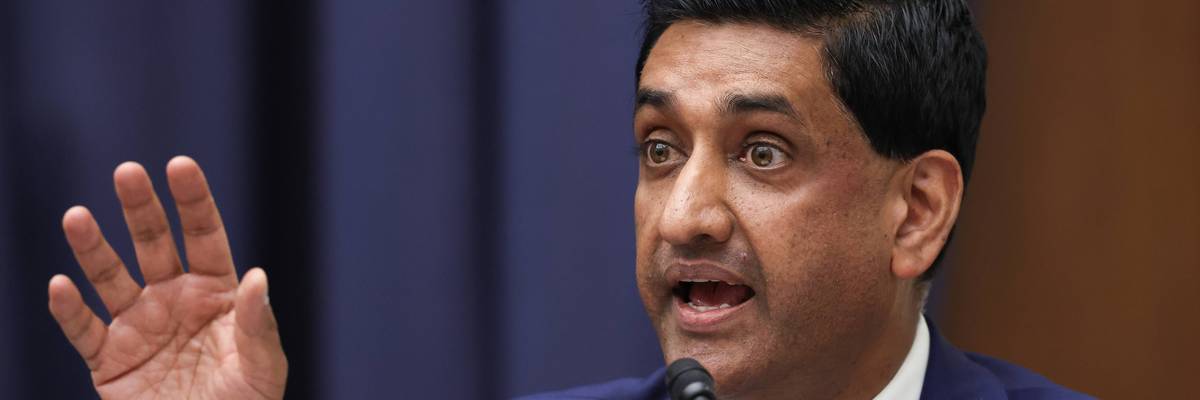
US Rep. Ro Khanna (D-Calif.) questions US Secretary of Defense Pete Hegseth as he testifies before the House Armed Services Committee on April 29, 2026 in Washington, DC.
(Photo by Win McNamee/Getty Images)
“We should be the party that says ‘Donald Trump, end this war, we’re going to support the negotiation’—and then we’re not going to get into these wars in the future.”
Congressman Ro Khanna on Tuesday suggested Democratic voters who believe the party lacks “principles,” as a number of respondents said in a new poll, have understandable questions about what Democrats stands for, as he denounced recent comments from several lawmakers who have attacked President Donald Trump for not being hawkish enough when it comes to the war he started in Iran.
“People want a Democratic Party that’s going to stand for things, that stands as the party that’s anti-war,” Khanna told Chris Hayes on MS NOW.
“And we should be the party that says, ‘Donald Trump, end this war, we’re going to support the negotiation’—and then we’re going to not get into these wars in the future,” he added.
Khanna accused his colleagues of sending the message: “Donald Trump, go blow up more things! Why aren’t you destroying more of Iran?”
“I’m not one of those Democrats,” said the congressman, who introduced a war powers resolution with Rep. Thomas Massie (R-Ky.) to stop Trump from launching unauthorized strikes against Iran. “I’m one of the people saying, ‘Yes, let’s get a negotiated settlement. Let’s work toward ending this war.’”
“The Democrats should be for ending this war and be against more of these foreign interventions,” said Khanna. “The last thing we want is to goad Donald Trump into getting us into more conflict there.”
"We should be the party that says 'Donald Trump, end this war, we're going to support the negotiation' — and then we're not going to get into these wars in the future" @RoKhanna to @ChrisLHayes on some Dems attacking Trump from the right over Iran dealpic.twitter.com/Rxbd7e1iJ6
As examples of what Khanna is talking about, influential Democrats including Rep. Debbie Wasserman Schultz (D-Fla.) and Sens. Cory Booker (D-NJ) and Chris Murphy (D-Conn.) have spent the last several days provoking the president over Iran, and by complaining that the deal to end the war isn’t tough enough on the country, which the US and Israel began preemptively attacking in February in violation of international law.
More than 3,400 people have been killed in Iran since the war started, while Israel has expanded hostilities to Lebanon, killing more than 3,000 people. The casualties in Iran have included about 150 people, mostly children, who were killed in an attack on a girls’ school when the war started; Amnesty International has called for the US to be held to account for the bombing. A number of other schools have also been attacked, as well as medical facilities.
Despite the carnage—as well as the economic impact of war, which Iran swiftly responded to by effectively closing the Strait of Hormuz, a key oil shipping route, and sending oil prices skyrocketing—Booker on Sunday debuted what Just Foreign Policy executive director Erik Sperling called “Democrat neocon talking points” regarding reports of an impending peace deal.
The senator said reports of the deal—including the reopening of the strait, a lift of US sanctions allowing Iran to sell oil freely, and an apparent agreement to hold formal talks on Iran’s nuclear program later—had him “outraged.”
“The president said he went into this to deal with the nuclear program. This does not deal with that,” said Booker, adding that the easing of sanctions of Iran would allow them to get “billions more” dollars.
“Giving Iran more money, as he has said, will allow them to do things like fuel their terrorist proxies,” the senator added.
His comments were followed by Wasserman Schultz’s interview on the same network Tuesday, when she said she was “concerned and frustrated over, again, another potential deal, a negotiation for a negotiation, where we’re going to unfreeze Iranian assets” and allowing Iran to “rebuild their ballistic missile program.”
Another Democrat comes out to the right of Trump, criticizing US-Iran negotiated deal to end the war:
"We're going to unfreeze Iranian assets and give them billions of dollars to be able to control proxies again?"
Booker has taken more than $800,000 from pro-Israel groups including the American Israel Public Affairs Committee, while Wasserman Schultz has taken more than $1.4 million.
Murphy also condemned the reported deal on social media Sunday, saying that Trump “hasn’t accomplished ANY of his constantly shifting goals.”
“Iran still has its ballistic missile and drone program,” he said. “They still have a navy that can close the strait. A hardline regime is still in charge.”
Jeet Heer of The Nation said that because the war on Iran “is immensely unpopular… prominent Democrats want to outflank Trump by being more hawkish.”
Historian and analyst Stephen Wertheim credited Khanna with articulating “what the vast majority of Democrats believe, but too few of their leaders say and mean.”
A March poll by Pew Research Center found that nearly 90% of Democrats and Democratic-leaning independents said the Trump administration had made the wrong decision going to war against Iran.
Khanna also spoke to Fox News over the weekend, saying he would support all efforts by Trump to negotiate a peace deal with Iran and expressing approval of the president’s apparent rejection of the “Lindsay Graham wing of the party,” referring to the South Carolina Republican, an outspoken advocate for military intervention in Iran and elsewhere.
People receive groceries from a food bank on October 30, 2025 in Miami, Florida.
(Photo by Joe Raedle/Getty Images)
A new analysis warns that large-scale loss of food assistance is “jeopardizing the short- and long-term health, education, and economic benefits of nutrition programs for our children and society.”
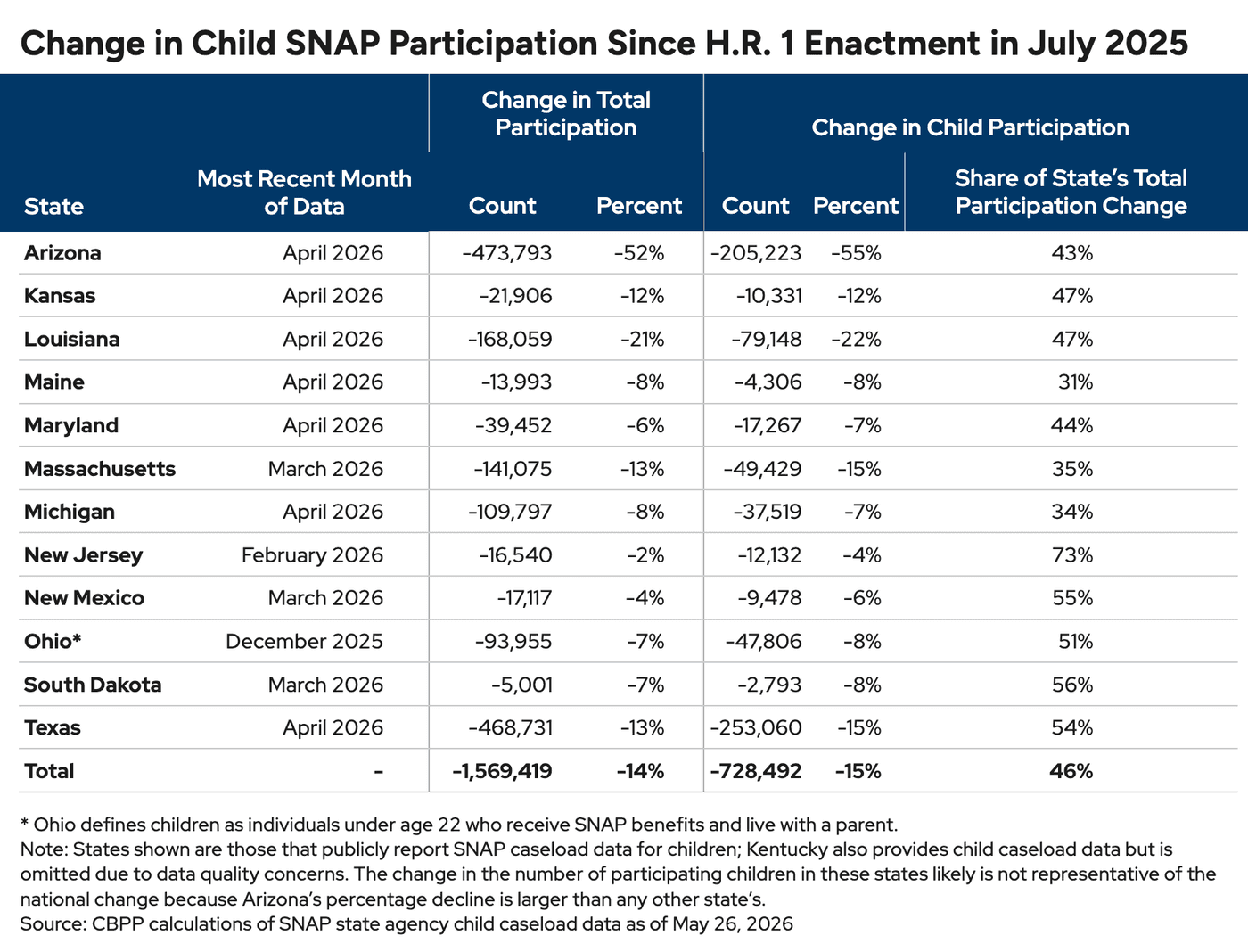
The budget package that US President Donald Trump and congressional Republicans rammed through last summer has already spurred large-scale loss of nutrition assistance among low-income children, with an analysis released Wednesday estimating that more than 700,000 kids across a dozen states have lost federal food aid since the GOP law took effect.
The Center on Budget and Policy Priorities (CBPP), a liberal think tank, found that the “sharp participation declines” among children likely stem from provisions of the Republican law that—for the first time in the program’s history—shift large Supplemental Nutrition Assistance Program (SNAP) benefit costs onto states. The law also expands punitive SNAP work requirements.
The new analysis notes that children account for “nearly half of the 1.6-million-person decline” in SNAP enrollment since last July among people of all ages in the 12 states with data available.
“The new law’s cost shift has led states to take steps that are making it harder for eligible people to receive SNAP, including families with children,” CBPP explained. “Losing SNAP also makes it harder for low-income children to qualify for other food assistance, such as WIC and free school meals—jeopardizing the short- and long-term health, education, and economic benefits of nutrition programs for our children and society.”
Republican lawmakers repeatedly denied that their legislation would strip food aid from needy children, with House Speaker Mike Johnson (R-La.) saying the package was laser-focused on “fraud, waste, and abuse.”
“We are not cutting SNAP,” Johnson falsely claimed in May 2025, just over a month before Trump signed the Republican legislation into law. The package will cut $186 billion from SNAP over the next decade and strip food aid from millions of low-income people, according to the nonpartisan Congressional Budget Office.
Katie Bergh, a senior policy analyst at CBPP, emphasized that the SNAP cuts triggered by the Republican law have not “fully taken effect,” meaning recent benefit losses among families across the country are just the start unless Congress moves quickly to avert disaster.
“Congress must act before even more eligible low-income families—including families with children—lose the food assistance they need to afford groceries, starting by delaying this SNAP cost shift for all states,” Bergh wrote on social media.
The Trump-GOP cuts to SNAP, combined with rising grocery costs stemming in large part from the president’s tariffs and war of choice against Iran, have resulted in surging food bank demand across the country.
“We’ve been going to food banks every week,” a single mom in Arizona whose SNAP benefits were recently cut off told NBC News. “We’re eating less, we’re eating more frozen stuff.”
Far from reversing course on their assault on federal nutrition assistance, Republicans and the Trump administration are doubling down, pursuing massive cuts to fruit and vegetable benefits for low-income mothers. CBPP has projected that roughly 5.4 million people would lose fruit and vegetable aid if Republicans’ newly proposed cuts become law.
Our work is licensed under Creative Commons (CC BY-NC-ND 3.0). Feel free to republish and share widely.
The former AOC staffer is an at-times divisive figure known for provoking the political establishment. Sunrise argues he’s needed in Congress to take on Trump.
Saikat Chakrabarti during a candidate forum for California’s 11th Congressional District in San Francisco on Jan. 7, 2026. Photo: Scott Strazzante/San Francisco Chronicle via Getty Images
The Sunrise Movement is leaning into its roots in climate activism with a congressional endorsement of Saikat Chakrabarti, the former chief of staff to Rep. Alexandria Ocasio-Cortez, D-N.Y., and one of the architects of the landmark environmental legislation known as the Green New Deal.
The youth climate group shared its endorsement with The Intercept with early voting underway in California and less than a week to go before primary day. Chakrabarti will face off against state Sen. Scott Wiener and San Francisco Board of Supervisors member Connie Chan, both Democrats, in a heavily contested primary race to succeed Democratic former House Speaker Nancy Pelosi in California’s 11th Congressional District.
“For years, the Sunrise Movement has shown us the power that people like all of us have when we organize strategically,” Chakrabarti wrote in a statement to The Intercept. “Together with Sunrise, we pushed Washington to respond to the needs of working people when most Democrats (and of course Republicans) refused to do so. We were able to change political reality in Washington, and we’ll do it again.”
Chakrabarti rose to national prominence after co-founding Justice Democrats in 2017 alongside other former presidential campaign staffers for Sen. Bernie Sanders, I-Vt., to support progressive primary challengers to establishment Democrats. He has been a thorn in the side of moderate Democrats ever since.
Chakrabarti became Ocasio-Cortez’s firstchief of staff after her upset victory over longtime incumbent Rep. Joe Crowley in 2018, a win that helped put Justice Democrats on the map and ushered in the first members of the progressive Squad in Congress. In Ocasio-Cortez’s office, he worked with the Sunrise Movement and other stakeholders to draft the Green New Deal. Elements of the bill were later included in the Biden-era Inflation Reduction Act, which invested $369 billion in fighting climate change but ultimately fell short of progressives’ loftiest ambitions.
Chakrabarti has long espoused progressive views and is expected to vote with Ocasio-Cortez and the rest of the Squad if elected to Congress. But despite his prominent role in Ocasio-Cortez’s early rise, his former boss has not endorsed Chakrabarti. That has driven speculation of a rift, which the candidate has continuously denied. Progressive Reps. Rashida Tlaib, D-Mich., and Ilhan Omar, D-Minn., have endorsed Chakrabarti, as has former Rep. Jamaal Bowman, D-N.Y. Justice Democrats, the group Chakrabarti helped found, is also backing his campaign.
After leaving Ocasio-Cortez’s office, Chakrabarti went on to lead New Consensus, a progressive environmental policy think tank that recently released the Mission for America, which he bills as a “successor” to the Green New Deal. The policy proposal seeks to “rapidly slash emissions” and help “build a new, clean economy” to protect workers against the threat of job cuts driven by the rise of artificial intelligence.
“We’re proud to endorse Saikat Chakrabarti. Saikat has spent years fighting for the Green New Deal, taking on corporate power, and delivering for working people, not billionaires and special interests,” Aru Shiney-Ajay, executive director of the Sunrise Movement, wrote in a statement to the Intercept.
The climate justice group pivoted this cycle to emphasize its explicit opposition to President Donald Trump and sees Chakrabarti as a candidate “ready to fight back with courage and vision,” Shiney-Ajay added. “We know he’ll be instrumental in helping build a Democratic Party that is unapologetically for working people, serious about confronting the climate crisis, and ready to take on authoritarianism head-on.”
We’re independent of corporate interests — and powered by members. Join us.
Chakrabarti has relished his role as an opponent of entrenched political power. He has long antagonized the 20-termcongresswoman he seeks to replace, slamming her in a series of 2019 tweets after then-House Speaker Pelosi penned an op-ed critical of AOC, who at the time was Chakrabarti’s boss. (Pelosi and Ocasio-Cortez, who hold divergent ideologies but are both known for their political savvy, have built bridges in the years since.)
While running for her seat, Chakrabarti has continued to provoke Pelosi, calling her out in a recent video after she endorsed Chan against him. He launched his campaign to challenge Pelosi before she announced her retirement in November, unlike his two opponents, who jumped in once it was clear they’d be competing for an open seat.
“My goal, honestly, is to replace a huge part of the Democrat establishment,” Chakrabarti said in November during an episode of the Intercept Briefing. “I’m calling for primaries all across the country. … I think we actually have to get in there and be in a position of power where we can do all that, so it’s not going to be this constant compromising with the establishment, trying to figure out how we can push.”
Politics is Chakrabarti’s second act. The tech entrepreneur made millions as a founding engineer of the payment process platform Stripe.
But in the tech-dominated district where Pelosi won reelection with 81 percent of the vote last cycle, Chakrabarti faces an uphill battle. Wiener, a state senator who has the support of the California Democratic Party, has a clear lead over both Chan and Chakrabarti, who appear to be neck and neck for second place. The top two candidates next Tuesday will advance to the general election in November.
“I believe we can improve the material lives of working people and build a future we all actually want to live in,” Chakrabarti told The Intercept. “I’m grateful to the Sunrise Movement for joining our coalition, and I look forward to working with them again in Congress.”
New York Times Opinion and The New York Times May 21, 2026 Sexual violence by Israeli forces against Palestinians is widespread, according to new reports and harrowing first-hand accounts. The Opinion columnist Nicholas Kristof details a pattern of systemic abuse and “unrestrained power” within Israeli detention centers that challenges the moral silence of the international community. Read Kristof’s column here: https://www.nytimes.com/2026/05/11/op… Read a Q&A about his column here: https://www.nytimes.com/2026/05/21/op…
By Nicholas Kristof
May 11, 2026 (NYTimes.com)
Transcript:
Sexual violence by Israeli forces against Palestinians is widespread, according to new reports and harrowing first-hand accounts. The Opinion columnist Nicholas Kristof details a pattern of systemic abuse and “unrestrained power” within Israeli detention centers that challenges the moral silence of the international community.
When Israel was attacked on Oct. 7, 2023, officials were quick to condemn the sexual violence of Hamas. “You’ve heard of the rape of Israeli women. Where the hell are you?” “Women raped, assaulted, paraded as trophies.” “Uses rape as a weapon of war.” “Sexual violence as a weapon of war by Hamas.” I went to the West Bank to talk with Palestinians who experienced sexual assault firsthand by Israeli soldiers, settlers and prison guards. Their harrowing accounts, backed by lawyers, surveys and international reports, suggest that sexual violence by Israelis against Palestinians is widespread. And that raises the question: Where is the revulsion against sexual assault now? I don’t see any evidence that Israeli leaders order rape, but they have built a security apparatus where, according to a 2025 United Nations report, sexual violence is a a major element in the ill-treatment of Palestinians. Prime Minister Netanyahu has called accusations of sexual violence by Israelis baseless. But my reporting suggests that sexual violence has greatly worsened under Netanyahu in recent years. What exactly does this look like? Here’s what I found. This is Sami al-Sai, a freelance journalist for international news organizations. They [prison guards] took me to a solitary cell, while handcuffed, leg cuffed and blindfolded. They put me on the ground in kneeling position with head down. They took off my pants and boxers, and started raping me with sticks and carrots in a very aggressive and painful way and harassing and touching my genitals in a very painful and forceful way. I spoke to a farmer who recounted how 20 settlers rampaged through Palestinian homes and used a hunting knife to cut off his clothes. I got out of the tent. I was standing right here. They pulled me inside. They used those zip ties, tied my hands with more than one zip tie. They tied my legs too. Hit me in the eye with a fist. They pulled me inside right here and started pouring dirt on me and water. They took off my pants and zip tied my penis and started pulling it. The zip ties were still on the ground when I visited. And this is Mohammad Matar, a Palestinian Authority official —— —— who says he was with two other Palestinians trying to protect a Bedouin village under attack from settlers when the settlers seized them, stripped them, beat them. And he says one tried to rape him with a stick. And he actually has some evidence of this interaction with the settlers in the form of a photo that the settlers posted to social media. One woman, 23 at the time of her detention, told me that she was regularly stripped naked, forcibly bent over and groped all over her body by male and female guards. One journalist said he had been held down and raped by a dog, a claim backed by other accounts from prisoners who report they underwent the same thing. I’m appalled by this pattern of abuse, partly because our American tax dollars subsidize the Israeli security forces. I fear that leaves us complicit. The United States has leverage, and we could use it to insist on an end to the impunity and to demand that Red Cross visits be restored for Palestinian detainees. Look, whether you consider yourself pro-Israeli or pro-Palestinian, here’s one thing we should be able to agree on: We’re anti-rape. The horrific abuse inflicted on Israeli women on Oct. 7 now happens to Palestinians day after day after day.
By Sophia Bollag, Staff Writer May 24, 2026 (SFChronicle.com)
Gift Article
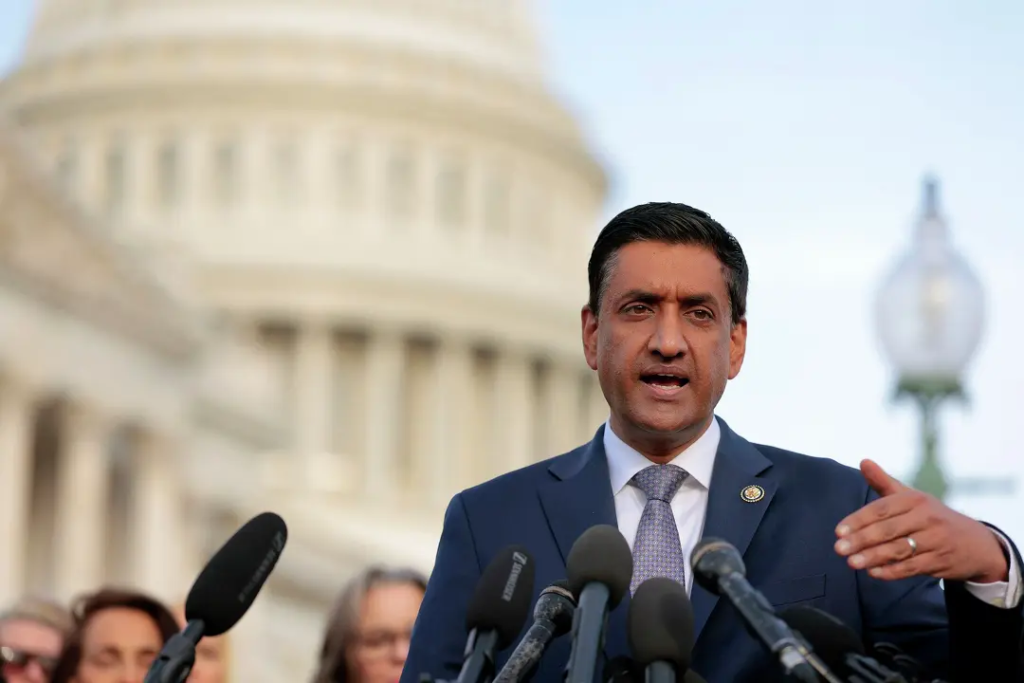
Rep. Ro Khanna, D-Santa Clara, shown discussing the Epstein files outside the U.S. Capitol last November, called for Supreme Court reforms Sunday during an appearance on NBC’s “Meet the Press.”Heather Diehl/Tribune News Service
In the wake of the Supreme Court’s latest move to gut the Voting Rights Act, Rep. Ro Khanna, D-Santa Clara, says his party needs to run on reforming the court in upcoming elections.
“We are not speaking up loudly enough, strongly enough against a court that is really rolling back civil rights,” he told journalist Kristen Welker on NBC’s “Meet the Press” Sunday morning. “The Democratic Party needs to run against this court.”
But in the long run, the Supreme Court’s ruling, which struck down a majority-Black congressional district in Louisiana and eviscerated a key provision of the Voting Rights Act of 1965, paved the way for Republicans to eliminate other majority-Black districts across the South. The ruling is already allowing Republicans to make some districts more favorable to their candidates in this year’s midterms and has the potential to dramatically tip the congressional map in their favor in 2028.
It’s the latest in a series of decisions by the Supreme Court, which comprises six conservatives appointed by Republican presidents and three liberals appointed by Democratic presidents, that are likely to benefit Republicans.
Khanna said his party should seize on that decision and advocate for creating term limits for Supreme Court justices, giving each president two appointees to the court and expanding the court from nine to 13 justices. Such extensive reform has faced opposition from establishment Democrats. Many legal scholars say imposing term limits would require an amendment to the Constitution.
Khanna dismissed calls for Ken Martin, the leader of the Democratic National Committee, to resign, but said the party needs to take a different approach to win elections.
“We do need to recognize that the status quo has failed, that this is a system that has created massive inequality, that the economy is lopsided and unfair,” he said. “Too often we’ve run status quo establishment candidates who have been unwilling to call out an economic and political system that has failed.”
Khanna pointed to his work, alongside Republican Rep. Thomas Massie of Kentucky, to force the release of the Justice Department’s files on sex offender Jeffrey Epstein as a victory that has put the president on his back foot. Both Khanna and Massie cited that effort as a reason Trump was motivated to back a Republican challenger to Massie in his Kentucky district.
Trump’s decision to back a primary challenger to a sitting congressman from his own party succeeded Tuesday, when Massie lost his bid for reelection. But the move has already started to backfire on Trump.
Another Republican who lost his primary to a Trump-backed challenger, Sen. Bill Cassidy of Louisiana, joined Democrats last week in backing a measure to rein in Trump’s power to wage war on Iran. A similar measure backed by Massie looked likely to pass in the House on Thursday if Speaker Mike Johnson, R-La., had not canceled the vote.
And Massie, who no longer has an incentive to align himself with Trump, has already promised to continue pushing the administration to release more Epstein files during the time remaining in his term.
“For me, it was completely worth it,” Massie told Welker on Sunday when she asked whether he regretted opposing the president. “I’ve got seven more months to keep going against the grain, which means voting for principles and for people over party.”
Sophia Bollag joined the San Francisco Chronicle as a politics reporter in 2022. She has covered state government from Sacramento since 2016 and has worked at The Sacramento Bee, The Associated Press and the Los Angeles Times. She grew up in the East Bay and graduated from Northwestern University, where she studied journalism and literature.