In death, Jeffrey Epstein has managed to do something no one else has been able to – drive a wedge between Donald Trump and his loyal base.
Releasing the so-called “Epstein files” was one of the campaign promises that resonated most with Donald Trump’s supporters.
The files, 300 gigabytes of data and physical evidence of the vile crimes of billionaire pedophile Jeffrey Epstein, have long been thought to contain the names of others in his depraved network.
Despite his friendship with Epstein, Trump has long positioned himself as the person capable of exposing the dark secrets contained in the files. But last month, after teasing the release of the files, the President and his administration backflipped.
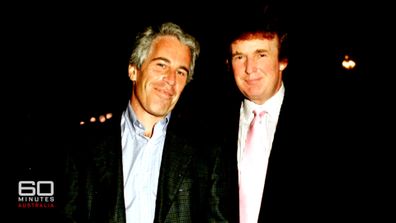
Jeffrey Epstein and Donald Trump were often seen together at parties and events. (60 Minutes)
The fallout has spiralled into a full-blown scandal that, for once, Donald Trump can’t seem to shake.
A soured friendship
In the 1990s Trump and Epstein were well known as men about town. One a notorious property developer, the other a wealthy financier, the pair were pictured together at parties and events from New York to Florida. Epstein was even invited as a guest to Trump’s wedding to Marla Marples in 2002.
By 2006 though, Epstein had been exposed as a paedophile and convicted of child sex trafficking. It would be years before the full extent of his depravity was revealed.
“I threw him out.”
Donald Trump has long denied knowing anything about Epstein’s crimes, and insists he ended the friendship many years ago.
“For years I wouldn’t talk to Jeffrey Epstein… and I threw him out of the place, persona non grata, I threw him out,” Trump told reporters recently.
But the friendship between the two men is now under renewed scrutiny due to President Trump’s handling of the Epstein files.
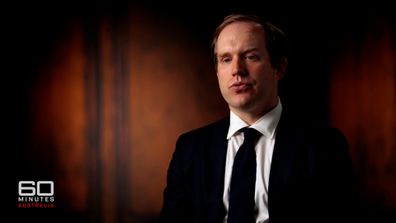
Seasoned political reporter and author Will Sommer told 60 Minutes many Americans voted for Trump because of his promise to declassify the files and “expose” the Washington elites.
Political reporter and author Will Sommer told 60 Minutes many voters made their decision based on Trump’s promises around the Epstein files. (60 Minutes)
“Trump supporters see Jeffrey Epstein as the devil,” he said.
“They also see him, as perhaps, someone who was the key to this larger network, this guy who was, in their belief, providing young girls to world elites.”
Many believe the names of who was in that network lie in the ‘Epstein files’ – more than 300 gigabytes of data and physical evidence of the vile crimes committed against more than 1000 girls and young women.
Earlier this year, Donald Trump was briefed by his attorney-general, Pam Bondi, on the fact his name appeared several times in the files, but it’s unclear in what capacity.
“So as a result people – even Trump supporters – are starting to say, you know, jeez, this is really suspicious,” Mr Sommer said.
A disturbing encounter
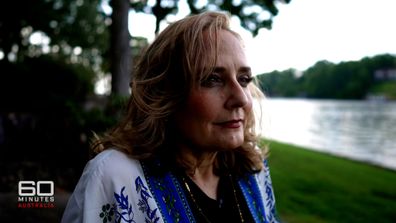
Among those with suspicions is Maria Farmer, who was hired, and abused by Jeffrey Epstein in the mid-1990s. During that time, Maria says she witnessed first hand how close her boss was to Donald Trump.
Speaking with 60 Minutes, Maria claims she had a disturbing encounter with Donald Trump in Epstein’s Manhattan office late at night in 1995.
Maria Farmer worked for Jeffrey Epstein in the mid 1990s. (60 Minutes)
Maria claims Epstein summoned her to the office, where she first met Trump. She says after she arrived, Trump walked in and looked at her with a “Cheshire grin”, to which she made the “ugliest face” she could think of.
Maria claims Epstein “thought it was adorable”. He then, according to Maria, told Trump “she’s not here for you,” and took him out of the room.
“So he escorts Trump into this other room and Trump utters under his breath, he mutters, “Oh, I thought she was 16,” and I thought that was just really weird,” she told 60 Minutes.
“It was beyond locker room talk.”
Maria says she reported Epstein and his accomplice, Ghislaine Maxwell to the FBI in 1996 and mentioned Donald Trump as someone who associated with the pair, but says authorities did nothing. She is now suing the US government for failing to protect her.
The White House contested Maria’s version of events and said Trump ‘was never’ in Epstein’s office.
A turning support base
Donald Trump has been particularly adept in his ability to endure scandal. In the last five years, the President has faced 91 felony counts, four criminal indictments, two impeachment trials and in a civil case has been found liable for sexual abuse.
Some MAGA supporters have turned on President Trump over his broken promise. (60 Minutes)
Yet, last November a majority of Americans still voted for him to lead them. But, with the promise of exposing Jeffrey Epstein’s darkest secrets as a significant campaign platform, many voters have been left feeling betrayed.
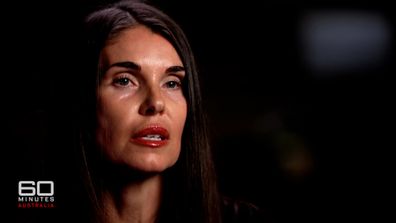
Among them is Teresa Helm, who was lured into Jeffrey Epstein’s dark orbit when she went for a job interview in 2002 at just 22 years old. At the time, Teresa was studying massage at a Los Angeles college.
Teresa says she was sexually assaulted by Epstein but it was years before she realised she was one of hundreds of young women ensnared in his depraved world.
“It was definitely systematic. Everything was pre-planned, prearranged, organised,” she told 60 Minutes.
Teresa Helm voted for Trump in last year’s election based on his promise to declassify the Epstein files. (60 Minutes)
“It’s impossible to do everything that they’ve done and harmed as many people as they have harmed without help … so, who are they?”
Teresa voted for President Trump in last year’s election because she believed he would expose Epstein’s wider network. And she’s not alone – videos posted on social media show supporters burning MAGA hats in response to Trump’s bumpy handling of the scandal.
“I think that that comes certainly when you make statements and promises and then you walk it back,” Teresa said.
What’s next for Donald Trump?
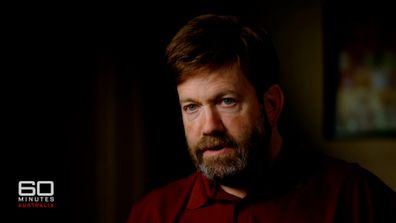
Pollster and political analyst Frank Luntz has done more focus groups with Trump voters than just about anyone in the United States. So he knows why, even in the face of scandal, Trump’s base is unshakeable.
“Donald Trump is the ultimate survivor.”
“His own voters aren’t voting for him because of his character. They’re voting for him because he’ll bring about the change they want and they need, and frankly, they deserve,” he told 60 Minutes.
While Luntz thinks his supporters are concerned about the President’s mishandling of the Epstein files, he doesn’t believe it will have a meaningful impact.
Frank Luntz says Donald Trump’s mishandling of the Epstein files may not harm him in the long-term. (60 Minutes)
“Donald Trump is the ultimate survivor, and I expect nothing different about this current situation.”
Will Sommer is not as convinced. He told 60 Minutes that Trump’s handling of the files has prompted serious questions from his supporters.
“It looks like he’s covering something up that he’s either covering up his relationship with a wealthy paedophile or that he’s maybe covering up for one of his friends,” he said.
“I think it will be a huge hit to his political capital and his prestige. I think this is a serious issue.”
“And I think it’s gonna haunt the 2028 presidential race too.”
BEVERLY HILLS, California, Aug 16 (Reuters) – Director Spike Lee’s multi-part documentary series for ESPN Films about former NFL quarterback Colin Kaepernick, who sparked a national debate when he protested racial injustice nearly a decade ago, will not be released, the filmmaker and ESPN said.
“ESPN, Colin Kaepernick and Spike Lee have collectively decided to no longer proceed with this project as a result of certain creative differences,” ESPN said in a statement to Reuters on Saturday.
The Reuters Daily Briefing newsletter provides all the news you need to start your day. Sign up here.
“Despite not reaching finality, we appreciate all the hard work and collaboration that went into this film.”
Lee told Reuters on Friday that the series was not going to be released.
“It’s not coming out. That’s all I can say,” Lee said on the red carpet ahead of the Harold and Carole Pump Foundation dinner, a fundraiser for cancer research and treatment, in Beverly Hills, California.
Asked why, the Oscar-winning director declined to elaborate, citing a nondisclosure agreement.
“I can’t. I signed a nondisclosure. I can’t talk about it.”
Kaepernick played for the San Francisco 49ers from 2011 to 2016. He ignited a national debate in 2016 when he knelt during the U.S. national anthem to protest systemic racism and police brutality.
The 37-year-old athlete has not played in the NFL since that season. Many experts believed his political activism, which triggered a movement that drew the ire of U.S. President Donald Trump, was the key reason teams were wary of signing him.
He later filed a collusion grievance against team owners, which was settled with the league in 2019.
A representative for Kaepernick said the player had no comment about the docuseries on Saturday.
Production on the series began in 2022, with Walt Disney-owned (DIS.N), opens new tab ESPN touting it as a “full, first-person account” of Kaepernick’s journey that would feature extensive interviews with the player.
In September, Puck News reported the project faced delays amid disagreements between Kaepernick and Lee over the direction of the film, and that ESPN Chairman Jimmy Pitaro was open to allowing the filmmakers to shop it elsewhere.
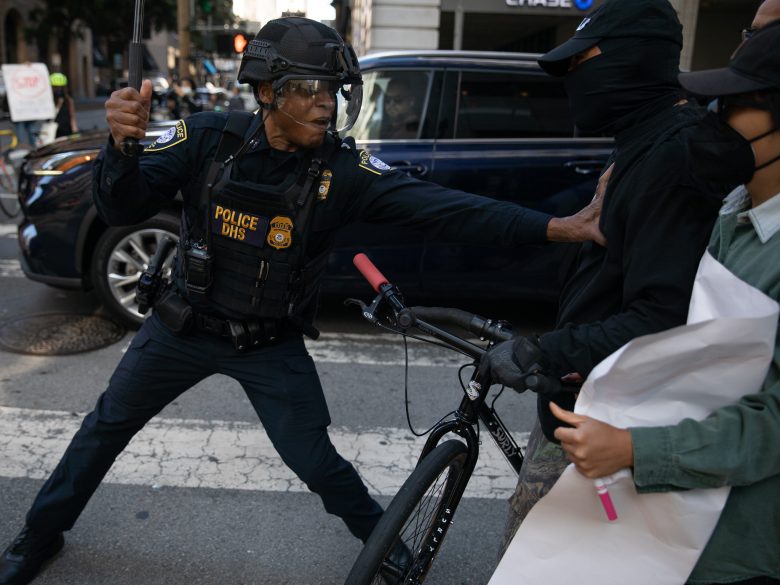
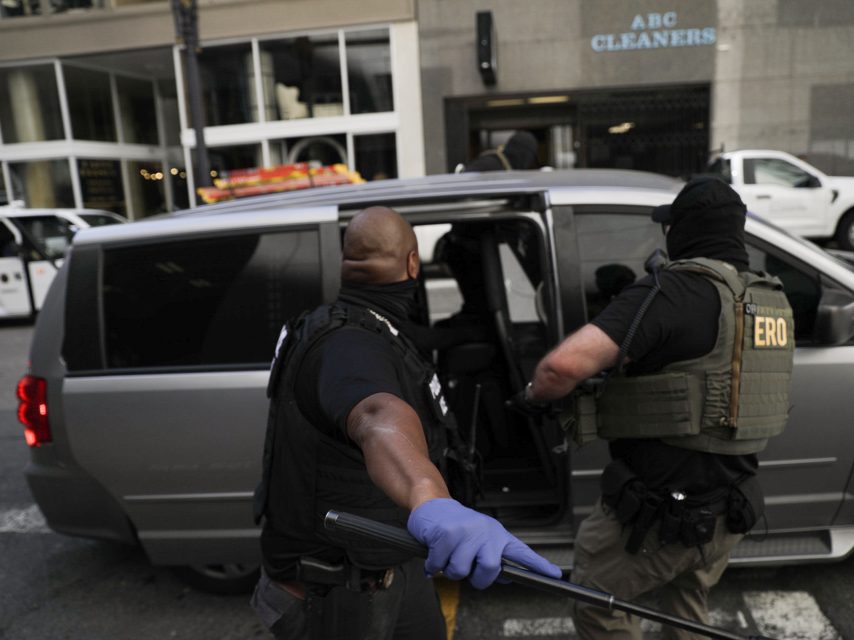
Federal immigration agents pepper-sprayed protesters and a reporter in San Francisco on Wednesday after arresting an asylum-seeker in immigration court that morning.
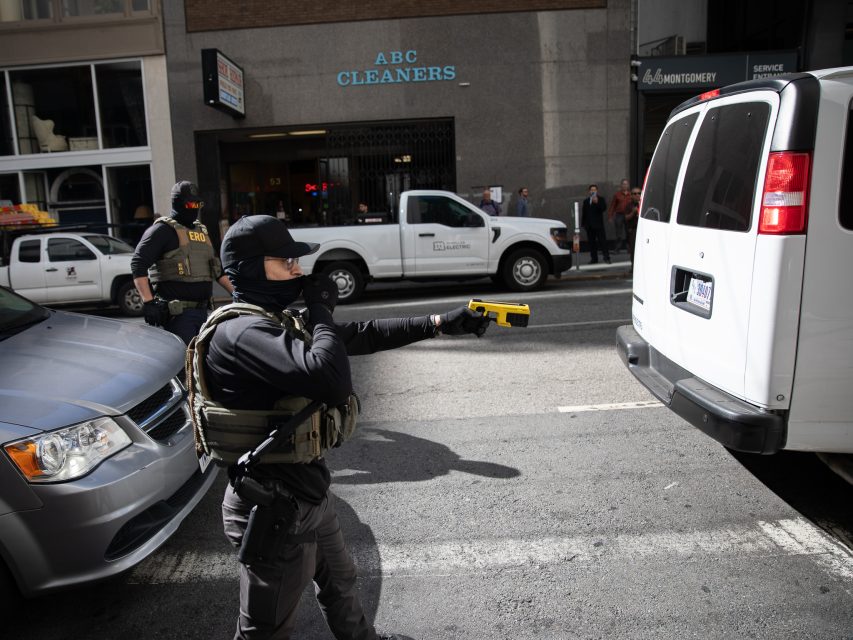
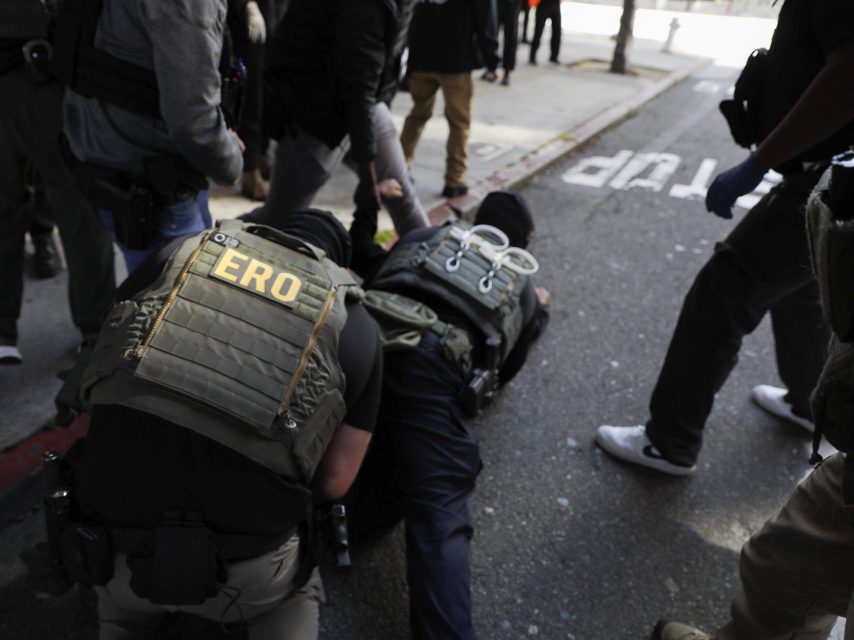
In a chaotic street scene caught on video, the agents pulled out batons and tasers and tackled several protesters to the ground, detaining at least one.
As has become routine, Immigration and Customs Enforcement agents arrested an asylum-seeker after a hearing at San Francisco’s immigration court, and were transporting them to their headquarters a half-mile away when protesters intervened.
Want the latest on the Mission and San Francisco? Sign up for our free daily newsletter below.Sign up
ICE officers encountered about 20 people who had gathered outside the court at 100 Montgomery St. Immigrants legally seeking asylum have been routinely arrested after their court hearings and flown to far-flung detention centers, and protesters often congregate outside court.
https://videopress.com/embed/yo4w44hk?cover=1&preloadContent=metadata&useAverageColor=1&hd=0Protesters captured chaotic scenes outside San Francisco immigration court on Wednesday, as ICE agents tackled several people to the ground.
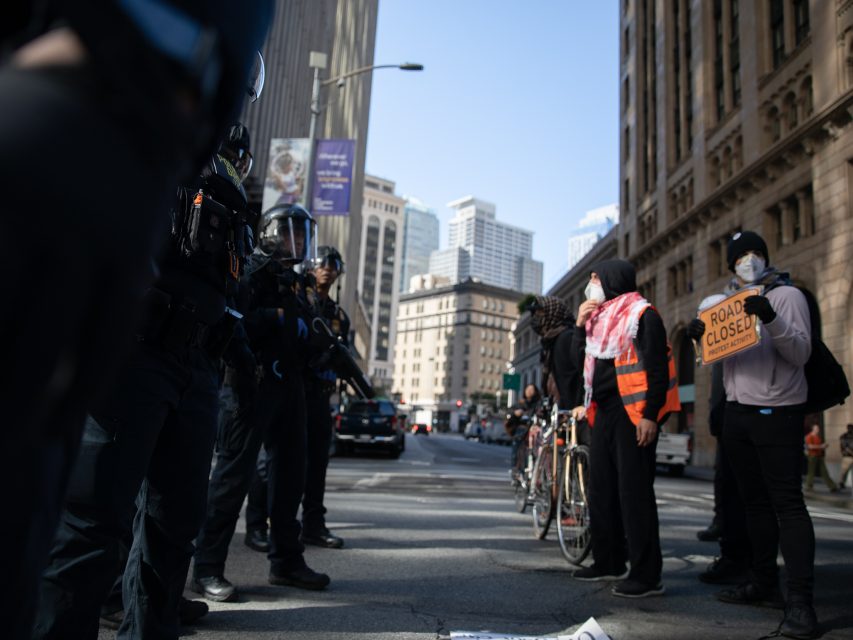
Witnesses said the two sides squared off — protesters trying to stop the vehicles, and ICE agents trying to get through.
“This car has ICE in it!” one protester yelled. “ICE is not welcome in San Francisco!” said another through a bullhorn as protesters stood in front of a silver minivan holding signs reading, “Stop your car to block ICE.”
Video shows masked ICE agents disembarking from the minivan and wielding batons to push the protesters aside.
“The protesters and the ICE agents were facing off … and there were probably like 30-40 passers by, stopped, staring, filming,” said Zenobia Pellissier Lloyd, a freelance photographer and former Mission Local intern.
Pellissier Lloyd said traffic and a Muni bus had effectively blocked the ICE vehicles in. The ICE vehicles then turned around and sped down a one-way street, she said.
ICE agents arresting a protester in downtown San Francisco at what have become common anti-ICE actions, on Aug. 20, 2025. Photo by Tyler Morris.
Video shows the protesters then chasing the van down the street.
About a dozen ICE agents headed toward 630 Sansome St., the ICE headquarters about a half mile away, followed by protesters. Pellissier Lloyd said the crowd shouted after them.
“It was just, ‘Shame! Shame! Shame!’ Someone had a megaphone saying, ‘These are ICE agents kidnapping our neighbors,” she said. “It was just a lot of, ‘What are you so afraid of? … How do you sleep at night? What will your children think of you?’”
ICE agents in downtown San Francisco on Aug. 20, 2025. Photo by Zenobia Lloyd.
The ICE agents were “holding each other’s arms, hands on each other’s shoulders, saying “Stay close, stay close,” Pellissier Lloyd said. “They were blocking cameras, they were randomly lashing out at people … They all had their weapons out, tasers ready.”
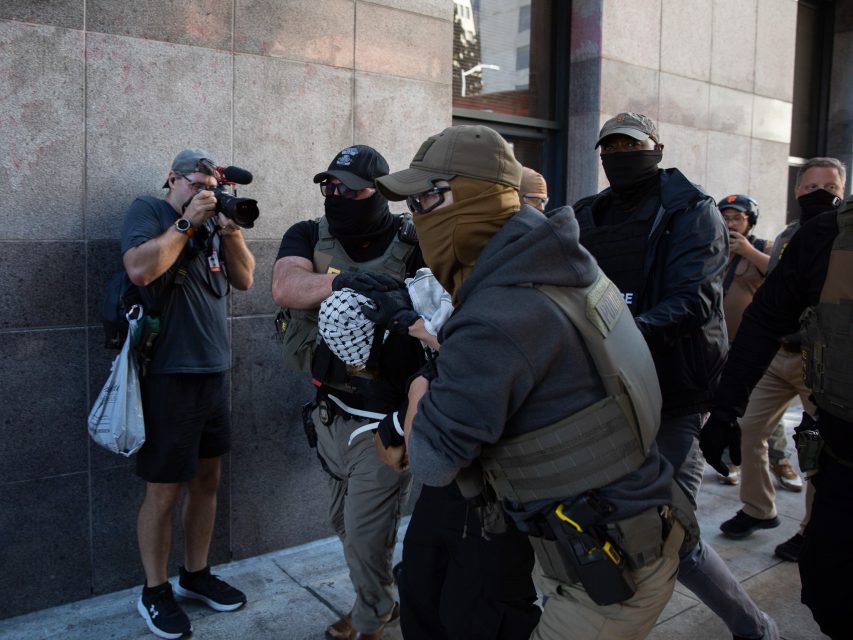
Several videos show ICE agents tussling with protesters, tackling at least four to the ground, zip-tying several, and pointing their tasers. At one point, an ICE agent “decides to turn and pepper-spray four people” about a block from the ICE headquarters, Pellissier Lloyd said.
One of them was a reporter with the online news site Gazetteer, who wrote that he was hit directly and “fell to the ground.”
“In a literal second, the agent pulled out his pepper gel, sprayed the protester next to me, and then shot a stream straight into my eyes,” the reporter, Eddie Kim, wrote.
ICE agents and protesters in downtown San Francisco on Aug. 20, 2025. Photo by Zenobia Lloyd.ICE agents arrest protesters in downtown San Francisco on Aug. 20, 2025. Photo by Zenobia Lloyd.ICE agents in downtown San Francisco on Aug. 20, 2025. Photo by Zenobia Lloyd.ICE agents zip tying a protester on the ground outside 630 Sansome St. on Aug. 20, 2025. Photo by Zenobia Lloyd.
Once the ICE agents arrived at HQ, “I turned and saw one protester on the ground, two ICE agents on top of them, and then dragging them into 630 Sansome,” Pellissier Lloyd said.
Mission Local has reached out to ICE for comment.
Wednesday’s detention marks the second time the Department of Homeland Security has detained a protester in San Francisco recently. On Aug. 8, ICE detained two protesters outside of the field office on Sansome.
Both of the people detained earlier this month were U.S. citizens. It was unclear if the protester detained on Wednesday was.
On Wednesday afternoon, the chaos outside could be felt inside the courtrooms as well.
Mission Local did not see any arrests at afternoon hearings. But one family was visibly shaken.
An asylum-seeker who appeared with two family members — including a child — asked the judge hearing his case, Arwen Swink, if he could appear by video for his next hearing.
“This is very tense for us,” he told Swink in Spanish through an interpreter. “This is the first day I feel afraid.”
A lawyer representing the Department of Homeland Security objected, citing department policy.
In recent months, asylum-seekers have been increasingly trying to appear remotely because of the arrests at San Francisco’s courtrooms.
Swink pushed back on the Homeland Security attorney.
There is “value” to in-person hearings, Swink said. But, the judge added, “many, many” immigrants have said they are afraid.
“The court does not condone using these facilities for any purposes that would generate fear,” Swink said, quickly adding the attorney himself may not be intending to do so.
Swink granted the man’s request to appear remotely in the future.
“Amen,” he said.
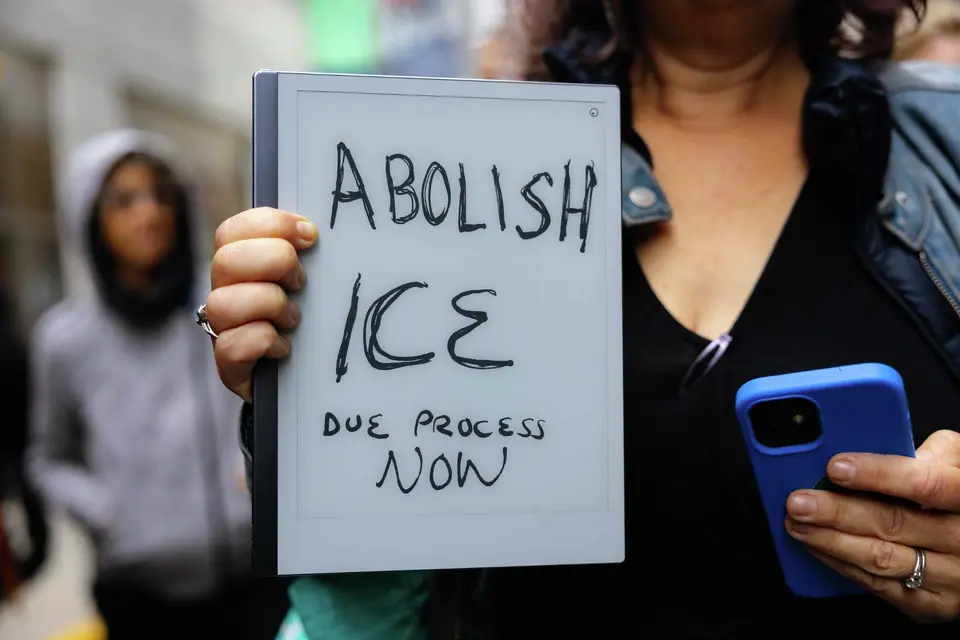
Immigrants like the man who was arrested this morning who are able to quickly connect with an attorney are sometimes released on habeas corpus petitions. Such petitions argue, often successfully in California, that their detention is a violation of their due process rights.
Protesters attempting to block ICE vehicles carrying an immigrant in downtown San Francisco on Aug. 20, 2025. Photo by Zenobia Pellissier Lloyd.
We’re a small, independent, nonprofit newsroom that works hard to bring you news you can’t get elsewhere.
In 2025, we have a lofty goal: 5,000 donors by the end of the year — more than double the number we had last year. We are 20 percent of the way there: Donate today and help us reach our goal!
I’m covering immigration. My background includes stints at The Economist in print and podcasting as well as reporting from The Houston Chronicle and elsewhere.More by Margaret Kadifa
Joe was born in Sweden, where half of his family received asylum after fleeing Pinochet, and then spent his early childhood in Chile; he moved to Oakland when he was eight. He attended Stanford University for political science and worked at Mission Local as a reporter after graduating. He then spent time at YIMBY Action and as a partner for the strategic communications firm The Worker Agency. He rejoined Mission Local as an editor in 2023. You can reach him on Signal @jrivanob.99.More by Joe Rivano Barros
The “Pacific Circuit” author and host of KQED’s Forum is preoccupied with inequity in Oakland. And he’s about to launch a community space that he hopes will become a beacon of resilience.
Containers are lined up near the cranes with a view of the Bay Bridge and San Francisco in the distance at the Port of Oakland on Sept. 26, 2024. Credit: Richard H. Grant for The Oaklandside
Help us tell the Oakland stories that matter to you and your fellow Oaklanders.
Alexis Madrigal’s The Pacific Circuit: A Globalized Account of the Battle for the Soul of an American City is a sweeping history of how the Port of Oakland has impacted West Oakland, its residents, and the city as a whole.
Madrigal centers the story around Ms. Margaret Gordon, co-founder of the West Oakland Environmental Indicators Project. Her family came to the Bay Area during the Great Migration of the 20th century, when millions of Black Americans left the Jim Crow South for the job opportunities and class mobility of the Northeast, the Midwest, and the West. While they found less oppressive conditions than the ones they left, Black people still faced racism, segregation, redlining, and displacement in their new homes, including in Oakland.
Madrigal documents fights by the the woman known by the community as Ms. Margaret to make sure that the predominantly Black residents of West Oakland are not left out of the spoils brought by trade moving through Oakland’s port.
Ms. Margaret Gordon, the co-founder of the West Oakland Environmental Indicators Project. Amir Aziz/The Oaklandside
“One of my central questions in the book was why money could flow through West Oakland in the form of cargo from the port or government dollars or even the drug trade, but it didn’t seem to stick in the area,” Madrigal writes. “Who is making the money that could go to help people in West Oakland?”
Madrigal is best known as a host of KQED’s Forum. He and his wife Sarah Rich are planning to launch Local Economy, a community and event space in Oakland’s Rockridge neighborhood, in October. They already have a lengthy slate of events lined up, including author talks, a cookbook club, board game nights, and art workshops.
The Oaklandside recently sat down with Madrigal outside the Local Economy space to talk about The Pacific Circuit, Oakland’s racial and political dynamics, and the rise of technology. This interview has been edited for length and clarity.
Alexis Madrigal, host of KQED’s Forum and The Pacific Circuit. Credit: Courtesy Alexis Madrigal
Let’s start with Local Economy. What need do you hope the space will fill?
Oakland has a ton of really creative people doing super interesting things, and that is one of the great things about it. I do a whole bunch of different kinds of events, and it feels like there’s some missing anchor points, and, I don’t know, ligaments running in between the different kinds of creative communities here. A big chunk of it was just trying to figure out how we could bring a sense of easy community, and also a space for a whole bunch of the people doing interesting stuff in Oakland to come together in the same place. A lot of people, particularly in this era of history, feel like there’s so much chaos happening at the national level, they feel isolation because of all of our devices, so we wanted to provide an antidote to those things and a beacon of community and resilience.
How are you going to sustain it?
One of the things I’ve noticed in reporting out The Pacific Circuit was that it’s really hard to make a business work if you’re making a coffee for $2 and selling it for $3. The leasing of these spaces is expensive. Everything is just incredibly expensive. So we wanted to build a model that worked with people directly supporting the community space.
In the old days you could have a cafe, you could have a bookstore, it would create this third space and people would be able to take advantage of that, and you’d support the space just by doing transactions. Because of Forum and other things, I talk to a lot of small business owners, and it’s really hard to do that, especially if you want to be able to program things that might only be for 10 people. How do you do that? Or you want to be able to bring art workshops that aren’t going to be super expensive for people. So the method we came up with is to have these monthly membership dues, which is in some ways new for this type of space, but also isn’t at all.
Think about the Italian social clubs of Temescal. There used to be so many different kinds of membership organizations that existed in cities, and a lot of them have gone away over time. But what is still really working in cities are all of these gyms, trainers, and yoga studios and the like. I started to think about, well, why is that? And some of it is, they have the monthly revenue. They have people who are sustaining the space. And so that’s where the model is coming from.
What are you hoping that “The Pacific Circuit” adds to the discourse about Oakland’s history?
I think it depends on the community. There’s a lot of different communities in Oakland. I think my hope is that if you’re someone whose family came to West Oakland in the 20th century, that it feels to you like the stories you heard from the people around you, the stories that were passed down to you or that you witnessed with your own eyes have been set down in a way that’s recognizable to you and that you feel adequately represents the hopes of people as well as the structural and racist difficulties that they encountered when they came.
Never miss a story.Sign up for The Oaklandside’s free daily newsletter.Email
I hope that for people who don’t have that lived experience or that ancestry, that it gets those people to understand the issues at play. So when they’re riding by on the BART train and they’re seeing these empty lots in West Oakland, that they understand that those were institutional choices that were made to try and crowd people out of that neighborhood for basically, explicitly racist reasons; that allowing those neighborhoods to be polluted is why there are a bunch of empty lots; allowing them to continue to be dumped in is why there’s a bunch of trash on the street; and that people don’t see the sort of urban dysfunction of West Oakland coming from individual residents or the failures of the community, but our political and social failures that have extracted from West Oakland for decades to the enrichment of the rest of the Bay Area, through the Port of Oakland, through BART, and through all the highways.
I hope that people see that interrelationship between the partial destruction of West Oakland and the enrichment of other people outside of the neighborhood.
West Oakland BART station seen from Seventh Street in West Oakland. BART runs through Seventh Street, previously a Black cultural center for arts and music. Credit: Amir Aziz/The Oaklandside
Were there any moments in researching the book that challenged your assumptions about how we got here?
I ride BART most days, and I like the BART system as a modern resident of Oakland. If you read BART official histories, they talk about the way that they acquired land. It seems like they have an idea themselves that they did it in an honorable way. And I think it was a little challenging to me to think that there were real downsides to building that system. I kept thinking to myself, why didn’t they just not put it on Seventh Street? Why not keep the commercial corridor alive of Black Oakland? Or why not underground it like they did in Berkeley, as pushed for by residents and activists? But of course, that’s not what they did. They did build it right down Seventh Street. I think that was one piece.
Maybe it’s clear from the book that I find globalization interesting. I think it’s not a bad thing that we have people from all over the world in the Bay Area. And one reason that we have all those people is that we’ve built all these commercial ties to Latin America and especially to Asia. Learning to balance the acute and specific impacts on West Oakland versus the sort of regional and national compelling things about globalization is another thing.
The third surprising thing for me was that I had known the Black Panthers from reading a bunch of books about them. Different historians have focused on different aspects of the Panthers’ legacy. You have people who focused a lot on the relationship with the police. You have people who focused a lot on the internationalist orientation, political orientation of the Panthers. You have people who focus on women and the Panthers and the specific Southern components of the Panthers’ thinking. There’s a whole bunch of different ways to look at the Panthers.
I did not realize until I started doing the research for the book how how much they had nailed that the Port of Oakland had become a center of global commerce, and therefore was a very interesting part of Oakland’s economic base that the Panthers could, in fact, access, if they’d been able to democratically take over the city. To me, it was just fascinating that in particular, Huey Newton’s analysis of globalization was just decades ahead of other later thinkers. And in part, that’s just because they were right here. They were thinking about transistors and semiconductors. They were thinking about supply chains and containerization, and they were thinking about the ways that that changed the material basis of life for people in Oakland. And to me, that was fascinating on its face.
West Oakland is home to tributes to the women of the Black Panther Party and a Huey Newton statue erected not far from where he was killed. Credit: Amir Aziz/The Oaklandside
With all of the advancements we’re seeing now with artificial intelligence and large language models, what are the conversations you think we should be having as a society right now about the downstream effects of those technologies on local communities?
This is going to be a little bit of a roundabout answer, maybe, but what I would say is, large language models and these generative AI models work because we’ve encoded so much of our world into our language. Not just in the words, but the way that we string them together, the way that we use them. That is the basis. A large language model has no concept of three-dimensional reality. They just know how people have talked about three-dimensional reality. There’s tons of worries on the internet about, “Well, how are we going to know things are real? How are we going to know things aren’t real?”
There’s a reason we call it ground truthing, like going out into the world, meeting your neighbors, touching the brick — these things are not AI-generated. And though digital layers are painted over the top of our communities, there is no AI hallucination about this table or this coffee. One possibly positive spin is that as the broader world becomes ever more AI-generated and hallucinatory, people will take refuge in the local places around them, because they can trust that. I think to the extent that we can build institutions locally, it’s really important that those institutions become the conduits for people into their city’s social and political life.
On the technology itself, a hugely important thing is, if we take the growth of these data centers, a really good analog for that growth is the growth of our Port network. These things take massive amounts of land. They inflict huge local costs on people, like what Elon Musk is doing down in Memphis. There are environmental justice organizers down there who are basically saying the exact same kinds of things that people like Ms. Margaret have been saying in West Oakland about the Port of Oakland for decades. And I think it’s important that those voices aren’t lost.
I think there’s AI people, in particular, who are like, “No, we’re building global super intelligence, why are we worried about some diesel emissions going into some people’s lungs?” And I think getting them to understand that these are real people in Memphis whose lives are being affected by this. It’s a long haul, because there’s a set of people who are not subject to those impacts and who feel like they’re doing the broader work of civilization. And I think some of my work is devoted to making sure that people internalize that and can’t ignore the literal human beings on the other end of some of these systemic creations.
Work continues at Radius Recycling near the Port of Oakland on Sept. 26, 2024. Credit: Richard H. Grant for The Oaklandside
Many of the conflicts in the book are the same fights we’re continuing to have today. At one point you wrote about the longshoremen’s strike of 1934, saying, “the police were not a neutral force, but an arm of the business community.” Later you write about another fight between the unions and the executives at the port, and the executives said if they had problems, they’d just go visit the Tribune, meaning the newspapers were also an arm of the business community. Do you see parallels today?
I’ve been like a card carrying member of the media for a very long time, but I also came into this field from the outside. It was the early blogging days and there was a sense that the mainstream media wasn’t, in fact, a neutral thing. I didn’t come up through journalism school being taught that newspapers were objective. That was not my sense of what newspapers did. And this book was fascinating that way, because you really can see the Oakland Tribune, specifically, was controlled by the most powerful Republican family in California. They had one member of the family as the publisher of the Tribune, and the other who was the senate majority Leader, a Republican.
You had a city that was becoming increasingly Black, and you had no political representation for Black people in Oakland. You had a police force that was overwhelmingly, almost exclusively, white during the 1950s even though police abuses had been documented of people in the Black community going back to the early 20th century.
I think a certain segment of our population remembers that time as the glory days. Like the port director in the old days did. He talks about just literally going to see the publisher of the Tribune and hashing things out with him in an oral history that’s in the Bancroft Library archives. His successor talks about, in that same oral history, how it used to be that people trusted the people who ran the city institutions. And he said that as a really good thing, where at the same time we know that the same city actors encircled West Oakland with freeways, drove BART down the main commercial thoroughfare, and attached the place to this massive stream of diesel trucks and, at that time, wildly polluting ships. They either had blinders on or didn’t care.
I think that greater conflict is, how do you get leaders of the city and business leaders to acknowledge the struggles of everyday people? Clearly it remains. There’s such a difference between people who own homes and see property values going up as essentially being good for them on a material basis, and people who are renters who know that property values going up is bad for them, and trying to have people come to some sort of understanding when their material realities are so different is tough.
You write about how many battles over urban change are really over whether development predicated on driving up property values works for everyone, and whether people at the bottom are really well served by that. Have you seen situations where that conversation plays out differently?
There have been some things in my time in Oakland that I feel like have really pressed upon that really precisely. Up at the Oakland Museum of California, Brandi Summers, who used to be a Berkeley geography professor, and Moms 4 Housing have an exhibit. There’s a piece of the exhibit on Black spaces and people remaining. I think Moms 4 Housing did an incredibly good job highlighting that moral drama. This was a group of homeless mothers who occupied a house that was owned by one of the big private equity firms that’s been buying up single family homes. I think that’s one of those political actions that really forced people to grapple with this. That’s a monster political intervention that I think had repercussions all over the world.
I think every gentrification fight is a little bit about this. The underlying power source in those fights is the sense of, “What does gentrification do for me?” I hope the book provides some sense of this. In the book, Phil Tagami, a big developer here in town, is sort of Ms. Margaret’s nemesis. I think most people who’ve grown up in the United States see development as something cities are supposed to do. That real estate development is how a city grows. It’s a sign of vitality and dynamism. And so I think one of the tricks of the book was to get you to be on the side of someone who doesn’t necessarily think that.
A banner protesting a potential coal terminal is seen on a home in West Oakland on Oct. 11, 2023. Credit: Amir Aziz/The Oaklandside
I also found similarities between the reporting in your book and things happening on my beat covering the challenges of an urban school district. You write about the term “blight” and how it’s not a neutral term. Oakland Unified has empty land and buildings that have become blighted. Ralph Bunche Academy, a school in West Oakland, no less, is being demolished right now because the campus had been abandoned.
I think one of the things that really drove me in this book was to ask the question of, Why would the city do this to itself? Why would it demolish all these homes in West Oakland? Why would it crush this commercial district on Seventh Street? What I came to on that was, there’s a whole intellectual history of how people thought about cities that went into that. But the specific thing was how blight was calculated.
This comes up in Oakland schools. It comes up in San Francisco schools. Oakland has a set of assets. Now you’ve got these school buildings. How do you determine which of these places should close? You could just not have a quantitative system. You could just say, “We’re going to close these, but not those.” In the laws that were passed to do redevelopment, it said you have to have a plan. And most cities interpreted that as, we’re going to have a quantitative process. We’re going to assign some scoring system or run an algorithm, and it’s going to say these are the places that are blighted, these are the ones that are not.
One thing that I really notice in so many of these community processes is that the game is basically fought over that equation, over those scoring systems. And a lot of the time, that means that the people who are in power, who don’t really want the community input, but already have an idea of what they’d like to have happen, would like that to be as opaque as possible. They’d like that to be more or less something that they can control without outside input.
One of the big things that I think about tactically for activists that comes out of this book is that that’s where you want to have the input. If you can get your scoring system put in place — if you can intervene upstream of that, that can have a huge impact.
That reminds me a lot of school closures. I interviewed a Stanford professor several months ago, Francis Pearman, who’s done research on school closures in Black communities and how they accelerate gentrification, and he looked at, Why is it always the Black schools that get closed? He also talks about the metrics that districts use — often it’s the underenrolled schools, or the schools with low achievement scores. And on its face, those might seem neutral, but a history of segregation and inequality has led to the lowest-enrolled or the lowest-achieving schools being the Black schools. And in Oakland, that’s something that people who are against school closures really challenge.
Schools are always such a third rail, but here’s my here’s my real thought on this, and it’s true across so many different things: Unless we can take into account the specific histories of Black communities and their relationship to the white power structures that were in place for all these long decades, you just can’t make it make sense. You can’t hand out structural scores to people that give some people all the low cards and then say the quantitative system is that everyone with the low cards now loses everything.
Parker Elementary in East Oakland was the site of a school closure fight and occupation in 2022. Credit: Amir Aziz/The Oaklandside
One of the really crucial things not just for a place like Oakland, but for the nation as a whole, is to think about what are the arguments and what are the histories that can build a multiracial coalition for reparations? There’s a set of white Americans who I think say yes to reparations, and there’s a much larger side who say no, but then there’s all these other people, right? Because the reality of reparations in California is that it would be a lot of Latinos and a lot of Asian people who would essentially be providing reparations, even though many of those people have their own histories of exclusions of various kinds, interventions in their home countries, and relationships to the U.S. state that are very complicated.
This wasn’t a surprise to me, but the book really drilled it into my soul that Black people’s situation in the United States is unique. Their histories are specific, and it’s one reason why I think we see at the national level every kind of legal, political, and social attack on being able to take into account the realities of the Black American situation. If you can’t take that into account, you can’t make good policy in America, and that’s just the end of the story. In some ideal world, would it be great if you could have totally race neutral policies that would actually do what they were intended to do? But you can’t.
A term you borrowed in your book that I found really compelling was “administrative evil.” It was coined by social scientists to describe “systems that submerged dehumanizing, terrible policies inside an envelope of technical rationality.” That seems so prevalent in our politics today. How do we get past this?
There is a lot of talk about this abundance agenda in Democratic politics, certainly, and anyone left of center. And I think the abundance politics position is like, we need to build more for everyone, and part of that will mean restricting local groups from controlling citywide policies. The Ezra Klein and Derek Thompson world would be like, Well, we’ve democratically elected these city leaders. These city leaders should therefore be able to make decisions on behalf of the city without the veto of small community groups. I get that argument.
This book details in quite exhausting detail how many different community processes have been put in place by cities in which community members have invested thousands of hours into doing these various things for the city — sometimes because it’s legislatively required, sometimes because the city wants to look like they’re doing a good thing, or the developer wants to like it’s doing a good thing. But ultimately, the community groups who want to build things and do things are given no power, given no capital, given no help. So all we’ve left community groups with is veto power.
I think there is an alternative that might allow us to get more things built, but it would have to give community groups the power and the resources to get more stuff done. And it may be that the solutions that community groups come up with are not what people who are implementing from the top down would come up with for those communities. And I think that’s true for rural places dealing with big renewable energy projects and power lines. And I think it’s true for urban places, too.
Hundreds of community members protested the Oakland Unified School District plan to close schools. Credit: Amir Aziz/The Oaklandside
As much as Oakland is a poster child for gentrification, it’s also a poster child for both the failure of gentrification and the failure of anti-gentrification politics, too. Like there was an era of anti-gentrification politics where it was literally, like, you can’t pave the streets, can’t put in trees, no government services. That is a losing proposition, because it ends up hurting lots of people to have terrible roads. Everyone hates it, it drives down trust in government overall, it makes people not want to support the city in general, and it makes people feel unsafe.
We’ve got to come up with ways of being able to improve our cities for the people who currently live in them, and I hope in the medium term, that does mean things like social housing. The propaganda that was run against public housing in this country and then the failure to fully fund the voucher system that exists really is a crime. We need to remember that cities are built by everyone in the city, and not just the people who own property in them. We owe it to the people doing the work of building the city — which is everyone — to stabilize their lives, even in the face of economic pressure. It can’t just be that the answer is they should move somewhere else that’s cheaper. That’s not an answer.
Anyone who knows anything about the culture and creative life of Oakland knows that the vast majority of what makes this place worth living in is driven by people who are renting. Artists aren’t buying a house. Musicians are not buying a house. They’re hanging on and making their art. We need that. If you don’t want that, you can go live in a million places in this country that don’t have the vibrant, creative, and artistic life we have here.
Lastly, what are your favorite books about Oakland that help explain why things are the way they are?
Two other books that are about this crucial period of time: Chris Rhomberg’s No There There, about mid-century Oakland labor politics. And if people really want to understand what Black people moving to the Bay Area encountered, read the book Wartime Shipyard by Katherine Archibald. It’s really important for people to understand how cities reacted to new Black migrants into the city because they were not welcomed with open arms. So much of what happened with urban renewal was about trying to get people to move back to the South. People really have to understand that when they’re thinking about what happened to West Oakland, Richmond, Hunters Point, Marin City, and all these places. It wasn’t like people got there, escaped Jim Crow and all the white people of Oakland and Berkeley were like, “Oh, welcome, finally, a place of respite for you and all of your ancestors.” No, that’s not what happened. And I think people do want to remember it that way sometimes.
Ashley McBride writes about education equity for The Oaklandside. Her work covers Oakland’s public district and charter schools. Before joining The Oaklandside in 2020, Ashley was a reporter for the San Antonio Express-News and the San Francisco Chronicle as a Hearst Journalism Fellow. In 2024, Ashley received the California School Board Association’s Golden Quill Award, which recognizes fair, accurate, and insightful reporting on public schools. Ashley earned her master’s degree in journalism from Syracuse University and holds a certificate in education finance from Georgetown University.More by Ashley McBride
Progressive Democrats of America Aug 18, 2025 We at PDA know that Americans, on balance, want to live in a progressive society – one with equal rights for all, world-class universal social services, and a prosperous middle class, so large that it holds the lion’s share of the aggregate wealth in the wealthiest country in recorded history. This is a vision embraced by a majority of Americans, and even larger majorities in “Blue” states like California. Thus, it follows that during the remaining three and a half years of the Trump Administration – when it’s next to impossible to imagine any progressive policies being adopted at the Federal level – we progressives should focus on passing socially transformative progressive legislation at the state and local level. Just as no city can have as much influence in this regard as New York City, where Zohran Mamdani’s candidacy is inspiring the city, state, country, and the world with its visionary platform, there can be no question that California is the largest, wealthiest, and most influential state in the country. We are thrilled to have Betty Yee as one of our featured guests this Sunday. The former Comptroller of the State of California, Betty, is running to be the next Governor in an open field without a clear frontrunner. Betty’s platform is all about re-centering the interests of the working and middle classes, truly building a California for All. With her unrivalled knowledge of the resources available for the state government, Betty Yee’s campaign is sure to have echoes of Zohran’s NYC Mayoral race, as it foregrounds practical and workable solutions to the problems that matter most to Californians. Betty Yee has been endorsed for Governor by Progressive Democrats of America – California (PDA-CA). We are thrilled that she will be sharing her vision for California, which is full of progressive ideas tailor-made to spread across the country and the world, when she joins us this Sunday at 4pm ET/1pm PT. RSVP Now! Also, the great immigrant rights advocate, Erika Andiola, will join us for an update on the movement to protect immigrant workers and combat ICE. Erika will also share some harrowing stories of DACA recipients, who have been swept up without due process by Trump’s and Steven Miller’s paramilitary force. Rest assured, we will leave the Town Hall with a clear sense of how we can support DACA recipients, individual immigrants, and working-class communities under siege – and help organize an effective opposition to the illegal, anti-constitutional fascist shock troops known as ICE that are terrorizing neighborhoods across the land.
[“What are some of the things a really great president would do at this moment in U.S. history?”]
Google AI Overview
A “great president” in the United States today, in August 2025, would likely focus on several critical issues and demonstrate specific leadership qualities, given the current domestic and international landscape
Here’s a breakdown of potential actions and qualities:
Addressing Key Challenges
Economic Issues: Tackle inflation and rising living costs, which Americans view as a top concern. Pew Research Center data shows 63% see inflation as a very big problem. The president would need to address the rising national debt, according to the Committee for a Responsible Federal Budget currently exceeding $36 trillion. Finding solutions to control corporate greed and exploitation of vulnerable populations is also expected, according to Quora users.
Political Divisions: Work towards bridging the partisan divide and promoting cooperation between Republicans and Democrats, notes the Pew Research Center. Address the erosion of trust in the federal government and businesses by demonstrating responsible leadership and accountability, says Gallup.
Social & Cultural Issues: Confront social and cultural divisions, potentially stemming from the ongoing “culture wars” surrounding identity, race, and gender, according to ABC News.
Foreign Policy & Geopolitics: Navigate a complex and increasingly dangerous global landscape. Manage the US role in international conflicts and disputes, and potentially reshape trade relationships through diplomatic means or tariffs. AInvest highlights how the US public’s view of Israel’s military actions has shifted, leading to scrutiny of defense contractors and potentially influencing investment flows. Sidley Austin LLP reports that trade agreements are being used to achieve broader diplomatic goals.
Demonstrating Leadership Qualities
Unifying & Inclusive: Work to represent all Americans, not just a particular party or demographic, and unify the nation, according to Learning for Justice.
Decisive & Bold: Make informed decisions quickly and confidently.
Ethical & Moral: Operate with a strong moral code and prioritize the well-being of others.
Empathetic & Understanding: Demonstrate empathy for the struggles of ordinary Americans.
Pragmatic & Compromising: Be willing to compromise and prioritize the country’s betterment over partisan interests.
Knowledgeable & Prepared: Possess a deep understanding of the economy, foreign policy, and American history.
Team Builder & Listener: Surround themselves with diverse and experienced advisors and be open to different perspectives.
In essence, a great president in this moment in US history would likely be a unifying leader focused on addressing the nation’s economic and social challenges while navigating complex geopolitical issues with a strong moral compass and a willingness to work collaboratively.
Addressing Economic Inequality
Progressive Taxation and Redistribution:
Increase the minimum wage: A direct and efficient way to boost income for low-wage earners, potentially stimulating the economy by increasing demand for goods and services.
Expand tax credits: Programs like the Earned Income Tax Credit (EITC) and Child Tax Credit (CTC) can provide income support to low-income families and individuals.
Implement wealth and inheritance taxes: Taxing accumulated wealth and inheritances can reduce the concentration of wealth at the top and fund public services.
Reform wealth-building policies: Make homeownership tax subsidies more progressive and promote retirement savings through programs like automatic IRAs and the reauthorized Assets for Independence program.
Investments in Human Capital and Opportunity:
Improve access to high-quality education and training: Expand apprenticeships, early childhood education, and make higher education more affordable, particularly for low-wealth families.
Strengthen social safety net programs: Provide robust unemployment insurance and cash assistance to support vulnerable populations.
Invest in infrastructure: Create jobs and stimulate economic growth in disadvantaged areas through investments in roads, bridges, and broadband internet access.
Address discrimination: Stronger enforcement of anti-discrimination laws in hiring, promotion, and pay can reduce race and gender inequalities.
[Oh, and no more arms to Israel toot suite! –m.z.]
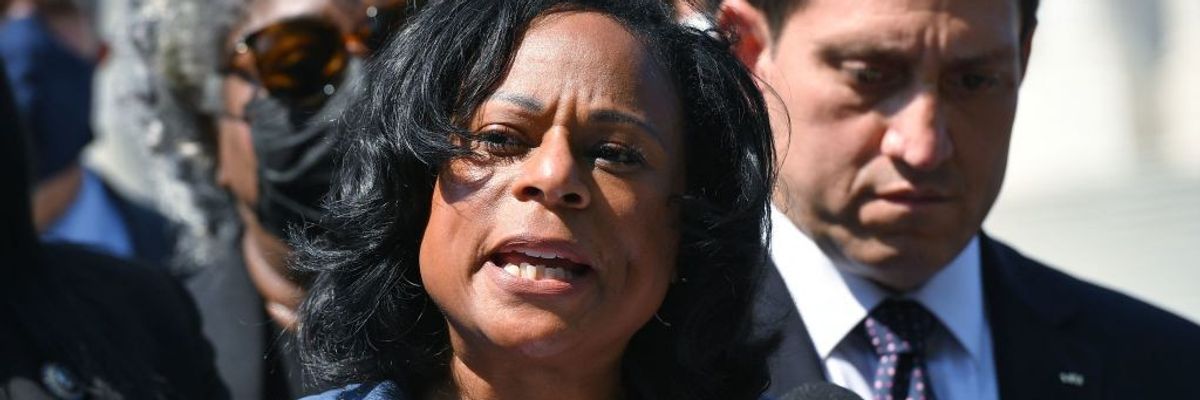
Texas State Democratic Representative Nicole Collier speaks outside the US Capitol in Washington, DC, on August 6, 2021, the anniversary of the Voting Rights Act signing in 1965.
(Photo by Mandel Ngan/AFP via Getty Images)
“Locking Rep. Nicole Collier inside the chamber is beyond outrageous,” said Texas Congresswoman Jasmine Crockett. “Forcing elected officials to sign ‘permission slips’ and take police escorts to leave? That’s not procedure. That’s some old Jim Crow playbook. Texas Republicans have lost their damn minds.”
Democratic Texas state Rep. Nicole Collier was forced to spend the night Monday inside the Texas State Capitol building in Austin after she refused to sign a “permission slip” to accept the mandatory escort by the Department of Public Safety imposed on Democrats by the Republicans who control the chamber.
Republican House Speaker Dustin Burrows announced the restrictions on members of the Democratic caucus earlier in the day after Democrats returned after a two-week hiatus out of state to prevent quorum in the House as a way to block a controversial mid-decade redistricting effort by the GOP that aims to hand the party up to five more seats in midterm congressional elections next year as a favor to President Donald Trump.
CNNreports that a majority of the Democrats in the caucus “complied with the law enforcement escort, showing reporters what they called ‘permission slips’ they received to leave the House floor and pointing to the officers escorting them around the Capitol.”
“I won’t just go along quietly with their intimidation or their discrimination.” —Democratic Texas state Rep. Nicole Collier
But not Collier, who represents the Fort Worth area in District 95.
“I refuse to sign. I will not agree to be in DPS custody,” Collier said. “I’m not a criminal. I am exercising my right to resist and oppose the decisions of our government. So this is my form of protest.”
In a video posted Monday night from inside the chamber, Collier explained why she refused to sign for the escort and lashed out at her Republican colleagues for their continued assault on the rule of law.
“My constituents sent me to Austin to protect their voices and rights,” said Collier in the video. “I refuse to sign away my dignity as a duly elected representative just so Republicans can control my movements and monitor me with police escorts. My community is majority-minority, and they expect me to stand up for their representation. When I press that button to vote, I know these maps will harm my constituents—I won’t just go along quietly with their intimidation or their discrimination.”
Fellow Democrats, both inside and beyond Texas, championed Collier’s stand and condemned the GOP for their latest authoritarian stunt.
“In the face of fascism, [Rep.] Nicole Collier is a hero,” said state Rep. Ana-María Rodríguez Ramos (D-102), chair of the Texas Legislative Progressive Caucus.
Seth Harp, a Democrat running for Congress in Florida this cycle, accused Texas Republicans of “just absolutely destroying the 4th amendment,” which bars unreasonable searches and seizures by the government. “It’s essentially kidnapping and taking a hostage,” Harp added.
“Hey GOP,” he asked, “exactly how much do you hate the Constitution?”
Rep. Jasmine Crocket (D-Texas), who previously served in the state’s legislature, also condemned the move by Burrows and his fellow Republicans.
“Let me be clear: LOCKING Rep. Nicole Collier inside the chamber is beyond outrageous,” Crockett declared in a social media post Monday evening.
“Forcing elected officials to sign ‘permission slips’ and take police escorts to leave? That’s not procedure,” she said. “That’s some old Jim Crow playbook. Texas Republicans have lost their damn minds.”
Our work is licensed under Creative Commons (CC BY-NC-ND 3.0). Feel free to republish and share widely.
As it has nationwide, ICE is arresting far more suspected immigration violators this summer than before
By Julie Zhu,Staff Writer Aug 18, 2025 (SFChronicle.com)
A crowd gathers outside of the San Francisco Immigration Court to protest recent ICE arrests in San Francisco on May 28. Since then, ICE arrests in Northern California and the U.S. have increased substantially.Manuel Orbegozo/For the S.F. Chronicle
ICE arrests in Northern California have surged this summer, a Chronicle analysis of deportation data shows. That’s in keeping with national trends.
The Department of Homeland Security, in coordination with Immigration and Customs Enforcement (ICE), claimed on Friday that they are “cleaning up the streets,” targeting what they continued to call the “WORST OF THE WORST” — including “illegal alien pedophiles, sex offenders, and violent thugs.”
But the numbers tell a more complicated story.
Since the beginning of 2025, U.S. Immigration and Customs Enforcement has arrested roughly 2,640 people in its San Francisco “area of responsibility” — a 123% increase compared to the final seven months of the Biden administration. The pace picked up dramatically in June and July.
That area spans a large portion of California, from Kern County northward, and also includes Hawaii, Guam and Saipan. The Chronicle’s analysis focused only on arrests made within California.
Notably, under the Trump administration, arrests of people without criminal convictions have risen sharply. Many of those taken into custody have only pending criminal charges — or none at all. In June, about 58% of arrests involved individuals with no prior convictions. That figure dipped slightly to 56% in July, but just a few months earlier, the numbers were far lower: In December, before President Donald Trump took office, only 10% of arrests involved people without a criminal conviction.
Among those without a conviction, ICE has arrested a large number of individuals whose only suspected violation is entering the country illegally or overstaying their visa. Although administration officials often call these undocumented immigrants “criminals,” being in the U.S. without legal status is a civil violation, not a crime.
Arrests of convicted criminals are also up. Those convictions varied widely — from serious and violent crimes like child sexual assault, homicide, and drug trafficking, to lesser charges such as traffic violations and low-level misdemeanors.
ICE officers raided a home in East Oakland on Tuesday and detained at least six people, including a minor and a person with a severe disability, according to an immigration attorney. In June, Oakland police confirmed to the Chronicle that ICE alerted them of its activity, but ICE did not provide additional details.
Also, for the first time in the Bay Area, ICE detained two U.S. citizens during a protest on Aug. 8, outside the agency’s San Francisco field office at 630 Sansome St. Oakland immigration attorney Aliya Karmali told Mission Local that she hasn’t seen “ICE arresting (U.S. citizen) protestors in the Bay since entering the legal field nearly 20 years ago.”
The picture is similar nationwide. National data from the Transaction Records Access Clearinghouse at Syracuse University indicates that the number of people detained by ICE — excluding those arrested by Customs and Border Protection — saw a 178% increase between Jan. 26 and July 13.
Since the beginning of 2025, ICE arrests of people with no criminal convictions has skyrocketed, with a 370% increase from the end of January to mid-July. In June, ICE held more people for immigration violations than for pending charges for the first time — a trend that continued into July.
Reports indicate that ICE has been targeting workers in mostly Latino neighborhoods and on jobsites — sometimes based on vague tips from people claiming they saw undocumented immigrants, but often with no clear reason at all. It has also arrested thousands of people in public places.
Though the administration views the increased immigration enforcement as necessary for public safety or border security, many believe the arrests are fueling fear, separating families, disrupting labor markets and local economies, and doing little to actually solve the country’s broader immigration problems.
“It seems like they’re just arresting people they think might be in the country without status and amenable to deportation,” said Julia Gelatt, associate director of the U.S. immigration policy program at the nonpartisan Migration Policy Institute, in a June Reuters story.
Julie Zhu is a data reporting intern at the Chronicle. Julie is a bilingual data journalist fluent in Mandarin and English with basic Spanish. She combines data analysis and visualization with strong reporting skills to create engaging, data-driven projects across beats that serve and connect with local communities. Julie recently completed an internship at Bloomberg News, where she reported exclusive stories on the global AI race and cybersecurity. She earned her M.S. in data journalism from Columbia Journalism School in 2024 and holds a B.A. in communication from UC Santa Barbara.
Shannon “SJ” Joslin, who has been a ranger and a wildlife biologist in the park since 2021, said they were fired Aug. 12 from what they described as their dream job. They said park leadership told them they “failed to demonstrate acceptable conduct” in their role by participating in the trans flag display.
“I’m devastated,” said Joslin, who is transand uses they/them pronouns. “We don’t take our positions in the park service to make money or to have any kind of huge career gains. We take it because we love the places that we work. I have a Ph.D. in bioinformatics, and I could be making a lot more money in Silicon Valley, which is only a few hours away, but I made career choices to position myself in Yosemite National Park, because this is the place that I love the most.”
SJ Joslin was a park ranger and wildlife biologist for Yosemite who studied bats.Courtesy SJ Joslin
When asked for comment on Joslin’s termination, a spokesperson for Yosemite National Park said the National Park Service, which oversees Yosemite, “is pursuing administrative action against multiple National Park Service employees for failing to follow National Park Service regulations.” The spokesperson declined to say which regulations the employees allegedly violated.
Rachel Pawlitz, a spokesperson for the NPS, said the agency and the Justice Department “are pursuing administrative action against several Yosemite National Park employees and possible criminal charges against several park visitors who are alleged to have violated federal laws and regulations related to demonstrations.”
Pawlitz added, “We do not comment on the specifics of personnel actions or criminal investigations. However, we want to emphasize that we take the protection of the park’s resources and the experience of our visitors very seriously, and will not tolerate violations of laws and regulations that impact those resources and experiences.”
Most demonstrations require a permit, Pawlitz said, and as a result, the U.S. Attorney’s Office for the Eastern District of California “is evaluating possible criminal charges based on a National Park Service investigation.”
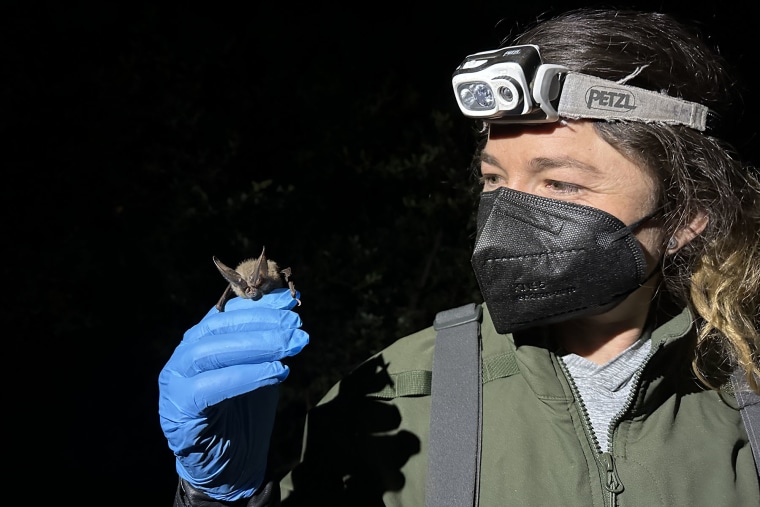
Joslin, who is 35 and had been going to the park for more than a decade prior to working there,has written Yosemite climbing guidebooks and volunteered to work overtime to help issue hiking permits and manage traffic in the park. As a wildlife biologist, they managed the park’s “big wall bats” program, to study how bats use cliffs and protect them from a deadly disease called white-nose syndrome.
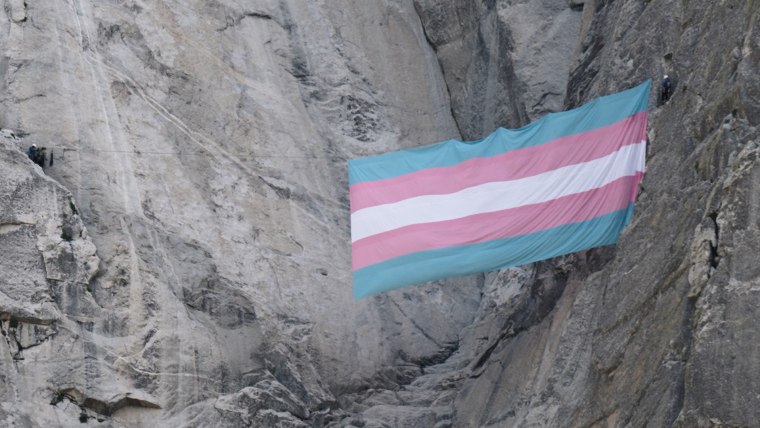
Joslin said they came up with the idea to hang the trans pride flag on El Capitan in the spring after President Donald Trump issued a variety of executive orders targeting trans people, including orders to change the federal definition of sex to exclude trans identities, restrict access to trans health care and prohibit trans women from competing in female sports.
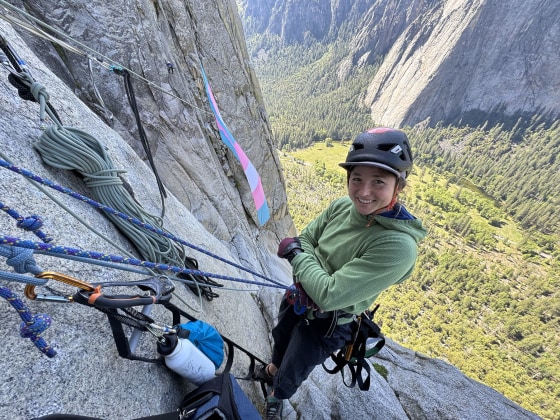
A transgender flag hangs on the face of Yosemite National Park’s iconic El Capitan rock formation in May.Jayce Kolinski
Joslin said the flag display, which they organized with other LGBTQ climbers and advocates and participated in outside of work hours, was intended to celebrate trans people and show that everyone is welcome in the nation’s parks. The flag was up on El Capitan for about two hours when park officials told the climbers to remove it, though the climbers said at the time that they were not told that they had broken any park rules.
About a week after the display, Joslin said, park leadership told them they were the subject of a criminal investigation into the hanging of the flag. After that investigation, Acting Deputy Superintendent Danika Globokar fired Joslin due to their participation in what leadership described as the “flag demonstration,” Joslin said.
Joslin said they asked for evidence proving that the flag display was a demonstration but said leadership did not provide any.
They also cited the long history of a variety of flags being flown on the rock’s face, including by park employees. For example, park employees flew an upside-down U.S. flag during Yosemite’s firefall event in February to protest the Trump administration’s cuts of National Park Service employees. A group of activists also raised a “Stop the genocide” flag on El Capitan in support of Palestinians in Gaza in June 2024.
SJ Joslin with a Townsend’s big-eared bat.Courtesy SJ Joslin
There was no policy prohibiting the display of flags on El Capitan until the day after Joslin and their team hung the trans flag, when the NPS issued a new rule banning the hanging of large flags in wilderness areas. Yosemite leadership updated the 2024 Superintendent’s Compendium to include the update.
“Hanging flags has been a tradition that climbers have done on El Cap for decades, and that’s both individuals who are visiting the park, but also employees that are on their off time,” Joslin said. “There’s never been any kind of ramifications to any of those flag hanging activities. I’m the only one who’s been fired for it.”
Joslin said two other NPS employees — one who works in Yosemite and another who works in a different park — are under investigation for helping to display the trans flag.
Joslin said being fired from a federal position will hurt their ability to work for the government, or any other park, in the future. They plan to seek legal counsel to try to contest the decision, citing an executive order Trump issued on the first day of his presidency to protect free speech and end federal censorship.
“I’m going to fight this tooth and nail,” Joslin said. “I think that everyone as Americans should be upset about this, and it doesn’t matter who I am or what my identity is, this is a matter of free speech.”
This Sunday’s Town Hall: Announcing This Week’s Progressive Town Hall: Every Sunday at 4pm ET/1pm PT RSVP HERE Join PDA activists online from across the country to discuss the importance of progressives reclaiming the American story from the MAGA right, an issue of heightened importance as we’re now within one... Continue reading →
We protest Heritage Foundation EVERY MONDAY (Join us!!!!) By admin | September 2, 2025 | Uncategorized Cliff Cash Comedy Premiered Jul 26, 2025 Every Monday at The Heritage Foundation 214 Massachusetts Ave. Washington D.C. 4pm protest 6pm pizza Every Friday at Fox News D.C. 400 N. Capitol St. Washington D.C. 4pm protest 6pm pizza We are... Continue reading →
One Million Rising: Strategic Non-Cooperation to Fight Authoritarianism Virtual Event · Hosted by No Kings Time Wednesdays 8 – 9:30pm EDT Location Virtual event Join from anywhere About this event Across the country, authoritarian forces are getting bolder and more dangerous. Trump and his allies are not hiding their agenda: mass deportations,... Continue reading →
THURSDAY, JUNE 29, 2023 AT 2 AM – 4 AM PDT How to create trust in a group? Details Event by Extinction Rebellion Empathy Circles online EMPATHY CAFE Duration: 2 hr Public · Anyone on or off Facebook How to create trust in a group? This is the question that arose in our... Continue reading →
When you volunteer for Saikat, it’s on us to give you a great experience and a genuine chance to make a difference. We don’t want to waste a second of your time. That’s why we’re always optimizing. And I’m excited to report that this Saturday we talked with 300% more... Continue reading →
This Sunday’s Town Hall: Announcing This Week’s Progressive Town Hall: Every Sunday at 4pm ET/1pm PT RSVP HERE Join PDA activists online from across the country to discuss the importance of progressives reclaiming the American story from the MAGA right, an issue of heightened importance as we’re now within one... Continue reading →
https://us06web.zoom.us/j/82277824260?pwd=fl9pABrChumF21XONZfFDtPSCk8RVe.1 Cost of Rome wishes… Now depends on who you are. (1) (Still free on a star.) A black hole departs. Speeding from its galaxy. New stars in its wake. (2) We say “Epstein files.” Trump says “N* F****** W**, *******S” Blacked out text matters. Trump executes grass. (Schedule 1... Continue reading →
We protest Heritage Foundation EVERY MONDAY (Join us!!!!) By admin | September 2, 2025 | Uncategorized Cliff Cash Comedy Premiered Jul 26, 2025 Every Monday at The Heritage Foundation 214 Massachusetts Ave. Washington D.C. 4pm protest 6pm pizza Every Friday at Fox News D.C. 400 N. Capitol St. Washington D.C. 4pm protest 6pm pizza We are... Continue reading →
One Million Rising: Strategic Non-Cooperation to Fight Authoritarianism Virtual Event · Hosted by No Kings Time Wednesdays 8 – 9:30pm EDT Location Virtual event Join from anywhere About this event Across the country, authoritarian forces are getting bolder and more dangerous. Trump and his allies are not hiding their agenda: mass deportations,... Continue reading →





 by
by