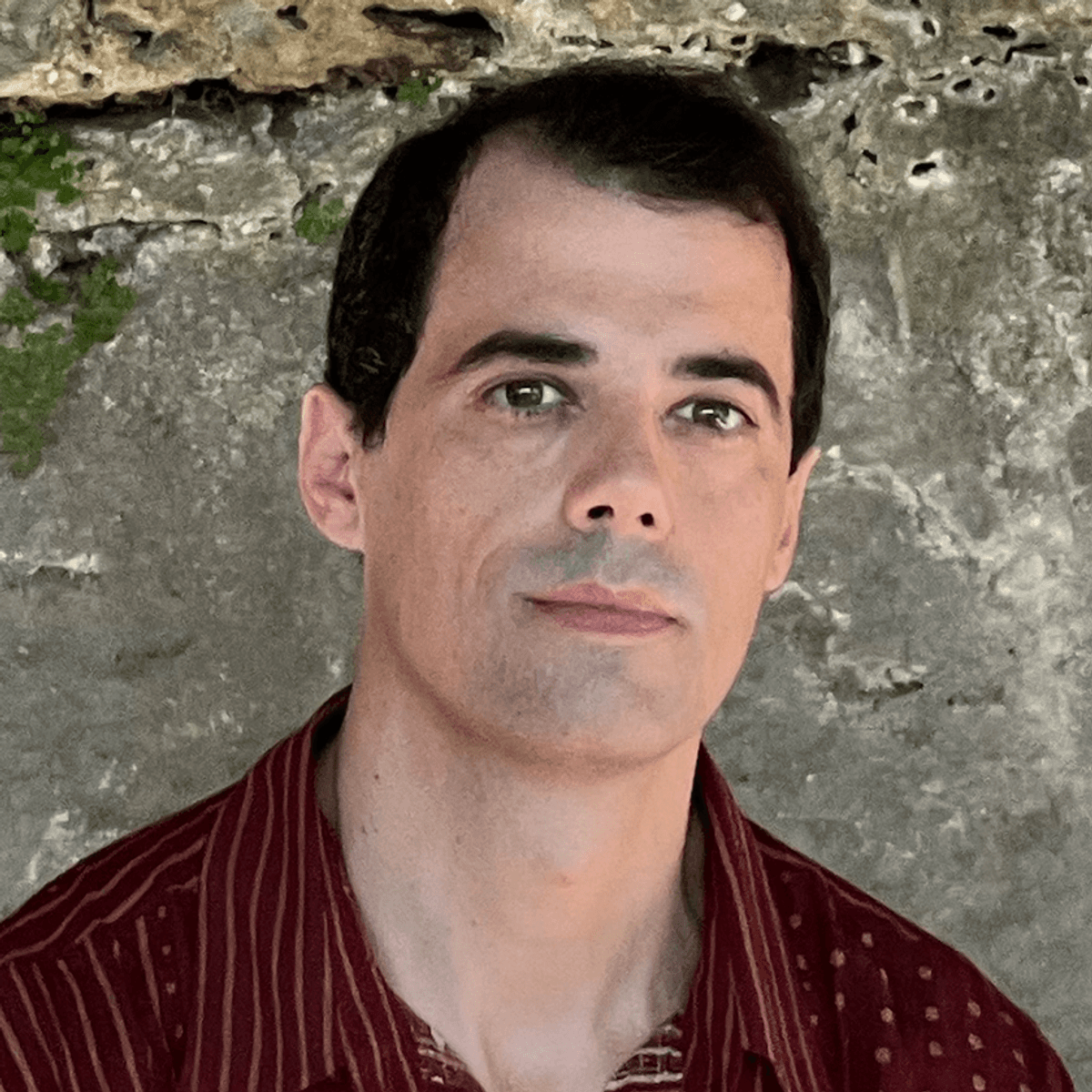
German Conservative Revolutionary who briefly joined the Nazis before he broke with them in 1934.
Rauschning joined the Nazi Party in 1932 and became the head of the parlement of Danzig in 1933.
In 1934 he left the Nazi party membership and defected to the United States where he denounced Nazism.
Rauschning is chiefly known for his book Conversations with Hitler in which he claimed to have many meetings and conversations with Hitler. His book is considered to be a fraud by historians.
After the war he became a staunch critic of the president of the federal republic of Germany Konrad Adenauer
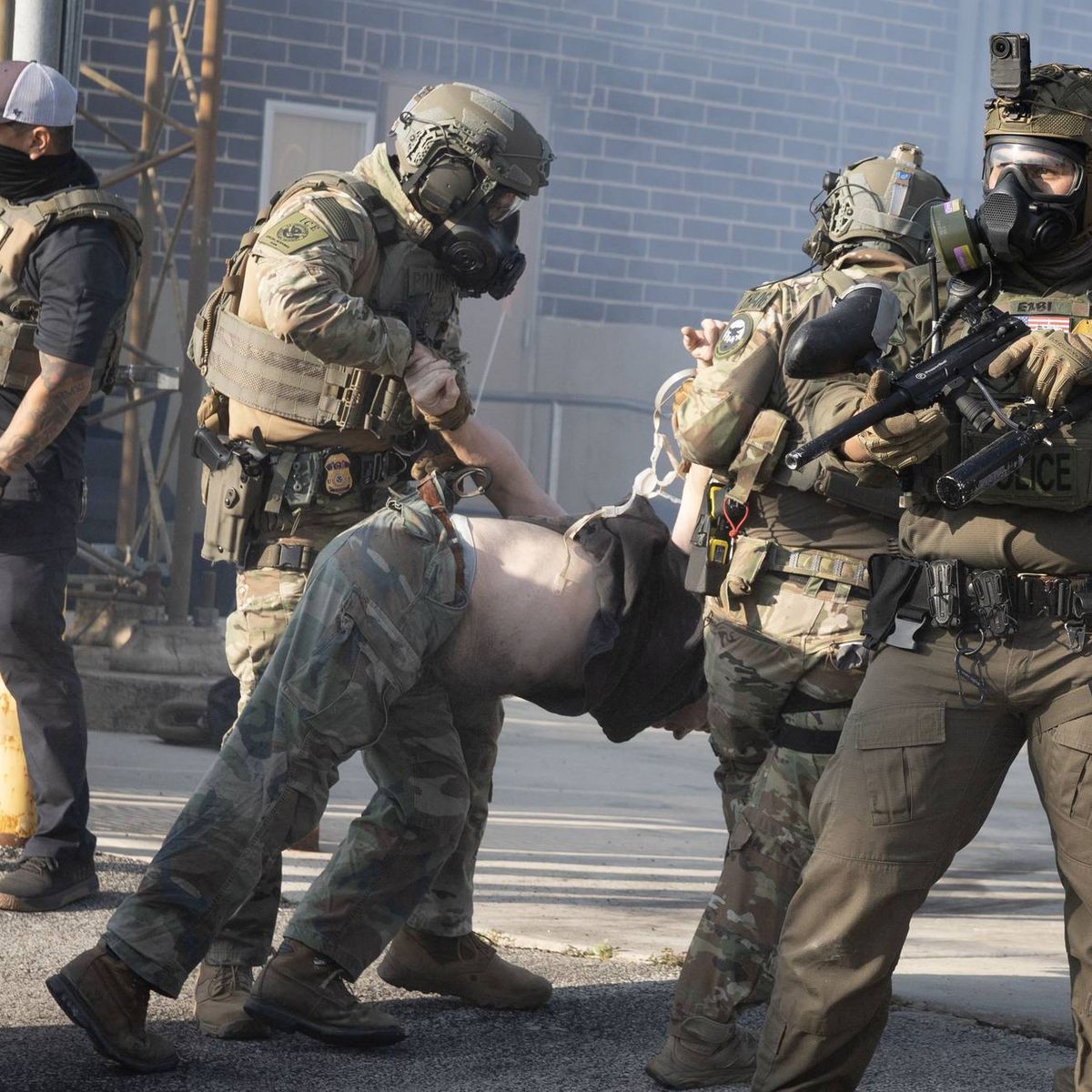
This may seem extreme, but the guy posting this was within his rights. These are not police. They cannot come into your house/home. Think of them as bounty hunters. Or… Think of them as idiots. That works.
As the US president moves from bombing one country to another, liberal-washing of Trump continues apace.
by Adam Johnson January 14, 2026 (therealnews.com)
US President Donald Trump speaks to the press upon returning to Joint Base Andrews in Maryland on January 13, 2026. Photo by Mandel NGAN / AFP via Getty Images
Get fearless, uncompromising truth in your inbox. Subscribe to The Real News.Sign up
Almost every major outlet has taken Trump’s alleged motivation for potentially bombing Iran of defending Iranian demonstrators at face value:
Wall Street Journal (1/11/26): “…a sign the president is considering reprimanding the regime for its crackdown on demonstrators as he has repeatedly threatened.”
New York Times (1/10/26): “Mr. Trump has not made a final decision [to bomb Iran], but the officials said he was seriously considering authorizing a strike in response to the Iranian regime’s efforts to suppress demonstrations set off by widespread economic grievances.’
New York Times (1/13/26): “…the Trump administration is simultaneously considering a range of measures, includingpossible military strikes, to try to prevent further killings of protesters.”
CNN (1/11/26): “President Donald Trump is weighing a series of potential military options in Iran following deadly protests in the country, two US officials told CNN, as he considers following through on his recent threats to strike the Iranian regime should it use lethal force against civilians.”
Washington Post (1/11/26): “The Trump administration is considering military options in response to the crackdown…”
Washington Post (1/13/26): “Trump’s escalating rhetoric and the soaring death toll from inside Iran come as the White House said this week that his administration was weighing diplomatic options while considering potential responses [to the shooting of protestors], including military strikes.
This was the same week Trump withdrew the US from 66 international organizations, many focusing on human rights and global development, continued to openly extort Venezuela for its oil resources, reaffirmed his desire to take over Greenland by force, dismissed new elections in Venezuela as a condition for anything, and launched a propaganda campaign against an activist his regime had just killed in broad daylight. Yet, Trump is said to be—or is heavily implied to be—motivated by defending free speech rights and democracy in Iran by the Wall Street Journal, New York Times, CNN, and Washington Post.
None of the above articles registered an ounce of skepticism about the White House’s stated motive, all either presenting the human rights concern as genuine or heavily implying it was.
So what else could be motivating Trump other than “defending demonstrators”? There are many options, of course—most far more consistent with the reality of Trump rather than a sudden Grinch-like transition from craven imperialist to bleeding-heart liberal. Could it perhaps be a desire to see a pro-US dictator take over the US’s longtime “enemy”? Could it be an attempt to decapitate an Iranian regime thwarting US hegemony in the Middle East? Could it be to eliminate, once and for all, the primary opponent of Israel? Could it be to raise tensions and drag Iran into a costly and deadly civil war? None of these motives are considered, much less examined, in the New York Times, Wall Street Journal, NBC News, Washington Post, or CNN’s coverage of his announcement—which didn’t seem at all perplexed by a president who has never once expressed even nominal sympathy for Freedom of Assembly and Freedom of Speech suddenly turning into Ken Roth.
Nor do any of these reports mention the key fact that no demonstrators, outside of fringe monarchists, are asking the US to launch airstrikes on Iran. Such an outside escalation is the militant, irresponsible fantasy of Lindsey Graham and Benjamin Netanhayu—not the activists in the street on whose behalf such a strike would ostensibly be waged. But just as they did with his oil tanker hijackings and attack on Venezuela and abduction of their leader 11 days ago, US media reflexively liberal-washes every act of aggression Trump undertakes, or threatens to undertake, when its aims are consistent with Washington foreign policy consensus.
This is despite Trump almost never bothering to run through the motions of displaying liberal or human rights motivations. When in his past, prior to 12 days ago when his threats to bomb Iran were accompanied by concern for “peaceful protestors,” has Trump ever expressed concern about protecting political dissent? According to his former Defense Secretary Mark Esper, at the height of George Floyd protests in 2020, then-President Trump asked Esper if he could order the military to shoot demonstrators “Can’t you just shoot them? Just shoot them in the legs or something?” Trump has praised physical attacks on reporters, praised extrajudicial killings of protestors, threatened to shoot “looters” without trial, and on Tuesday promised a ‘DAY OF RECKONING & RETRIBUTION” for anti-ICE protestors in Minnesota. Don’t any of the Pentagon and White House reporters mindlessly echoing Trump’s supposed concern for dissidents in Iran find this a bit unserious and pretextual? Will they include any critical examination of his motives at all?
None is to be found. Despite it being an obvious pretext to push the US into a full-blown regime change war against Iran, the idea that Trump seeks to “reprimand the regime for its crackdown on demonstrators” is being taken at face value by adults who not only should know better, but certainly do. We know from events in just the past few weeks that pretexts are dropped just as easily as they appear. Last week, just before their arraignment of Venezuelan President Nicolás Maduro, the Trump Department of Justice not only dropped its claim that Maduro was the head of the ‘Cartel de los Soles,’ but that the cartel existed at all. A central element justifying their military buildup on Venezuela, Exhibit A in the pretext to attack, bomb, and kidnap the head of another country, once it faced minimal outside scrutiny, was abandoned, put into a memory hole, and everyone just moved on.
Trump and the pro-war forces in his administration are clearly using Iranian suppression of demonstrations as a pretext for long-existing regime change designs. They are not simply responding in earnest to a humanitarian crisis unfolding to their surprise and dismay. A dynamic made all the more obvious by the fact that Trump has not once mentioned freedom and human rights as a motive for any potential action until a few days ago.
Why does having a sober and realistic assessment of Trump’s motivations matter? Because, in addition to the inherent propaganda value feigned concern for human rights carries, accurately assessing motives allows us to better predict outcomes. Had our media focused more on oil extraction and the goals of isolating Cuba and China, rather than trumped up “drug charges” on Venezuela, they could have better prepared the public for what we’ve seen this week: a mob-like shakedown operation complete with a backdoor meeting with US oil firms in Trump’s best effort to exploit Venezuela’s resources, worries about Venezuelan “fentanyl” now suddenly gone. No doubt in the event of a US-led bombing campaign of Iran Trump’s supposed concern for “demonstrators” and “people of Iran” will, likewise, vanish like smoke in the wind as the US pivots to sowing chaos and sectarian divisions rather than seeking to usher in organic democracy in Iran.
But for now this pretext is doing yeoman’s work: giving a thin justification for yet another military attack on yet another country. Unable to manufacture “drug cartel” pretenses, or a fresh anti-terror framework, or the threat of an attack on the US by an undermanned and scrambling Iranian government, the forces of war within the White House decided to act like the president cares about human rights and free speech. The president, clearly with reluctance, agreed to play along. The question is: Why is the whole of the US press doing so as well?
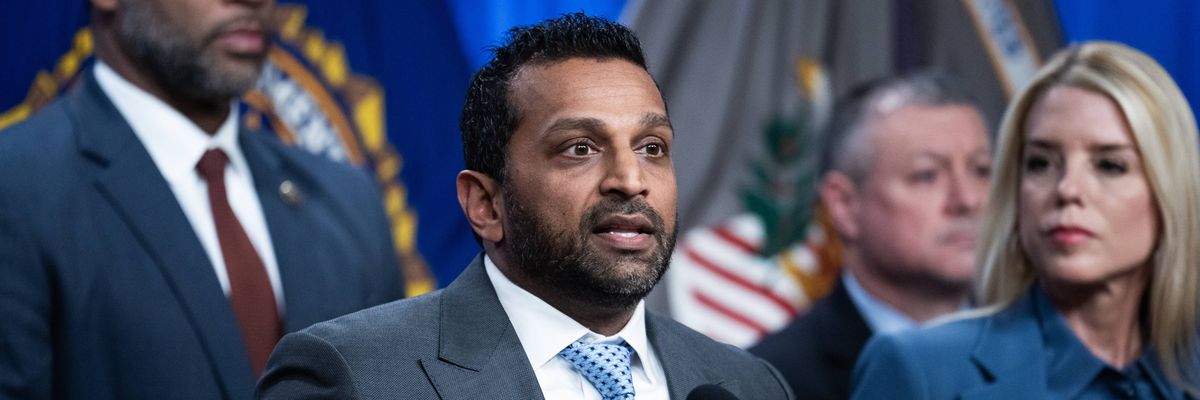
FBI Director Kash Patel, who has said he will “come after people in the media,” conducts a news conference at the Department of Justice on December 4, 2025.
(Photo by Tom Williams/CQ-Roll Call, Inc. via Getty Images)
“This is a tremendous escalation in the administration’s intrusions into the independence of the press,” said one First Amendment advocate.
A press freedom group on Wednesday accused the Trump administration of a “disturbing escalation” in its “war on the First Amendment” after the FBI executed a search warrant at the home of a Washington Postjournalist who has extensively covered President Donald Trump’s attempts to gut the federal workforce.
FBI agents reportedly conducted a search early Wednesday morning at the Virginia home of Hannah Natanson as part of an investigation into a federal contractor who is accused of illegally retaining classified documents.
“If true, this would be a serious violation of press freedom,” said the Freedom of the Press Foundation in a social media post.
The Post reported that the agents seized Natanson’s cellphone, Garmin watch, a personal laptop, and a laptop issued by the newspaper.
The warrant stated that the FBI was investigating Aurelio Perez-Lugones, a system administrator with top secret security clearance who has been accused of taking classified intelligence reports to his home in Maryland. The documents were found in his lunch box and basement, an FBI affidavit said.
Politico senior legal affairs reporter Kyle Cheney noted that the criminal complaint regarding Perez-Lugones’ case does not mention allegations that he gave any classified documents to a reporter.
“The FBI’s search and seizure of a journalist’s personal and professional devices appears to be a serious violation of press freedom and underscores why we need to enact greater federal protections for both journalists and their sources,” said Clayton Weimers, executive director of Reporters Without Borders North America. “Attorney General Pam Bondi confirmed the seizure is linked to an investigation into a federal contractor who is alleged to have leaked classified information. It’s worth reiterating, though we shouldn’t have to, that journalists have a constitutionally protected right to publish government secrets. We call for the FBI to immediately return Hannah Natanson’s devices.”
Jameel Jaffer, director of the Knight First Amendment Institute at Columbia University, told the New York Timesthat the FBI search at Natanson’s home was “intensely concerning” and could chill “legitimate journalistic activity.”
“There are important limits on the government’s authority to carry out searches that implicate First Amendment activity,” Jaffer said.
As the Committee to Protect Journalists notes in a guide to reporters’ legal rights, the Privacy Protection Act of 1980 established high standards for searches and seizures of journalists’ materials that are “reasonably believed to be related to media intended for dissemination to the public—including ‘work product materials’ (e.g., notes or voice memos containing mental impressions, conclusions, opinions, etc. of the person who prepared such materials) and ‘documentary materials’ (e.g., video tapes, audio tapes, photographs, and anything else physically documenting an event).”
“These materials generally cannot be searched or seized unless they are reasonably believed to relate to a crime committed by the person possessing the materials,” reads the guide. “They may, however, be held for custodial storage incident to an arrest of the journalist possessing the materials, so long as the material is not searched and is returned to the arrestee intact.”
Last year, the US Department of Justice (DOJ) ended a Biden-era policy that limited its ability to search or subpoena a reporter’s data as part of investigations into leaks.
Attorney General Pam Bondi said the DOJ “will not tolerate unauthorized disclosures that undermine President Trump’s policies, victimize government agencies, and cause harm to the American people.”
Before becoming FBI director, Kash Patel said in 2023 that should Trump return to the White House, his administration would “come after people in the media” in efforts to target the president’s enemies.
The Post reported Wednesday that “while it is not unusual for FBI agents to conduct leak investigations around reporters who publish sensitive government information, it is highly unusual and aggressive for law enforcement to conduct a search on a reporter’s home.”
Natanson has spent much of Trump’s second term thus far covering his efforts to fire federal employees, tens of thousands of whom have been dismissed as the president seeks to ensure the entire government workforce is pushing forward his right-wing agenda.
She wrote an essay last month for the Post in which she described being inundated with messages over the past year from more than 1,000 federal employees who wanted to tell her “how President Donald Trump was rewriting their workplace policies, firing their colleagues, or transforming their agency’s missions.” She has written about the toll the mass firings have had on workers’ mental health.
Bruce D. Brown, president of the Reporters Committee for Freedom of the Press, said in a statement that “physical searches of reporters’ devices, homes, and belongings are some of the most invasive investigative steps law enforcement can take.”
“There are specific federal laws and policies at the Department of Justice that are meant to limit searches to the most extreme cases because they endanger confidential sources far beyond just one investigation and impair public interest reporting in general,” said Brown. “While we won’t know the government’s arguments about overcoming these very steep hurdles until the affidavit is made public, this is a tremendous escalation in the administration’s intrusions into the independence of the press.”
Our work is licensed under Creative Commons (CC BY-NC-ND 3.0). Feel free to republish and share widely.
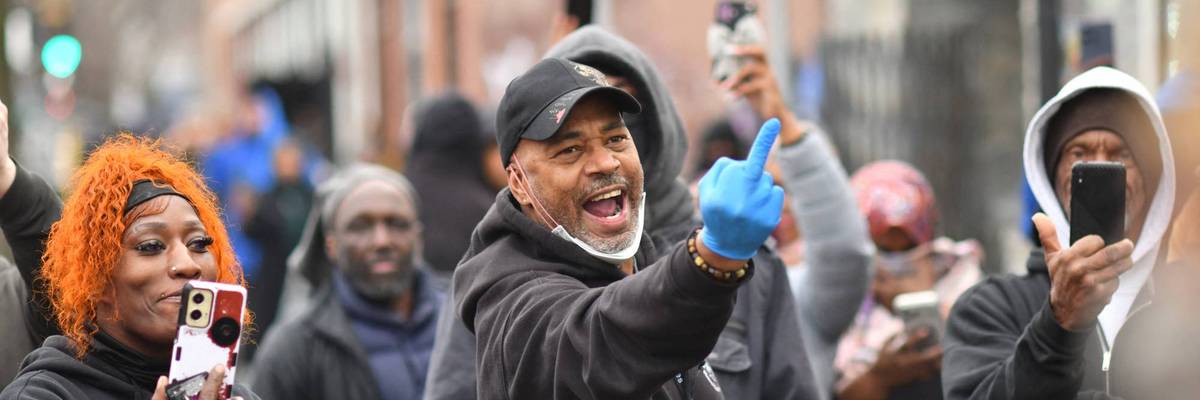
A man gestures at US Border Patrol agents as they detain an unidentified man of Somali descent in Minneapolis, Minnesota, on January 8, 2026.
(Photo by Octavio Jones/AFP via Getty Images)
“The First Amendment unequivocally protects the right to observe, monitor, and take pictures and video of government officials conducting their duties in public.”
“We join together as nonprofit civil rights and free expression advocates to condemn the Trump administration’s statements that it is illegal to record videos of ICE agents. These claims are incorrect as a matter of law, directly contrary to our First Amendment values, and deeply troubling for democratic governance,” NCAC said in a statement.
“The ability to hold the government accountable is at the very core of our democracy. To preserve that ability, the First Amendment unequivocally protects the right to observe, monitor, and take pictures and video of government officials conducting their duties in public. This explicitly includes law enforcement officers engaged in their public duties,” the coalition continued, citing decisions from all federal appellate courts that have addressed the issue.
In a Wednesday appearance on KQED‘s podcast Close All Tabs, CJ Ciaramella, a criminal justice reporter at Reason, similarly highlighted that while the US Supreme Court “actually hasn’t put out a ruling saying there’s an unambiguous First Amendment right to film the police,” the circuit courts “that have considered the issue have pretty much said there is a First Amendment right to record the police and observe the police, and they’ve all decided that pretty unambiguously.”
“And this ranges from, you know, the 9th Circuit, which is traditionally a pretty liberal leaning court, to the 5th Circuit, which has a reputation as a more conservative circuit court,” Ciaramella explained. “The 5th Circuit looked at it and said, you know, based on the First Amendment tradition, the Supreme Court precedents, this seems pretty unambiguous to us.”
“So it’s not a completely like black and white issue, but it’s also not… a thorny or divisive First Amendment question. Every court that’s looked at it has said, yeah, based on our long First Amendment traditions. And in America, you have a right to record the police,” he added. “Now, Minnesota is in one of the circuits that hasn’t yet ruled on this.”
The NCAC statement comes amid a flurry of videos of violent and otherwise problematic ICE actions, especially in Minneapolis, where Trump has sent thousands of troops and ICE officer Johnathan Ross fatally shot Renee Nicole Good in the head last week. Ross was recording on his phone, and amid mounting calls for his arrest and prosecution, the Department of Homeland Security (DHS) has put out a “propaganda” video defending the actions of ICE agents.
Journalists and other critics of Good’s killing have debunked DHS claims in part by pointing to bystanders’ footage from the scene.
While the NCAC statement doesn’t point to any specific incidents with agents, it does sound the alarm about Homeland Security Secretary Kristi Noem’s suggestion last July that videotaping ICE operations is “violence” and anyone “doxing” agents will be prosecuted.
After playing a clip of Noem’s remarks on Close All Tabs, host Morgan Sung said: “Notice the use of the word doxing here. That’s the act of posting private information about someone to target and harass them, usually like their home address or personal phone number. The Trump administration has equated identifying and publicly naming ICE agents to doxing.”
NCAC argued that “statements such as Secretary Noem’s misinform the public about their First Amendment rights and chill constitutionally protected speech. As a policy matter, threats to punish those who monitor law enforcement increase the likelihood that people will be intimidated out of exercising their constitutional rights and lead to precisely the outcome such oversight is intended to prevent—law enforcement agents who act with impunity as transparency is demonized by political leaders.”
Like ICE, agents with Customs and Border Protection, another DHS agency, have been sent to various cities and recorded behaving violently in recent months, often while donning masks. After Ross killed Good, Border Patrol Commander Greg Bovino—who is currently in Minnesota—sent a “legal refresher” to agents in the field stating that taking photos and recordings is protected activity under the First Amendment.
The coalition said that “regardless of one’s views on immigration policy, the increased budget and enforcement operations of ICE were a core campaign issue in the presidential election, and are a widespread topic of conversation and concern.”
“Recordings of law enforcement directly inform the public, shape policy discussions, and even serve as the catalyst for large-scale political movements across the political spectrum. They have helped to expose horrific and illegal acts by the government,” NCAC pointed out. “At the same time, they also protect law enforcement officers. If an officer is acting within the bounds of the law, a recording will help prove as much.”
“We stand behind the public’s well-established right to record public officials, law enforcement, and ICE agents engaged in their public duties. We jointly condemn this administration’s refusal to recognize the First Amendment right to record officers in public. And we call on this administration to recognize that constitutional rights are a feature, not a bug, of democratic governance,” the coalition concluded. “For our constitutional rights to be real, our public officials must uphold them—as they have sworn to do.”
The groups that signed on to the statement are the ACLU, Center for Democracy & Technology, Center for Protest Law & Litigation at the Partnership for Civil Justice Fund, Defending Rights & Dissent, Electronic Frontier Foundation, Freedom of the Press Foundation, Government Information Watch, Knight First Amendment Institute, National Coalition Against Censorship, People for the American Way, Public Citizen, Tully Center for Free Speech, and Woodhull Freedom Foundation.
Joining them as individuals are writer and historian Pat McNees, and three experts from Yale Law School: David A. Schulz, Stacy Livingston, and Tobin Raju.
Our work is licensed under Creative Commons (CC BY-NC-ND 3.0). Feel free to republish and share widely.
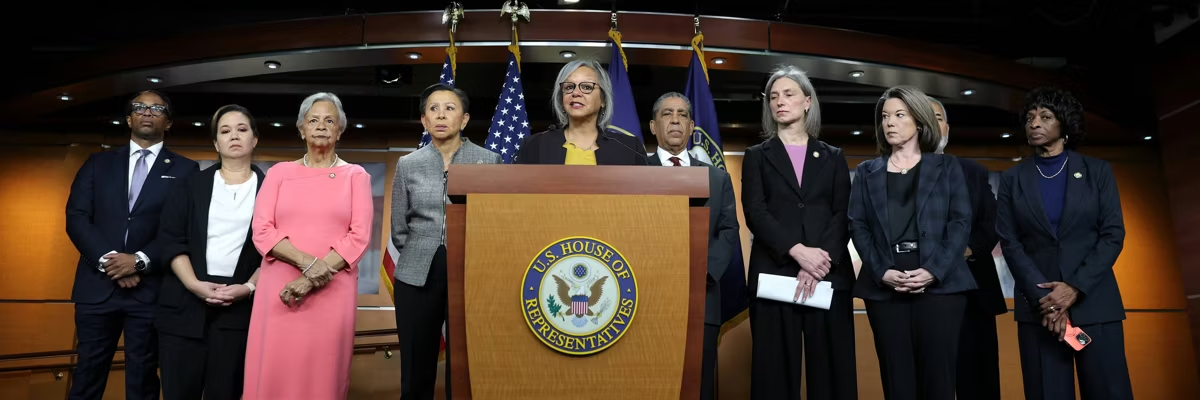
Congresswoman Robin Kelly (D-Ill.), joined by fellow House Democrats, speaks a news conference on articles of impeachment against US Secretary of Homeland Security Kristi Noem at the US Capitol in Washington, DC on January 14, 2026.
(Photo by Kevin Dietsch/Getty Images)
“Noem and her rogue agents are the ones terrorizing our communities, and she is breaking the law to do so,” said Rep. Robin Kelly.
Citing the deadly “reign of terror” unleashed by President Donald Trump’s immigration enforcers against both migrants and US citizens, a Democratic congresswoman on Wednesday formally introduced articles of impeachment against Homeland Security Secretary Kristi Noem.
Rep. Robin Kelly of Illinois filed three articles of impeachment against Noem for alleged obstruction of justice, violation of public trust, and self-dealing. The move—which Kelly first announced on January 7— followed last week’s killing of Renee Nicole Good, an American citizen, by Immigration and Customs Enforcement (ICE) officer Jonathan Ross in Minneapolis.
“Secretary Noem has brought her reign of terror to the Chicagoland area, LA, New Orleans, Charlotte, Durham, and communities north to south to east to west,” Kelly told reporters at a Wednesday press conference. “She needs to be held accountable for her actions.”
Speaking on the House floor earlier, Kelly said that “Operation Midway Blitz has torn apart the Chicagoland area.”
https://twitter.com/i/status/2011142881470541891
During the Department of Homeland Security (DHS) operation, ICE agents shot and killed Silverio Villegas González and then allegedly lied about the victim’s behavior in a bid to justify the killing. Federal enforcers have attacked protesters and bystanders with tear gas, pepper balls, flash-bang grenades, and other weapons during Midway Blitz and other operations across the country.
“President Trump declared war on Chicago and then he brought violence and destruction to our city and our suburbs in the form of immigration enforcement,” Kelly said.
“In my district, federal agents rappelled down from Blackhawk helicopters and burst into an apartment building in the South Shore area,” the congresswoman continued. “The dragged US citizens and noncitizens alike out of their beds in the middle of the night.”
“They claim the apartment was infiltrated by members of a Venezuelan gang. I don’t understand this president’s obsession with Venezuela, but they did not arrest a single member from that gang,” she added, alluding to Trump’s illegal attacks on the South American country and abduction of its president and his wife.
Moving on to Minneapolis, Kelly said that “an ICE officer shot and killed Renee Nicole Good in cold blood.”
“Without knowing any of the facts or an investigation, Secretary Noem lied about what happened,” the congresswoman said. “She called a beloved 37-year-old mom a ‘domestic terrorist.’ Secretary Noem and her rogue agents are the ones terrorizing our communities, and she is breaking the law to do so. I will hold her accountable.”
Kelly’s articles of impeachment accuse Noem of:
Obstructing Congress by refusing to allow lawmakers into federal immigration facilities and withholding congressionally designated disaster relief funds from states that refused to cooperate with Trump’s crackdown;
Violating public trust by denying people detained by ICE their due process as guaranteed under the Constitution; and
“These are not policy disagreements,” Kelly said during her House floor remarks. “These are violations of her oath of office, and she must answer for her impeachable actions.”
As of late Wednesday morning, more than 70 House Democrats had signed on as co-sponsors of the effort.
“I’ve signed on to impeach Secretary Noem,” Rep. John Larson of Connecticut said on X. “She must be held accountable for her corruption and her attacks on the Constitution. She’s hypercharged ICE’s lawlessness and cheered as it has terrorized our communities. She has to go.”
Rep. Bonnie Watson Coleman of New Jersey, who also joined the impeachment effort, said that Noem’s “malicious and incompetent leadership has led to chaos across the nation.”
Rep. Summer Lee of Pennsylvaniasaid on X: “People are being hunted. Families torn apart. A woman was just shot in the face. And DHS seem to think it’s acceptable. It’s past time to impeach Kristi Noem.”
I signed onto @RepRobinKelly's articles of impeachment against Secretary Noem because she is unfit and unqualified to hold her position.
Secretary Noem’s reckless disregard for the rule of law continues to be a threat to the safety and wellbeing of communities across the… pic.twitter.com/3umd8KZPxt
A DHS spokesperson called the impeachment effort “silly.”
“As ICE officers are facing a 1,300% increase in assaults against them, Rep. Kelly is more focused on showmanship and fundraising clicks than actually cleaning up her crime-ridden Chicago district,” the spokesperson said. “We hope she would get serious about doing her job to protect American people, which is what this department is doing under Sec. Noem.”
The effort to impeach Noem came after state and city officials in Minnesota and Illinois on Monday sued the Trump administration in a bid to block federal forces “from conducting civil immigration enforcement” without “express congressional authorization.”
“People are being racially profiled, harassed, terrorized, and assaulted,” Democratic Minnesota Attorney General Keith Ellison said earlier this week. “Schools have gone into lockdown. Businesses have been forced to close. Minnesota police are spending countless hours dealing with the chaos ICE is causing. This federal invasion of the Twin Cities has to stop, so today I am suing DHS to bring it to an end.”
Our work is licensed under Creative Commons (CC BY-NC-ND 3.0). Feel free to republish and share widely.
An ICE agent taking part in an operation in Florida in 2018. Credit: Courtesy of DHS.
Alameda County officials will gather on Thursday to discuss two initiatives designed to shield residents from federal immigration agents and the kinds of violence and chaos they’ve stoked in Minneapolis and other cities.
One of the proposals is to draft a county-wide plan for dealing with immigration enforcement. This would include rapid-response protocols for government agencies and community partners, plus training for staff and public communication strategies.
The other plan would involve the creation of “ICE-Free Zones” on properties owned by Alameda County. The county would develop a policy to restrict immigration agents from using its properties for staging civil enforcement actions, surveillance or processing people.
Supervisor Nikki Fortunato Bas introduced both proposals last November, citing lessons learned from other cities that have experienced heavy immigration enforcement, including Los Angeles, Chicago and Portland. The proposals were continued to this week’s meeting so supervisors can incorporate feedback from the sheriff, district attorney, probation department and public defender.
“Our goal is simple: every resident should be able to access health care, courts, schools, and public services without fear,” Bas said in a statement. “Coordinate response plans and ICE-Free Zones are essential tools in building community safety and power during this time.”
Since Donald Trump’s inauguration last year, Alameda County officials have been preparing for a surge in immigration enforcement. Tensions rose in October after Customs and Border Protection agents arrived at a Coast Guard base in Alameda in preparation for a major enforcement action. But the operation was cancelled by President Trump at the last moment following his conversations with San Francisco Mayor Daniel Lurie and several tech billionaires.
Last week, an ICE officer named Jonathan Ross shot and killed a 37-year-old unarmed woman named Renee Good in Minneapolis. Trump and other administration officials have attempted to label Good as a domestic terrorist, claiming she tried to ram Ross with her car. But videos of the shooting show Good speaking calmly to Ross and attempting to drive away from him before he shot her multiple times.
Henry Benjamin Whipple (February 15, 1822 – September 16, 1901) was an American religious leader and activist. He was the first Episcopalbishop of Minnesota and gained a reputation as a humanitarian and an advocate for Native Americans.
Born in Adams, New York, he was raised in the Presbyterian church but became an Episcopalian through the influence of his grandparents and his wife, Cornelia, whom he married in 1842. Whipple attended Oberlin College from 1838 to 1839 and worked in his father’s business until he was admitted to holy orders in 1848.
After ordination Whipple served parishes in Rome, New York, and Chicago, where he gained a reputation for his service to poor immigrant groups. His Chicago ministry drew him to the attention of the newly formed Episcopal Diocese of Minnesota, which elected him its first bishop in 1859. He served until his death in 1901.
Although concerned with establishing his denomination in the new state of Minnesota, Whipple soon began to champion the cause of Native American groups in the state against what he saw as an abusive and corrupt Federal policy towards Native Americans. He is best known for his clemency pleas in favor of a group of Dakota who fought against the United States government in the U.S.-Dakota War of 1862 in the area around New Ulm, Minnesota. On December 26, 1862, the largest mass execution in U.S. history occurred in Mankato during the pause in US military operations. Thirty-eight Dakota were hanged for war crimes in the conflict. A total of 303 were sentenced to be hanged but President Lincoln commuted 265 in the largest mass commutation on record. Lincoln’s intervention was not popular at the time. Two commemorative statues are located on the site of the hangings (now home to the Blue Earth County Library and Reconciliation Park). He was referred to as “Straight Tongue” by some Dakota because of his honesty in dealing with them.
Whipple is memorialized by the Bishop Whipple Federal Building in Fort Snelling, Minnesota, which houses, among other things, offices for members of Minnesota’s congressional delegation. His name is also found on a building on the campus of Concordia College in Moorhead, Minnesota, called Bishop Whipple Hall, a building which was originally a prep school built by Episcopalians but which was purchased by Norwegian Lutherans in 1891 as the main building of their newly founded Concordia College.[1]
Shattuck School (now coordinated with St. Mary’s Hall and St. James School as Shattuck-St. Mary’s School, formerly The Bishop Whipple Schools: Shattuck, St. Mary’s, St. James)[2] is a prominent Episcopal boarding preparatory school in Faribault, Minnesota, which grew up around the campus of Seabury Divinity School, which Whipple founded. (The seminary itself merged with Western Theological Seminary in Evanston, Illinois, and the campus of Seabury-Western Theological Seminary was in Evanston until its merger with Bexley Hall, and what is now known as Bexley Seabury Seminary has its campus on the south side of Chicago.) The main boy’s dormitory at Shattuck is called Whipple Hall. He is buried beneath the altar of the Cathedral of Our Merciful Saviour in Faribault, Minnesota.
Early life
Henry Benjamin Whipple was born on February 15, 1822, in Adams, New York. He was educated at a private boarding school in Clinton[disambiguation needed], New York, and at Jefferson County Institute in Watertown, New York. In 1839, he attended Oberlin Collegiate Institute, but his health failed and his physician recommended an active business life.
After several years working for his father, a country merchant, Whipple began studying for the ministry in the Episcopal Church. He was ordained a deacon on August 17, 1849, became rector of Zion Church in Rome, New York, in November 1849, and was ordained priest on July 16, 1850.[3] Whipple served as rector of Zion Church from 1849 to 1857, becoming known both for the size and wealth of his parish and for his work among the poor. In 1857, Whipple helped organize and became the first rector of the Church of the Holy Communion on Chicago‘s South Side, the first free church in the city. He drew his parishioners from “the highways and the hedges” – clerks, laborers, railroad men, travelers, and derelicts – sought converts among the city’s Swedish population, and regularly officiated in a Chicago prison.
On June 30, 1859, Whipple was elected the first Episcopal bishop of Minnesota, an office he held until his death more than forty years later. He was consecrated bishop on October 13, 1859, the feast day of James, brother of Jesus, at St. James Episcopal Church during the General Convention in Richmond by bishops Jackson Kemper, Leonidas Polk, and William H. DeLancey, with George Burgess delivering the sermon.[4] In December of that year, Whipple made his first visitation of his diocese, including the Ojibwe missions of E. Steele Peake and John Johnson Enmegahbowh. In the spring of 1860 he moved his family to Faribault, establishing it as the see of the diocese.
During his episcopate, Whipple guided the development of the Episcopal Church in Minnesota from a few missionary parishes to a flourishing and prosperous diocese. For many years, especially during the first two decades of his episcopate, he made regular missionary sojourns by wagon or coach through the rural areas of the state, often in mid-winter, preaching in cabins, school houses, stores, saloons, and Native American towns. Until the diocese was financially secure, he pledged himself to personally support several of its missionary clergy and assumed many other financial obligations of the church. He unified a diocese that at the time of his election was divided into two quarreling factions.
In 1860, Whipple incorporated the Bishop Seabury Mission in Faribault, building it upon the foundations laid by James Lloyd Breck and Solon W. Manny, who in 1858 had founded a divinity school and school for boys and girls. With the help of gifts from eastern donors, the mission developed into three separate but closely connected schools: Seabury Divinity School, Shattuck School for boys, and St. Mary’s Hall for the education of daughters of the clergy. Whipple also helped found the Breck School in Wilder, Minnesota, to educate the children of farmers.
Advocate for Native Americans
Whipple was best known outside of Minnesota for his dedication to the welfare of the Native Americans and for his missionary work among Dakota and Ojibwe in Minnesota. He returned from his first visitation of his diocese with a firm commitment to establish Native American missions and reform of the United States American Indian system. Whipple regularly included Native American towns on his visitations, built up the Episcopal mission to the Ojibwe based at the White Earth Reservation, and appealed for support of Native American missions by lectures throughout the United States and in Europe.
In the early years of his episcopate, Whipple’s espousal of American Indian reform and commitment to Native American missions earned him the enmity of many white settlers who hated Native Americans, and led some of his fellow bishops to look upon him as a fanatic. His attitude was denounced most bitterly after the Dakota War of 1862, when, in appeals to President Lincoln and through the press, Whipple opposed wholesale executions and extermination or deportation of the Dakota. Whipple even criticized his distant cousin and former Minnesota governor, Colonel Henry Sibley in such matters.
The leadership of the nearly 100-member Congressional Progressive Caucus said Tuesday that it will “oppose all funding” for US immigration enforcement in any upcoming government appropriations bills without substantial reforms, a position laid out as federal agents unleashed by President Donald Trump continued to terrorize communities across the country.
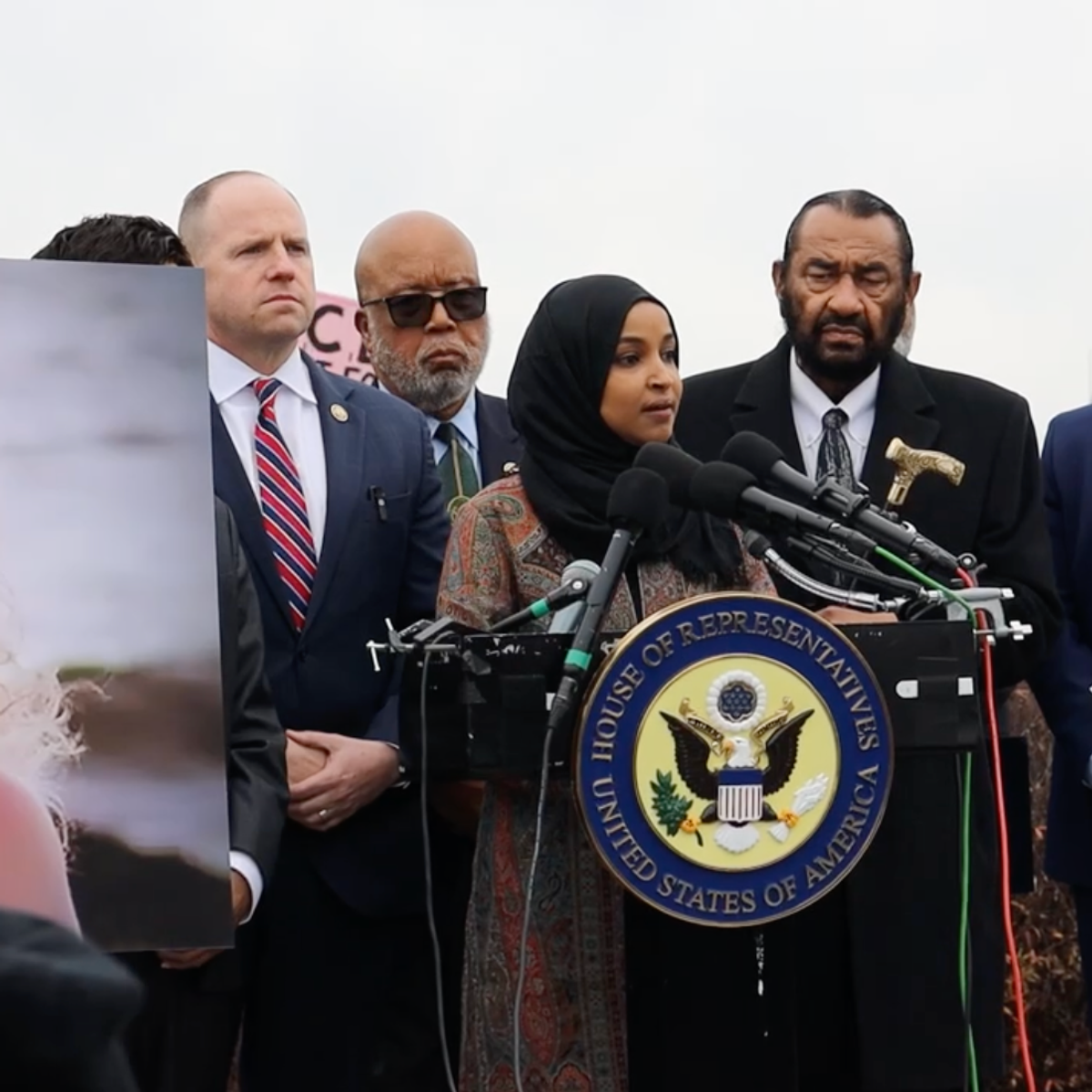
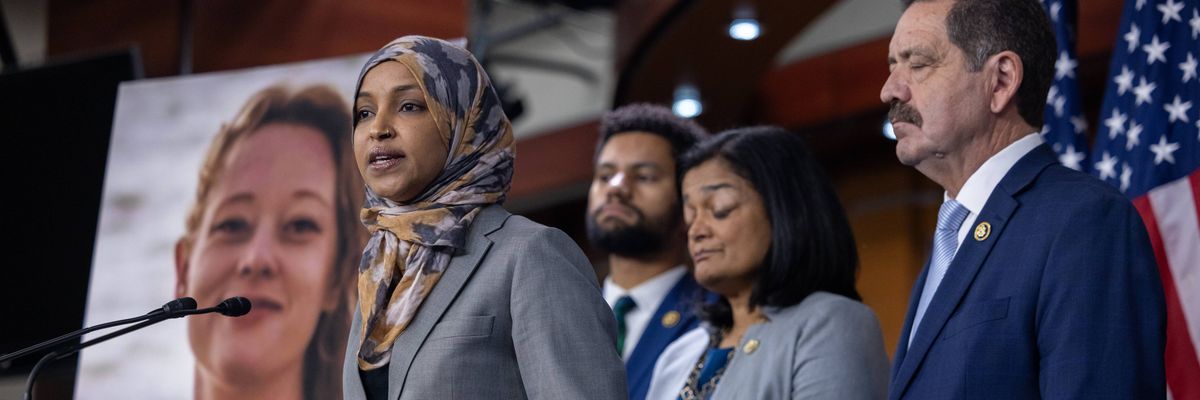
Rep. Ilhan Omar (D-Minn.), deputy chair of the CPC, said during a press conference alongside other caucus members that “demanding accountability is not radical.” Omar represents the district where 37-year-old Renee Good was shot and killed by Immigration and Customs Enforcement (ICE) agent Jonathan Ross last week.
“Calling for systematic reforms is not extreme,” Omar continued. “This is the bare minimum required to restore safety and justice back to our communities.”
Omar, a frequent target of Trump’s bigotry, said the CPC’s official position is to “oppose all funding for immigration enforcement in any appropriation bills until meaningful reforms are enacted to end militarized policing practices.”
“We cannot and we should not continue to fund agencies that operate with impunity, that escalate violence, and that undermine the very freedoms this country claims to uphold,” the congresswoman said. “ICE has no place in terrorizing Minneapolis or any American community.”
The CPC’s press conference marked an intensification of a fight over Department of Homeland Security (DHS) funding that erupted in the wake of Good’s killing in Minneapolis last week. ICE, which is part of DHS, currently has a larger budget than that of a dozen national militaries, thanks to a massive infusion of funding approved by congressional Republicans and Donald Trump last summer.
NBC Newsreported Tuesday that “Democratic opposition has already frozen a DHS measure that was slated to be added to an appropriations package getting a Senate vote this week.”
“Congress may have to fall back on a stopgap bill to prevent a funding lapse for DHS,” the outlet added. “That’s where things get trickier for Democrats. If House Republicans pass a continuing resolution on their own, which would keep DHS running on autopilot, Senate Democrats would again have to choose between accepting it and forcing a partial shutdown.”
Rep. Rosa DeLauro (D-Conn.), the top Democratic appropriator in the House, said Tuesday that she does “not support increasing funding for ICE” and is “looking at policy riders in the homeland security funding bill to rein in ICE.”
“ICE is terrorizing our communities, and I have called on masked, armed ICE agents to leave our towns,” DeLauro added.
An Economist/YouGov poll released this week found that, for the first time, more Americans support abolishing ICE entirely (46%) than oppose it (43%). Democratic support for abolishing ICE is currently at 77%, according to the survey.
In an appearance on MS NOW, Omar said that “we want this terror to stop.”
“People are angry. People are frustrated. They’re confused. They don’t understand why this chaos is necessary,” said Omar. “And they certainly do not want this level of militarized ICE and border agents just roaming the streets, harassing and terrorizing their neighbors.”
Our work is licensed under Creative Commons (CC BY-NC-ND 3.0). Feel free to republish and share widely.
Fighting ICE’s Violence While Preserving Our Gorgeous Soul Power
Thirty-seven-year-old poet and mother of three children Renee Nicole Good was murdered by a masked, cursing ICE agent. It was yet another in a series of tragic atrocities perpetrated by Trumps’ gang of thugs.
It was also a clarification: The masks ICE agents wear aren’t about anonymity but about removing the last vestiges of accountability. They’re the final erasure of the human face from state violence. This is what tyranny looks like when it stops pretending.
Sorry to be so blunt, but it’s the sad and shocking truth.
So how do we fight the escalating brutality without becoming brutalized ourselves? How do we resist the fascist creep without letting it colonize our inner landscape?
+
The Insurrectionary’s Paradox
Here’s the challenging practice: We need wrathful compassion, that fierce Buddhist concept where love becomes so intense it manifests as holy rage against those who harm the vulnerable. Not hatred, which damages the hater, but a righteous anger that’s an expression of care extended so far it won’t tolerate cruelty.
We can think of it this way: If someone were beating a child in front of us, our immediate intervention wouldn’t come from hatred of the abuser but from love of the child. The force we would use to stop the violence would be an expression of our care.
This is the alchemy we need now. ICE’s violence against immigrants (and even non-immgrants) demands our intervention because we love what they’re destroying: human dignity, sanctuary, and refuge.
+
Practical Insurgency as Self-Care
On our behalf, I’m tempted to ask the question “how do we fight while caring for ourselves?” But that contains a false premise. Done right, the fighting is the self-care. Here’s why:
We stay sane by taking vigorous action. Helplessness is the real psychological poison. Every practical thing we do is an antidote to the corrosive feeling of complicity through inaction: joining rapid response networks, contributing to immigrant defense funds, participating in ICE office disruptions, providing sanctuary, and documenting abuses.
We preserve joy by defending it collectively. The authoritarian gangsters want to steal our capacity for delight, to make us so despairing and exhausted that we forfeit our imagination.
But we refuse. We organize potlucks for undocumented neighbors. We hold dance parties outside detention centers. We make beauty while we make trouble. The exuberance isn’t separate from the resistance; it’s one of the main points of the resistance.
We resist mass hallucination by grounding ourselves in embodied reality. The fascist atrocity project depends on abstractions: immigrants as “invaders” and humans as “illegals.”
We counter this with fierce particularity. We learn the name of every person ICE detains. We tell their specific stories, as in: Renee Nicole Good was an award-winning queer poet who was renowned for her kindness. Her last words on earth, uttered to her killer, were, “That’s fine, dude. I’m not mad at you.”
We make the violence concrete and the humanity undeniable. This refusal to let brutality be normalized into abstraction is both activism and meditation.
+
Can Our Struggle Be a Form of Play?
The question might ostensibly seem frivolous given the stakes. But consider the possibility that rigid seriousness is just another form of the authoritarian rigidity we’re fighting against. What if we approach resistance with the spirit of serious play—not frivolous, but creative, surprising, and uncontainable?
For example: street theater that mockingly reenacts ICE raids with agents played as cowardly masked thugs. Paint or chalk murals that celebrate immigrants’ contributions, impossible to remove without admitting some fascist is trying to erase these truths. Flash mobs singing lullabies outside detention centers in multiple languages. Memes that make ICE agents’ violence so recognizable as un-American that even moderate citizens recoil.
The playfulness isn’t disrespectful to the horror. It’s a refusal to let the horror dictate the terms of engagement entirely. It keeps our imaginations wild and hungry and free because the authoritarian mind can’t comprehend or predict creative insurgency.
+
Constructive Anger, Unconsumed
How do we summon a righteous blend of practical love and constructive anger? Here’s the recipe:
We root the anger in specific compassion. We don’t let it become abstract fury at “the system” or “fascism.” We focus it: The ICE agent named Jonathan Ross shot Renee Nicole Good in the face at pointblank range and then cursed her as she died.
Honduran asylum seeker Mirian G. was detained in Texas and held in an ICE-run detention center while her 18‑month‑old son was taken to a separate facility 120 miles away, with no chance to comfort him or say goodbye.
A farmworker in Ventura County, California, Jaime Alanís García / Alanís, died after falling 30 feet from a greenhouse roof while fleeing an ICE raid at Glass House Farms in Camarillo on July 10, 2025.
Specificity like this keeps the anger clean, purposeful, and constructive.
And we channel it into action that empower us. Because anger that just churns inside us becomes acid. Whereas we can turn our anger into sacred fuel: Use it to build mutual aid networks, fund legal defense, disrupt deportation operations, create sanctuary spaces.
We also tend the opposite pole equally. For every hour of wrathful organizing, we spend time cultivating beauty. We register the power and glory of our loved ones, our creative practices, our moments of sensory pleasure, and our moments of imagining better worlds.
They’re what we’re defending. They keep us from becoming burned-out husks who’ve won some battles but lost our souls.
+
Cheerful Buoyancy as Revolutionary Technology
The authoritarian thugs are counting on our despair. Our cheerful buoyancy (which isn’t the same as naive optimism) can disrupt their evil plans. (And yes, they are EVIL.)
So we hold the full weight of the terror, cruelty, and fascist acceleration . . . AND we ALSO experience joy, pleasure, and fun. Because joy, pleasure, and fun aren’t contingent on circumstances being good. They’re our choice to remain alive to beauty even amidst dire situations.
This is embodied spirituality in action. Disembodied spirituality would tell us to transcend the political horror and not let it disturb our inner peace. But a path of embodied spirituality says: No. We feel it all. The rage, the grief, the fear . . . AND the delight, the sensory pleasure, the connection, the hope.
Practical applications:
– Start meetings with a genuinely delightful burst like a poem, a song, or good news
– Build regular sabbath time into our activism (one day a week, no news, no organizing, just pleasure)..
– Practice what adrienne maree brown calls “pleasure activism”—the insistence that what we’re fighting for should be present in how we fight.
– Cultivate absurdist humor about the situation. It’s not dismissive, but recognizes how cartoonishly evil masked federal agents are.
+
How Do We Refrain From Being Consumed by Hatred?
Even as we fight against the hatred and danger unleashed by masked bullies perpetrating harm under the aegis of ICE, we remember: Hatred corrodes the hater. It’s a toxin that poisons from within.
The answer isn’t to suppress the rage or pretend we don’t feel it. Instead, we transform rage by grounding it in love: love for the victims, love for the possibility of justice, and love for the world we’re trying to build.
Here’s a practice: When we feel hatred rising toward an ICE agent, a collaborating judge, or a politician enabling this violence, pause, we ask ourselves: What am I really feeling?
Beneath the hatred is often grief. That’s the deeper feeling.
We let ourselves feel that grief all the way down to the bottom of the grief. It connects us to life’s deep sources. And from the grief comes the fierce determination that can sustain a long struggle without consuming us.
This doesn’t mean being soft on perpetrators. It means staying human while fighting inhumane systems.
+
Building While Burning
How do we remain dedicated to building beauty and truth and justice and love even as we keep our imaginations wild and hungry and free?
The key insight: We don’t build these things AFTER we have defeated fascism. We build them as one of the methods of defeating fascism.
Every one of our mutual aid networks is doing prefigurative politics. We are showing what a caring society looks like. Every sanctuary space is a liberated zone. Every community defense training is both practical skill-building and a demonstration that we protect each other, not the corrupt state.
Our art, writing, music, and poetry aren’t separate from the fight. They comprise our consciousness-building infrastructure. They give people the philosophical and imaginative resources to resist authoritarian simplicity with complex, embodied alternatives.
When we write a poem, we’re not escaping the struggle. We’re modeling the attention and beauty and truth-telling the world needs. When we make music, we’re creating the soundtrack for resistance and joy. When we build community, we’re establishing the networks that will sustain us through the fight ahead.
+
OUR ALIVENESS IS A THREAT TO THEM
Remember: our aliveness is a threat to them. The autocrats want to turn everyone into fearful, passive, joyless subjects. Every moment we choose vitality, creativity, connection, we are already winning a small battle. We’re proving that their project of domination is incomplete, that something in us remains untamed and unbowed.
So here’s the practice, the working, the way forward:
We wake each morning and feel the full weight of what’s happening. Don’t numb ourselves to the ongoing terror.
Then we choose, deliberately, to also feel joy. Make breakfast with sensuous attention. Notice beauty. Connect with our beloveds.
Let both feelings be true simultaneously. This is embodied spirituality: not transcending the difficulty but fully inhabiting our life within it.
Take action, any action, toward protecting immigrants, disrupting ICE, building sanctuary. Even small actions break the paralysis and feed the soul.
Do it with others. Isolation is the enemy; connection and community are the medicine.
Be creative, surprising, and playful in our methods. The autocrats expect grimness and despair. Give them something they can’t predict or control.
Tend our own beauty and truth and joy as fiercely as we fight for others’. We are what we’re defending.
The fight is long. We must pace ourselves. This is a marathon, not a sprint.
And finally: Our art, our relationships, our pleasures, and our wild imagination aren’t separate from the resistance. They’re the point of it. They’re what makes us dangerous to authoritarianism. We know that life can be beautiful, strange, free, and we won’t forget it, won’t let their brutality have the final word.
The masked ICE agents think the masks make them powerful. But we see through them to the cowardice, the complicity, and the abandonment of humanity. And we will fight them with everything we have: rage and love, seriousness and play, practical solidarity and wild imagination.
Because the fight itself is how we stay human while they choose to be monsters.
We protest Heritage Foundation EVERY MONDAY (Join us!!!!) By admin | September 2, 2025 | Uncategorized Cliff Cash Comedy Premiered Jul 26, 2025 Every Monday at The Heritage Foundation 214 Massachusetts Ave. Washington D.C. 4pm protest 6pm pizza Every Friday at Fox News D.C. 400 N. Capitol St. Washington D.C. 4pm protest 6pm pizza We are... Continue reading →
Happy Pride Month! In celebration of the history, resilience, and leadership of LGBTQ+ people, please join us for our next Solidarity in Action Speaker Series event, Leading With Inclusion: Courageous Solidarity Across LGBTQ+ Communities on Tuesday, June 16 (7pm ET/4pm PT). Together, we will learn practical strategies for accountable allyship and inclusive... Continue reading →
Milk Club June General Membership Meeting Date: Tuesday, June 16 Time: 7-9 PM Location: SF LGBT Center, 1800 Market Street, San Francisco Zoom Link: Click here
One Million Rising: Strategic Non-Cooperation to Fight Authoritarianism Virtual Event · Hosted by No Kings Time Wednesdays 8 – 9:30pm EDT Location Virtual event Join from anywhere About this event Across the country, authoritarian forces are getting bolder and more dangerous. Trump and his allies are not hiding their agenda: mass deportations,... Continue reading →
THURSDAY, JUNE 29, 2023 AT 2 AM – 4 AM PDT How to create trust in a group? Details Event by Extinction Rebellion Empathy Circles online EMPATHY CAFE Duration: 2 hr Public · Anyone on or off Facebook How to create trust in a group? This is the question that arose in our... Continue reading →
Trump Regime Takedown: Every Saturday Saturday, March 7, 2026 12:00 PM 2:00 PM Tesla San Francisco999 Van Ness AvenueSan Francisco, CA, 94109United States (map) Google Calendar ICS Keep democracy alive every Saturday by showing up, taking a stand, and sticking together for the long haul. Standing together is better than standing alone. Let’s get together... Continue reading →
Milk/Alice Pride Happy Hour and Dance Party Date: Saturday, June 20 Time: 4-9 PM Location: Lookout, 3600 16th Street, SF. Details: Join us at Lookout for the queerest Happy Hour Dance Party- curated by Milk’s very own ✨Marie ✨, the genius behind some of San Francisco’s most unforgettable dance floors. Expect hot beats, cute... Continue reading →
This Sunday’s Town Hall: Announcing This Week’s Progressive Town Hall: Every Sunday at 4pm ET/1pm PT RSVP HERE Join PDA activists online from across the country to discuss the importance of progressives reclaiming the American story from the MAGA right, an issue of heightened importance as we’re now within one... Continue reading →
This event is on Sunday June 21st from 4pm-6pm. You’re invited to join us in person as we break down last week’s Election results. Join the League of Pissed Off Voters for a panel on Sunday, June 21st, from 4pm – 6pm. We’ll look at some maps and try to answer questions... Continue reading →
We protest Heritage Foundation EVERY MONDAY (Join us!!!!) By admin | September 2, 2025 | Uncategorized Cliff Cash Comedy Premiered Jul 26, 2025 Every Monday at The Heritage Foundation 214 Massachusetts Ave. Washington D.C. 4pm protest 6pm pizza Every Friday at Fox News D.C. 400 N. Capitol St. Washington D.C. 4pm protest 6pm pizza We are... Continue reading →