


NATIONAL POPULAR VOTE
The National Popular Vote bill would guarantee the Presidency to the candidate who receives the most popular votes in all 50 states and the District of Columbia. It would make every vote for President equal throughout the United States. It would guarantee that every voter in every state matters in every presidential election.
The shortcomings of the current system of electing the President stem from “winner-take-all” laws that have been enacted at the state level. These laws award 100% of a state’s electoral votes to the candidate receiving the most popular votes in each state.
Because of these state winner-take-all laws, five of our 45 Presidents (including two of the last three) have come into office without having won the most popular votes nationwide.
Another problem created by state winner-take-all laws occurs in every presidential election, namely that presidential candidates have no reason to campaign in, or pay attention to, voters in states where they are safely ahead or hopelessly behind.
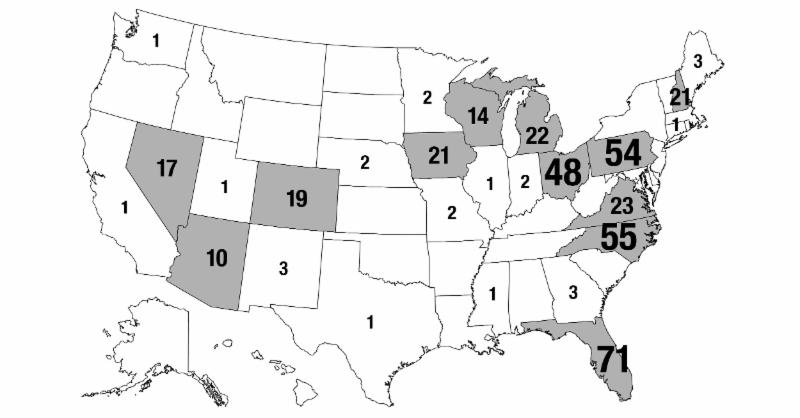
In 2016, almost all (94%) general-election campaign events and virtually all expenditures were in the 12 closely divided “battleground” states (where Trump’s support was in the 43%-51% range). Two-thirds of the campaign events (273 of 399) were in just 6 states (OH, FL, VA, NC, PA, MI). Almost all small states (12 of 13), almost all medium-sized states (22 of 25), and almost all western states, southern states, and northeastern states were totally ignored.
 |
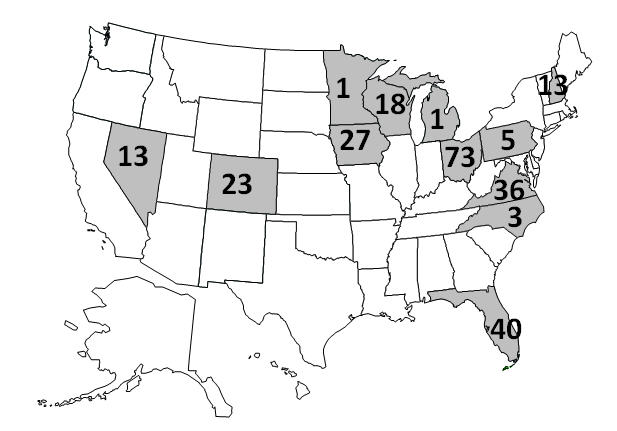
In 2012, 100% of the general-election campaign events and virtually all expenditures were concentrated in the 12 closely divided “battleground” states (where Romney’s support was 45%-51%). Two-thirds of the events (176 of 253) were concentrated in just 4 states (OH, FL, VA, IA).
 |
The 2020 campaign map will be similar unless the system is changed.
Fortunately, it does not take an amendment to the U.S. Constitution to change these existing state winner-take-all laws. State winner-take-all laws were enacted by state legislatures under their authority under Article II of the U.S. Constitution:
“Each State shall appoint, in such Manner as the Legislature thereof may direct, a Number of Electors….”
These state laws may be changed in the same way as they were originally enacted — namely by action of a state legislature.
The winner-take-all method of awarding electoral votes was not the Founding Fathers’ choice. It was used by only three states in the nation’s first presidential election in 1789 (and repealed by all three by 1800). Winner-take-all was never debated at the Constitutional Convention or mentioned in the Federalist Papers. The Founding Fathers were dead for decades before our current state-by-state winner-take-all method of awarding electoral votes became predominant.
Under the National Popular Vote bill, the national popular vote winner will receive all the electoral votes from the enacting states. The bill will take effect when enacted by states possessing a majority of the electoral votes — enough to elect a President (270 of 538). When the Electoral College meets in mid-December, the national popular vote winner will become President because the enacting states will provide him or her with at least 270 electoral votes. Thus, the candidate receiving the most popular votes in all 50 states and DC will always become President under the National Popular Vote bill.
A total of 3,153 state legislators among all 50 states have endorsed the National Popular Vote bill. .
OTHER THINGS YOU CAN DO
- Please share our home page at www.NationalPopularVote.com with your friends on Facebook or other social networks.
- Visit your state legislators at their local office or state capitol office to emphasize your support. Or, phone them. You can look up their office address, phone, and web address by entering your zip code and address at www.NationalPopularVote.com/write and then clicking on “contact info for my legislators and officials.”
- Learn more about National Popular Vote from 14 short videos on our home page at www.NationalPopularVote.com.
- Learn more about National Popular Vote from chapter 9 of our book Every Vote Equal: A State-Based Plan for Electing the President by National Popular Vote. The entire book is free to read or download.
- Please donate to National Popular Vote to enable us to continue this important work.


