He turned Bob Dylan onto pot and Woody Guthrie. He organized underground poetry and political protest. He was part of the city’s radical soul, and we will miss him
Diamond Dave Whitaker died March 2, and with him went a part of San Francisco’s soul.
Diamond D, as he called himself whenever he got me on the phone, was an icon, the kind of person who made this city a beacon for the wild, the crazy, the poets, the artists, the radicals, the beats, and the hippies. He was all of that.
He was also one of the sweetest, kindest people I have ever met.
The legends are more than legend, they are true: Diamond D was, indeed, the first person to smoke pot with Bob Dylan. He introduced Dylan to the writing of Woody Guthrie, which Dylan freely admits changed his life. Some of Dylan’s earliest songs were recorded at Diamond D’s house in Minneapolis.
Diamond D never lost faith in San Francisco’s promise. I have no idea who took this photo, but Dave was not a believer in copyright so I am not going to worry about it; contact me and I’ll give you credit. (Update: CreditGabreila Remy,, The Guardsman.)
Diamond Dave lived much of his life in San Francisco. He did pirate radio, and I was on a bunch of his shows. He organized underground poetry readings. He lived in later years in a place that was somewhere between a squat and a converted warehouse behind the Farmer’s Market on Alemany; out the window of his room was an unpermitted skateboard park. He didn’t skate, but he loved the outlaw skaters.
In fact, Diamond Dave seemed to love everyone. He had that old, wonderful, hippie vibe that hate and anger were just a waste of time and energy.
Every time he read poetry or presented or lead a demonstration, he would end by saying, “don’t panic; keep it organic.”
Once upon a time, San Francisco had plenty of room for people like Diamond D, and John Ross, and folks who cared more about peace and love and art and rebellion than about income and wealth. The city is much, much poorer without them.
Don’t panic; keep it organic. Rest in peace and power, Diamond Dave. The city you made into your home will miss you.
48 Hills welcomes comments in the form of letters to the editor, which you can submit here. We also invite you to join the conversation on our Facebook, Twitter, and Instagram.
Tim Redmond has been a political and investigative reporter in San Francisco for more than 30 years. He spent much of that time as executive editor of the Bay Guardian. He is the founder of 48hills.
This article is adapted from my new booklet, “Grab Them by the E.A.R.R.: How to Make Politicians Do What You Want.” The full booklet is available as a free download here: https://buymeacoffee.com/theer/e/487906
If you can contribute, please do. We are printing physical copies and putting them directly into the hands of every state Attorney General, every Governor, and every state legislator in America. We are mailing them, handing them out at fundraisers and town halls, and distributing them to activists on the ground. We exclusively hire humans and use union labor wherever it’s available. Contribute here: https://buymeacoffee.com/theer
State legislators say that six to eight contacts on one side of an issue feels like a landslide of public opinion. Show up at their district office with four other people and staff starts sweating about reelection.
Six phone calls. Five people in a lobby. That is how thin the margin is between being ignored and being taken seriously.
We have been lied to about our own power because people with power benefit from us not using what we have.
I spent nearly a decade learning how power actually works. Air Force veteran, law enforcement, national security, politics. Training in behavioral intervention, open-source intelligence, and the mechanics of influence that stay buried in agency manuals most people never see. I learned how institutions move, and I learned what makes the people who run them nervous.
Then I watched good people waste years on activism that accomplishes nothing. Marches that feel good as regressive policies were passed. Petitions that get filed in the trash. Phone calls made once, then never again. Organizations that spend 95 percent of their energy on bylaws and board meetings and 5 percent on actual pressure. People who show up for one protest, see no immediate result, and conclude the whole thing is rigged.
The system is rigged. But we can still win.
It moves every single day for lobbyists. It moves for organized money. It moves for anyone who shows up consistently, knows exactly who to pressure, stays on message, and never stops. The people who run things are not geniuses. They are not invincible. Politicians are busy and frequently lazy. They are terrified of losing their jobs, and they will move if you make standing still more painful than moving.
I wrote a booklet to make that happen. It is called “Grab Them by the E.A.R.R.” Educate yourself on the targets and who funds them. Activate by showing up and applying pressure. Recruit others so it multiplies. Repeat until we have toppled tyrants and their grand old parties.
Here is what makes it different from everything else you have read about civic engagement.
It is leaderless. Not because leaders get targeted, though they do. Because requiring leaders is a bottleneck. It limits who can participate and when. This model has no bottleneck. You figure out what you can sustain and you do it. Others do the same. No permission needed. No gatekeepers. No waiting for someone to tell you it is time to start.
It balances independence with collaboration. You can act alone, right now, on your own initiative. You can also coordinate when it helps, collaborate when it makes sense, invite people to participate, and accept invitations. But you never need permission or orders to be an effective activist. You never wait for approval. The choice to act is always yours.
It flips the ratio. Traditional activism tells you to form an organization, file for 501c3 status, elect a board, draft bylaws, get permits. Most organizations spend 95 percent of their effort on this bureaucracy and 5 percent on actual pressure. This model inverts that. 95 percent action. The rest takes care of itself.
It is designed for the long haul. The goal is sustained pressure at an intensity you can maintain for years. Start with five minutes a day. One phone call. One email. That is enough to build the habit. Once the habit exists, you expand. You are not sprinting toward a single event. You are training in a practice that becomes part of who you are.
It is self-multiplying. Each person brings in others. Not through campaigns or advertisements, but through relationships. You invite a friend into something you are already doing. They invite someone else. The network grows through people who actually know each other, which makes it resilient in ways top-down organizations never are.
And the math is on our side. A hundred persistent people can shape policy for a town. A thousand for a city. Ten thousand for a state. We don’t need a majority. We need a committed minority that never stops.
It works. Political scientist Erica Chenoweth studied 323 campaigns across a century and found nonviolent movements succeed more than twice as often as violent ones. The civil rights movement took fourteen years. Marriage equality took eleven. They won because they outlasted everyone who told them there was no chance. And 83 percent of the movements Chenoweth studied that succeeded never hit the famous 3.5 percent threshold. They still won.
The booklet gives you everything. How to find your targets and who funds them in fifteen minutes. How to hit them on every platform simultaneously so they cannot escape. How to structure demands with deadlines that pin them down. How to escalate when nothing moves. How to contact their donors and create friction that travels back fast. How to work local media so their name shows up in print attached to your issue. How to file public records requests that make officials realize they are being investigated. How to recruit so the pressure compounds instead of burning out.
Download it. Read it. Use it. Share it.
The system counts on us giving up. Most people do. They try once, see no immediate result, and conclude it does not work. They were never a threat.
The threat is the person who keeps showing up after the first setback, and the tenth, and the fiftieth. The person who understands that fighting is winning. Every hour they spend dealing with you is an hour they are not spending on something worse. Every sleepless night you cause is a victory. Every resource they burn responding to pressure is a resource they cannot use against us. And sometimes they actually face consequences. The threat is the person who treats this like a fun practice instead of an occasional burden.
If you can contribute, here is what your money funds:
We are printing physical copies and distributing them to every state Attorney General, every Governor, and every state legislator in America. We are mailing copies directly. We are organizing distribution at fundraisers, town halls, and public events so these booklets end up in the hands of both politicians and the constituents pressuring them. We are building a grassroots network so activists across the country have physical copies to hand out. We are also working on an entire distributed activist toolkit based off of these principles.
This takes printing, postage, logistics, and labor. We exclusively hire humans and use union labor wherever it is available.
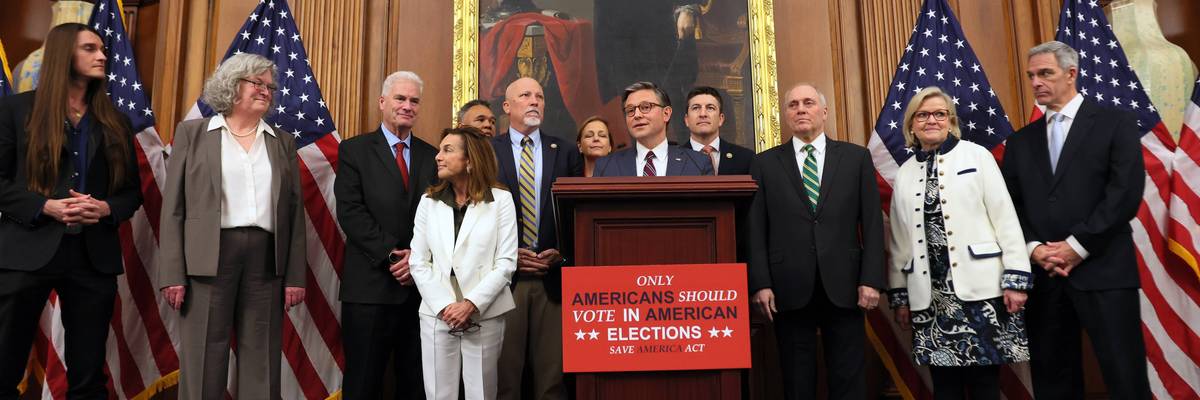
US House Speaker Mike Johnson (R-La.) speaks alongside other Republicans during a news conference about voting legislation on February 11, 2026 at the Capitol in Washington, DC.
(Photo by Michael M. Santiago/Getty Images)
The SAVE America Act and related bills “aren’t about keeping our elections free and fair,” warned the ACLU. “They’re about politicians setting the stage to interfere with election results they don’t like.”
In a pair of Truth Social posts on Thursday, President Donald Trump urged congressional Republicans to pass the voter suppression bill that is stalled in the US Senate after being advanced by the House of Representatives last month.
“The Republicans MUST DO, with PASSION, and at the expense of everything else, THE SAVE AMERICA ACT—And not the watered down version. This is a Country Defining fight for the Soul of our Nation!” Trump wrote Thursday morning.
In a separate post about an hour later, the president added:
THE SAVE AMERICA ACT! 1. ALL VOTERS MUST SHOW VOTER I.D. (IDENTIFICATION!). 2. ALL VOTERS MUST SHOW PROOF OF CITIZENSHIP IN ORDER TO VOTE. 3. NO MAIL-IN BALLOTS (EXCEPT FOR ILLNESS, DISABILITY, MILITARY, OR TRAVEL!). 4. NO MEN IN WOMEN’S SPORTS. 5. NO TRANSGENDER MUTILATION SURGERY FOR CHILDREN, WITHOUT THE EXPRESS WRITTEN APPROVAL OF THE PARENTS
The posts came just eight months ahead of the midterms that will determine which party controls each chamber of Congress for the rest of the president’s second term—which is also supposed to be his final, under the 22nd Amendment to the US Constitution, but the 79-year-old with a history of lying about election results and voter fraud has repeatedly teased trying to stay in power.
Trump and other advocates of the SAVE America Act—and its state-level copycats—have claimed that the bill is necessary to prevent immigrants from participating in elections, even though noncitizen voting is already illegal and research has made clear that voter fraud is incredibly rare in the United States.
The House-approved version of the bill, led by Rep. Chip Roy (R-Texas) and Sen. Mike Lee (R-Utah), would require states to regularly submit voter rolls to the US Department of Homeland Security, and to obtain proof of citizenship, in person, when registering someone to vote. It would also force voters to present eligible photo identification at the polls.
Critics of the bill have argued that rather than tackling the nonexistent issue of noncitizen voting, the SAVE America Act would disenfranchise eligible voters who don’t have access to proof of citizenship documents—such as people who have lost paperwork, can’t afford replacements, or have changed their names.
The ACLU has a tool to help Americans contact their senator to oppose the SAVE Act, SAVE America Act, and Make Elections Great Again (MEGA) Act. The automatic message says in part that “these bills aren’t about keeping our elections free and fair. They’re about politicians setting the stage to interfere with election results they don’t like. Please reject these dangerous, anti-voter bills.”
While House Republicans were able to approve the legislation mostly along party lines—the only Democrat who supported it was Rep. Henry Cuellar of Texas, who notably received a pardon from the president recently—the Senate GOP’s majority is too slim to get most bills past the 60-vote filibuster without some Democratic support.
Trump also renewed his call for passing the legislation in his State of the Union address last month, specifically calling out Senate Majority Leader John Thune (R-SD). The following day, the Associated Pressreported that Thune backs the bill, and Republicans were discussing how to send it to the president’s desk.
According to the AP:
Senate Republicans “aren’t unified on an approach,” Thune said on Wednesday after Trump’s speech.
In an effort to get around Democratic opposition, Trump and others have pushed a so-called “talking filibuster,” which would bring the Senate back to the days of the movie Mr. Smith Goes to Washington, when senators talked indefinitely to block legislation. Today, the Senate mostly skips the speeches and votes to end debate, which takes 60 votes in the Senate where Republicans have a 53-47 majority.
Republicans wouldn’t have to change the rules to force a talkathon. They could simply keep the Senate open and make Democrats deliver speeches for days or weeks to delay taking up the legislation. But Thune would still need enough support from his caucus to move forward with that approach, and he said this week that “we aren’t there yet.”
Absent progress in the Senate, several state legislatures are considering similar bills. Citing the Voting Rights Lab tracker, Talking Points Memoreported Tuesday that 15 states have 26 active election bills with proof of citizenship requirements.
“I think what we’re often seeing in these states is that there’s an effort to send political messages that don’t necessarily comport with the reality of election integrity or the needs of election officials,” David Becker, a former US Department of Justice lawyer and executive director and founder of the nonpartisan Center for Election Innovation and Research, told TPM.
“Like the SAVE Act, this would require citizens to regularly work to make up for government deficiencies, digging out and showing their citizenship papers over and over and over again when they’ve already shown them,” Becker said of state-level proposals. “Why are we insisting that citizens have to work for government, rather than government working for us?”
Our work is licensed under Creative Commons (CC BY-NC-ND 3.0). Feel free to republish and share widely.
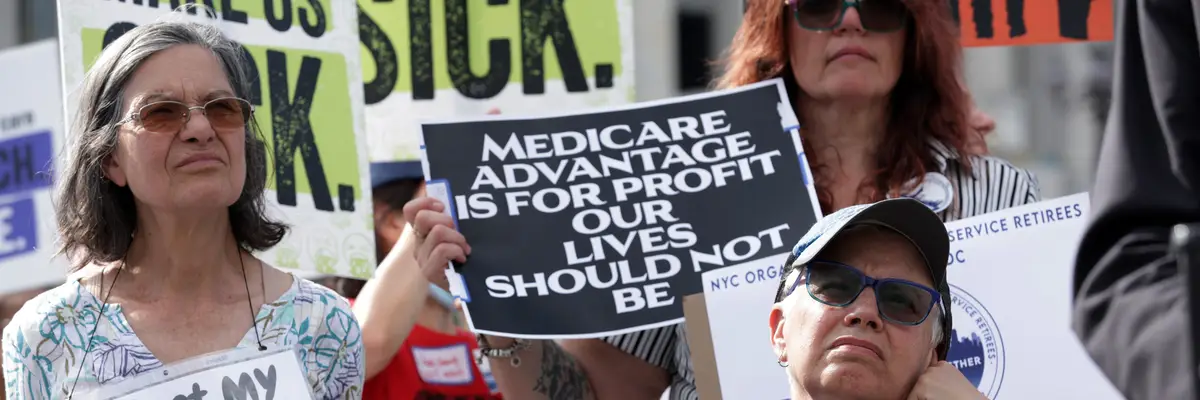
Advocates hold signs during a news conference on Medicare Advantage plans in front of the US Capitol on July 25, 2023 in Washington, DC.
(Photo by Alex Wong/Getty Images)
“We don’t allow banks to call themselves the U.S. Treasury Investment Fund,” said Rep. Mark Pocan. “We don’t allow anyone to call themselves USPS Plus. So why allow insurance companies to call private insurance Medicare Advantage?”
A group of Democratic lawmakers on Wednesday reintroduced legislation aimed at reining in for-profit insurance companies who use the Medicare name to market their plans.
The “Save Medicare Act,” being reintroduced by US Reps. Mark Pocan (D-Wis.), Ro Khanna (D-Calif.), and Jan Schakowsky (D-Ill.), bars private insurers from using the word “Medicare” in marketing their plans, imposing “significant fines” for any insurer that doesn’t comply.
At issue, the lawmakers said, is that insurers are flooding the airwaves with ads for Medicare Advantage plans during open enrollment periods. The ads are deceiving Americans into thinking their plans are just variations of Medicare services offered by the federal government, they said.
“Let’s be clear: Medicare Advantage is not Medicare,” said Schakowsky. “These private insurance plans use Medicare’s trusted name while too often denying medically necessary care, restricting providers, and overcharging taxpayers by billions. That is unacceptable. We have seen insurers exploit the system to boost profits at the expense of seniors.”
Khanna noted that Medicare Advantage is “a private insurance program that too often boosts profits by limiting coverage,” even as it “misleads seniors into thinking it’s traditional Medicare.”
“That’s wrong,” Khanna emphasized. “This legislation will stop private insurers from cashing in on the Medicare name. We should be working to protect and expand real Medicare instead.”
Pocan declared that “only Medicare is Medicare,” adding that Medicare Advantage plans “often leave patients without the benefits they need while overcharging the federal government for corporate profit.”
“This bill makes clear what is—and what is not—Medicare,” added Pocan, “and ensures this essential program will continue to serve seniors and other Americans for generations to come.”
Pocan also posted a video on social media where he talked about his elderly mother being unable to see the physician that came to her assisted living home because she relied on Medicare Advantage and the doctor in question was out of network.
“She would have had to go all the way across town to get that care,” Pocan explained. “The problem is, she wasn’t very mobile and she never got the medical care.”
We don't allow banks to call themselves the U.S. Treasury Investment Fund. We don't allow anyone to call themselves USPS Plus.
So why allow insurance companies to call private insurance Medicare Advantage?
“We don’t allow banks to call themselves the U.S. Treasury Investment Fund,” said Pocan. “We don’t allow anyone to call themselves USPS Plus. So why allow insurance companies to call private insurance Medicare Advantage?”
Many progressive critics have for years pointed to Medicare Advantage as a legitimate example of wasteful spending by the federal government.
A report released in January by the Medicare Payment Advisory Commission (MedPAC), an independent congressional agency that advises lawmakers on Medicare, estimated that overpayments to Medicare Advantage plans could total $76 billion in 2026.
One major factor in the overpayments is that patients using Medicare Advantage plans tend to be healthier than patients on traditional Medicare, with the result being that private insurers charge the government more than is necessary to meet these patients’ needs.
On Wednesday, Schakowsky said that the “crucial legislation” she joined Khanna and Pocan in introducing “will end deceptive marketing and ensure beneficiaries understand the difference between traditional Medicare and private insurance plans.”
“Seniors deserve transparency, accountability, and the full benefits they have earned,” she said.
Our work is licensed under Creative Commons (CC BY-NC-ND 3.0). Feel free to republish and share widely.
Wajahat Ali Mar 3, 2026 As Trump’s wars rage and income inequality soars, corporate Democrats are doubling down on crushing progressives ahead of the 2026 elections. The party’s establishment prioritizes donors over voters, leaving the left base frustrated and disillusioned. Joining me to break down what this means for the Democratic Party, its future, and the progressive movement is Saikat Chakrabarti, former chief of staff to Alexandria Ocasio-Cortez and a key architect of grassroots progressive organizing. We discuss whether the party can be saved from its centrist chokehold or if it’s already too late to reclaim its soul. Listen in to hear what it will take for progressives to fight back, reshape the agenda, and challenge the broligarchs controlling both parties. https://thelefthook.substack.com/p/wa…
Register and vote: Democracy is won at the ballot box — in every election, at every level. Register, confirm your registration, and bring your community with you.
In “Bernie for Burlington,” Dan Chiasson’s affection for his subject risks turning history into a sales pitch.
Bernie Sanders, pictured here in his first term, served as the mayor of Burlington, Vt., from 1981 to 1989.Credit…Donna Light/Associated Press
By Alexander Nazaryan
Alexander Nazaryan writes about politics, culture and science.
Feb. 4, 2026 (NYTimes.com)
When you purchase an independently reviewed book through our site, we earn an affiliate commission.
BERNIE FOR BURLINGTON: The Rise of the People’s Politician and the Transformation of One American Place, by Dan Chiasson
I always read the acknowledgments page of a book I’m reviewing. They’re usually bland, pro forma affairs. Sometimes, though, they give an inadvertent glimpse into the authorial soul.
Dan Chiasson concludes his new book, “Bernie for Burlington,” a history of the eight years during the 1980s that Bernie Sanders spent running the state’s biggest city, with a shout-out to his subject: “And thank you, Bernie Sanders — for Burlington.” I think that’s the heart of what bothered me about this impressive but frustrating book.
Senator Sanders, according to Chiasson, is “arguably the most influential leftist politician in the modern history of the nation,” “a national figure of historic impact” who “leveled Burlington’s old hierarchies, networks and institutions,” turning the city into a “wacky, D.I.Y. civic experiment.” This “seasoned manipulator of the sometimes-hostile media,” who “overcame the fears of the establishment with one smart, nonpolitical initiative after another,” transformed Burlington into “a one-of-a-kind, historic inquiry into the possibilities for human happiness in an American city.”
Today an English professor at Wellesley College, Chiasson was born and raised in Burlington in a working-class Catholic family during the years of the four-term Sanders mayoralty. His affection for that place and time is obvious and often artfully rendered, as when he writes about the city’s first Xerox machine, where “metalheads ran off posters for their bands” and a local math professor printed a widely read anti-Sanders newsletter.
Chiasson is a witty, gifted poet and a sometime poetry critic for The New Yorker, the author of five collections. His poetic voice is jazzy and self-effacing, quietly assured.
We miss those qualities here. Sanders is legendary for the loyalty he inspires in adherents. But, unfortunately, the Independent senator benefits from Chiasson’s affection more than his book does. By collapsing the distance between himself and his subject, Chiasson turns history into a sales pitch.
He hasn’t chosen an easy subject. To his supporters’ delight and his critics’ frustration, Sanders has been focused on the same issues for decades, without concern for shifting attitudes or polls. And he’s not cuddly: As his advisers put it in a 1982 memorandum, “You are not nice to people.”
Sanders was one of many “idealistic pilgrims” from larger cities who saw Vermont as an affordable place to put countercultural politics into practice. He first went there in 1968, spent his first years as an “itinerant carpenter and freelance writer, deeply influenced by the rogue psychoanalyst Wilhelm Reich.” (Sanders even penned some creepy erotica.)
“Bernie for Burlington” is at its best when it ignores both Bernie and Burlington. Writing about Vermont as a whole, Chiasson is encumbered neither by ideological affinities nor by hometown pride. He describes a state whose character is composed of “progressivism, thrift and orneriness.”
Vermonters were traditionally resistant to government initiatives, and hostility was not limited to Washington. Chiasson chillingly describes “Rural Vermont,” a eugenics study from 1931 that “speaks of the deteriorating of Yankee blood and the problem of towns being overtaken by immigrants who were ‘failures elsewhere.’” A story of quaint inns, ski resorts and quirky antique shops, this is not.
Between 1945 and the mid-1960s, the number of farms in Vermont fell sharply. The college-educated newcomers, inspired by back-to-the-land guides, provided a necessary blood transfusion, even if their experiments were often quixotic.
Sanders ran for public officeas a candidate of the radical Liberty Union Party, four times between 1972 and 1976, losing two U.S. Senate races and two bids for the governor’s mansion. He had become, Chiasson acknowledges, a “perennial candidate.”
In Chiasson’s telling, an adviser named Richard Sugarman persuaded Sanders to leave behind the “performative politics” of the 1960s. By 1977, Chiasson writes, “the hippies were now in their 30s, with families to raise and mortgages to pay.” Sanders announced he was leaving Liberty Union later that year, charging that the party had not been aggressive enough in fighting “banks and corporations.”
It’s a testament to Chiasson’s research that I often found myself highlighting people and places I wanted to explore further. But the accumulation of detail also makes for an infuriating reading experience. A book that is about the time Sanders spent as mayor of Burlington takes 257 pages to get to his first mayoral run.
The Sanders candidacy was powered by “a new wave of Vermont transplants” who were liberal but not especially interested in forming communes. “Their music was Madonna, Patti Smith and Talking Heads,” Chiasson writes, their clothes bright and chic. And for these new arrivals, “part of the Burlington experience was voting for Sanders.”
In the four terms that followed, Sanders would turn a “dowdy, backward, deeply Catholic” city into “the place to see socialism in action,” Chiasson argues. Yet he appears to undermine his own argument by conceding that, in some respects, Sanders turned into “a classic ribbon-cutting mayor.” He also calls the proud democratic socialist an “innovative capitalist.”
An honest assessment of Sanders’s mayoralty would grant that he expanded parkland along the shores of Lake Champlain, made important strides in creating affordable housing and practiced a grass-roots politics that took the concerns of young people seriously. At the same time, he engaged in the kind of gestures Sugarman had advised against, such as his controversial 1985 trip to visit the Sandinista rebels in Nicaragua.
In 1988, Sanders went to the U.S.S.R. While there, he attempted to make Yaroslavl, an ancient settlement north of Moscow, Burlington’s sister city. Chiasson sarcastically excoriates a New York Times Moscow correspondent, Anton Troianovski, for reporting deeply, during the 2020 Democratic presidential primary, on Sanders’s efforts while mayor to foster closer ties with the Soviet Union. It’s an unseemly attack that accuses Troianovski of trying to “red-bait” Sanders, while failing to acknowledge the very real risks to high-profile American journalists in Putin’s Russia.
Sanders and his wife, Jane, did not participate in this book, though it is not clear how much they would have had to add. Chiasson writes about traveling to Vermont in 2024 to meet Sanders at a picnic, where Chiasson told Sanders about growing up in his Burlington. The response from Sanders: “Oh, boy.”
It must have been an anticlimactic encounter, though maybe also an apt one. The stubborn Sanders has cleared the way for younger, more charismatic democratic socialists, including Alexandria Ocasio-Cortez and Zohran Mamdani. But Chiasson does little to dispel the charge, frequently voiced by Sanders critics, that he has few robust legislative accomplishments.
I have no doubt that Chiasson has written the authoritative history of the Sanders tenure in Burlington. Whether this somewhat confounding labor of love was necessary, whether it tells us something important or new, is more difficult for me to say.
BERNIE FOR BURLINGTON: The Rise of the People’s Politician: and the Transformation of One American Place | By Dan Chiasson | Knopf | 569 pp. | $35
A version of this article appears in print on March 1, 2026, Page 16 of the Sunday Book Review with the headline: Idol Worship. Order Reprints | Today’s Paper | Subscribe
Yes. Saikat Chakrabarti was one of the co-founders of Justice Democrats.
The group was founded in 2017.
The main founders were:
Saikat Chakrabarti
Zack Exley
Kyle Kulinski
Cenk Uygur.
Chakrabarti served as an executive director of Justice Democrats and helped design the organization’s strategy and technology for grassroots organizing.
The group became well known for recruiting progressive challengers, including Alexandria Ocasio-Cortez, whose 2018 primary victory over Joe Crowley was a major early success.
In short:
Yes — Chakrabarti co-founded Justice Democrats and played a central role in building it.
If you want, I can also explain something many people miss: how Justice Democrats grew out of another project called “Brand New Congress.” That backstory is actually pretty interesting politically.
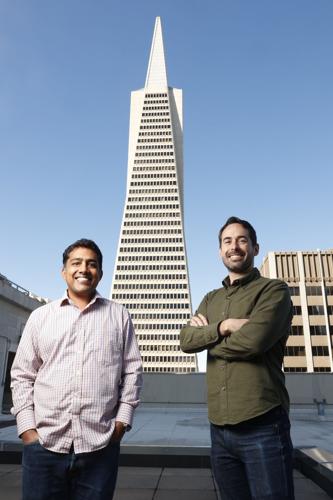
Sachin Agarwal (left) and Steven Bacio, co-founders of GrowSF at their office in San Francisco with a view of the Transamerica Pyramid on Monday, March 2, 2026. Craig Lee/The Examiner
Two independent San Francisco advocacy organizations are separately planning to spend millions of dollars on city elections this year, largely to preserve the politically moderate majority that voters installed in 2024 on the Board of Supervisors.
Jay Cheng, the executive director of Neighbors for a Better San Francisco, said his group expects to spend $5 million to $7 million through November between races for supervisor and local ballot measures, including to oppose a union-backed proposal to raise The City’s Overpaid Executive Tax.
“There’s a lot at stake in this election, especially around keeping San Francisco’s recovery going, and a big part of that is keeping the moderate majority on the Board of Supervisors, keeping a moderate majority on the school board,” he said.
Neighbors for a Better San Francisco has been one of San Francisco’s most powerful and well-funded political organizations on the more-conservative end of San Francisco’s political spectrum since its founding six years ago. It focuses on issues that include public safety, homelessness, public education and fiscal responsibility.
Its plans also include spending $1 million to support candidates in several school board races and about $2 million on voter education, including about The City’s budget, said Cheng, who previously discussed his spending plans with Politico.
Meanwhile, GrowSF has budgeted at least $250,000 per supervisorial contest, including two races in the June primary election and as many as five in the November general election. The group’s level of involvement will depend on whether or not organizers determine the races to be competitive, said Sachin Agarwal, a GrowSF co-founder and co-director.
Jay Cheng, executive director of Neighbors for a Better San Francisco: “There’s a lot at stake in this election, especially around keeping San Francisco’s recovery going.”Craig Lee/The Examiner
GrowSF is a nonprofit that advocates for building more housing, streamlining government, and maintaining clean and safe streets, among other things. It has received support from a wide variety of sources, including Garry Tan, the CEO of the famed startup accelerator Y Combinator, who is known for attacking progressive politicians on social media. Tan was previously on GrowSF’s board of directors.
GrowSF’s top focus has always been the Board of Supervisors since the organization was created five years ago. Though obscure to many, the Board of Supervisors wields enormous influence over city life with its lawmaking power, Agarwal said.
“We think that the Board Supervisors is critically important in moving San Francisco forward,” he said.
In addition to getting involved in supervisor races, Agarwal said GrowSF will also send its trademark voter guides to registered voters across The City. That will bring the group’s total budget for the June election to about $2 million and another $3 million for the November election, of which as much as $1.25 million could go to the November supervisor races, he said.
By comparison, GrowSF spent about $1.8 million on the November 2024 election, about $700,000 of which went to influence races for supervisor, Agarwal said.
Sachin Agarwal, left seen with fellow GrowSF co-founder Steven Bacio at their office in San Francisco: “We think that the Board Supervisors is critically important in moving San Francisco forward.”Craig Lee/The Examiner
“We are stepping it up this year,” he said. “We’re going to be prepared to go really big.”
A moderate majority could make it easier for Mayor Daniel Lurie to grapple with looming budget deficits, Agarwal said.
It could also be helpful for sending voters any charter-reform proposals that might be developed by a task force that Lurie and Board of Supervisors President Rafael Mandelman launched in December — possibly even for the November ballot, Agarwal said. The City Charter is effectively San Francisco’s constitution, and six supervisors’ signatures are required for the board to send a proposed amendment to voters.
GrowSF in 2024 was the leader of the successful “Dump Dean” campaign to oust former Supervisor Dean Preston, who was replaced by current District 5 Supervisor Bilal Mahmood. GrowSF spent more than $300,000 in that race, according to city records.
“We’ve taken everything that we learned from the last District 5 race with ‘Dump Dean’ — what worked well, what didn’t work well, how do we spend money effectively to get good information to voters?” Agarwal said. “We’re taking all of our learnings, and we’re going to apply them to every district this year.”
GrowSF so far has set up two independent committees — one to support District 2 Supervisor Stephen Sherrill, who was appointed by former Mayor London Breed in December 2024, and one to support District 4 Supervisor Alan Wong, who was appointed by Lurie on Dec. 1.
A campaign spokesperson for Sherrill, whose district includes the Marina and Cow Hollow neighborhoods, emphasized in a statement that independent groups make their own decisions about local races.
Wong rival Natalie Gee, who is chief of staff for Supervisor Shamann Walton, labeled GrowSF as an “outside group” out of step with residents in the Sunset district, which makes up most of District 4. GrowSF endorsed former Supervisor Joel Engardio, the lawmakere who was recalled by voters last year after he sponsored a ballot measure to close part of Great Highway to make way for Sunset Dunes park.
“District 4 voters will see through GrowSF’s big money and vote for the candidate who has consistently fought against outside wealthy interests,” Gee said.
Agarwal responded that he has lived in The City for 25 years and been a west-side resident for more than seven years.
On the initiative front, Cheng also said Neighbors for a Better San Francisco would be fighting a union-backed proposal to increase the Overpaid Executive Tax, which he said would “kill our recovery.”
Scott Mann, a spokesperson for the Stand Up for SF campaign pushing the tax, called Cheng’s warning about the local economy is “nothing more than a scare tactic intended to mislead voters.”
A bigger threat to the recovery would be cuts to the services that have stabilized The City, including health care, mental-health services, homelessness prevention and home care, he said.
On the supervisorial front, Cheng said Neighbors for a Better San Francisco would focus on District 8, which includes the Castro, Noe Valley and Cole Valley. The group will support candidate Manny Yekutiel, owner of Manny’s cafe and event space in the Mission. Yekutiel’s opponents include Gary McCoy, a campaign manager at U.S. Rep. Nancy Pelosi’s Save Our Healthcare campaign.
A Yekutiel spokesperson said his campaign would not comment and underscored that Neighbors for a Better San Francisco acts independently.
Catie Stewart, a campaign spokesperson for McCoy, suggested the group’s spending might be fruitless.
“If dumping Republican money into San Francisco politics were a guaranteed path to victory, we’d see a lot more of Neighbors’ candidates in office by now,” Stewart said.
Critics of Neighbors for a Better San Francisco have frequently pointed out that the organization’s financial backers — notably William Oberndorf — include people who have also contributed heavily to Republicans.
In District 10, meanwhile, Cheng, said his organization would back Theo Ellington against a raft of candidates, including Dion-Jay Brookter, a nonprofit executive endorsed by Walton, who is term-limited out of office.
District 10, in the southeastern part of The City, includes Potrero Hill, Bayview and Hunters Point.
Ellington was a member of the Neighbors for a Better San Francisco board from 2022 until 2025, said Noah Finneburgh, a consultant for the Ellington campaign, via email.
“Theo is a Bayview native with a deep family history in San Francisco, and that’s resonating with voters,” Finneburgh said. “It’s also reflected in who is funding this campaign — we have more than 500 grassroots donations from artists, teachers, nurses, small business owners, and community leaders.”
Vanessa Pimentel, a consultant with Brookter’s campaign, predicted that District 10 residents will not be swayed by any big spending.
“We’ve seen high-dollar interference before, and we’ve seen it fail when it collides with informed, engaged residents who care deeply about their neighborhoods,” Pimentel said. “This election isn’t for sale. It belongs to the people of San Francisco, and they won’t be fooled.”
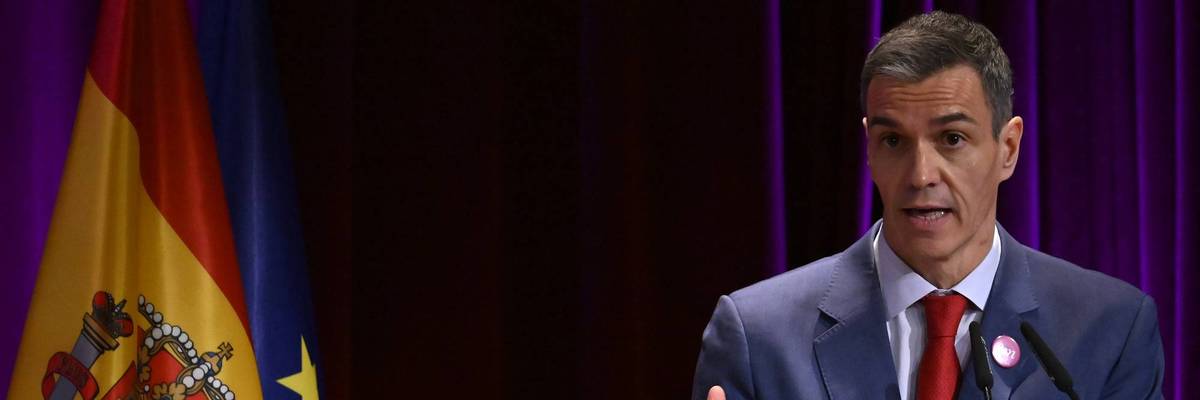
Spanish Prime Minister Pedro Sánchez speaks during an event in Madrid on March 4, 2026.
(Photo by Burak Akbulut/Anadolu via Getty Images)
European leaders expressed solidarity with Spain after Trump threatened a trade embargo in retaliation for the prime minister saying the US could not use Spanish military bases to attack Iran.
Spanish Prime Minister Pedro Sánchez on Wednesday appeared undaunted by President Donald Trump’s threat to impose a full trade embargo on Spain in retaliation for its refusal to allow the US to use its military bases to wage war on Iran.
In a 10-minute televised address, Sánchez told the Spanish public that the country “will not be complicit in something that is bad for the world and contrary to our values and interests simply out of fear of reprisals from someone.”
Despite Trump’s threat, the Spanish government’s position on the US and Israel’s attacks on Iran, the prime minister said, can be summarized as “no to war.”
The address came hours after Trump claimed the US military would use Spain’s military bases to launch warplanes “if we want,” despite Spanish Foreign Minister José Manuel Albares’ earlier statement that the facilities could not be used “for anything that isn’t covered by the [United Nations] Charter.”
The US and Israel began attacking Iran early Saturday morning after Oman’s foreign minister said American and Iranian officials had been making progress toward a deal on Iran’s nuclear program.
Legal experts have said the unprovoked attacks are a clear violation of international law and the UN Charter, which prohibits the use of force unless it is “authorized by the UN Security Council or is a necessary and proportionate act of individual or collective self-defense in response to an armed attack.”
Secretary of State Marco Rubiostunned observers this week when he claimed the US and Israel had waged war because of an “imminent threat”—one that was posed because the US believed Israel was planning to strike Iran, and Iran was expected to retaliate against that potential attack.
On Wednesday, Sánchez said the US and Israeli strikes against Iran, which have so far killed more than 1,000 people, according to Iranian officials, signify a “breakdown of international law.”
He compared the bombings to the George W. Bush administration’s invasion of Iraq, which led to eight years of war and killed over 100,000 Iraqi civilians, and warned against “repeating the mistakes of the past.”
“Very often great wars start with a chain of events spiraling out of control due to miscalculations, technical failures, and unforeseen circumstances,” said the prime minister, who has also been outspoken in his opposition to Israel’s US-backed assault on Gaza and the Trump administration’s invasion of Venezuela in January. “Therefore, we must learn from history and cannot play Russian roulette with the fate of millions.”
Trump on Tuesday also expressed anger over Spain’s refusal to cave to his demand that all North Atlantic Treaty Organization (NATO) member states commit to spending 5% of their gross domestic product on defense by 2035.
But other members of the European Union, which collectively negotiates trade with the US, were quick to express solidarity with Spain.
German Chancellor Friedrich Merz, who met with Trump at the White House on Tuesday, told the president that European countries would not agree to a trade agreement with the US that didn’t include Spain, while French President Emmanuel Macron spoke to Sánchez to convey his “solidarity.” European Council President António Costa also said he has spoken to the Spanish prime minister and reaffirmed the EU’s “firm commitment to the principles of international law and the rules-based order everywhere in the world.”
Despite Europe’s strong stance against Trump’s threats, US Treasury Secretary Scott Bessent on Wednesday doubled down on the president’s rhetoric, appearing on CNBC to accuse Spain of “not meeting their NATO requirement” and of putting “American lives at risk” by not allowing the US to use its bases.
Stéphane Séjourné, the EU’s internal market commissioner, was not deterred by Bessent’s comments, warning that “any threat against member state is by definition a threat against the EU.”
He noted that European countries already joined together this year to defend Greenland from Trump’s claim that he would take over the autonomous territory, part of the Danish kingdom, by force.
“If you threaten one particular country… well, we’ve seen that about Greenland,” said Séjourné. “I think we saw that there was a lot of unity.”
Our work is licensed under Creative Commons (CC BY-NC-ND 3.0). Feel free to republish and share widely.
Trump Regime Takedown: Every Saturday Saturday, March 7, 2026 12:00 PM 2:00 PM Tesla San Francisco999 Van Ness AvenueSan Francisco, CA, 94109United States (map) Google Calendar ICS Keep democracy alive every Saturday by showing up, taking a stand, and sticking together for the long haul. Standing together is better than standing alone. Let’s get together... Continue reading →
This Sunday’s Town Hall: Announcing This Week’s Progressive Town Hall: Every Sunday at 4pm ET/1pm PT RSVP HERE Join PDA activists online from across the country to discuss the importance of progressives reclaiming the American story from the MAGA right, an issue of heightened importance as we’re now within one... Continue reading →
We protest Heritage Foundation EVERY MONDAY (Join us!!!!) By admin | September 2, 2025 | Uncategorized Cliff Cash Comedy Premiered Jul 26, 2025 Every Monday at The Heritage Foundation 214 Massachusetts Ave. Washington D.C. 4pm protest 6pm pizza Every Friday at Fox News D.C. 400 N. Capitol St. Washington D.C. 4pm protest 6pm pizza We are... Continue reading →
One Million Rising: Strategic Non-Cooperation to Fight Authoritarianism Virtual Event · Hosted by No Kings Time Wednesdays 8 – 9:30pm EDT Location Virtual event Join from anywhere About this event Across the country, authoritarian forces are getting bolder and more dangerous. Trump and his allies are not hiding their agenda: mass deportations,... Continue reading →
THURSDAY, JUNE 29, 2023 AT 2 AM – 4 AM PDT How to create trust in a group? Details Event by Extinction Rebellion Empathy Circles online EMPATHY CAFE Duration: 2 hr Public · Anyone on or off Facebook How to create trust in a group? This is the question that arose in our... Continue reading →
Trump Regime Takedown: Every Saturday Saturday, March 7, 2026 12:00 PM 2:00 PM Tesla San Francisco999 Van Ness AvenueSan Francisco, CA, 94109United States (map) Google Calendar ICS Keep democracy alive every Saturday by showing up, taking a stand, and sticking together for the long haul. Standing together is better than standing alone. Let’s get together... Continue reading →
This Sunday’s Town Hall: Announcing This Week’s Progressive Town Hall: Every Sunday at 4pm ET/1pm PT RSVP HERE Join PDA activists online from across the country to discuss the importance of progressives reclaiming the American story from the MAGA right, an issue of heightened importance as we’re now within one... Continue reading →
We protest Heritage Foundation EVERY MONDAY (Join us!!!!) By admin | September 2, 2025 | Uncategorized Cliff Cash Comedy Premiered Jul 26, 2025 Every Monday at The Heritage Foundation 214 Massachusetts Ave. Washington D.C. 4pm protest 6pm pizza Every Friday at Fox News D.C. 400 N. Capitol St. Washington D.C. 4pm protest 6pm pizza We are... Continue reading →
One Million Rising: Strategic Non-Cooperation to Fight Authoritarianism Virtual Event · Hosted by No Kings Time Wednesdays 8 – 9:30pm EDT Location Virtual event Join from anywhere About this event Across the country, authoritarian forces are getting bolder and more dangerous. Trump and his allies are not hiding their agenda: mass deportations,... Continue reading →
THURSDAY, JUNE 29, 2023 AT 2 AM – 4 AM PDT How to create trust in a group? Details Event by Extinction Rebellion Empathy Circles online EMPATHY CAFE Duration: 2 hr Public · Anyone on or off Facebook How to create trust in a group? This is the question that arose in our... Continue reading →