‘A labor of love’: Interfaith winter shelter program returns for 37th year

saint marys (copy)
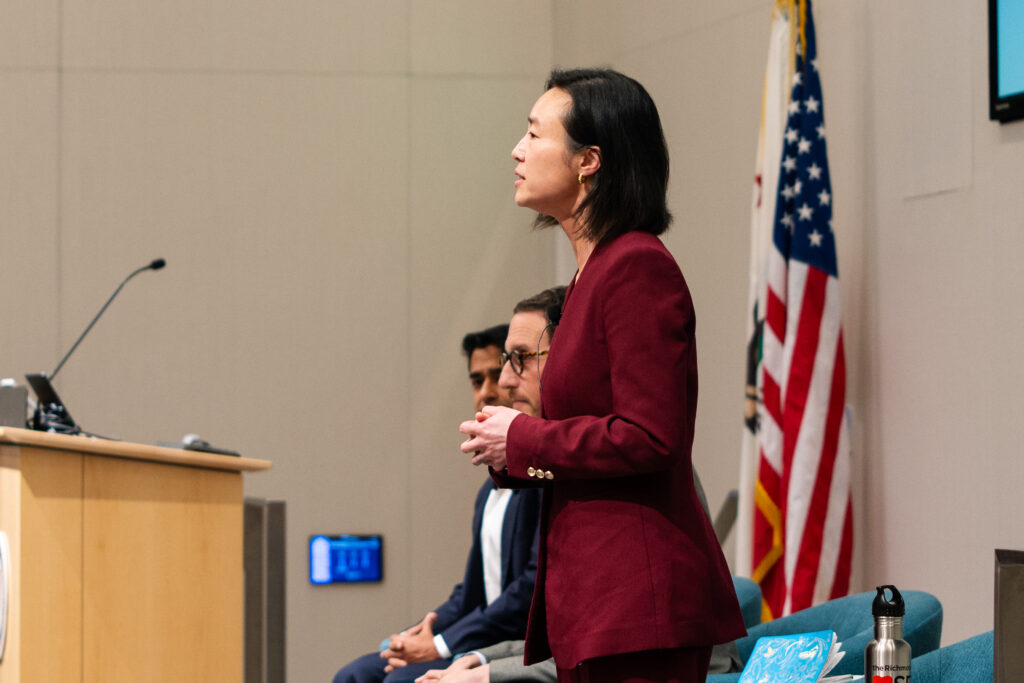
Cathedral of St. Mary of the Assumption, at 111 Gough St., is one of the sites hosting emergency shelter for San Franciscans experiencing homelessness as temperatures plummet over the next four months.Kevin N. Hume/SF Examiner

An annual emergency shelter initiative aimed at providing shelter for those experiencing homelessness in The City during the coldest months of the year is officially operational.

San Francisco’s Interfaith Winter Shelter program commemorated its 37th year on Thursday, with five participating sites opening their doors to those in need on a rotating basis over the next few months. The program, which has been expanding winter shelter capacity since 1989, remains a key resource for the unhoused in a city strapped for shelter beds and affordable housing.

The shelter program, which continues until March 29, 2026, rotates between the Canon Kip Senior Center, St. Mary’s Cathedral, St. Mark’s Lutheran Church, First Unitarian Universalist Church & Center, and the Quaker Meeting House. The number of beds available changes depending on the site, with Canon Kip the smallest at 30 beds, and St. Mary’s the largest at 80.

“Our city will not stand idle when our neighbors need a warm meal and a place to stay,” said Mayor Daniel Lurie during a visit to Canon Kip Senior Center in SoMa on Thursday. “This effort expands our shelter capacity for four months across sites supported by our interfaith leaders.”

Chris Callandrillo, the chief program officer at Episcopal Community Services, an interfaith partner that supports the program, said last year his organization served around 600 guests, providing more than 6,000 hot meals to those who needed it.

“These are not just numbers. These are real people’s lives,” Callandrillo said. “Moreover, the shelter also serves as an access point where people can get connected to the resources and services needed to help them permanently exit homelessness, as well as a hub for social connection to combat isolation, especially during the holidays.”

Daniel Lurie speaks at the opening of the emergency winter shelter as part of the 37th annual Interfaith Winter Shelter program at Canon Kip Senior Center at 705 Natoma St. on Dec. 4, 2025Natalia Gurevich/SF Examiner

Those who stay at the shelter sites are all self-referrals, said Deborah Bouck, a spokesperson for the San Francisco Department of Homelessness and Supportive Housing. While bed availability changes each night starting at 6 p.m., when the sites transition from their daily operations, visitors can hold onto their bed for more than one night. 

This changes as the sites rotate, she said, which happens on a monthly-ish basis and is posted online. Guests are informed of the move beforehand.

The program was created in 1989 in response to the growing homelessness crisis in The City and, over the last few decades, the need has increased, said Michael Pappas, the executive director of the San Francisco Interfaith Council.

“Over three decades, I think the greatest disruption was COVID-19,” he said of the global pandemic of March 2020. “I remember at the very beginning of COVID-19, we had to shut it down because the volunteers were preparing our meals … and nobody knew what was going to happen.”

At the end of 2020, when the program was set to resume, St. Mary’s maintained its shelter during the entire four-month stint, as it was the largest site and deemed the safest for congregate shelter.

“It is a labor of love,” Pappas said, of operating the program every year.

While there have been discussions in the past about operating this emergency shelter year-round, he said it would be too much to ask of the participating partners, as each space serves another purpose.

“A lot of them have rental space that they have to give up,” Pappas said, of the additional strain on participating sites caused by operating the program. “They get a stipend from The City, but it’s barely enough to pay for electricity. They’re doing the best that they can, and we’re always looking for new spaces.”

It was just last year that the Quaker community stepped forward and offered its space to the roster, he said.

One of the first guests staying at Canon Kip on Thursday said he found out about the shelter through a flyer at the Gubbio Project, another homelessness resource site in The City.

Gil, who asked to go by his first name to protect his privacy, said he’d been living on the streets since July of 2024, after getting evicted from his home. He’s been working with The City’s Homeless Outreach Team to find permanent housing, but the process got “derailed” during the recent holiday.

“They have good people, their hearts are in the right place,” Gil said. “It’s just about having the resources.”

But while he’s been on wait lists, living on the street has become more of a challenge in recent weeks as the weather has turned, Gil said, as he was recovering from a bout of walking pneumonia.

“I’m thankful that this place is here, that it’s a safety net,” he said. “I really don’t want to stay on the street.”

Medicare for All Is Popular — Even When Put Up Against Attacks

(dataforprogress.org)

Americans are consistently saying that the cost of living is their top concern, and health care prices, in particular, are set to soar in 2026 — with employers expected to face the largest price increase in more than a decade. This comes as Americans already spend far more than any other country on health care, despite having some of the worst rates of life expectancy and infant mortality among wealthy nations.

Medicare for All, a policy popularized by Senator Bernie Sanders, would provide all Americans with health care that is free at the point of service, paid for by tax increases.

In a new survey, Data for Progress finds that 65% of voters support a Medicare for All system — described as a “national health insurance program…that would cover all Americans and replace most private health insurance plans.” This includes majorities of Democrats (78%) and Independents (71%), and a plurality of Republicans (49%).

Next, respondents were provided with more details about what a Medicare for All system would entail: that it would “eliminate most private insurance plans and replace premiums with higher taxes, while guaranteeing health coverage for everyone and eliminating most out-of-pocket costs like copays and deductibles.”

After receiving this information, a similar majority of voters (63%) support Medicare for All — including 64% of Independents and a slight plurality of Republicans.

Finally, respondents were provided with arguments from both sides on Medicare for All, with supporters arguing that the policy would ensure everyone can receive the care they need and save families money, and opponents arguing that it would raise taxes and give the government too much control over health care.

After receiving these messages, a majority of voters (58%) say they still support Medicare for All.

Broadly, these findings demonstrate that voters support Medicare for All, even after being informed that it would raise taxes and eliminate most private insurance plans.


Survey Methodology

From November 14 to 17, 2025, Data for Progress conducted a survey of 1,207 U.S. likely voters nationally using web panel respondents. The sample was weighted to be representative of likely voters by age, gender, education, race, geography, and recalled presidential vote. The survey was conducted in English. The margin of error associated with the sample size is ±3 percentage points. Results for subgroups of the sample are subject to increased margins of error. Partisanship reflected in tabulations is based on self-identified party affiliation, not partisan registration. For more information please visit https://dataforprogress.org/our-methodology.

https://www.filesforprogress.org/datasets/2025/11/dfp_medicare_for_all.pdf#view=fitH

November 26, 2025

The District 4 supervisor race will be nasty, brutish — and short

The Sunset has a new supervisor — and a bruising, reductive and rapid election on the horizon

A person in a blue shirt and striped tie stands outdoors in front of a tree, looking at the camera. by Joe Eskenazi December 8, 2025 (MissionLocal.org)

Traffic lights at a beachside intersection silhouetted against a vivid sunset sky with orange, pink, and purple clouds.
A final sunset before the Great Highway closes. Photo by Abigail Van Neely, March 13, 2025.

There’s an old joke in which two old ladies are sitting down to dinner. One complains that “The food in this place is terrible.” The other responds, “I know! And such small portions!” 

That, in a nutshell, will be your District 4 supervisor race. It’s going to be a reductive and nasty — and terrible — slog. But Sunset residents will be voting in less than six months.

The sleepy Sunset, the Outer Boroughs of San Francisco, has, counter-intuitively, become San Francisco’s political Wild Wild Westside. Voters in September overwhelmingly recalled their supervisor, Joel Engardio, for championing the transformation of the  Upper Great Highway into a park. 

Mission Local logo, with blue and orange lines on the shape of the Mission District

Want the latest on the Mission and San Francisco? Sign up for our free daily newsletter below.Sign up

It was the first of many regime changes. Mayor Daniel Lurie on Nov. 6 launched a thousand Google searches by tapping unknown 29-year-old Beya Alcaraz to the role — only for her to resign a week later after post-appointment vetting by the media revealed allegations of appalling conditions at Alcaraz’s former pet shop and her own text messages copping to paying workers “under the table” and skimping on taxes. 

A game show-like process to anoint the next supervisor followed, with a game-show-like number of would-be supes getting the Whammy after the media pointed out issues like not voting, being a Republican or “forgetting” to file tax returns. Alan Wong, a 38-year-old National Guardsman, former legislative aide and City College trustee, was nearly the last contestant standing. 

Will Wong become the first District 4 supervisor to win re-election since Katy Tang or will regime change come for him too? The angriest people in District 4 want cars on the Great Highway and high-rises to stay on the east side of town. Wong has remained coy about his hopes for the Great Highway and alienated upzoning critics immediately when he threw in for the mayor’s upzoning plan at his first board meeting. This only added to Wong’s challenges; being saddled with this vote is akin to swimming from Alcatraz to Aquatic Park and, at the last moment, being tossed a cinder block to carry. 

11/24 - 12/1

Beneath the surface of what could be San Francisco’s most serene neighborhood, great vengeance and furious anger are roiling. It’s possible that a figure from the Engardio recall will jump into the race. But, even if that doesn’t come to pass, Sunset residents are still simmering over the specter of Fontana Towers by the beach and inordinately preoccupied with crime in one of the city’s safest neighborhoods. 

In case you’re wondering, “I’m as mad as hell and I’m not going to take this anymore!” in Cantonese is 我好嬲,真係唔會再忍啦!

The D4 stage is set for hyperbolic and specious arguments in a race that promises to be nasty, brutish and short. Here are a few to look out for: 

Immigration Crackdown and Resistance
A man in a suit speaks at a podium with a seal, surrounded by a group of formally dressed people outdoors.
San Francisco’s Sunset District welcomes its new supervisor, Alan Wong, on Dec. 1, 2025. Photo by Yujie Zhou.

Who wants to take stuff away from cops? 

Your humble narrator wrote earlier that it was a curious decision on the part of the mayor’s office  to have progressive candidate Natalie Gee participate in the “Who Wants to be a District 4 Supervisor?” game show-like process when there was never any real chance she’d be appointed. Wong’s electability was not helped by this spectacle, and Gee emerged as a stronger candidate because of it. In the one event in which participants were allowed to vote for their preferred supervisor, Gee won a majority of votes in a straw poll — in a four-way contest.

Wong either can’t or won’t give the most fervent opponents of Sunset Dunes Park and Westside upzoning what they want. That put him in an immediate hole. But he — or, more accurately, his backers  — can deflect from Wong’s shortcomings, past, present and future, by attempting to render Gee unelectable. This is already under way via attempts to immolate Gee as an anti-police extremist. 

Last month, police union president Louis Wong signed his name to a stern letter to the mayor. Wong inveighed against Gee’s potential appointment in part because of an answer she provided in a 2024 Harvey Milk Club questionnaire supporting the use of Tasers by law enforcement and writing that she’d rather officers use less-lethal weapons than firearms. With disarming speed, this kompromat found its way all the way to the British tabloid the Daily Mail, which did not disappoint with the headline “Democrat set to control huge swathe of San Francisco believes police should be banned from carrying guns.” 

Valencia Cyclery 62325

That’s how you spell “swath” in Britain, where, incidentally, only around 3.9 percent of cops carry guns. It’s not clear a British reader would find this story all that salacious.  

Neither should an American reader: Reached for comment, Gee said she simply would rather police officers use weapons that are less likely to kill people. She never wrote anything about taking cops’ guns away and  does not support doing this — because that would be crazy. 

San Francisco politics can be confusing even to good-faith outsiders, so it warrants mentioning that, by local standards, Gee’s answer to this question was less progressive than Alan Wong’s. He wrote, in the same questionnaire, that the SFPD should not have Tasers at all. This is our status quo and one needn’t be a wild liberal to espouse such a position: Tasers fail at an alarmingly high rate, and, even when they work, they can be ineffective when the person being Tased is, like every Northern Californian, dressed in layers. 

Back to the Picture SR

Many of Wong’s past positions on policing appear to be out of step with the law-and-order policies District 4 residents, per recent polling, crave today. In a 2020 questionnaire, he answered — in writing — that 25 percent of the police budget should be reallocated to “housing,homeless services, social workers, health, and education.”

Far from defunding the police, every candidate who will be running for D4 supervisor next year will say that they want the police department to recruit and retain more officers. The SFPD staffing crisis is real and costs the city a fortune in overtime. But that’s not something a district supervisor has any control over — the mayor runs the police department. And, even down 500-odd cops, crime rates in San Francisco are at their lowest in decades. A historical analysis reveals a surprisingly erratic correlation between police staffing, arrest rates and crime rates. 

There is a nuanced conversation to be had here. Don’t expect it to take place during this campaign. 

Two women stand on a city street. One woman smiles while holding campaign flyers with images and text. Cars and people are visible in the background.
Natalie Gee speaks with District 4 residents outside of Wah Mei School in the Sunset on Nov. 21, 2025. Photo by Io Yeh Gilman

Who wants Fontana Towers by the Beach? 

Westside residents were clearly incensed by the closure of the Great Highway. They’re livid about the upzoning as well, but it’s difficult to foresee it being quite as galvanizing a force. That’s because when the Great Highway was closed — it closed. Nothing is going to be upzoned for a while. 

Zoning, in and of itself, does not cause buildings to spring from the ground as if erected via hypnosis. Not, at least, while access to capital is low and interest rates are high. Not Jimmy Carter high, but plenty high. 

So, for the foreseeable future, upzoning remains a concept, not a reality. In harnessing it as a political issue, however, upzoning critics’ strategy harks to a line in the “Happy Happy Joy Joy” song: I don’t think you’re happy enough! That’s right! I’ll teach you to be happy! 

Now substitute “scared” for “happy.”  

So, yes, that was candidate Natalie Gee saying on Instagram that 20,564 units of rent-controlled housing are exposed to potential razing and redevelopment via the upzoning plan. Is this correct? Yes. Is it accurate? That’s harder to claim. 

Buildings with three or more units that qualify for rent control are protected by an amendment to the upzoning plan. So those 20,564 units citywide are primarily in duplexes that haven’t been converted to condos. To casually state that 20,564 units are at risk to be razed would assume that every duplex in San Francisco is on a lot big enough to build a larger housing development — a housing development lucrative enough to offset the ordeal of evicting tenants, getting city approval to demolish rent-controlled housing and then getting the financing to pay for something big and new. Unless the Ellis Act is used to empty the building, the tenants evicted from said housing will also have the right to return at their former rent under both state and local law. 

But Wong voted for this, and now it’s his to defend. 

A man in a suit and tie smiles at the camera, standing in front of an outdoor background illuminated by a warm sunset.
David Lee

Into these rough waters sails a  third notable entrant, David Lee, who recently filed papers to run against Gee and Wong next year. Something of the William Jennings Bryan of San Francisco, Lee has already run three times for District 1 supervisor (he lost) and once for state assembly (he didn’t win). Earlier this year, he moved from the other side of the park into District 4. Will the fifth time be the charm? 

If Wong and Gee tear each other down, Lee could absolutely be the beneficiary. There’s even a precedent for this: In 2006 real estate investor (and future prison inmate) Ed Jew landed the D4 supervisor position as other, better-known candidates savaged each other. 

The 2026 race will be strange and terrible — and such small portions. Bon appétit. 

Three people do acrobatics and hula hoop in a park with city buildings and palm trees in the background. A cartoon computer screen stands with them, displaying "missionlocal.org.

Keep Mission Local free by making a tax-deductible donation today!

We have a big year-end goal: $300,000 by Dec. 31.

It’s more important than ever that everyone has access to news that reports, explains and keeps them informed. Paywalls don’t serve anyone. 

Your support makes it possible for Mission Local’s content to be forever free — for everyone.

about:blank

Donate

Latest News

Times have changed at Ward 86 — but clinic space has not. After S.F. hospital worker’s killing, that looms large.

Times have changed at Ward 86 — but clinic space has not. After S.F. hospital worker’s killing, that looms large.

S.F. taps outside firm to find out what led to killing of social worker Alberto Rangel

S.F. taps outside firm to find out what led to killing of social worker Alberto Rangel

What’s on now at San Francisco museums, December 2025

What’s on now at San Francisco museums, December 2025

Joe Eskenazi

getbackjoejoe@gmail.com

Managing Editor/Columnist. Joe was born in San Francisco, raised in the Bay Area, and attended U.C. Berkeley. He never left.

“Your humble narrator” was a writer and columnist for SF Weekly from 2007 to 2015, and a senior editor at San Francisco Magazine from 2015 to 2017. You may also have read his work in the Guardian (U.S. and U.K.); San Francisco Public Press; San Francisco Chronicle; San Francisco Examiner; Dallas Morning News; and elsewhere.

He resides in the Excelsior with his wife and three (!) kids, 4.3 miles from his birthplace and 5,474 from hers.

The Northern California branch of the Society of Professional Journalists named Eskenazi the 2019 Journalist of the Year.More by Joe Eskenazi

Longtime Peace Activist Cora Weiss Dies at Age 91

December 9, 2025 (DemocracyNow.org)

Image Credit: Reuters

Here in New York, the longtime peace activist Cora Weiss has died at the age of 91, after decades of advocacy demanding civil rights, nuclear disarmament, gender equality and the abolition of war. In the 1960s, Cora Weiss was a national leader of Women Strike for Peace, which played a major role in bringing about the end of nuclear testing in the atmosphere. She organized protests against the Vietnam War and served as president of the Hague Appeal for Peace. She was nominated for a Nobel Peace Prize multiple times. Cora Weiss also served for decades on the board of Downtown Community Television. She last appeared on Democracy Now! in 2022.

Cora Weiss: “Climate change and nuclear weapons are the apocalyptic twins. And we have to prevent one and get rid of the other. We have to abolish nuclear weapons immediately. There should be no question about it anymore. They’re too dangerous and unnecessary. And who wants to destroy the world and the lives of everybody in it?”

Cora Weiss’s husband, Peter Weiss, the well-known human rights attorney, died several weeks ago just shy of his 100th birthday. Cora Weiss died yesterday on Peter Weiss’s 100th birthday.

Report Misconduct by Federal Agents to the California Attorney General

(oag.ca.gov)

Members of the public may use this form to report (including submitting video footage or photographic evidence) potentially unlawful activity in California by federal agents or personnel, such as officers or agents of Immigration and Customs Enforcement (ICE), Customs and Border Protection (CBP), or federalized National Guard soldiers or airmen. Federal agents have broad authority to enforce federal laws, including federal immigration laws, but they must do so lawfully. Examples of potentially unlawful activity by federal law enforcement agents include use of excessive force, unlawful searches or arrests, wrongful detentions, interference with voting, or other civil-rights violations.

Please be advised that filing a complaint does not mean that the Office of the Attorney General will take any action on your complaint. The Office of the Attorney General is prohibited by law from representing private individuals or providing legal advice, legal research, or legal analysis to private individuals. You may obtain a referral to a certified lawyer referral service by calling the State Bar at 1-866-442-2529 or via its website at: https://www.calbar.ca.gov. If you cannot afford a private attorney, you may consider contacting your local legal aid office. For a referral, visit www.lawhelpca.org and click on the Find Legal Assistance tab.

If you are a victim, witness to a crime, or experiencing an emergency, you should contact your local police department or call 911. Use of this form is not meant to replace reporting emergencies or crimes in your area to local law enforcement.

Fields with an asterisk (*) are required. For information on the collection and use of personal information, please see our notice, Information Collection, Use and Access.

Link to form: https://oag.ca.gov/reportmisconduct

PICASSO’S FAMOUS REPLY TO QUESTION ABOUT HIS PAINTING GUERNICA

(mage from Wikipedis.org)

  • Google AI Overview
  • Context: During WWII, German officers searched Picasso’s Paris studio and found a photograph of his painting Guernica, which depicted the bombing of a Basque town by Nazi forces.
  • The Exchange: The officer pointed to the photo and asked, “Did you do that?”.
  • Picasso’s Reply: Picasso calmly replied, “No, you did”.
  • Meaning: This response directly blamed the Nazis for the horrors of war and the suffering shown in the painting, turning their question back on them. 

WELLESLEY ON WAR

Next to a battle lost, the saddest thing is a battle won,”

Arthur Wellesley, the Duke of Wellington, after the costly victory at the Battle of Waterloo

Field Marshal Arthur Wellesley, 1st Duke of Wellington (May 1, 1769 – September 14, 1852) was an Anglo-Irish British Army officer and statesman who was one of the leading military and political figures in Britain during the early 19th century, twice serving as Prime Minister of the United Kingdom. Wikipedia

TURNER’S “SLAVE SHIP”

Smarthistory Dec 17, 2012 Joseph Mallord William Turner, Slave Ship (Slavers Throwing Overboard the Dead and Dying, Typhoon Coming On), 1840 (Museum of Fine Arts, Boston) Speakers: Lori Landay & Beth Harris. Created by Beth Harris and Steven Zucker.

THE TENNIS COURT OATH

The Tennis Court Oath (Le Serment du Jeu de paume) by David (Image from Wikipedia.org)

  • Google AI Overview

The Tennis Court Oath in Paris (actually at Versailles) on June 20, 1789, was a pivotal moment in the French Revolution where deputies of the Third Estate (commoners) vowed not to disband until they’d written a constitution for France, after being locked out of their meeting hall by King Louis XVI. This defiant act established the National Assembly, shifted power from the monarchy to the people’s representatives, and set the stage for the revolution by asserting popular sovereignty and demanding fundamental rights. 

Key Details:

  • When: June 20, 1789.
  • Where: A royal tennis court (Jeu de Paume) near the Palace of Versailles, as their usual hall was closed.
  • Who: Deputies of the Third Estate, who represented the majority of the French population, along with some clergy and nobles.
  • What they did: They swore an oath to stay together until France had a new, written constitution.
  • Significance: It was a bold challenge to absolute monarchy, marking the beginning of the French Revolution by establishing the principle that political authority resided with the people and their representatives, not the king. 

Context:

  • France faced severe debt, leading King Louis XVI to convene the Estates-General (clergy, nobility, commoners).
  • The Third Estate felt underrepresented and, declaring themselves the National Assembly, defied the King’s attempts to control them.
  • The King’s hostile reaction (locking them out) only strengthened their resolve, leading to the oath and, eventually, to events like the Storming of the Bastille a few weeks later. 

INHERIT THE WIND (1960) | OFFICIAL TRAILER

Amazon MGM Studios

Jun 29, 2021 #MGM#InherittheWindSpencer Tracy and Fredric March go toe-to-toe in this recreation of the most titanic courtroom battle of the century. Stanley Kramer directs this masterpiece featuring Gene Kelly in a critically acclaimed dramatic role. “Inherit the Wind” is powerful, provocative cinema and a heaping measure of entertainment as attorney Clarence Darrow (Tracy) faces off against fundamentalist William Jennings Bryan (March) in a Tennessee town where a teacher has been brought to trial for teaching Darwinism. Subscribe:    / @amazonmgmstudios   Watch more MGM videos: [ADD RELEVANT PLAYLIST OR VIDEO LINK] Inherit the Wind (1960) Directed By: Stanley Kramer Screenplay by: Nedrick Young and Harold Jacob Smith Based Upon the Play by: Jerome Lawrence and Robert E. Lee Cast: Spencer Tracy, Fredric March, Gene Kelly Co-Starring: Dick York, Donna Anderson Not Rated Available on Blu-Ray, DVD and digital platforms.

Watch for free on Tubi.tv: https://tubitv.com/movies/304806/inherit-the-wind