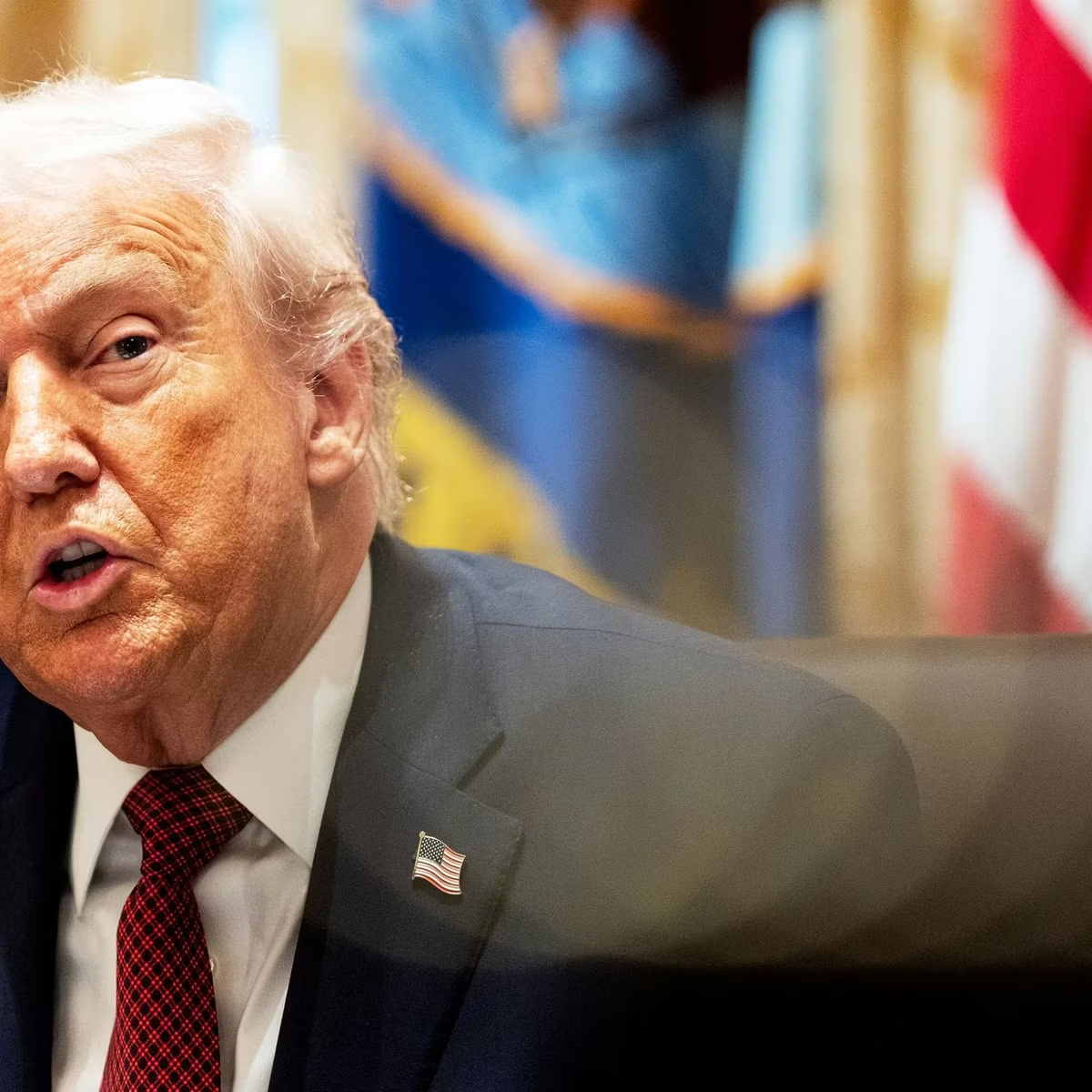
If the world does not stand up to Donald Trump now, he will continue to wage military attacks on other countries, kidnap their leaders and steal their resources. History tells us appeasement of an aspiring fascist leader like Trump will only empower him. Will the world learn from history–or will they allow Trump to repeat it?!
Those words may sound over the top, but only because they are being applied to an American President. Put that fact aside for a moment and ask yourself: What would be our reaction if Putin waged a surprise military attack and kidnapped the leader of an oil rich country after he spoke of wanting to take their oil? Is there any doubt the US would be leading the charge to impose sanctions?
Of course not–as we saw with our reaction to Putin’s illegal invasion of Ukraine. And the rationale was the same: If the world did not stand up to Putin, he could very well be like Hitler in 1938 when he annexed Austria and then set his eyes on Czechoslovakia.
Does anyone doubt that Trump who attempted a coup, incited the Jan. 6 terrorist attack and then pardoned his MAGA terrorists is just as dangerous as the fascist leaders and tyrants we have seen in the modern era?!
Now let’s be clear about one thing: Venezuela’s leader Nicolas Maduro is awful. He headed a brutal and oppressive regime. As Human Rights Watch (HRC) documented, since Maduro stole the 2024 election, the Venezuelan government “has killed, tortured, detained, and forcefully disappeared people seeking democratic change.” The head of HRC said earlier this year, “Foreign governments should recommit to supporting the fight for democracy and human rights in Venezuela and press to hold the Maduro government accountable for its atrocities.”
But the way to effectuate change is within the parameters of international law—sanctions, diplomatic pressure, bank freezes, etc. Instead, Trump has turned the United States into a rogue nation by openly and repeatedly violating international law—beginning with murdering people in international waters off the coast of Venezuela.
That is not just my view but also international legal experts and United Nation’s officials. Just last month, I wrote an article that focused on UN High Commissioner for Human Rights Volker Türk’s statement on why the military strikes on fishing boats by Trump are illegal under international law. As the UN official noted, “Under international human rights law, the intentional use of lethal force is only permissible as a last resort against individuals who pose an imminent threat to life.”
Turk continued that based on the “very sparse” information about the ships provided by Trump, “none of the individuals on the targeted boats appeared to pose an imminent threat to the lives of others or otherwise justified the use of lethal armed force against them under international law.” This view is backed up international legal experts.
Every fishing boat targeted was more than 1,500 miles from the US coastline—in other words days away. None were an imminent threat to our nation or citizens. And Trump lied that the ships carried fentanyl. Fentanyl does not come from Venezuela.
Finally, Trump declared two weeks ago that his designs on Venezuela were actually about taking the oil. That is when Trump told reporters about Venezuela, “We had a lot of oil there. As you know they threw our companies out, and we want it back.” He backed that up with a post on social media demanding Venezuela return “to the United States of America all of the Oil, Land, and other Assets that they previously stole from us.” (As fact checkers note, the oil was owned by Venezuela as a natural resource—not by the United States.)
Given the world yawned as Trump murdered more than 100 people in fishing boats, Trump knew he could escalate the military action which led to Saturday’s surprise military attack and kidnapping of Maduro. After the attack, Trump vowed “to run the country” until we can install a leader who lines up with Trump’s views. (I hope the people of Venezuela like higher prices, higher unemployment and Trump’s name being affixed to all their big buildings!)
But Trump—not being able to censor himself given his cognitive slide—also told us that he will be sending in oil companies to take the oil. Trump declared, “We’re going to have our very large United States oil companies, the biggest anywhere in the world, go in, spend billions of dollars, fix the badly broken infrastructure, the oil infrastructure, and start making money for the country.”
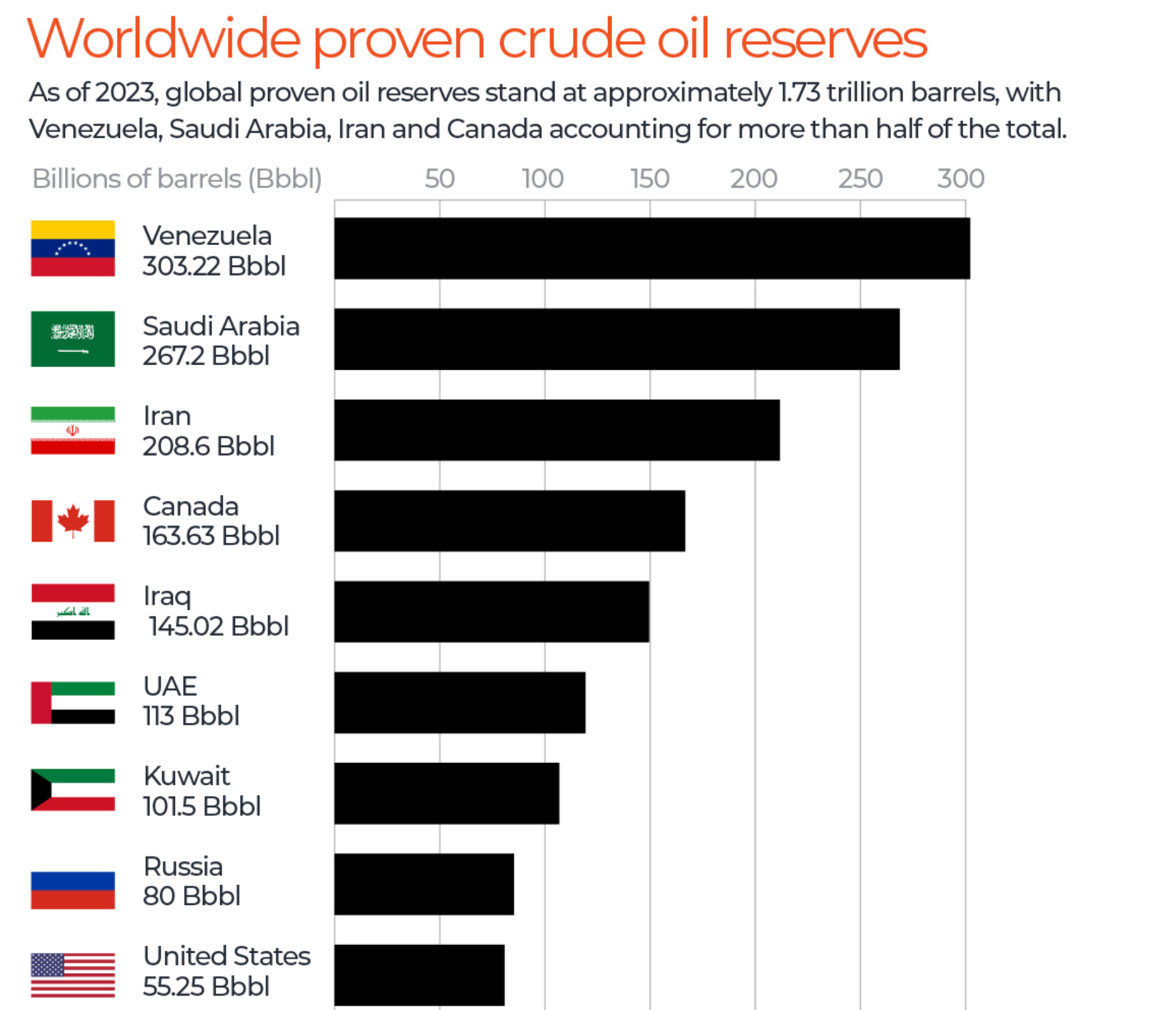
These massive, multi-national oil companies are NOT doing a public service. They are going into Venezuela to make billions for their executives and shareholders. This is just as Trump promised during the 2024 campaign when he told the oil oligarchs if they support him with massive campaign donations, they will make even more money when he is the White House. Big oil did exactly what Trump asked so Trump is now rewarding them with access to literally the largest oil reserves in the world.
Few support this military action. A recent Quinnipiac poll found nearly 2/3’s of Americans oppose military action against Venezuela. What percentage support military action? Only 25%. That means even a big chunk of MAGA opposes it. But Trump doesn’t care. This a military campaign to help the oil oligarchs who bankrolled his campaign.
The idea that Trump is bringing Maduro to justice for allowing drugs to come to America is a joke. Just weeks ago, Trump pardoned former Honduran President Juan Orlando Hernandez—a narco-terrorist who was a business associate of the notorious drug dealer El Chapo. As I wrote about, Hernandez was convicted of helping violent drug cartels dump more than 400 tons of cocaine in the United States. Based on the overdose death data, Hernandez was responsible for more American deaths than Bin Laden. That is who Trump pardoned.
Put politics aside for a moment. Think about how the United States of America is now seen on the world stage after Trump waged a surprise military attack upon Venezuela to remove the regime, has vowed to “run” the country until he can find a new leader who will do what he wants and is openly sending in his oil oligarchs to make billions off the nation’s oil?! Is that the America you want to be known for?!
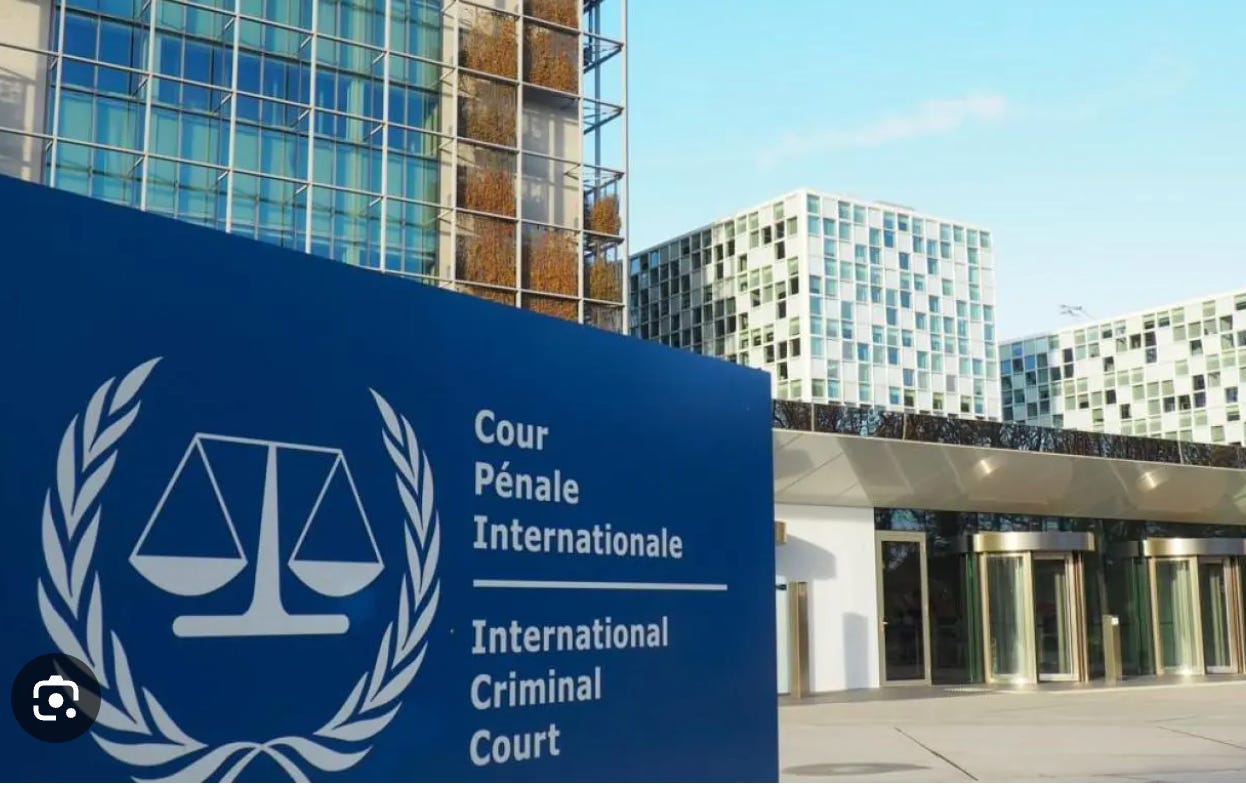
At this point, Democrats in Congress need to do more than just move to impeach Trump. They should be calling for the International Criminal Court (ICC) to investigate Trump for his crimes. And while it’s true that the US is not a member of the ICC, the court still has jurisdiction over a citizen of a non-member country who commits war crimes on the territory of an ICC member country. Venezuela is a member nation of the ICC meaning Trump can be charged for war crimes, crimes against humanity or other crimes he commits on the soil of Venezuela.
Trump is the Putin of the Western hemisphere and should be treated as such including being prosecuted and personally sanctioned—along with his top officials—by other nations.
As we learned with Trump, if there is no punishment for his crimes, he will commit more—meaning he will 100% attack other nations. That is why we must demand Trump be prosecuted at The Hague. Even the threat of that very real prosecution may be enough to deter Trump from more illegal military actions. In any event, we can’t be silent or the world will believe that we all agree with Trump’s illegal actions!
The Dean’s Report by Dean Obeidallah is a reader-supported publication. To receive new posts and support my work, consider becoming a free or paid subscriber.
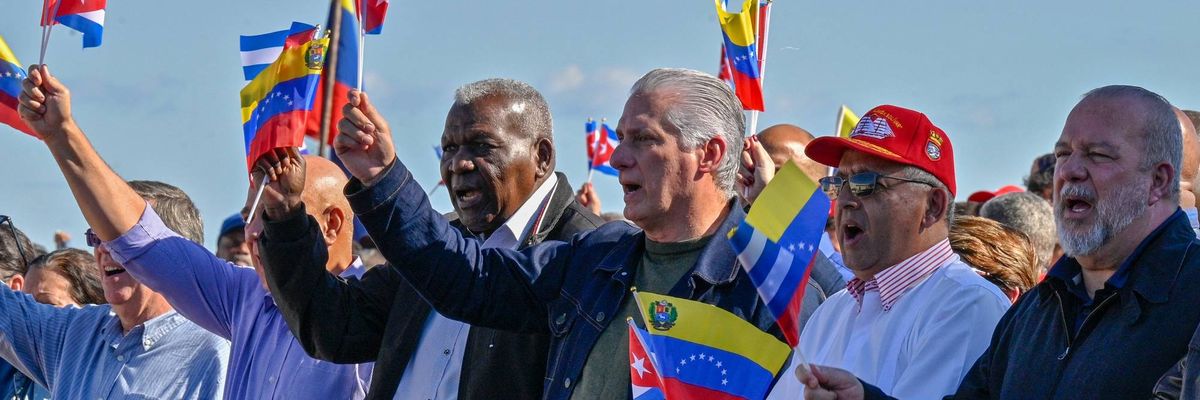
Cuban President Miguel Diaz-Canel waves a Venezuelan national flag in Havana on January 3, 2026.
(Photo by Adalberto Roque/AFP via Getty Images)
“The ‘Trump corollary’ to the Monroe Doctrine—applied in recent hours with violent force over the skies of Caracas—is the single greatest threat to peace and prosperity that the Americas confront today,” said Progressive International.
US President Donald Trump and top administration officials, including Secretary of State Marco Rubio, characterized Saturday’s assault on Venezuela and abduction of the country’s president as a warning shot in the direction of Cuba, Mexico, Colombia, and other Latin American nations.
During a Saturday press conference, Trump openly invoked the Monroe Doctrine—an assertion of US dominance of the Western Hemisphere—and said his campaign of aggression against Venezuela represented the “Donroe Doctrine” in action.
In his unwieldy remarks, Trump called out Colombian President Gustavo Petro by name, accusing him without evidence of “making cocaine and sending it to the United States.”
“So he does have to watch his ass,” the US president said of Petro, who condemned the Trump administration’s Saturday attack on Venezuela as “aggression against the sovereignty of Venezuela and Latin America.”
Petro responded defiantly to the possibility of the US targeting him, writing on social media that he is “not worried at all.”
In a Fox News appearance earlier Saturday, Trump also took aim at the United States’ southern neighbor, declaring ominously that “something’s going to have to be done with Mexico,” which also denounced the attack on Venezuela and abduction of President Nicolás Maduro.
“She is very frightened of the cartels,” Trump said of Mexican President Claudia Sheinbaum. “So we have to do something.”
“This armed attack on Venezuela is not an isolated event. It is the next step in the United States’ campaign of regime change that stretches from Caracas to Havana.”
Rubio, for his part, focused on Cuba—a country whose government he has long sought to topple.
“If I lived in Havana and I was in the government, I’d be concerned, at least a little bit,” Rubio, who was born in Miami to Cuban immigrant parents, said during Saturday’s press conference.
“It is the next step in the United States’ campaign of regime change that stretches from Caracas to Havana—and an attack on the very principle of sovereign equality and the prospects for the Zone of Peace once established by the Community of Latin American and Caribbean States,” the coalition said in a statement. “This renewed declaration of impunity from Washington is a threat to all nations around the world.”
“Trump has clearly articulated the imperial logic of this intervention—to seize control over Venezuela’s natural resources and reassert US domination over the hemisphere,” said Progressive International. “The ‘Trump corollary’ to the Monroe Doctrine—applied in recent hours with violent force over the skies of Caracas—is the single greatest threat to peace and prosperity that the Americas confront today.”
Our work is licensed under Creative Commons (CC BY-NC-ND 3.0). Feel free to republish and share widely.
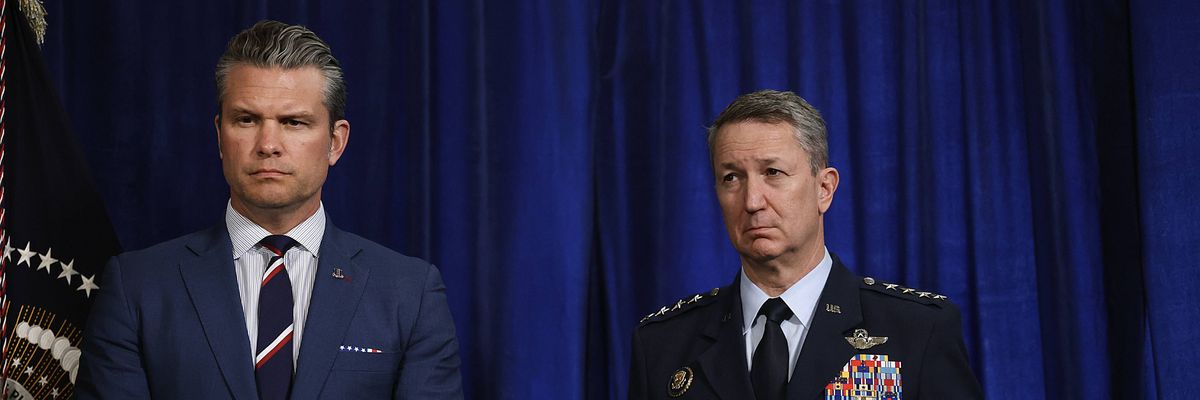
US Defense Secretary Pete Hegseth and Chairman of the Joint Chiefs of Staff Dan Caine listen as President Donald Trump addresses the media on January 3, 2026.
(Photo by Joe Raedle/Getty Images)
“Trump has no right to take us to war with Venezuela. This is reckless and illegal,” said Rep. Greg Casar. “Congress should vote immediately on a War Powers Resolution to stop him.”
Members of the US Congress on Saturday demanded emergency legislative action to prevent the Trump administration from taking further military action in Venezuela after the president threatened a “second wave” of attacks and said the US will control the South American country’s government indefinitely.
Rep. Greg Casar (D-Texas), chair of the Congressional Progressive Caucus (CPC), said that “Congress should vote immediately on a War Powers Resolution to stop” President Donald Trump, whose administration has for months unlawfully bombed boats in international waters and threatened a direct military assault on Venezuela without lawmakers’ approval.
“Trump has no right to take us to war with Venezuela. This is reckless and illegal,” said Casar. “My entire life, politicians have been sending other people’s kids to die in reckless regime change wars. Enough. No new wars.”
Another prominent CPC member, Rep. Rashida Tlaib (D-Mich.), said in response to the bombing of Venezuela and capture of its president that “these are the actions of a rogue state.”
“Trump’s illegal and unprovoked bombing of Venezuela and kidnapping of its president are grave violations of international law and the US Constitution,” Tlaib wrote on social media. “The American people do not want another regime change war abroad.”
Progressives weren’t alone in criticizing the administration’s unauthorized military action in Venezuela. Establishment Democrats, including Sen. Adam Schiff of California and others, also called for urgent congressional action in the face of Trump’s latest unlawful bombing campaign.
“Without congressional approval or the buy-in of the public, Trump risks plunging a hemisphere into chaos and has broken his promise to end wars instead of starting them,” Schiff said in a statement. “Congress must bring up a new War Powers Resolution and reassert its power to authorize force or to refuse to do so. We must speak for the American people who profoundly reject being dragged into new wars.”
Sen. Tim Kaine (D-Va.) said he will force a Senate vote next week on a bipartisan War Powers Resolution to block additional US military action in Venezuela.
“Where will this go next?” Kaine asked in a statement. “Will the president deploy our troops to protect Iranian protesters? To enforce the fragile ceasefire in Gaza? To battle terrorists in Nigeria? To seize Greenland or the Panama Canal? To suppress Americans peacefully assembling to protest his policies? Trump has threatened to do all this and more and sees no need to seek legal authorization from people’s elected legislature before putting servicemembers at risk.”
“It is long past time for Congress to reassert its critical constitutional role in matters of war, peace, diplomacy, and trade,” Kaine added. “My bipartisan resolution stipulating that we should not be at war with Venezuela absent a clear congressional authorization will come up for a vote next week.”
The lawmakers’ push for legislative action came as Trump clearly indicated that his administration isn’t done intervening in Venezuela’s internal politics—and plans to exploit the country’s vast oil reserves.
During a press conference on Saturday, Trump said that the US “is going to run” Venezuela, signaling the possibility of a troop deployment.
“We’re not afraid of boots on the ground,” the president said in response to a reporter’s question, adding vaguely that his administration is “designating various people” to run the government.
Whether the GOP-controlled Congress acts to constrain the Trump administration will depend on support from Republicans, who have largely applauded the US attack on Venezuela and capture of Maduro. In separate statements, House Speaker Mike Johnson (R-La.) and Senate Majority Leader John Thune (R-SD) described the operation as “decisive” and justified.
Ahead of Saturday’s assault, the Republican-controlled Congress rejected War Powers Resolutions aimed at preventing Trump from launching a war on Venezuela without lawmakers’ approval.
One Republican lawmaker who had raised constitutional concerns about Saturday’s actions, Sen. Mike Lee of Utah, appeared to drop them after a phone call with Secretary of State Marco Rubio.
But Sen. Andy Kim (D-NJ) noted in a statement that both Rubio and Defense Secretary Pete Hegseth “looked every senator in the eye a few weeks ago and said this wasn’t about regime change.”
“I didn’t trust them then, and we see now that they blatantly lied to Congress,” said Kim. “Trump rejected our constitutionally required approval process for armed conflict because the administration knows the American people overwhelmingly reject risks pulling our nation into another war.”
Our work is licensed under Creative Commons (CC BY-NC-ND 3.0). Feel free to republish and share widely.
The Trump administration’s military assault on Venezuela and apparent abduction of the country’s president in the early hours of Saturday morning sparked immediate backlash from leaders in Latin America and across the globe, with lawmakers, activists, and experts accusing the US of launching yet another illegal war of aggression.
Latin American leaders portrayed the assault as a continuation of the long, bloody history of US intervention in the region, which has included vicious military coups and material support for genocidal right-wing forces.
“This is state terrorism against the brave Venezuelan people and against Our America,” Cuban President Miguel Diaz-Canel wrote in a social media post, demanding urgent action from the international community in response to the “criminal attack.”
Evo Morales, the leftist former president of Bolivia, said that “we strongly and unequivocally repudiate” the US attack on Venezuela.
“It is brutal imperialist aggression that violates its sovereignty,” Morales added. “All our solidarity with the Venezuelan people in resistance.”
Colombian President Gustavo Petro, one of the first world leaders to respond to Saturday’s developments, decried US “aggression against the sovereignty of Venezuela and of Latin America.” Petro said Colombian forces “are being deployed” to the nation’s border with Venezuela and that “all available support forces will be deployed in the event of a massive influx of refugees.”
“Without sovereignty, there is no nation,” said Petro. “Peace is the way, and dialogue between peoples is fundamental for national unity. Dialogue and more dialogue is our proposal.”
The presidents of Chile and Mexico similarly condemned the assault as a violation of Venezuela’s sovereignty and international law.
“Based on its foreign policy principles and pacifist vocation, Mexico urgently calls for respect for international law, as well as the principles and purposes of the UN Charter, and to cease any act of aggression against the Venezuelan government and people,” the Mexican government said in a statement. “Latin America and the Caribbean is a zone of peace, built on mutual respect, the peaceful settlement of disputes, and the prohibition of the use and threat of force, and therefore any military action puts regional stability at serious risk.”
One Latin American leader, far-right Argentine president and Trump ally Javier Milei, openly celebrated the alleged US capture of Venezuelan President Nicolás Maduro, declaring on social media, “FREEDOM ADVANCES.”
Leaders and lawmakers in Europe also reacted to the US bombings. Pedro Sánchez, the prime minister of Spain, issued a cautious statement calling for “deescalation and responsibility.”
British MP Zarah Sultana was far more forceful, writing on social media that “Venezuela has the world’s largest oil reserves—and that’s no coincidence.”
“This is naked US imperialism: an illegal assault on Caracas aimed at overthrowing a sovereign government and plundering its resources,” Sultana added.
This story has been updated to include statements from the presidents of Chile and Mexico.
Our work is licensed under Creative Commons (CC BY-NC-ND 3.0). Feel free to republish and share widely.
The governing ideology of the far right has become a monstrous, supremacist survivalism. Our task is to build a movement strong enough to stop them
Sun 13 Apr 2025 (TheGuardian.com)
The movement for corporate city states cannot believe its good luck. For years, it has been pushing the extreme notion that wealthy, tax-averse people should up and start their own high-tech fiefdoms, whether new countries on artificial islands in international waters (“seasteading”) or pro-business “freedom cities” such as Próspera, a glorified gated community combined with a wild west med spa on a Honduran island.
Yet despite backing from the heavy-hitter venture capitalists Peter Thiel and Marc Andreessen, their extreme libertarian dreams kept bogging down: it turns out most self-respecting rich people don’t actually want to live on floating oil rigs, even if it means lower taxes, and while Próspera might be nice for a holiday and some body “upgrades”, its extra-national status is currently being challenged in court.
Now, all of a sudden, this once-fringe network of corporate secessionists finds itself knocking on open doors at the dead center of global power.
The first sign that fortunes were shifting came in 2023, when a campaigning Donald Trump, seemingly out of nowhere, promised to hold a contest that would lead to the creation of 10 “freedom cities” on federal lands. The trial balloon barely registered at the time, lost in the daily deluge of outrageous claims. Since the new administration took office, however, would-be country starters have been on a lobbying blitz, determined to turn Trump’s pledge into reality.
“The energy in DC is absolutely electric,” Trey Goff, the chief of staff of Próspera, recently enthused after a trip to Capitol Hill. Legislation paving the way for a bevy of corporate city-states should be complete by the end of the year, he claims.
Inspired by a warped reading of the political philosopher Albert Hirschman, figures including Goff, Thiel and the investor and writer Balaji Srinivasan have been championing what they call “exit” – the principle that those with means have the right to walk away from the obligations of citizenship, especially taxes and burdensome regulation. Retooling and rebranding the old ambitions and privileges of empires, they dream of splintering governments and carving up the world into hyper-capitalist, democracy-free havens under the sole control of the supremely wealthy, protected by private mercenaries, serviced by AI robots and financed by cryptocurrencies.
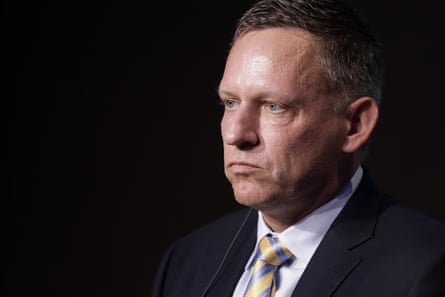
Peter Thiel in Tokyo in 2019. Photograph: Kiyoshi Ota/Bloomberg via Getty Images
One might assume that it is contradictory for Trump, elected on a flag-waving “America first” platform, to lend credence to this vision of sovereign territories ruled over by billionaire god-kings. And much has been made of the colorful flame wars between the Maga mouth-piece Steve Bannon, a proud nationalist and populist, and the Trump-allied billionaires he has attacked as “technofeudalists” who “don’t give a flying fuck about the human being” – let alone the nation state. And conflicts inside Trump’s awkward, jerry-rigged coalition certainly exist, most recently reaching a boiling point over tariffs. Still, the underlying visions might not be as incompatible as they first appear.
The startup country contingent is clearly foreseeing a future marked by shocks, scarcity and collapse. Their high-tech private domains are essentially fortressed escape pods, designed for the select few to take advantage of every possible luxury and opportunity for human optimization, giving them and their children an edge in an increasingly barbarous future. To put it bluntly, the most powerful people in the world are preparing for the end of the world, an end they themselves are frenetically accelerating.
That is not so far away from the more mass-market vision of fortressed nations that has gripped the hard right globally, from Italy to Israel, Australia to the United States: in a time of ceaseless peril, openly supremacist movements in these countries are positioning their relatively wealthy states as armed bunkers. These bunkers are brutal in their determination to expel and imprison unwanted humans (even if that requires indefinite confinement in extra-national penal colonies from Manus Island to Guantánamo Bay) and equally ruthless in their willingness to violently claim the land and resources (water, energy, critical minerals) they deem necessary to weather the coming shocks.
Though it builds on enduring rightwing tendencies … we simply have not faced such a powerful apocalyptic strain in government before
Interestingly, at a time when previously secular Silicon Valley elites are suddenly finding Jesus, it is noteworthy that both of these visions – the priority-pass corporate state and the mass-market bunker nation – share a great deal in common with the Christian fundamentalist interpretation of the biblical Rapture, when the faithful will supposedly be lifted up to a golden city in heaven, while the damned are left to endure an apocalyptic final battle down here on earth.
If we are to meet our critical moment in history, we need to reckon with the reality that we are not up against adversaries we have seen before. We are up against end times fascism.
Reflecting on his childhood under Mussolini, the novelist and philosopher Umberto Eco observed in a celebrated essay that fascism typically has an “Armageddon complex” – a fixation on vanquishing enemies in a grand final battle. But European fascism of the 1930s and 1940s also had a horizon: a vision for a future golden age after the bloodbath that, for its in-group, would be peaceful, pastoral and purified. Not today.
Alive to our era of genuine existential danger – from climate breakdown to nuclear war to sky-rocketing inequality and unregulated AI – but financially and ideologically committed to deepening those threats, contemporary far-right movements lack any credible vision for a hopeful future. The average voter is offered only remixes of a bygone past, alongside the sadistic pleasures of dominance over an ever-expanding assemblage of dehumanized others.
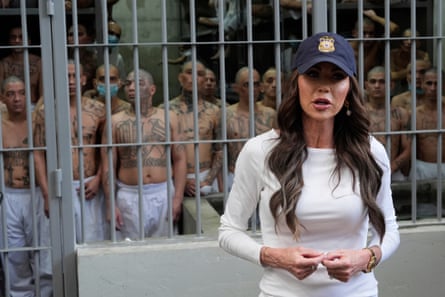
And so we have the Trump administration’s dedication to releasing its steady stream of real and AI-generated propaganda designed solely for these pornographic purposes. Footage of shackled immigrants being loaded on to deportation flights, set to the sounds of clanking chains and locking cuffs, which the official White House X account labeled “ASMR”, a reference to audio designed to calm the nervous system. Or the same account sharing news of the detention of Mahmoud Khalil, a US permanent resident who was active in Columbia University’s pro-Palestinian encampment, with the gloating words: “SHALOM, MAHMOUD.” Or any number of homeland security secretary Kristi Noem’s sadism-chic photo ops (atop a horse at the US-Mexican border, in front of a crowded prison cell in El Salvador, slinging a machine gun while arresting immigrants in Arizona …).
Kristi Noem speaks during a tour of an El Salvador prison in March. Photograph: Alex Brandon/AP
The governing ideology of the far right in our age of escalating disasters has become a monstrous, supremacist survivalism.
It is terrifying in its wickedness, yes. But it also opens up powerful possibilities for resistance. To bet against the future on this scale – to bank on your bunker – is to betray, on the most basic level, our duties to one another, to the children we love, and to every other life form with whom we share a planetary home. This is a belief system that is genocidal at its core and treasonous to the wonder and beauty of this world. We are convinced that the more people understand the extent to which the right has succumbed to the Armageddon complex, the more they will be willing to fight back, realizing that absolutely everything is now on the line.
Our opponents know full well that we are entering an age of emergency, but have responded by embracing lethal yet self-serving delusions. Having bought into various apartheid fantasies of bunkered safety, they are choosing to let the Earth burn. Our task is to build a wide and deep movement, as spiritual as it is political, strong enough to stop these unhinged traitors. A movement rooted in a steadfast commitment to one another, across our many differences and divides, and to this miraculous, singular planet.
Not so long ago, it was primarily religious fundamentalists who greeted signs of apocalypse with gleeful excitement about the long-awaited Rapture. Trump has handed critical posts to people who subscribe to that fiery orthodoxy, including several Christian Zionists who see Israel’s use of annihilatory violence to expand its territorial footprint not as illegal atrocities but as felicitous evidence that the Holy Land is getting closer to the conditions under which the Messiah will return, and the faithful will get their celestial kingdom.
Mike Huckabee, Trump’s newly confirmed ambassador to Israel, has strong ties to Christian Zionism, as does Pete Hegseth, his secretary of defense. Noem and Russell Vought, the Project 2025 architect who now leads the office of budget and management, are bothstaunch advocates for Christian nationalism. Even Thiel, who is gay and notorious for his party lifestyle, has been heard musing about the arrival of the antichrist of late (spoiler: he thinks it’s Greta Thunberg, more on that soon).
But you don’t need to be a biblical literalist, or even religious, to be an end times fascist. Today, plenty of powerful secular people have embraced a vision of the future that follows a nearly identical script, one in which the world as we know it collapses under its weight and a chosen few survive and thrive in various kinds of arks, bunkers and gated “freedom cities”. In a 2019 paper titled Left Behind: Future Fetishists, Prepping and the Abandonment of Earth, the communication scholars Sarah T Roberts and Mél Hogan described the longing for a secular Rapture: “In the accelerationist imaginary, the future is not about harm reduction, limits or restoration; rather it is a politics driving toward an endgame.”
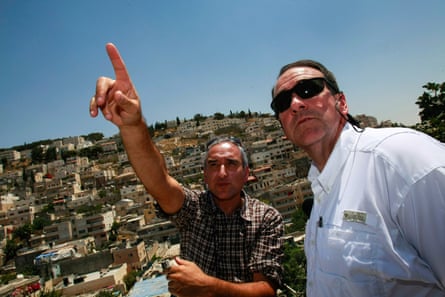
Mike Huckabee touring Jewish settlements in East Jerusalem in 2008. Photograph: David Silverman/Getty Images
Elon Musk, who dramatically grew his fortune alongside Thiel at PayPal, embodies this implosive ethos. This is a person who looks up at the wonders of the night sky and apparently sees only opportunities to fill that inky unknown with his own space junk. Though he burnished his reputation warning about the dangers of the climate crisis and AI, he and his so-called “department of government efficiency” (Doge) henchmen now spend their days escalating those same risks (and many others) by slashing not only environmental regulations but entire regulatory agencies, with the apparent end goal of replacing federal workers with chatbots.
Who needs a functioning nation state when outer space – now reportedly Musk’s singular obsession – beckons? For Musk, Mars has become a secular ark, which he claims is key to the survival of human civilization, perhaps via uploaded consciousnesses to an artificial general intelligence. Kim Stanley Robinson, the author of the sci-fi Mars Trilogy that appears to have partially inspired Musk, is blunt about the dangers of the billionaire’s fantasies about colonizing Mars. It is, he says, “just a moral hazard that creates the illusion we can wreck Earth and still be okay. It’s totally not true.”
Much like religious end-timers who long to escape the corporeal realm, Musk’s drive for humanity to become “multiplanetary” is made possible by his inability to appreciate the multispecies splendor of our only home. Evidently uninterested in the vast bounty that surrounds him, or in ensuring Earth can continue buzzing with diversity, he instead deploys his vast fortune to bring about a future that would see a handful of people and robots eke out survival on two barren orbs (a radically depleted Earth and a terraformed Mars). Indeed, in a strange twist on the Old Testament tale, Musk and his fellow tech billionaires, having arrogated god-like powers to themselves, aren’t content to just build the arks. They appear to be doing their best to cause the flood. Today’s rightwing leaders and their rich allies are not just taking advantage of catastrophes, shock-doctrine and disaster-capitalism style, but simultaneously provoking and planning for them.
What of the Maga base, though? Not all are sufficiently faithful to earnestly believe in the Rapture, and most certainly don’t have the cash to buy a spot in a “freedom city” let alone on a rocket ship. Fear not. End times fascism offers the promise of many more affordable arks and bunkers, these ones well within reach for lower-level foot soldiers.
Listen to Steve Bannon’s daily podcast – which bills itself as Maga’s premier media outlet – and you will be barraged with a singular message: the world is going to hell, the infidels are breaching the barricades, and a final battle is coming. Be prepared. The prepper message becomes particularly pronounced when Bannon switches to hawking his advertisers’ products. Buy Birch Gold, Bannon tells his audience, because the over-leveraged US economy is going to crash and you can’t trust the banks. Stock up on ready-to-eat meals from My Patriot Supply. Sharpen your target practice using a laser-guided at-home system. The last thing you would want to do is depend on the government during a disaster, he reminds listeners (left unsaid: especially now that the Doge boys are selling off the government for parts).
End times fascism is a darkly festive fatalism – a final refuge for those who find it easier to celebrate destruction than imagine living without supremacy
Bannon doesn’t only urge his audience to make their own bunkers, of course. He also advances a vision of the United States as a bunker in its own right, one in which Ice agents stalk the streets, workplaces and campuses, disappearing those deemed enemies of US policy and interests. The bunkered nation lies at the heart of the Maga agenda, and of end times fascism. Inside its logic, the first job is to harden national borders and expunge all enemies, foreign and domestic. This ugly work is now well under way, with the Trump administration, enabled by the supreme court, having invoked the Alien Enemies Act to deport hundreds of Venezuelan immigrants to Cecot, the now infamous mega-prison in El Salvador. The facility, which shaves prisoners heads and packs up to 100 people into a single cell, stacked with bare bunks, operates under the civil liberties-destroying “state of exception” first declared over three years ago by the country’s crypto-loving, Christian Zionist prime minister, Nayib Bukele.
Bukele has offered to provide the same fee-for-service system for US citizens the administration would like to drop into a judicial black hole. “I love that,” Trump said recently, when asked about the proposal. No wonder: Cecot is the sick if logical corollary of the “freedom city” fantasy – a zone where everything is for sale and due process does not apply. We should expect much more of this sadism. In a chillingly candid statement, the acting Ice director, Todd Lyons, told the 2025 Border Security Expo that he wanted to see a more “business”-oriented approach to these deportations, “like [Amazon] Prime, but with human beings”.
If policing the boundaries of the bunkered nation is end times fascism’s job one, equally important is job two: for the US government to lay claim to whatever resources its protected citizens might need to get through the tough times ahead. Maybe it’s Panama’s canal. Or Greenland’s fast-melting shipping routes. Or Ukraine’s critical minerals. Or Canada’s fresh water. We should think of this less as old-school imperialism than super-sized prepping, at the level of the national state. Gone are the old colonial fig leaves of spreading democracy or God’s word – when Trump covetously scans the globe, he is stockpiling for civilizational collapse.
This bunker mentality also helps explain JD Vance’s controversial forays into Catholic theology. The vice-president, who owes his political career in no small part to the largess of the premier prepper Thiel, explained to Fox News that, according to the medieval Christian concept of ordo amoris (translated both as “order of love” and “order of charity”), love is not owed to those outside the bunker: “You love your family, and then you love your neighbor, and then you love your community, and then you love your fellow citizens in your own country. And then after that, you can focus and prioritize the rest of the world.” (Or not, as the Trump administration’s foreign policy would indicate.) In other words, we owe nothing to anyone outside our bunker.
Though it builds on enduring rightwing tendencies – justifying hateful exclusions is hardly new under the ethno-nationalist sun – we simply have not faced such a powerful apocalyptic strain in government before. The “end of history” swagger of the post-cold war era is rapidly being supplanted by a conviction we are in the actual end of times. Doge may wrap itself in the banner of economic “efficiency”, and Musk’s underlings may evoke memories of the young, US-trained “Chicago Boys” who designed the economic shock therapy for Augusto Pinochet’s dictatorial regime, but this is not simplythe old marriage of neoliberalism and neoconservatism. It’s a new, money-worshiping millenarian mashup that says we need to smash the bureaucracy and replace humans with chatbots in order to cut “waste, fraud and abuse” – and, also, because the bureaucracy is where the Trump-resisting demons hide. This is where the tech bros merge with the TheoBros, a real group of hyper-patriarchal Christian supremacists with ties to Hegseth and others in the Trump administration.
Steve Bannon advances a vision of the United States as a bunker in its own right. Photograph: Chip Somodevilla/Getty Images
As fascism always does, today’s Armageddon complex crosses class lines, bonding billionaires to the Maga base. Thanks to decades of deepening economic stresses, alongside ceaseless and skillful messaging pitting workers against one another, a great many people understandablyfeel unable to protect themselves from the disintegration that surrounds them (no matter how many months of ready-to-eat meals they buy). But there are emotional compensations on offer: you can cheer the end of affirmative action and DEI, glorify mass deportation, enjoy the denial of gender-affirming care to trans people, villainize educators and health workers who think they know better than you, and applaud the demise of economic and environmental regulations as a way to own the libs. End times fascism is a darkly festive fatalism – a final refuge for those who find it easier to celebrate destruction than imagine living without supremacy.
It’s also a self-reinforcing downward spiral: Trump’s furious attacks on every structure designed to protect the public from diseases, dangerous foods and disasters – even to tell the public when disasters are headed their way – strengthen the case for prepperism at both the high and low ends, all while creating myriad new opportunities for privatization and profiteering by the oligarchs powering this rapid-fire unmaking of the social and regulatory state.
At the dawn of Trump’s first term, the New Yorker investigated a phenomenon that it described as “doomsday prep for the super-rich”. Back then, it was already clear that in Silicon Valley and on Wall Street, the more serious high-end survivalists were hedging against climate disruption and social collapse by buying space in custom-built underground bunkers and building escape homes on high ground in places like Hawaii (where Mark Zuckerberg has downplayed his 5,000 sq ft underground pad as a “little shelter”) and New Zealand (where Thiel purchased nearly 500 acres but found his plan to build a luxury survivalist compound rejected by local authorities in 2022 for being an eyesore).
This millenarianism is bound up with a suite of other Silicon Valley intellectual fads, all premised on an end-times-inflected belief that our planet is headed towards a cataclysm and it’s time to make some hard choices about which parts of humanity can be saved. Transhumanism is one such ideology, encompassing everything from minor human-machine “enhancements” to the quest to upload human intelligence into a still illusory artificial general intelligence. There is also effective altruism and longtermism, both of which skip over redistributive approaches to helping those in need in the here and now in favor of a cost-benefit approach to doing the most good in the long term.
Though they can appear benign at first glance, these ideas are shot through with dangerous racial, ableist and gender biases about which parts of humanity are worth enhancing and saving – and which could be sacrificed for the supposed good of the whole. They also share a marked lack of interest in urgently addressing the underlying drivers of collapse – a responsible and rational goal that a growing cohort of figures now actively shun. Instead of effective altruism the Mar-a-Lago regular Andreessen and others have embraced “effective accelerationism”, or the “deliberate propulsion of technological development” without guardrails.
Meanwhile, even darker philosophies are finding a wider audience, like the neoreactionary pro-monarchy rants of the coder Curtis Yarvin (another one of Thiel’s intellectual touchstones), or the “pro-natalism” movement’s obsession with dramatically increasing the number of “western” babies (a Musk fixation), as well as the exit guru Srinivasan’s vision of a “tech zionist” San Francisco where corporate loyalists and police join forces to politically cleanse the city of liberals to make way for their networked apartheid state.
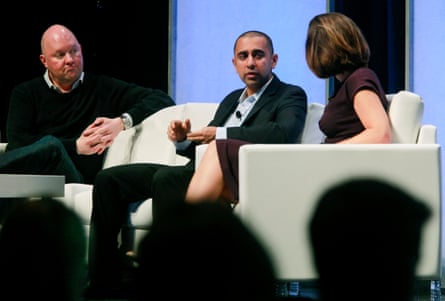
Marc Andreessen and Balaji Srinivasan speak during a panel discussion about bitcoin in San Francisco in 2014. Photograph: Paul Chinn/San Francisco Chronicle via Getty Images
As the AI scholars Timnit Gebru and Émile P Torres have written, though the methods may be new, this “bundle” of ideological fads “are direct descendants of first-wave eugenics”, which also saw a small subset of humanity making decisions about which parts of the whole were worth continuing and which needed to be phased out, cleared out, or terminated. Until recently, few paid attention. Much like Próspera, where members can already experiment with human-machine mergers such as having their Tesla keys implanted into their hands, these intellectual fads seemed to be the marginal hobby horses of a few Bay Area dilettantes with money and caution to burn. No longer.
Three recent material developments have accelerated end times fascism’s apocalyptic appeal. The first is the climate crisis. While some high-profile figures might still publicly deny or minimize the threat, global elites, whose ocean-front properties and datacenters are intensely vulnerable to rising temperatures and sea levels, are well-versed in the ramifying perils of an ever-heating world. The second is Covid-19: epidemiological models had long predicted the possibility of a pandemic devastating our globally networked world; the actual arrival of one was taken by many powerful people as a sign that we have officially arrived at what US military analysts forecasted as “the Age of Consequences”. No more predictions, it’s going down. The third factor is the rapid advancement and adoption of AI, a set of technologies that have long been associated with sci-fi terrors about machines turning on their makers with ruthless efficiency – fears expressed most forcefully by the same people who are developing these technologies. All of these existential crises are layered on top of escalating tensions between nuclear-armed powers.
None of this should be written off as paranoia. Many of us feel the imminence of breakdown so acutely that we cope by entertaining ourselves with various versions of life in a post-apocalyptic bunker, streaming Apple’s Silo or Hulu’s Paradise. As the UK analyst and editor Richard Seymour reminds us in his recent book, Disaster Nationalism: “The apocalypse is no mere fantasy. We are living in it, after all, from deadly viruses to soil erosion, from economic crisis to geopolitical chaos.”
The forces we are up against have made peace with mass death. They are treasonous to this world and its human and non-human inhabitants
Trump 2.0’s economic project is a Frankenstein’s monster of the industries driving all of these threats – fossil fuels, weapons and resource-ravenous cryptocurrency and AI. Everyone involved in these sectors knows that there is no way to build the artificial mirror world that AI promises to construct without sacrificing this world – these technologies consume too much energy, too many critical minerals, and too much water for the two to coexist in any kind of equilibrium. This month, the former Google executive Eric Schmidt admitted as much, telling Congress that AI’s “profound” energy needs are projected to triple in the next few years, with much of it coming from fossil fuels, because nuclear can’t come online fast enough. This planet-incinerating level of consumption is necessary, he explained, to enable an intelligence “higher” than humanity, a digital god rising from the ashes of our relinquished world.
And they are worried – just not about the actual threats they are unleashing. What keeps the leaders of these entangled industries up at night is the prospect of a civilizational wake-up call – of serious, internationally coordinated government efforts to rein in their rogue sectors before it’s too late. From the perspective of their ever-expanding bottom lines, the apocalypse is not collapse; it’s regulation.
The fact that their profits are predicated on planetary devastation helps explain why do-gooder discourse among the powerful is giving way to open expressions of disdain for the idea that we owe each other anything by right of our shared humanity. Silicon Valley is done with altruism, effective or otherwise. Meta’s Mark Zuckerberg pines for a culture that celebrates “aggression”. Alex Karp, Thiel’s business partner at the surveillance firm Palantir Technologies, rebukes the “losing” “self-flagellation” of those who question American superiority and the benefits of autonomous weapons systems (and, by association, the lucrative military contracts that have made Karp’s vast fortune). Musk informs Joe Rogan that empathy is “the fundamental weakness of western civilization” and he vents, after failing to purchase a supreme court election in Wisconsin: “It increasingly appears that humanity is a biological bootloader for digital superintelligence.” Meaning we humans are nothing but grist for Grok, the AI service he owns. (He did tell us he was “dark Maga” – and he’s not the only one.)
In arid and climate-stressed Spain, one of the groups calling for a moratorium on new datacenters calls itself Tu Nube Seca Mi Río – Spanish for “your cloud is drying my river”. The name is fitting, and not just for Spain.
An unspeakably dismal choice is being made before our eyes and without our consent: machines over humans, inanimate over animate, profits over all else. With stunning speed, the big tech megalomaniacs have quietly rolled back their net-zero pledges and lined up by Trump’s side, hellbent on sacrificing this world’s real and precious resources and creativity at the altar of a vampiric, virtual realm. This is the last great heist, and they are getting ready to ride out the storms they themselves are summoning – and they will try to defame and destroy anyone who gets in their way.
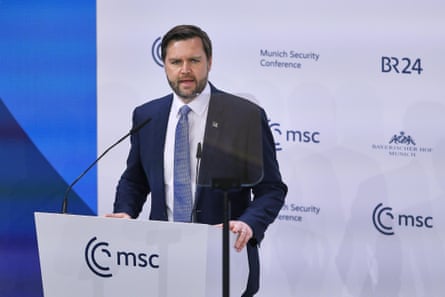
Consider Vance’s recent European sojourn, where the vice-president harangued world leaders for “handwringing about safety” in relation to job-destroying AI while demanding Nazi and fascist speech go uncurtailed online. At one point he made a telling aside, expecting a laugh that never came: “If American democracy can survive 10 years of Greta Thunberg’s scolding, you guys can survive a few months of Elon Musk.”
JD Vance speaks at the Munich Security Conference in February. Photograph: dts News Agency Germany/REX/Shutterstock
His comment echoed those made by his equally humorless patron Thiel. In recent interviews focused on the theological underpinnings of his far-right politics, the Christian billionaire has repeatedly compared the indefatigable young climate activist to the antichrist – a figure he warns was prophesied to come bearing a misleading message of “peace and safety”. “If Greta gets everyone on the planet to ride a bicycle, maybe that’s a way to solve climate change, but it has sort of this quality of going from the frying pan into the fire,” Thiel intoned.
Why Thunberg, why now? In part, it’s clearly the apocalyptic fear of regulation eating into their super-profits: according to Thiel, the science-based climate action Thunberg and others demand could only be enforced by a “totalitarian state”, which he claims is more dire a threat than climate breakdown (most distressingly, the taxes under such conditions would be “quite high”). There may also be something else about Thunberg that frightens them: her steadfast commitment to this planet and the many life forms who call it home – not to simulations of this world generated by AI, or to a hierarchy of those deserving of life and those who are not, nor to any of the various extra-planetary escape fantasies the end times fascists are selling.
She is committed to staying, while the end times fascists have, at least in their imaginings, already left this realm, ensconced in their opulent shelters or transcended to the digital ether, or to Mars.
Shortly after Trump’s re-election, one of us had the opportunity to interview Anohni, one of the few musicians who have attempted to make art that wraps its arms around the death drive that has gripped our world. Asked about what connects the willingness of powerful people to let the planet burn and the drive to deny bodily autonomy to women and to trans people like her, she responded by drawing on her Irish Catholic upbringing: it’s “a very long-held myth that we are enacting and embodying. This is the culmination of their Rapture. This is their escape from the voluptuous cycle of creation. This is their escape from Mother.”
How do we break this apocalyptic fever? First, we help each other face the depth of the depravity that has gripped the hard right in all of our countries. To move forward with focus, we must first understand this simple fact: we are up against an ideology that has given up not only on the premise and promise of liberal democracy but on the livability of our shared world – on its beauty, on its people, on our children, on other species. The forces we are up against have made peace with mass death. They are treasonous to this world and its human and non-human inhabitants.
Second, we counter their apocalyptic narratives with a far better story about how to survive the hard times ahead without leaving anyone behind. A story capable of draining end times fascism of its gothic power and galvanizing a movement ready to put it all on the line for our collective survival. A story not of end times, but of better times; not of separation and supremacy, but of interdependence and belonging; not of escaping, but staying put and staying faithful to the troubled earthly reality in which we are enmeshed and bound.
This basic sentiment, of course, is not new. It is central to Indigenous cosmologies, and it lies at the heart of animism. Go back far enough and every culture and faith has its own tradition of respecting the sanctity of here, and not searching for Zion in an elusive ever-distant promised land. In eastern Europe, before the fascist and Stalinist annihilations, the Jewish socialist Labor Bund organized around the yiddish concept of Doikayt, or “hereness”. Molly Crabapple, who has written a forthcoming book about this neglected history, definesDoikayt as the right to “fight for freedom and safety in the places where they lived, in defiance of everyone who wanted them dead” – and rather than be forced to flee to safety in Palestine or the United States. Perhaps what is needed is a modern-day universalization of that concept: a commitment to the right to the “hereness” of this particular ailing planet, to these frail bodies, to the right to live in dignity wherever on the planet we are, even when the inevitable shocks forces us to move. “Hereness” can be portable, free of nationalism, rooted in solidarity, respectful of indigenous rights and unbounded by borders.
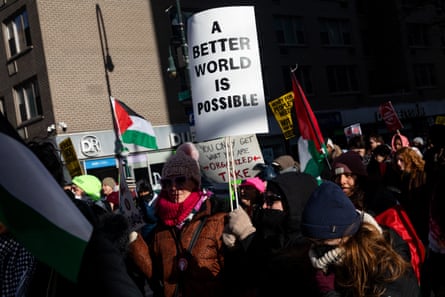
Anti-Trump protesters march against the administration in New York in January. Photograph: Julius Constantine Motal/The Guardian
That futurewould require its own apocalypse, its own world-ending and revelation, though of a very different sort. Because as the scholar of policing Robyn Maynard has observed: “In order to make earthly planetary survival possible, some versions of this world need to end.”
We have reached a choice point, not about whether we are facing apocalypse but what form it will take. The activist sisters Adrienne Maree and Autumn Brown touched on this recently on their aptly named podcast, How to Survive the End of the World. In this moment, when end times fascism is waging war on every front, new alliances are essential. But instead of asking: “Do we all share the same worldview?” Adrienne urges us to ask: “Is your heart beating and do you plan to live? Then come this way and we will figure out the rest on the other side.”
To have a hope of combating the end times fascists, with their ever-constricting and asphyxiating concentric circles of “ordered love”, we will need to build an unruly open-hearted movement of the Earth-loving faithful: faithful to this planet, its people, its creatures and to the possibility of a livable future for us all. Faithful to here. Or, to quote Anohni again, this time referring to the goddess in which she now places her faith: “Have you stopped to consider that this might have been her best idea?”
The Trump administration’s military assault on Venezuela and apparent abduction of the country’s president in the early hours of Saturday morning sparked immediate backlash from leaders in Latin America and across the globe, with lawmakers, activists, and experts accusing the US of launching yet another illegal war of aggression.
Latin American leaders portrayed the assault as a continuation of the long, bloody history of US intervention in the region, which has included vicious military coups and material support for genocidal right-wing forces.
“This is state terrorism against the brave Venezuelan people and against Our America,” Cuban President Miguel Diaz-Canel wrote in a social media post, demanding urgent action from the international community in response to the “criminal attack.”
Evo Morales, the leftist former president of Bolivia, said that “we strongly and unequivocally repudiate” the US attack on Venezuela.
“It is brutal imperialist aggression that violates its sovereignty,” Morales added. “All our solidarity with the Venezuelan people in resistance.”
Colombian President Gustavo Petro, one of the first world leaders to respond to Saturday’s developments, decried US “aggression against the sovereignty of Venezuela and of Latin America.” Petro said Colombian forces “are being deployed” to the nation’s border with Venezuela and that “all available support forces will be deployed in the event of a massive influx of refugees.”
“Without sovereignty, there is no nation,” said Petro. “Peace is the way, and dialogue between peoples is fundamental for national unity. Dialogue and more dialogue is our proposal.”
The presidents of Chile and Mexico similarly condemned the assault as a violation of Venezuela’s sovereignty and international law.
“Based on its foreign policy principles and pacifist vocation, Mexico urgently calls for respect for international law, as well as the principles and purposes of the UN Charter, and to cease any act of aggression against the Venezuelan government and people,” the Mexican government said in a statement. “Latin America and the Caribbean is a zone of peace, built on mutual respect, the peaceful settlement of disputes, and the prohibition of the use and threat of force, and therefore any military action puts regional stability at serious risk.”
One Latin American leader, far-right Argentine president and Trump ally Javier Milei, openly celebrated the alleged US capture of Venezuelan President Nicolás Maduro, declaring on social media, “FREEDOM ADVANCES.”
Leaders and lawmakers in Europe also reacted to the US bombings. Pedro Sánchez, the prime minister of Spain, issued a cautious statement calling for “deescalation and responsibility.”
British MP Zarah Sultana was far more forceful, writing on social media that “Venezuela has the world’s largest oil reserves—and that’s no coincidence.”
“This is naked US imperialism: an illegal assault on Caracas aimed at overthrowing a sovereign government and plundering its resources,” Sultana added.
This story has been updated to include statements from the presidents of Chile and Mexico.
US President Donald Trump shared on his social media account the first photograph of Venezuelan President
Nicholas Maduro aboard the USS Iwo Jima on Saturday, Jan. 3, Anadolu Agency reports.
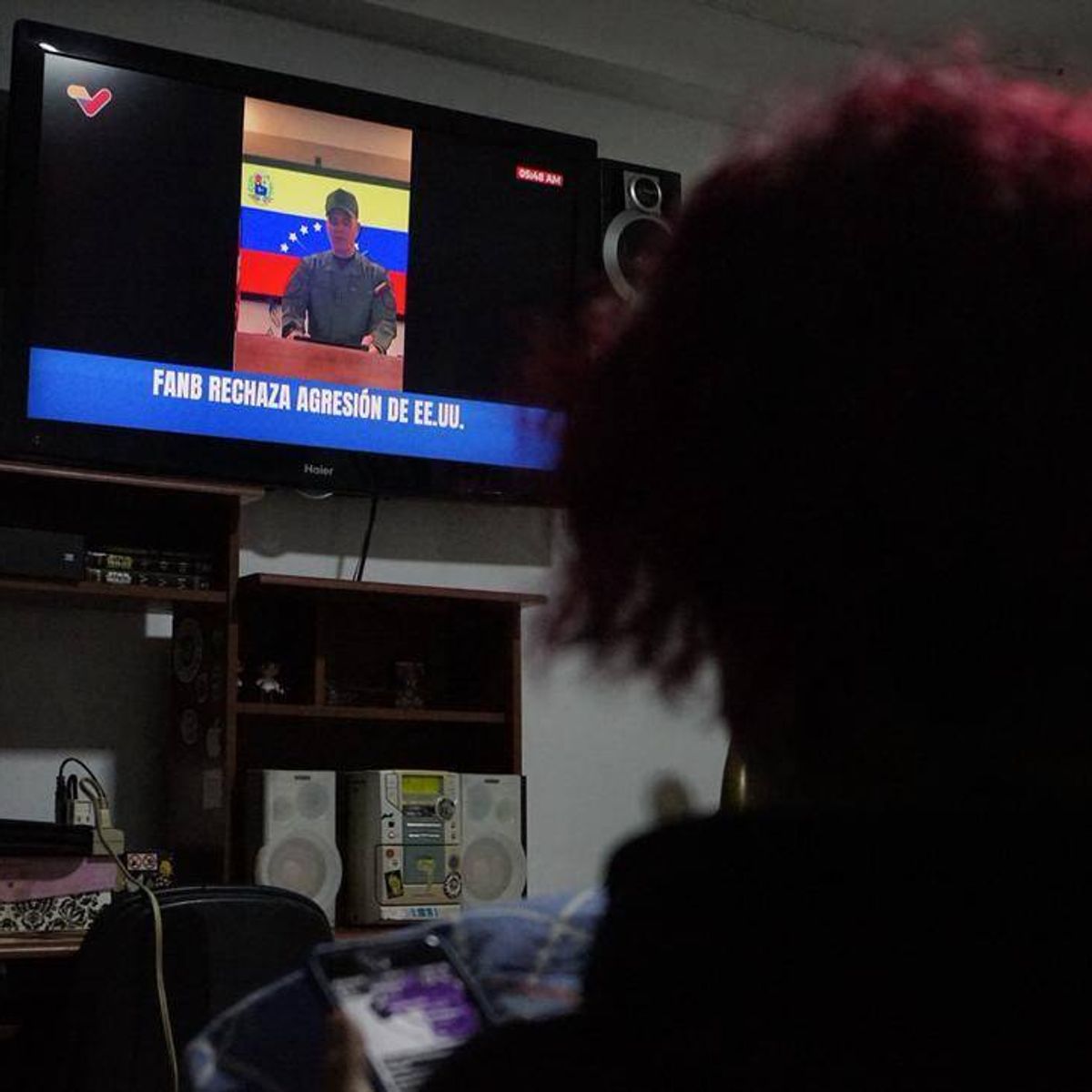
Earlier, Venezuela’s government said the US of attacked civilian and military installations in multiple states, and declared a national emergency.
Trump confirmed the strike on his social media platform Truth Social, saying Maduro and his wife, Cilia Flores, had been captured and flown out of the country.
He later told Fox News that his forces did an “incredible job” and he watched the operation “in real time.” Asked about the next steps on Venezuela, he said the US will be “very much” involved in the process.
US Attorney General Pam Bondi said Maduro and his wife have been indicted in New York. The two have been charged with “Narco-Terrorism Conspiracy, Cocaine Importation Conspiracy, Possession of Machineguns and Destructive Devices, and Conspiracy to Possess Machineguns and Destructive Devices against the United States,” she said on X.
“They will soon face the full wrath of American justice on American soil in American courts.”
1. Saturday, 1:00pm – 2:30pm, No War on Venezuela!
Meet at:
Powell & Market St SF
STOP the BOMBINGS
Explosions have been reported across Caracas, Venezuela as an apparent U.S. bombing campaign has begun targeting the country. This war is not about drug trafficking, it is not about democracy — it is about stealing Venezuela’s oil and dominating Latin America. It is an outrageous escalation in a campaign of murder in international waters and piracy targeting civilian ships trading with Venezuela.
We need to take to the streets and say no to another endless war! The people of this country do not want another war! A U.S. war would cause death and destruction for the people of Venezuela. The war machine consumes an unimaginable amount of our tax dollars while working families struggle to make ends meet. In an all-out war with Venezuela, it will be working class young people who are sent to kill and die, not the children of executives at ExxonMobil and LockheedMartin. The people need to take to the streets and say not to Trump’s war on Venezuela!
2. Saturday, 2:00pm – 4:00pm, What’s the Deal with Venezuela?
The Starry Plough Pub 3101 Shattuck Avenue, Berkeley, CA 94705 also online: Please register in advance at https://bit.ly/SSS-Venezuela to receive your personal link to participate in this event online
Please help us celebrate our return to the Starry Plough by ordering food and/or drinks. Please arrive early to place your order so that you do not miss any of the presentations. An open discussion will follow the presentations.
U.S. government officials have already admitted that CIA forces and other “clandestine” warfare groups have been operating within Venezuela, and the movement of large naval forces to the area signal an intent to invade. The “clandestine” acts of war already constitute aggression, illegal under international law. The blowing up of boats, with the clearly false excuse that they are somehow running drugs to the USA, is a crime. Further military action will be war crimes.
Our speakers will address the question: Why is the U.S. Government, and particularly the current Trump regime, attacking Venezuela, and what can we do about it? Laura Wells – Green Party of California, Task Force on the Americas Roger Harris – Task Force on the Americas and the Venezuela Solidarity Network *Organizations listed for identification purposes only.
We will be accepting donations which will be divided among the sponsoring organizations. This event is sponsored by the Alameda County Peace and Freedom Party, the Alameda County Green Party and Bay Area System Change Not Climate Change.
Join a monthly demonstration at the Chevron in Temescal | 5500 Telegraph in Oakland | FIRST SUNDAY OF THE MONTH, 1-3 PM
Signs and chants will be provided. Bring your energy and tambourines!
Israel’s genocide machine couldn’t run without power from Chevron. Israel’s war on Gaza and Occupation of Palestine contributes to the climate catastrophe. Chevron supplies light and energy via its operation and co-ownership of two major Israeli-claimed fossil gas fields in the Mediterranean.
Chevron’s extraction activities are funneling millions of dollars in tax revenues to Israeli government coffers, directly fueling Israel’s system of settler colonialism and violence against all Palestinians. In 2022, those revenues amounted to over $462 million. BDS is a global nonviolent Palestinian led movement, and we demand that Chevron immediately cut its contracts with genocidal Israel, and end its role in climate devastation globally.
4. Monday, 12:30pm – 1:30pm, No Monarchs Monday: Protest at Tesla in San Francisco
At the Tesla Dealership, 999 Van Ness (corner of Van Ness and O’Farrell) SF
No Monarchs Monday (the butterflies are ok). Join us to stand up for democracy, civil liberties, and the planet, and against the fascist/authoritarian Trump Regime! STOP THE BOMBING, NO WAR IN VENEZUELA! Bring a sign if you have one.
A New York homeboy if ever there was oneI do not mean this as a negative assessment when I say that what Zohran Mamdani’s inaugural address as mayor of New York reminded me most of was Woody Allen’s Manhattan—albeit with a more all-encompassing view of the city. Like Manhattan, Mamdani’s speech was a love-besotted tour of New York—though with a focus on the city’s multiracial working and middle class you can’t find anywhere in the Allen oeuvre.
For Mamdani, this focus was intended to be a means of identification and reassurance (I am one of you, I know you), legitimacy (I represent all of you), and commitment (I will fight for you all). It was a homeboy speech. A local—not an express—was stopping at every other street corner to celebrate the halal carts and the delis.
It was besotted not just with the New York of today but also with some of its history. It came with name checks for de Blasio, Dinkins, and La Guardia (with whoops from the crowd for Fiorello), with a salute to the city “where the language of the New Deal was born.” The ceremony included several very New York songs, most notably two socialist-inspired anthems: “Bread and Roses” and “Over the Rainbow,” the latter with lyrics by lifelong socialist Yip Harburg, who once said, “I’m a New Yorker down to the last capillary.” (I’m sure Yip’s 99-year-old son Ernie, resident of the East Village, found “Rainbow”’s inclusion particularly apropos.)
Mamdani also name-checked DSA, the Democratic Socialists of America, though it was one of about a hundred neighborhoods, constituencies, and groups of workers that he acknowledged. It was, withal, a socialist speech, of the particular genre perfected by two socialists who preceded Mamdani to the podium: Rep. Alexandria Ocasio-Cortez and Sen. Bernie Sanders. That genre is centered on demonstrating that, as Sanders said again and again, there’s nothing “radical” about universal child care, affordable housing, and accessible public transit—policies that polling has shown to be exceedingly popular not just with the small number of American socialists but also with the large number of American nonsocialists. The same polling also shows sizable majorities favoring the kind of tax hikes on the super-rich that Sanders and Mamdani advocate.
Fundamentally, the politics of Mamdani’s address was that of repossession, of taking the city away from the wealthiest 1 or 5 percent who’ve claimed it as their bespoke playground, and making the remaining 99 or 95 percent able to claim it as their own, too.
To the extent that Mamdani’s speech had a theoretical focus, it was the resounding rejection of the neoliberalism that characterized the politics of both parties for most of the past half-century. For too long, he said, people had turned to the private sector to solve society’s problems, which the private sector was both ill-equipped and unwilling to do. He made clear that the conceit that “the era of big government is over,” as Bill Clinton once said, was itself over. Rather than tell his fellow New Yorkers to lower their expectations of what government could do, he vowed that “the only expectation I seek to reset is that of small expectations.”
That sentence on expectations was worded in a way to echo the inaugural address of another New Yorker, Franklin Roosevelt, when he said, “The only thing we have to fear is fear itself.” And the socialism that Mamdani described sounded much like those New Deal policies that had the government undertake needed tasks at which the private sector had failed abjectly. Sanders has always cited FDR as the model for his social democratic policies and his attacks on those whom FDR called “malefactors of great wealth,” and Mamdani was effectively, if not overtly, claiming the same lineage in his address. (The only reference during the ceremonies to a socialist from abroad came from nonsocialist Jumaane Williams, the city’s public advocate, who mentioned in passing Maurice Bishop, the long-ago prime minister of the small Caribbean island nation of Grenada, from which Williams’s parents immigrated to New York.)
Right-wing editorialists may seize upon Mamdani’s comment that it was time to replace the harshness of “rugged individualism” with “the warmth of collectivism,” but it was clear to anyone who listened to his speech that by “collectivism,” Mamdani meant “community” of the most diverse character imaginable. Knowing that the work of relegitimating government as a force for good requires continual public pressure to make government accomplish needed tasks, the mayor of the city of “biryani and pastrami on rye” asked the movement that had brought him to power not to stand down. “The work,” he concluded, “has only just begun.” Harold Meyerson Editor-at-Large
Help Outreach Working Group lift the fog of corporate media. Donate to help us maintain this website and distribute literature on the street.
This Sunday’s Town Hall: Announcing This Week’s Progressive Town Hall: Every Sunday at 4pm ET/1pm PT RSVP HERE Join PDA activists online from across the country to discuss the importance of progressives reclaiming the American story from the MAGA right, an issue of heightened importance as we’re now within one... Continue reading →
We protest Heritage Foundation EVERY MONDAY (Join us!!!!) By admin | September 2, 2025 | Uncategorized Cliff Cash Comedy Premiered Jul 26, 2025 Every Monday at The Heritage Foundation 214 Massachusetts Ave. Washington D.C. 4pm protest 6pm pizza Every Friday at Fox News D.C. 400 N. Capitol St. Washington D.C. 4pm protest 6pm pizza We are... Continue reading →
The national conversation on health care is heating up, and we need to make sure Medicare for All is at the center of it. With a volatile primary season underway, and the midterms and a presidential primary on the horizon, some politicians and pundits are trying to steer the conversation... Continue reading →
One Million Rising: Strategic Non-Cooperation to Fight Authoritarianism Virtual Event · Hosted by No Kings Time Wednesdays 8 – 9:30pm EDT Location Virtual event Join from anywhere About this event Across the country, authoritarian forces are getting bolder and more dangerous. Trump and his allies are not hiding their agenda: mass deportations,... Continue reading →
THURSDAY, JUNE 29, 2023 AT 2 AM – 4 AM PDT How to create trust in a group? Details Event by Extinction Rebellion Empathy Circles online EMPATHY CAFE Duration: 2 hr Public · Anyone on or off Facebook How to create trust in a group? This is the question that arose in our... Continue reading →
Public Banking Coalition monthly meetings Next call: Nov 11 Excitement is building for public banking and once a month, PBI hosts an hour-long Public Banking Coalition online meeting to share the excitement and successes. Find out the latest updates on the advances being made all across the country from local advocates themselves... Continue reading →
When you volunteer for Saikat, it’s on us to give you a great experience and a genuine chance to make a difference. We don’t want to waste a second of your time. That’s why we’re always optimizing. And I’m excited to report that this Saturday we talked with 300% more... Continue reading →
Trump Regime Takedown: Every Saturday Saturday, March 7, 2026 12:00 PM 2:00 PM Tesla San Francisco999 Van Ness AvenueSan Francisco, CA, 94109United States (map) Google Calendar ICS Keep democracy alive every Saturday by showing up, taking a stand, and sticking together for the long haul. Standing together is better than standing alone. Let’s get together... Continue reading →
This Sunday’s Town Hall: Announcing This Week’s Progressive Town Hall: Every Sunday at 4pm ET/1pm PT RSVP HERE Join PDA activists online from across the country to discuss the importance of progressives reclaiming the American story from the MAGA right, an issue of heightened importance as we’re now within one... Continue reading →
We protest Heritage Foundation EVERY MONDAY (Join us!!!!) By admin | September 2, 2025 | Uncategorized Cliff Cash Comedy Premiered Jul 26, 2025 Every Monday at The Heritage Foundation 214 Massachusetts Ave. Washington D.C. 4pm protest 6pm pizza Every Friday at Fox News D.C. 400 N. Capitol St. Washington D.C. 4pm protest 6pm pizza We are... Continue reading →








 Harold Meyerson