


- Brianna Smith
- Mar 14, 2024 (DailyCal.org)
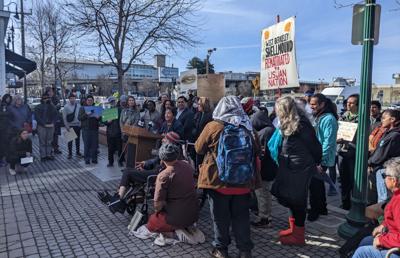
In a historic decision, the city of Berkeley has purchased and returned a historic shellmound land site to the Ohlone people.
On Tuesday, Mayor Jesse Arreguín and Councilmember Sophie Hahn announced they bought the historic Ohlone land in West Berkeley, which was set to be developed, and the title of the land was given to the Sogorea Te’ Land Trust. The process to reclaim this land started eight years ago when talks of developing the land began.
“It’s one of the most significant sites in the greater San Francisco Bay area,” said UC Berkeley anthropology professor Kent Lightfoot. “It was one of these shellmounds that was built up over thousands of years. It’s an accumulation of soil, shell and other materials that were constructed and built up.”
The West Berkeley Shellmound site is about 6000 years old and is the earliest and largest of the shellmound sites in the Bay Area. The site is currently a 2.2-acre parking lot and remains undeveloped, meaning the land underneath is still intact.
Lightfoot is an archaeologist who was called in to uncover the evidence that would prove the significance of the land and justify why it should be saved. His work revealed small artifacts, spatial distributions of house structures and thousands of herring remains. Not only did this show that this land was used by Indigenous people, but it proved the land was sacred.
According to Lucy Gill, an alumna of the UC Berkeley anthropology doctorate program, a shellmound is “a historic structure” constructed by indigenous people over a “millennium.” Shellmounds are made up of shells and rocks and are often located where freshwater meets the bay. The site in West Berkeley had a floor and postholes, and it was a place for burial and ceremonies.
According to the Confederated Villages of Lisjan, or CVL, a shellmound holds importance as a sacred burial site of the Ohlone and Miwok peoples. Such sites are considered to be living cemeteries and places of prayer, veneration and connection with ancestors.
In 2018, the company that owns the land, Ruegg & Ellsworth, submitted a zoning application for a proposed project. It was rejected because of the historic structures identified on the land, which was designated as a City Landmark in 2000. Ruegg & Ellsworth chose to sue the city.
Berkeley and CVL won against Ruegg & Ellsworth in Alameda County Superior Court in 2019, but the decision was later reversed by the California Court of Appeals. Ruegg & Ellsworth eventually received a permit to build but never did. Ultimately, it listed the land for sale.
Berkeley and CVL negotiated a global settlement that would resolve all litigation and transfer the title of the land to Berkeley. Ruegg & Ellsworth accepted $27 million for the land and as settlement for any outstanding claims. Of the total, $25.5 million was contributed by the Sogorea Te’ Land Trust, a woman-led Indigenous group associated with the CVL, and the remainder was contributed by the city government.
“(At the meeting) it was just great to see everybody really celebrating,” Lightfoot said. “It’s a footprint where all sorts of things can happen.”
The Sogorea Te’ Land Trust plans to make the land into a natural open space area. It will become a cultural space with a proposed cultural center and commemorative park.
Most importantly, it will be a space for both tribal dances and ceremonies and will bring various tribes together.
“The City of Berkeley and the Confederated Villages of Lisjan Nation joined together to right a historic wrong,” said Tribal Chair of the Lisjan Nation Corrina Gould in a press release. “This is not only the most challenging urban sacred site victory in California’s history, it’s also among the most culturally significant for the Lisjan people.”

Brianna Smith
GA reporter
Follow Brianna Smith


