


By Nanette Asimov, Higher Education Reporter
Updated June 20, 2024 5:20 p.m. (SFChronicle.com)
Stanford University is taking a hard line on a student who could face felony charges after being arrested this month while covering the takeover of the president’s office for the campus newspaper. Press freedom groups are crying foul.
Over the objections of advocates for press freedom, Stanford University is taking a hard line on a student journalist who could face felony charges after being arrested this month while covering the takeover of the president’s office for the campus newspaper.
Police arrested freshman Dilan Gohill, 19, a reporter for the Stanford Daily, alongside a dozen protesters who broke into the administration building, locked themselves inside and caused extensive damage in the early hours of June 5, before being removed.
“We believe that the Daily reporter reporting from inside the building acted in violation of the law and University policies,” university officials wrote in an unsigned statement five days after the arrests.
We “fully support having him be criminally prosecuted and referred to Stanford’s (disciplinary) Office of Community Standards along with the other students,” the statement said, noting that Stanford will not intervene in the criminal investigation or withdraw the reporter’s disciplinary referral.
On Thursday, the First Amendment Coalition, a nonprofit advocacy group based in San Rafael, the Student Press Law Center in Washington, D.C., and two dozen journalism groups sent a letter to Santa Clara County District Attorney Jeff Rosen asking him not to prosecute Gohill.
“It is clear to us that Gohill was present to cover the news,” the letter said, noting that the reporter’s news beat for the Daily was student activism and that the Israel-Hamas protest movement is one of the nation’s biggest news stories.
“Based on the circumstances and absence of any criminal motivation, we urge your office to avoid expending significant resources prosecuting a young journalist who was acting in good faith to serve the public’s interest in timely coverage of newsworthy events,” the advocates wrote.
The Stanford Daily’s editors have also called on the district attorney not to prosecute Gohill.
Rosen’s office has not yet reviewed evidence or even received any cases yet, a process that can take six to eight weeks, said Sean Webby, a spokesperson for the district attorney.
After receiving a tip that pro-Palestinian protesters would take over the Stanford administrative building before dawn on June 5, the student newspaper sent two reporters to cover the story, university officials said in their statement.
When the activists broke a window and entered the building, one of the reporters remained outside. The other, Gohill, accompanied a dozen people inside. There, he reported that the protesters “barricaded doors with bike locks, chains, ladders and chairs and covered security cameras with tin foil.”
They also damaged the offices, the university said. Police arrived and arrested 13 people, including Gohill, who spent 15 hours in jail, said Max Szabo, a publicist and attorney acting as Gohill’s spokesperson.
“For a university renowned for churning out some of the brightest minds, Stanford leadership’s calls for the criminal prosecution of a young journalist covering a protest is decidedly dim witted,” Szabo said in a statement.
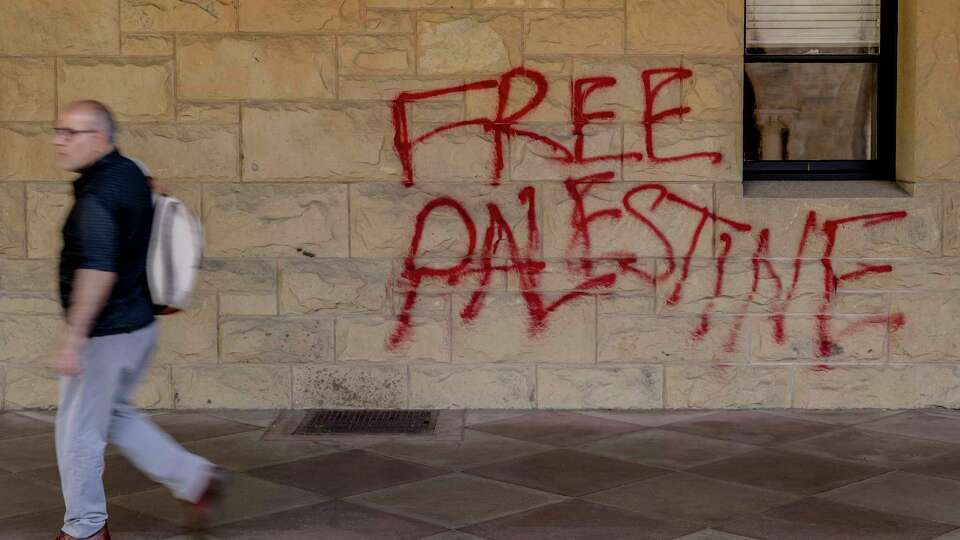
Gohill was among three members of the Stanford Daily staff who were present during the building occupation, where protesters also damaged the outside of several historic stone structures by painting threats and anti-Israel and anti-police graffiti in dozens of places.
The student reporter who stayed outside of the building wasn’t arrested. Another newspaper staff member participated in the protest — not as a reporter — and was arrested. The paper demoted that student, who later resigned. All of those arrested, including Gohill, were suspended and barred from campus, while seniors were not allowed to graduate.
Since then, Stanford has lifted Gohill’s suspension and allowed him on campus because “we do not believe he presents an immediate threat.”
But the university explained in its statement why administrators believe Gohill should be criminally prosecuted for following the protesters into the building.
California’s Penal Code 409.7 describes journalists’ right under the First Amendment to cover police actions without being arrested, but the same law lets police arrest anyone “engaged in activity that is unlawful,” Stanford said.
“The First Amendment does not protect the right to break, enter, and/or trespass in a locked private building,” the university said. Its statement also pointed to the Student Press Law Center, which reminds students on its website that “being a journalist is not a license to jaywalk, trespass on private property, block automobile traffic or otherwise violate laws that apply to everyone else.”
The Student Press Law Center, however, is among the First Amendment advocates urging the district attorney not to prosecute Gohill.
David Loy, legal director of the First Amendment Coalition, brushed aside questions of whether Gohill technically broke the law.
“We do not think it’s in the interest of justice to prosecute a reporter for being a reporter,” Loy said.
“There’s no evidence he was conspiring with the protesters or had any intent to do anything other than report the news, which he did do,” Loy said. “That was a service to the community.”
Reach Nanette Asimov: nasimov@sfchronicle.com
June 20, 2024|Updated June 20, 2024 5:20 p.m.
HIGHER EDUCATION REPORTER
Nanette covers California’s public universities – the University of California and California State University – as well as community colleges and private universities. She’s written about sexual misconduct at UC and Stanford, the precarious state of accreditation at City College of San Francisco, and what happens when the UC Berkeley student government discovers a gay rights opponent in its midst. She has exposed a private art college where students rack up massive levels of debt (one student’s topped $400k), and covered audits peering into UC finances, education lawsuits and countless student protests.
But writing about higher education also means getting a look at the brainy creations of students and faculty: Robotic suits that help paralyzed people walk. Online collections of folk songs going back hundreds of years. And innovations touching on everything from virtual reality to baseball.
Nanette is also covering the COVID-19 pandemic and served as health editor during the first six months of the crisis, which quickly ended her brief tenure as interim investigations editor.
Previously, Nanette covered K-12 education. Her stories led to changes in charter school laws, prompted a ban on Scientology in California public schools, and exposed cheating and censorship in testing.
A past president of the Society of Professional Journalists’ Northern California chapter, Nanette has a master’s degree in journalism from Columbia University and a B.A. in sociology from Queens College. She speaks English and Spanish.
Source : https://www.sfchronicle.com/bayarea/article/stanford-presses-prosecution-student-journalist-19523761.php?utm_content=cta&sid=53b8a5219dbcd4db6500018b&ss=P&st_rid=null&utm_source=newsletter&utm_medium=email&utm_term=headlines&utm_campaign=sfc_morningfix


