


By Laura Waxmann, Staff Writer Updated June 21, 2026 (SFChronicle.com)
Gift Article
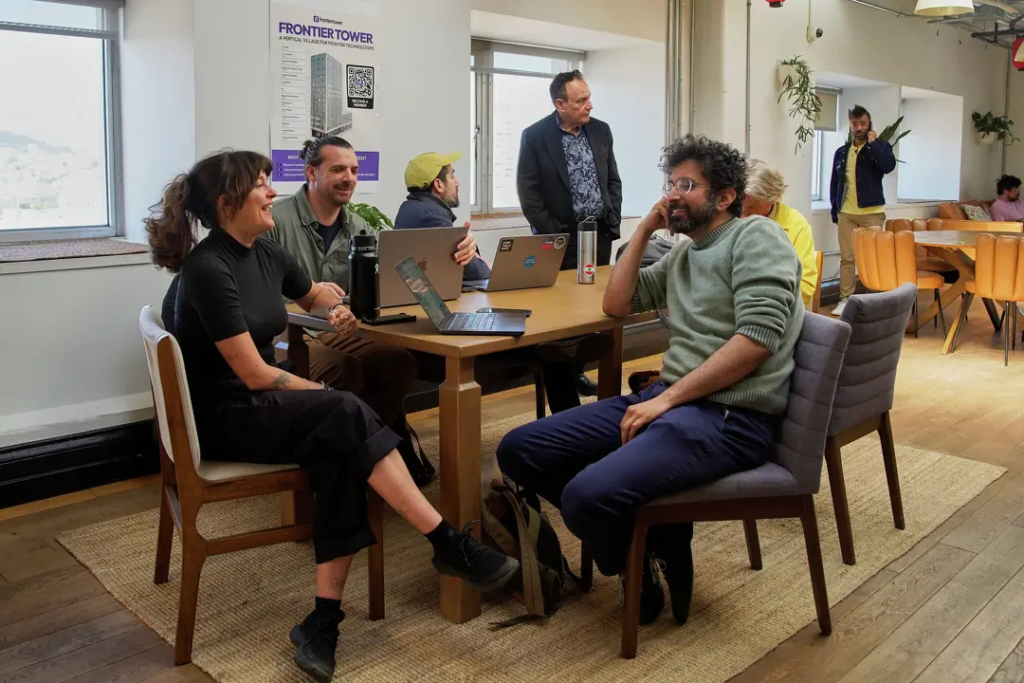
Frontier Tower members celebrate the first anniversary San Francisco incubator’s first anniversary in April. The previously vacant downtown building has become a “vertical village” for a variety of projects ranging from longevity to robotics. But members say a power struggle has developed.Giselle Garza Lerma/S.F. Chronicle
At the corner of Sixth and Market streets, a nondescript gray high-rise known as Frontier Tower blends into downtown San Francisco’s landscape of urban decay and reinvention. Inside the former office building is a microcosm of the city, a conglomeration of technologists and artists with idealistic visions of tomorrow. Most of them want to change some aspect of the world with their work, even if they can’t all agree on how.
On some floors, occupants have created wet labs and artificial intelligence startups, or experimented with sparring humanoid robots. One space has been converted into a functional hyperbaric chamber. Elsewhere, jewelry that records conversations was built by a team that included a member who has been recording his life continuously for more than a decade.
And when biotech founder Elliot Roth wants to use the elevator to visit one of those stations, he presses his hand against the control panel, which reads the pill-size chip implanted under his skin.
Subdermal implants like the one in Roth’s hand aren’t required for those who work in the building. But that blend of experimentation, personal autonomy and futurism has defined much of the activity inside Frontier Tower, which emerged last year from the husk of a vacant office building at 995 Market St.
This grand experiment is run by a group of German investors who purchased the distressed tower for a steep discount to test new forms of social and professional life in the heart of the city. Instead of rent, Frontier Tower grants “citizenship” for $190 a month, selecting applicants based on what they plan to build inside. Each themed floor is supposed to govern itself, with designated leaders recruiting more occupants and organizing events. If accepted, applicants gain access to lab space, tools, shared tech infrastructure and a built-in professional network. More than 700 people have joined so far, and its founders plan to take the concept to other cities.
“We’re trying to rethink how people live, work and organize together in cities,” said co-founder Christian Nagel. “The vision is still to build a blueprint that can be replicated all over the world.”
Another part of that vision was the creation of a decentralized, self-governed community oriented around pushing the boundaries of human potential in a future increasingly shaped by artificial intelligence.
But in recent months, disagreements over management of Frontier Tower have fractured this utopian vision. Several floors now sit empty amid simmering conflicts between floor leaders and founders over who ultimately controls and stands to gain from the future of the experiment, and whether Frontier Tower still supports earlier ambitions around co-ownership and community-led decision-making.
It’s creating a familiar tension in tech-saturated San Francisco: The power struggle between profitability and purpose. Some who believed the tower could offer a different model just as AI startups begin reshaping the city now worry their community experiment is just a glorified version of a hacker house — or a regular office.
“That’s not why we all came in and gave our labor for free for a year,” said Mingzhu Heseri, a former floor co-leader. “They said there will be joint ownership. Instead, they have chased out the high-value communities that helped them build the space.”
14th floor: Human Flourishing
Hallway lights flicker unpredictably inside Frontier Tower, and many members opt for the stairs rather than enduring the slow elevator. A mural painted on the ground-level facade adds a splash of color to an otherwise bleak city block.
Inside, cameras monitor common areas and workspaces, and many floors are locked behind key card access for research, private work and experimentation.
For much of its first year, the tower operated with little centralized structure, its culture shaped floor to floor by the people occupying them. Appointed floor leads — like Roth — were charged with building out their spaces, organizing events, recruiting more members and, in some cases, designing governance systems with minimal oversight from ownership.
The arrangement has helped cultivate the sense, repeated often inside the building, that Frontier Tower is not simply a co-working space but a live experiment in how urban communities might organize themselves in the age of tech innovation and changing work dynamics.
Shoes were discouraged on the 14th floor, known as the Human Flourishing Floor, where rugs covered nearly every inch of space and couches and cushions outnumbered desks. The point was to allow its occupants to feel “a little bit more human and in our bodies,” said Judy Zhou, an early member of the floor.
The work focused less on accelerating technology and more on managing its social consequences. On this floor, discussions about AI often drifted away from product development toward more social and philosophical topics: What happens to communities when jobs disappear? Who benefits from automation? And what would a healthier version of innovation look like?
Heseri, who founded the floor and served as its co-lead, spoke of imagining alternatives to the culture that has long shaped Silicon Valley and restoring humanity by reinventing systems that optimized for speed and efficiency. It was this promise that drew her to the tower when it was just an idea being pitched by the founders without a physical home.
By most startup measures, the experiment has worked. Several companies connected to the building have raised significant venture funding, and Frontier Tower has become the latest gathering place for AI researchers, founders and investors as a new tech boom takes hold in San Francisco.
But building a community, Heseri said, does not lend itself easily to the logic of quotas and growth targets.
Floors were expected to recruit more members, to reach roughly 80 by the end of 2025. But some, including the Human Flourishing floor, fell short. In Heseri’s view, Frontier Tower started to drift toward more traditional landlord-tenant dynamics and away from the self-governing experiment it set out to be.
“This project has, consciously or unconsciously, been captured by extractive capitalism,” Heseri said, despite “what might have been best intentions.”
After Zhou joined Frontier Tower, she began hosting weekly tea ceremonies — gatherings where members would remove their shoes, sit together and talk. Over time, members organized conferences, community programming and collaborative projects that, in her view, became central to Frontier Tower’s identity and public image. Zhou said they also began questioning whether the people building the tower’s culture would ever meaningfully share in its upside.
While floors are given room to self-organize, key aspects of the tower’s operations — such as space and funding allocations or revoking memberships — ultimately sit with a central team made up of the founders and a committee that includes outside experts and more members from various floors.
“The only way to create sustainable stewardship of community is for the community to eventually own the thing they’re stewarding,” Zhou said. “I think it’s very difficult to not fall into an adversarial landlord versus tenant relationship if you don’t eventually create some pathway to co-ownership.”
Eighth floor: Biopunk
Roth typically flashes his key card implant to take the elevator to the eighth floor. Called Biopunk, it’s where members experiment with everything from lab automation to gene modification and microbial art, which uses bacteria and fungi to produce visually striking patterns. The floor hosts biosecurity hackathons and peptide raves, gatherings focused on experimenting with biology and chemical compounds like peptides. Visitors whisked into one room might find themselves suddenly strapped into a Kernel headset, a portable helmet that uses infrared light to scan brain activity.
Startups connected to the floor, which has more than 100 members, have already raised significant funding, including Zeon Systems, a lab-automation company that filmed its Y Combinator application video inside the tower and later raised roughly $5 million. Another, Muse Bio, a biotech startup focused on the use of menstrual stem cells for wellness products, recently raised more than $1 million.
Roth has spent years building independent community labs around the world in an effort to democratize bioscience. But he said Frontier Tower offers something he had not yet encountered: a “vertical village” where researchers, artists, engineers, nonprofit leaders and founders regularly cross paths. “That’s where new ideas come from,” he said, “at the intersection of different disciplines.”
And yet, some of the people who had been deeply invested in its ideals no longer had a place in the tower. By June, the leaders and several members of three floors — Robotics and Hard Tech, the Makerspace and Human Flourishing — had departed from the building.
Nagel, the Frontier Tower co-founder, said some floors were always meant to rotate, as participants find success with their projects and move on. The group that helped launch the tower’s popular robot fighting events stepped back from its role leading the Robotics floor as the project grew, he said. The tower also ended its relationship with the Makerspace team several months ago. Nagel said new leaders were already being brought in for those spaces and added that all members of these floors were invited to stay.
Heseri, the Human Flourishing Floor lead, rejected the notion that community leaders inside the tower were meant to come and go. Her floor was terminated completely and will be merged with another floor. This was ultimately due to what Nagel referred to as issues over intellectual property rights and “mutual respect,” he said: “We didn’t feel like it was a match anymore.”
According to David Andrews, a former Frontier Tower member, tensions grew over time as some floor leads questioned their roles despite helping build communities and representing the tower to prospective investors, without the promise of pay or equity.
The tower’s founders have said that 20% of revenue was allocated to floor leads as “startup capital” to help cultivate their communities and test sustainable operating models.
Andrews said the relationship began to fray when some members started reaching out to investors about launching a comparable project in another nearby building.
“I can appreciate from the founders’ side that it feels like disloyalty from the tower leads, but I think the backstory was this buildup of frustration,” he said.
While members focused on developing life inside the tower, the founders were fundraising and pursuing expansion opportunities in San Francisco and abroad. A proposed Frontier project in London came close, but ultimately fell through, according to Nagel. Other spaces in San Francisco the team sought to acquire were lost in negotiations, he said.
“What drew a lot of us in was this vision of a self-governed village,” said tower member Chelsea Borruano, who is planning to exit the project. “The biggest point of failure is never really asking members what they needed.”
Zhou confirmed she recently founded Apollo Innovation Commons, which she described as “true community-owned infrastructure.” She also intends her project to take over a vacant space downtown.
“I had started fundraising, and the deck got to apparently one of the investors that was investing in the Frontier Tower,” Zhou said.
Borruano said that pitching the same investors wasn’t the only problem: “The reason it ended up here is based on months of them trying to work with the tower and getting constantly ignored.”
15th floor: Executive level
The growing disagreement inside Frontier Tower is not simply about a building. It reflects two competing ideas of what the building is: a community that occupies real estate, or a real-estate-backed institution designed to produce community at scale.
The tension is partly rooted in Frontier Tower’s origin story. From the beginning, the project was conceived as infrastructure for a new kind of networked society. It emerged from many of the same crypto, AI and longevity networks that formed around Zuzalu, an experimental Montenegro pop-up city backed by Ethereum co-founder Vitalik Buterin. These communities are often organized around ideals of decentralization, collective ownership and self-governance, using blockchain-based systems to distribute decision-making and reduce reliance on traditional institutions. One of the San Francisco tower’s floors is even dedicated to Buterin’s blockchain network.
According to Frontier Tower CEO Xenofon Kontouris, the broader movement is partly driven by a desire to accelerate experimentation in areas such as longevity and biotechnology that face heavy regulation in the United States and elsewhere.
“We started shifting from temporary hubs and pop-up cities to permanent hubs, and San Francisco was very interesting for many people,” Kontouris said. “The culture of working hard and of being healthy already exists here — it’s what has been tried to be replicated in these pop-up cities that I’ve been a part of.”
Frontier Tower’s co-founders themselves came out of many of those worlds. Nagel, Christian Peters and Jakob Drzazga brought backgrounds spanning venture capital, crypto and emerging technology, along with that shared interest in how physical spaces can shape communities.
While in their 20s, Nagel and Drzazga had operated a small co-living and community space in Leipzig, Germany, where they lived upstairs and ran a techno club below. The business was successful, and the experience stayed with them. Years later, after reconnecting at Burning Man, the former partners began discussing how to build what Nagel described as a “functional community” organized around a shared purpose.
Then the pandemic and remote work reset real estate values in urban cores.
“In every metropolitan area in the United States, commercial real estate, after the pandemic, hasn’t recaptured the value and utility it once had,” Kontouris said. “We believe that we can have hundreds of properties that can create a very risk-balanced portfolio that would allow for our communities to build on top of.”
For its founders, Frontier Tower was never meant to be a single building: “10 towers by the end of 2026. 100 by 2027. 13 million citizens by 2028,” reads a manifesto they published last summer, framing Frontier Tower as the early infrastructure for a “network society.”
In recent months those ambitions have become more measured. Rather than racing to expand in other cities, the team focused on refining its San Francisco footprint.
In October, Frontier Tower’s founders purchased the Commodore Hotel, a six-story building that previously housed art students in the Tenderloin. The property is being used for Frontier Tower’s residency program, which brings in founders from all over the world to use the tower’s infrastructure in exchange for equity stakes in companies that emerge from the program.
“We’re exploring dedicated venue spaces, more hotels, more lab space,” Nagel said. “We’re also trying to get deeper into frontier technology and the research side of things.”
He acknowledged that Frontier Tower’s growth has forced it to confront a familiar question intentional communities eventually face: How should a self-organizing community govern itself?
“We have made some adjustments,” he said, including limiting the number of nonmembers who may attend free events in the tower.
“They essentially wanted to be a pop-up city that lasted forever,” said Gage Olesen, a painter who helps operate the arts and music floor inside the tower. “What they found was that this is problematic. Through community stress testing the idea, we identified the problems and found ways to solve them.”
Heseri, from the Human Flourishing Floor, was drawn to the project for its attempt to rethink the structure of tech communities. But she grew concerned that, without a more intentional guiding ethos, the tower risked perpetuating old problems. “If we default to the same dynamics, we can’t build new systems,” she said.
The warning proved to be a dividing line. By mid-June, Heseri and Zhou had been banned from the tower.
Sixth floor: Arts and music
During his first day at Frontier Tower last month, game developer Jarory de Jesus wandered onto the sixth floor, an arts and music space that is one of the few areas in the building accessible to all members and visitors.
De Jesus said he works remotely and had been searching for a sense of community since moving to San Francisco a year and a half ago, describing many social and creative spaces in the city as difficult to access without existing connections.
“I don’t want to be home alone all day,” he said. “I’m a musician and a poet as well as a game developer, but I don’t really have a place to play music with other people.”
Olesen said the arts and music floor was designed to make possible these informal encounters between people who would not normally meet in the city’s more siloed creative and tech circles.
But he also acknowledged that bringing San Francisco’s working artists into the tower has not been straightforward. Many remain wary of spaces fueled by venture capital or startup culture, he said, burned by years of seeing art used as branding or an afterthought rather than infrastructure. Building trust takes time and consistency, he said, adding that Frontier Tower still offers a chance to move against that broader trend.
“When arts, tech and humanities properly interact, beautiful things happen. But there is always a moment of misalignment of incentives, especially when people are solving for profit primarily, which is inherent to tech,” Olesen said.
“The ethos when I came here was not controlling artists, but giving them space.”
June 21, 2026|Updated June 21, 2026 9:33 a.m.
Reporter
Laura Waxmann covers the business community with a focus on commercial real estate, development, retail and the future of San Francisco’s downtown. Prior to joining The Chronicle in 2023, she reported on San Francisco’s changing real estate and economic landscape in the wake of the COVID-19 pandemic for the San Francisco Business Times.
Waxmann was born and raised in Frankfurt, Germany, but has called San Francisco home since 2007. She’s reported on a variety of topics including housing, homelessness, education and local politics for the San Francisco Examiner, Mission Local and El Tecolote.