


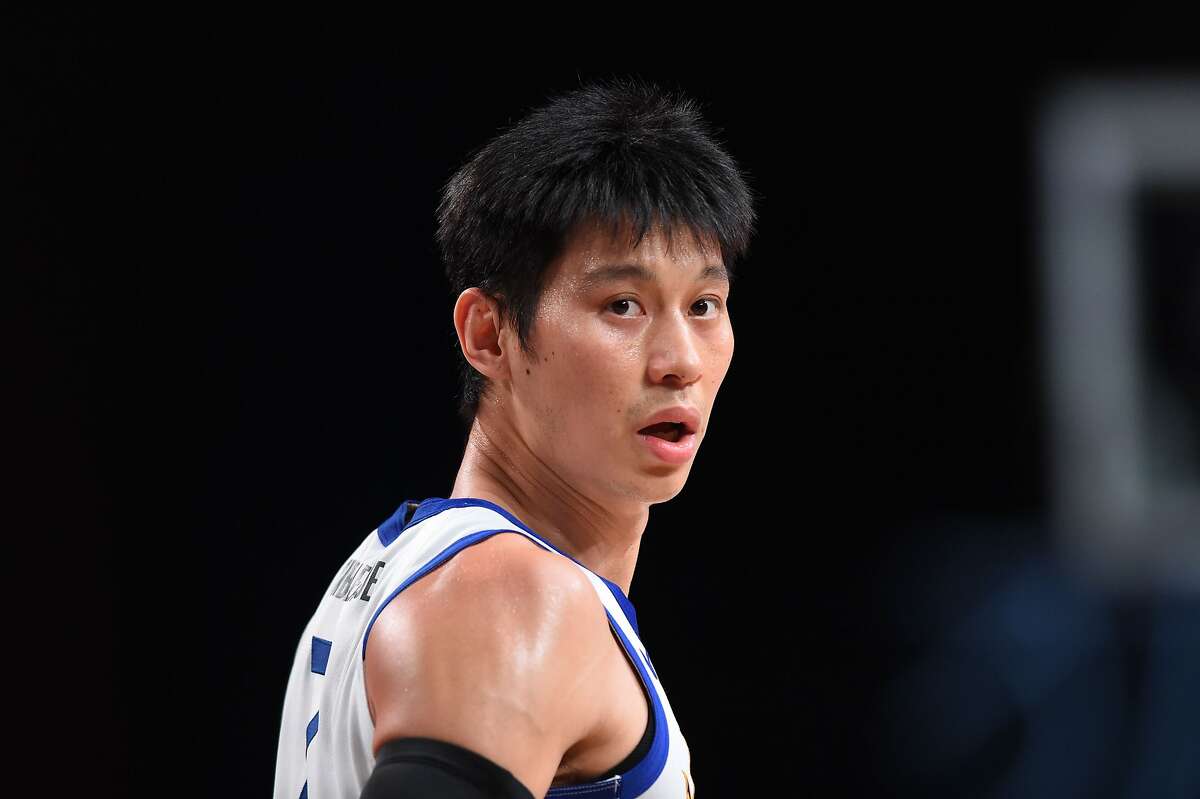
Jeremy Lin spent much of his 42-night stay at Walt Disney World’s Coronado Springs Resort reading 15 books.
One called “The Burden is Light,” in which a New York-based pastor details the merits of freeing oneself from the pressure of accolades or comparisons, particularly resonated with him. Since returning from the G League bubble near Orlando five weeks ago, Lin, 32, has revisited the book often to remind himself how he wants to live.
For nearly a decade, he was consumed by the desire to recapture the success of that unforgettable month in 2012 known as “Linsanity.” Now, as he waits to see whether his recent stint with the Santa Cruz Warriors was enough to land an NBA contract, Lin feels at peace with whatever could happen.
His January decision to forgo a seven-figure deal in China and sign with Golden State’s G League affiliate for $35,000 was rooted in a need to show himself that he still belongs at the sport’s highest level. After averaging 19.8 points, 3.2 rebounds and 6.4 assists in nine games with Santa Cruz, Lin heard from his agent that he had eased NBA front offices’ concerns about his age and efficiency.More on Jeremy Lin
Whether he gets a roster spot in coming days will depend on whether a team needs an offensive-minded backup point guard capable of mentoring younger players. But even if Lin doesn’t receive another shot at the NBA, he’ll continue to establish himself as a leading voice against the surge in anti-Asian violence.
Nine years removed from the three-week stretch with the Knicks that made him an international phenomenon, Lin boasts nearly 17 million followers across Twitter, Instagram and Chinese platforms Sina Weibo and Douyin. Over the past two months, as reports surfaced of more and more violent episodes against people of Asian descent, Lin pleaded numerous times on social media to “#StopAsianHate.”
In late March, less than a week after eight people — including six Asian or Asian-American women — were shot and killed at Atlanta-area spas, Lin co-wrote an 852-word piece with his sister-in-law for Time detailing his anger over the recent spike in animus toward Asians. In it, he expressed regret over not doing more during “Linsanity” to advocate for Asian-Americans.
“I just wanted to play basketball during that time in 2012,” wrote Lin, who is Taiwanese-American and a Palo Alto native. “…It’s one of my biggest failures.”
In the wake of that rise to international prominence, Lin recognized why Asians and Asian-Americans had connected so deeply with his story: They were desperate for more stereotype-defying representations in mainstream media. Over the next seven years, as he maintained a global following despite bouncing among six NBA franchises, Lin met with community leaders and advocates to learn more about Asian-American history.
What he found was that, though Asians in the U.S. are widely considered one of the country’s most successful minority groups, elderly Asians — the ones who moved across the world in search of a better life — were often struggling on society’s fringes. As he saw then-president Donald Trump’s penchant for calling the coronavirus the “Chinese virus” last year contribute to a rise in anti-Asian bias, Lin decided to further educate himself.
When he checked into Room 3296 at Coronado Springs Resort in late January, he brought with him more than a dozen books about everything from civil rights leaders to self-help to the Asian-American experience. Jon Tyson’s “The Burden is Light,” which he read in a day, reinforced for Lin the need to rethink how he viewed success. It shouldn’t be measured in how many points he scored, but rather the positive influence he can have on others.
This was a driving force behind Lin’s decision to post to social media in late February about the rise in violence against people of Asian descent. Within hours, his call for action became a national story, with many focusing on a 16-word line toward the end of his message: “Being a 9 year NBA veteran doesn’t protect me from being called ‘coronavirus’ on the court.” The G League opened an investigation into the matter, and Lin became discouraged that the focus was suddenly on him instead of the people he was trying to help.
Some coverage portrayed him as a victim of racism, which frustrated Lin because he considered the real victims those Asians and Asian-Americans who had been pushed, beaten, kicked and spit on. Other stories and TV news segments trumpeted Lin as a hero, which in his mind was also unfair because he viewed the people who had dedicated their lives to racial equality as the true heroes.
“I sent one tweet,” Lin said. “I drafted a caption, wrote a tweet, posted a picture, but there’s people on the ground who’ve spent years and years working to bring about change. To me, it was like, ‘If you want to talk about a hero, it’s these types of people.’”
Such attention could have easily been a distraction during perhaps the most crucial time of Lin’s basketball career. In the G League bubble, Lin — more than 1½ years removed from his last NBA game — had less than a month to convince NBA front offices that he deserved another chance.
It hardly helped that he missed six of Santa Cruz’s 15 games with back spasms. A string of injuries, most notably a ruptured patella tendon in the 2017-18 opener with Brooklyn, had hastened Lin’s NBA exit, and he knew even a minor ailment could give teams pause.
To help him tune out the chatter about his social-media posts and health, Lin set aside time for what he calls his “devotional.” For about an hour each morning in Room 3296, he sang Christian songs, read his Bible and wrote in his gratitude journal.
When Lin returned to the court, he played with a joy that had been missing in his last couple NBA seasons. His shooting percentages — 50.5% from the field, 42.6% from 3-point range and 87.9% from the foul line — were the highest he’d posted at any professional level. Younger teammates Jordan Poole and Nico Mannion lauded him for his mentorship. With Lin leading the way, Santa Cruz reached the G League semifinals.
Since getting back to Palo Alto last month, he has continued to juggle his activism with workouts and pickup games. During an Instagram Live three weeks ago with the Mental Health Coalition, Lin opened up about how therapy sessions last year helped him come to terms with the emotional baggage of being an Asian-American in a sport with few other players who look like him. A week later, he appeared on “The Ellen DeGeneres Show” and shared a story about an opposing team shouting, “Go back to China!” at him when he was in sixth grade.
Much of Lin’s free time has been spent meeting with local non-profits committed to racial equality and catching up with old acquaintances from differing backgrounds. When someone says something about race relations that he hadn’t thought about, he pulls out a pen and jots down notes.
Lin’s goal is still to get back to the NBA, but his reason for that pursuit has evolved. No longer does he merely want to prove to himself that he is still good enough to play alongside the world’s best. By returning to the NBA, Lin aspires to offer a measure of hope to a group of people in need of some uplifting.
“I can’t talk enough about how cool that would be,” said Lin, the only player who ranked among the top 11 scorers at the G League bubble who has yet to play in the NBA this season. “What it means to see Asian Americans succeed and excel in different fields, the impact is beyond words.
“But even if I don’t get that opportunity, I’m just happy I was in the U.S. while all of this was going on. I don’t regret my decision to go to the G League at all.”
Connor Letourneau moved to the Golden State Warriors beat in September 2016 after a year covering Cal. Previously, he spent two years covering the Oregon State Beavers for The Oregonian. Letourneau is a University of Maryland alum who has interned for The Baltimore Sun and blogged for The New York Times. A Portland, Ore., native, he is interested in telling the stories that extend beyond the field or court.VIEW COMMENTSTop of the News

©2021 Hearst