by YUJIE ZHOU APRIL 18, 2022 (MissionLocal.org)
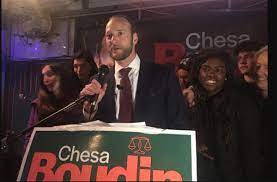
Two years ago, Chesa Boudin won the District Attorney’s election by a mere 2,840 votes, boosted in the ranked-choice voting system by 13,162 votes from his Chinese American competitor Nancy Tung. Much was made of Boudin’s support from a generally conservative voting bloc, a win helped by his ability to speak some Cantonese to Chinese voters.
With the 2022 San Francisco District Attorney recall election just two months away, however, Chinese voters appear to be more polarized than ever over the progressive they helped to elect. In part, the backlash appears to be part of a recall fervor and a reach for scapegoats to blame for anti-Asian incidents as well as a general – albeit not entirely correct – impression that crime has escalated.
Alison Wong, 62, a Sunset homeowner who supports the recall, would like nothing better than to buck the criminal justice system of California as a whole. For her, it is not a discussion of Boudin’s performance or his attitudes toward criminals, but longstanding anger at a system that she disagrees with and she feels affects her life.
“Chesa Boudin is just a part of the San Francisco system. He’s collaborating with the mayor and the police,” she said. “The officers above Boudin protect the criminals, and he is bound to obey.”
Boudin, in fact, defeated Mayor London Breed’s preferred candidate, Suzy Loftus — whom Breed took the extraordinary step of installing as DA only 24 hours before ballots were set to be mailed to voters. His relationship with the mayor remains acrimonious. He was pilloried by the Police Officers Association before, during, and after his campaign and is in the midst of an overt political war with Chief Bill Scott and the police department. But, to Wong, these facts hold no appeal. She is angry about the way her city is run and even though he is an outsider in that system, she sees him as part of it.
“I voted to recall the governor last year,” she said. “And if I could vote to recall the mayor, I’d do that too.”
Many elected officials and community leaders accuse recall supporters of either misunderstanding or misconstruing the facts around crime – though those in the pro-recall camp seemed unmoved by these arguments.
“I don’t think there’s a worse DA than Chesa Boudin in America; he’s probably the worst,” said Leanna Louie, a recall supporter who’s been a San Francisco resident for 42 years. “You know, there are some DAs who actually prosecute criminals, right?”
Others disagree – strongly. “I think they have not heard that Boudin is doing more for Chinese Americans than any district attorney,” said former Richmond District supervisor Sandra Lee Fewer.
“To be honest, the biggest fear that I have is that our community is being used at this moment to advance a political agenda,” said Joyce Lam, another recall opponent and the political director of the Chinese Progressive Association.
The boos Boudin received at last month’s Lunar New Year Parade might even be taken to indicate the majority of the community is against Boudin. Still, the lack of reliable polls, coupled with the hesitancy of the Chinese community towards voting, make it difficult to predict the role they’ll play in the June election.
“If you ask the Chinese living in the Sunset, I believe some 80 percent are against Boudin,” said Alison Wong. “But when it comes to voting, it’s a different story.”
“He’s too soft on crime,” say the recall supporters
For Wendy Wong, and many others, the problem with Boudin centers around a concern about perceived increases in crime and Boudin’s attitude towards the police.
“To me, hate crimes towards Asians, hate crimes to the elderly, targeting some weak and disabled people, those crimes have been increasing in the last two years. And what I saw was he let people go without any bail – he advocates for that ‘zero-dollar’,” said Wong, who is the spokesperson for the San Francisco Coalition for Good Neighborhoods.
Boudin launched the so-called “zero-dollar bail policy” right after taking office in January 2020, a measure that prohibited prosecutors from asking for money bail. The policy, which reflects Boudin’s belief that “no one should be jailed for poverty” has been temporarily adopted statewide; similar policies are also being tested out in other states. And, despite Wong’s arguments, a 2020 study from the MDRC suggests that reducing money bail does not lead to increased rates of re-arrest.
Voters like Wong are difficult to sway. When thieves broke into her car parked four blocks from the police station, “police didn’t even want to take my report.”
Taking that report is, ostensibly, a police officer’s job. But instead of blaming the police for dereliction of duty, she blames Boudin. “It’s because the DA will not prosecute those small crimes.”
But, in fact, most crimes have declined and Boudin has charged more than any DA since 2011, according to data from the DA’s office.
Nevertheless, in interview after interview, members of the Chinese community cited San Francisco’s rising crime levels as a reason to recall Boudin. While homicide and gun violence rose during the pandemic, San Francisco Police Chief Bill Scott has said the rise reflected a national pattern.
The overall crime levels in San Francisco remain significantly lower than they were before the pandemic began.
CHECK CRIME RATES FOR 2021
Explore: How crime rates changed in San Francisco last year
by WILL JARRETT JANUARY 30, 2022
Chinatown merchants, also want to see more from the DA’s office. Storeowners there have grown nervous following rampant cases of petty shoplifting – last month, 10 stores were reportedly hit by theft and robbery in 24 hours.
The occasional theft of jade, fruit and groceries has added to already sluggish business during the pandemic, according to Edward Siu, chairman of the Chinatown Merchants United Association. “The merchants make very little money selling their goods, and I would even go so far as to say that probably more than half of the money is stolen,” he said.
Siu feels Proposition 47 of 2014 is responsible because it recategorizes nonviolent offenses below $950 as misdemeanors rather than felonies – a price tag rarely reached by the goods in Chinatown stores. “When people see others stealing without consequences, they will also steal,” Siu said. According to him, shopkeepers sometimes rejoice when the thief is an old Chinese woman whom they can threaten with the prospect of her crime being reported to her family members.
Siu is not the only person to put forward this argument, though the reality may be more complicated. So far, research suggests Proposition 47 has not led to a significant increase in crime rates, though it has widely become a “scapegoat” blamed for the perception of increasing crime rates. And while $950 might seem high, the threshold in most states is now $1,000 or more.
Still, every time someone mentions the law, they inevitably think of Boudin.
“I understand the police because they are also passive ‘middlemen’,” said Siu. But for him, the DA is different. “Boudin can’t bypass the state law, but there must be something he can do to help us, and he didn’t try.”
“They’re being used,” say the recall opponents
The Chinese on the other side of the recall issue have also invariably felt the pain of anti-Asian violence in the city — but they distrust not just the recall campaign’s arguments but the campaign itself.
“The recall campaign is exploiting the trauma that many Asian community members have felt and experienced over anti-Asian hate incidents,” said Henry Der, former chair of Chinese for Affirmative Action and an opponent of the recall. “I think the recall campaign against Chesa Boudin is based on a lot of disinformation and lies about what he and his office have done since he took office.”
“It’s good that Chesa used to be a public defender, because he’s learned to find out more about the defendant, and the district attorney should do that too,” said Bill Ong Hing, former police commissioner and a professor of law and immigration studies at the University of San Francisco.
“It’s the duty of the district attorney to question the police,” Hing said. If they’re truly being demoralized, then “it means the police have to make sure that they understand what their duty is, what their responsibility is, and that there should be better education of the police as well.”
Hing also feels that, in comparison to his predecessor, George Gascón, Boudin’s has done a “particularly good job on anti-Asian violence,” launching measures including staffing a hate crime hotline, appointing Chinatown native Kasie Lee as chief of Victim Services, and a recent training program for SFPD officers on the evidence needed to prove hate crimes.
Recall supporters like Wendy Wong, however, feel the exact opposite. “Stop going to communities doing a PR job. Just do his real job by prosecuting people,” she said.
Former District 1 supervisor Sandra Lee Fewer feels the problem results from a misunderstanding of the jurisdiction of the DA, the SFPD, the courts and even the jails. And based on her years of experience communicating with police, Fewer added that, “People who commit crimes are not thinking three steps ahead: After they get arrested, after they get in jail, that they’re not thinking, ‘Oh, well, the District Attorney is not going to press charges,’” she said. “Their first and foremost thing in their mind is, ‘Am I going to get caught by the police?’”
The experts concur with that: Research on diversion programs does indeed show that “People who are not prosecuted for misdemeanors are much less likely to find themselves in a courtroom again within two years.”)
Vincent Pan, a former police commissioner and executive director of the non-profit Chinese for Affirmative Action, described himself as independent in relation to the recall. Still, he said he understands that many Chinese Americans place faith in the idea of “locking them up,” but treating it as a cure-all oversimplifies the complexity of the criminal justice system. “If that was a solution, America would already be the safest country. We lock up more people than anybody.”
A similar gridlock has fallen over the uncertainty of who will be appointed by the mayor as the next DA if Boudin is recalled.
For Pan, the format of the recall election itself is an obstacle. “In the past when we had our elections, we’d posted candidate forums or debates, you can kind of ask each candidate, ‘will you do this?’, or ‘will you do this?’” he said. “One of the difficult things about recall elections is we don’t know who the replacement would be.”
David Ho, one of Boudin’s hired consultants, offers a particularly vigorous defense in response. “You cannot name one single individual leader or entity that is supporting the recall of Chesa Boudin as district attorney. Because people who’ve been doing this kind of work in this space for decades, year in year out, understand the complexity of the criminal justice system.”
But this split between community leaders and the base is only more evidence for Richmond District homeowner Meina Young’s argument: “Now you know how out of touch they are.”
Alvin Lee, also a member of Boudin’s campaign, partially attributed the perception of a higher crime rate to the pandemic. “People are at home more nowadays,” he said. “So they might be seeing a few more things. A lot of people are on Facebook, on Twitter every day, and they’re on Nextdoor.”
Why blame Chesa Boudin? “It’s easier to find a scapegoat,” said Norman Yee, former Board of Supervisors president and opponent of the recall. “It’s hard to change people’s mind once they grab on to a particular narrative.”
Alex Tom, former Chinese Progressive Association executive director and opponent of the recall, sees the DA recall campaign as driven by the Chinese right-wing, which has been emboldened by both Trump and their overwhelming recent victory in the school board recall election. “What we noticed nationally for the Chinese right-wing is that people spreading rumors, misinformation, disinformation, a lot of them tend to be more educated. They will put stuff out on WeChat, and really take advantage of people.”
Still, Tom remains optimistic about the community and its ability to grasp the situation. “Chinese people are very savvy because they went through a lot,” he said. “They see through people very quickly. And when Chinese people see people’s political intentions, that’s when it’s going to become clearer.”
THE NUMBERS ON CHARGING RATES AND THE DATA ON RECALL FUNDING
Data shows Chesa Boudin files charges more than prior DAs
by ELENI BALAKRISHNAN APRIL 11, 2022
Explore: See who is funding the Boudin recall
by WILL JARRETT DECEMBER 15, 2021
YUJIE ZHOU
Yujie Zhou is our newest intern. Before falling in love with the Mission, she covered New York City, studied politics through the “street clashes” in Hong Kong, and earned a wine-tasting certificate in two days. She’s proud to be a bilingual journalist. Follow her on Twitter @Yujie_ZZ.