- By Adam Shanks | Examiner staff writer
- Jan 4, 2023 (SFExaminer.com)
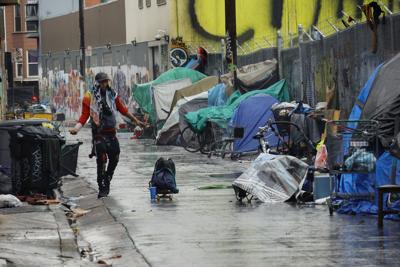
The City has asked a judge to clarify her ruling that places constraints on sweeps of homeless encampments.
A federal court ruling issued last month sparked questions about exactly what San Francisco must offer the homeless before citing them for behaviors like camping on a city sidewalk.
In a motion filed Tuesday, The City asked U.S. District Court Judge Donna Ryu to define what makes a person “involuntarily homeless,” and thus protected from enforcement of laws targeting encampments.
What did you miss during work?
Sign up for The San Francisco Examiner’s free afternoon newsletterEmail
By submitting this form, you are consenting to receive marketing emails from: San Francisco Examiner, 465 California Street, San Francisco, CA, 94104, US, https://www.sfexaminer.com. You can revoke your consent to receive emails at any time by using the SafeUnsubscribe® link, found at the bottom of every email. Emails are serviced by Constant Contact.Sign up!
How Boise impacts S.F’s homeless policies
In 2018, the Ninth U.S. Circuit Court of Appeals issued a pivotal ruling that established protections for people experiencing homelessness
The City also argued that it is now torn between two federal court rulings.
The first demands that it enforce laws against homeless encampments outside UC Hastings (now the University of California College of the Law, San Francisco).
The second ruling, issued by Ryu in December, prohibits The City from conducting sweeps of homeless encampments unless it offers people experiencing homelessness an alternative place to stay.
“Without clarification, the court’s order puts San Francisco in an impossible situation, practically and legally,” City Attorney David Chiu wrote in a statement on Tuesday. “I am concerned that this order, if interpreted broadly, will lead to more people suffering on our City streets.’”
The City was concerned that Ryu’s ruling required it to not only offer a bed to a specific person being removed from an encampment, but that it have enough available shelter beds to accommodate every single person experiencing homelessness in The City before conducting sweeps.
Such a requirement would be functionally impossible to fulfill for The City, which has about 3,050 shelter beds, the vast majority of which are occupied. As of the most recent census, The City has an unsheltered homeless population of 4,397.
The legal questions were raised thanks to a lawsuit filed last year by several homeless advocacy organizations and people who have experienced homelessness in The City. They claimed that The City’s enforcement against encampments — and failure to collect and label the possessions of people it removes from them — violates the constitutional rights of the unhoused.
“Basically what The City is doing is trying to get another bite at the apple because they lost,” said Jennifer Friedenbach, executive director of the Coalition on Homelessness, which is one of the plaintiffs in the lawsuit.
How a judge’s ruling is — and isn’t — impacting S.F.’s homeless sweeps
Despite the confusion sparked by a judge’s ruling last week, The City can — and has already continued to — conduct sweeps of homeless encampments
The City’s response to encampments is led by the Healthy Streets Operations Center, which melds the resources of multiple departments with a role to play in addressing street conditions and homelessness.
In the wake of the ruling, HSOC has continued to respond to homeless encampments, but questions persisted about exactly what laws they could enforce and under what conditions they could do so.
In her ruling, Ryu stressed that she did not intend to prevent San Francisco from addressing public health issues.
“The relief sought by plaintiffs will not bar defendants’ efforts to ‘keep public spaces clean and sanitary’ or ‘allow safe access’ to sidewalks and rights-of-way since plaintiffs do not ask the court to enjoin any ordinances targeting public health nuisances or willfully obstructing streets, sidewalks, or other passageways,“ Ryu wrote.
But she also stressed how practically implausible it is for a homeless person to obtain shelter on their own in San Francisco.
In justifying the ruling, Ryu leaned heavily on the logic contained in Martin v. Boise, a landmark Ninth Circuit Court of Appeals ruling that prohibited cities from enforcing laws like sleeping outside unless they first offer adequate shelter.
“In Martin, the Ninth Circuit held that ‘so long as there is a greater number of homeless individuals in (a jurisdiction) than the number of available beds (in shelters), the jurisdiction cannot prosecute homeless individuals for involuntarily sitting, lying, and sleeping in public,’” Ryu noted in the ruling.
Another $1.45 billion to end unsheltered homelessness in S.F.?
Ending unsheltered homelessness in San Francisco would cost The City billions of dollars over the next three years, according to a new report
The City is now asking Ryu to clarify the definition of “involuntarily homeless,” to whom the order applies.
It wants Ryu to stipulate “that a particular individual is not ‘involuntarily homeless’ where San Francisco has offered that individual adequate temporary shelter,’” regardless of whether or not there is a shelter bed available to every unsheltered homeless person in The City.
If Ryu means that The City needs to rapidly expand shelter in order to enforce laws against encampments, The City worries it could run afoul of a separate court order issued in June 2020.
In that case, UC Hastings sued The City for failing to clear the streets around its campus.
The injunction issued in that case states “The City is hopeful that most people offered an alternative location will be willing to accept it, but if necessary to comply with this stipulated injunction The City will employ enforcement measures for those who do not accept an offer of shelter or safe sleeping sites to prevent re-encampment.”
But The Hastings lawsuit never gave The City a green light to violate peoples’ constitutional rights, Friedenbach said.
The question of whether or not The City has to have enough beds for its entire homeless population in order to enforce certain laws is, to some extent, irrelevant to Friedenbach.
“The City is not offering shelter to the vast majority of people in any one encampment,” Friedenbach said. “We’re not really asking for anything more than the city to follow the law and have an effective and humane response out on the streets.”