Sep. 1, 2023 (SFChronicle.com)
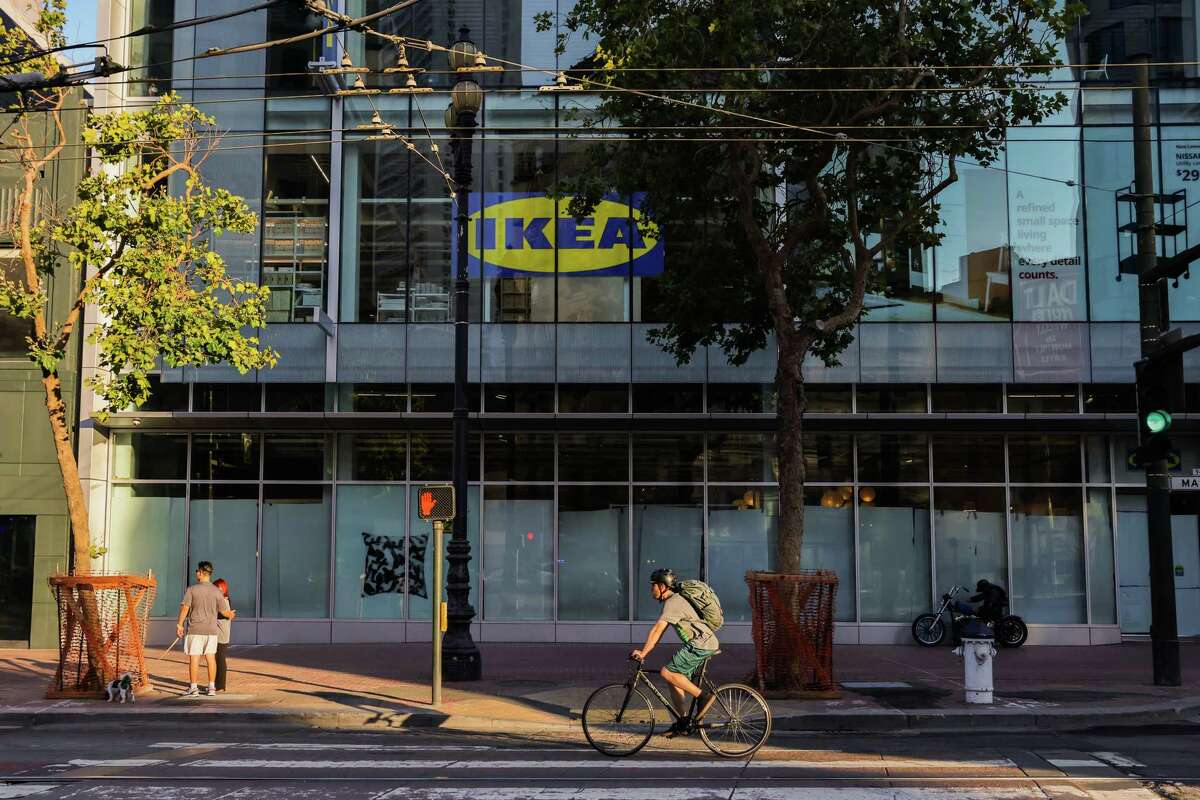
Before you get too excited about watching soccer games where Westfield mall now stands — an idea percolating at City Hall — I suggest you visit the new IKEA that’s a half-block away.
A week after it opened, shoppers still fawn over cleverly named kitchen gadgets and scented candles. You’ll wait in line for Swedish meatballs with lingonberry jam. But the housewares emporium is the lone tenant in a 250,000-square-foot building that was hailed as Mid-Market’s salvation when it was approved in 2010 — and sat totally empty from its 2016 completion until last month.
The moral of the story? Big plans in big cities often fall short of expectations. What sounds dramatic can be a dead end, or at best a modest success.
I’m not writing off the trial balloon being floated by Mayor London Breed with regards to San Francisco Centre, the beleaguered bastion of bourgeois retail that Nordstrom abandoned last week and that former owner-developer Westfield has handed off to its lenders.
People from the mayor on down have been spitballing ideas all summer about the mall’s future, and Breed upped the ante last week when describing how City Hall is working with the architecture firm Gensler on conceptual ideas about replacing the 1.5 million square foot structure with an arena that could double as a concert venue.
“We hope to be able to share that information with the public fairly soon and potentially get the ball rolling,” Breed told a crowd at the Chamber of Commerce. If nothing else, she pointed out, such a complex would be a great way “to diversify what happens in the downtown area.”
If this sounds vague … it is.
San Francisco wants to find a spot where a permanent home for women’s soccer can be built. A troubled mall and a downtown that could use a boost — voila! What could be simpler than swapping the former for the latter?
The answer: Just about anything. There’s no owner right now, just lenders trying to figure out what to do with a great location and a lot of empty space. Nor is the mall closed, despite all the what-if talk. You can still walk past Burberry and Boss on your way to Bloomingdale’s.
Even if someone bought the site, and determined there was value in starting from scratch, and nailed down all necessary approvals, we’re talking about something that might be ready a decade from now. By then, San Francisco will either have disappeared down the doom loop, or be booming yet again.
That’s the thing with big plans. They offer easy answers, but that’s not how cities work.
Which brings us back to IKEA.
When the project was approved in 2010 — replacing three small, old buildings with a five-story glass box — developers and boosters touted it as what the chamber called “one of the best hopes in decades to revitalize Mid-Market.” The box would be filled with mass-market tenants attracting customers eager to patronize a part of town known for “street-level enterprise of a different sort,” to quote a Chronicle article from when the plan first surfaced.

SFNext is Chronicle coverage devoted to the city’s most vexing problems.
To become involved: Send feedback, ideas and suggestions to sfnext@SFChronicle.com
By the time construction began in 2014, CityPlace had become Market Street Place. New developers were talking about cool bowling alleys and cool movie lofts and maybe a food emporium a la New York’s Chelsea Market. As for smaller tenants, no problem: “The Hayes Valley and Valencia crowd want to be in Mid-Market,” one retail broker told the press, presumably with a straight face.
Two years later, construction complete, the glass box still lacked tenants (“We’re pretty picky,” explained the developer). But! There was yet another name — 6×6 — because “we have something that is cool and exciting and appeals to younger people.”
More for you
- Will S.F.’s Westfield mall become a stadium? Mayor Breed says city is studying the idea
- Mayor Breed worked to bring IKEA to downtown S.F. Will her bet pay off?
Beyond the comic value of dusting off bluster gone bust, the saga of how IKEA came to be shows the problem with supposed silver bullets. The first developer hatched a big plan and lined up supporters who said it would bring salvation. Instead, his block-dampening void just made things worse.
Funny thing is, IKEA’s debut genuinely feels like a fresh start.
The exterior looks dated, but that was the case from day one. IKEA’s three-story interior, though, has an amiable air that suggests you’re in a friendly warehouse — a perfect fit for the umlauted knickknacks.
Looking beyond design, IKEA’s emphasis on furniture for small apartments is in tune with its locale, rather than feeling like a standard outpost of an overexposed brand. And the building is owned by a spin-off of IKEA, Ingka Centres — if extra shops and restaurants radiating the same vibe open early next year along with a full-floor coworking space, Market Street will show a bit of momentum rather than regression.
“IKEA is a pretty unique draw, and the ability to have that downtown is exciting,” said Sarah Dennis-Phillips, who heads the city’s Office of Economic and Workforce Development.
A veteran planner, Dennis-Phillips this week extolled the idea of looking into a downtown soccer stadium — but also was careful not to overhype it.

The Get Involved calendar
Search for public meetings on top San Francisco issues so you can add your voice.
Calendar Submit an event More coverage
“We want to work with the National Women’s Soccer League” on identifying possible locations where a stadium could be built within the city, Dennis-Phillips said. “One cool idea possibly might be at the Westfield (site). Other cool ideas are possible.”
Equally important, she suggested, is an initiative dubbed Vacant to Vibrant: 17 empty storefronts downtown that will be filled by small entrepreneurs starting in mid-September. The idea is to stir things up on long-quiet streets. See what sticks.
“Little changes can lay the groundwork for bigger ones,” Dennis-Phillips said, calling the six-month experiment “an example of what’s possible.”
One final trivia note.
There’s nothing new about the idea of a downtown stadium that would boost business and draw the crowds. Exactly such a “Big League Sports Arena” was promised as a key part of the Yerba Buena redevelopment project — in 1969. Instead we have theaters, museums and a playground atop a convention center. Not a bad trade at all.
Reach John King: jking@sfchronicle.com; Twitter: @johnkingsfchron
Written By John King
John King is The Chronicle’s urban design critic and a two-time Pulitzer Prize finalist who joined the staff in 1992. His book “Portal: San Francisco’s Ferry Building and the Reinvention of American Cities” will be published by W.W. Norton in November.

 ©2023 Hearst Communications, Inc.