


From Wikipedia, the free encyclopedia
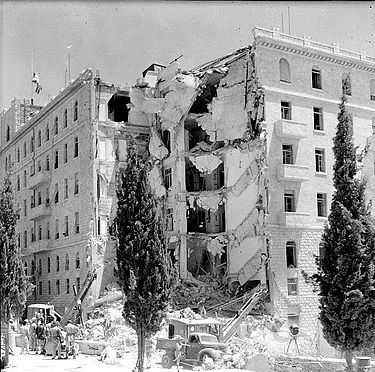
| King David Hotel bombing | |
|---|---|
| Part of the Jewish insurgency in Palestine | |
| The hotel after the bombing | |
| Location | Jerusalem, Mandatory Palestine |
| Date | July 22, 1946 12:37 pm (UTC+2) |
| Target | King David Hotel |
| Attack type | Bombing |
| Deaths | 91 |
| Injured | 46 |
| Perpetrators | Irgun |


The British administrative headquarters for Mandatory Palestine, housed in the southern wing[1] of the King David Hotel in Jerusalem, were bombed in a terrorist attack[2][3] on July 22, 1946, by the militant right-wing[4] Zionist underground organization the Irgun during the Jewish insurgency.[5][6][7] 91 people of various nationalities were killed, including Arabs, Britons and Jews, and 46 were injured.[8]
The hotel was the site of the central offices of the British Mandatory authorities of Palestine, principally the Secretariat of the Government of Palestine and the Headquarters of the British Armed Forces in Palestine and Transjordan.[8][9] When planned, the attack had the approval of the Haganah, the principal Jewish paramilitary group in Palestine, though, unbeknownst to the Irgun, this had been cancelled by the time the operation was carried out. The main motive of the bombing was to destroy documents incriminating the Jewish Agency in attacks against the British, which were obtained during Operation Agatha, a series of raids by mandate authorities. It was the deadliest attack directed at the British during the Mandate era (1920–1948).[8][9]
Disguised as Arab workmen and as hotel waiters, members of the Irgun planted a bomb in the basement of the main building of the hotel, whose southern wing housed the Mandate Secretariat and a few offices of the British military headquarters. The resulting explosion caused the collapse of the western half of the southern wing of the hotel.[9] Some of the deaths and injuries occurred in the road outside the hotel and in adjacent buildings.[9]
Controversy has arisen over the timing and adequacy of any warnings.[9] The Irgun stated subsequently that warnings were delivered by telephone; Thurston Clarke states that the first warning was delivered by a 16-year-old recruit to the hotel switchboard 15 minutes before the explosion. The British Government said after the inquest that no warning had been received by anyone at the Secretariat “in an official position with any power to take action.”[10]
Background
See also: List of Irgun attacks and List of Irgun members
Motivation for the bombing

The Irgun committed the attack in response to Operation Agatha, known in Israel as “Black Saturday”.[11] British troops had searched the Jewish Agency on June 29 and confiscated large quantities of documents directly implicating the Haganah in the Jewish insurgency against Britain. The intelligence information was taken to the King David Hotel,[12] where it was initially kept in the offices of the Secretariat in the southern wing. The Irgun was determined to destroy that wing of the hotel in order to destroy the incriminating documents.
Hotel layout
In plan form, the six-story hotel, which was opened in 1932 as the first modern luxury hotel in Jerusalem,[13] had an I-shape, with a long central axis connecting wings to the north and south. Julian’s Way, a main road, ran parallel and close to the west side of the hotel. An unsurfaced lane, where the French Consulate was situated and from where access to the service entrance of the hotel was gained, ran from there past the north end of the hotel. Gardens and an olive grove, which had been designated as a park, surrounded the other sides.[8]
Government and military usage
In 1946, the Secretariat occupied most of the southern wing of the hotel, with the military headquarters occupying the top floor of the south wing and the top, second and third floors of the middle of the hotel.[14] The military telephone exchange was situated in the basement.[8][9] An annex housed the military police and a branch of the Criminal Investigation Department of the Palestine Police.[13]
Rooms had first been requisitioned in the hotel in late 1938, on what was supposed to be a temporary basis. Plans had already been made to erect a permanent building for the Secretariat and Army GHQ, but these were cancelled after the Second World War broke out, at which point more than two-thirds of the hotel’s rooms were being used for government and army purposes.[8]
In March 1946, British Labour Party Member of Parliament (MP) Richard Crossman gave the following description of activity at the hotel: “private detectives, Zionist agents, Arab sheiks, special correspondents, and the rest, all sitting around about discreetly overhearing each other.”[15] Security analyst Bruce Hoffman has written that the hotel “housed the nerve centre of British rule in Palestine”.[16]
Previous attacks
Amichai Paglin, chief of operations of the Irgun, developed a remote-controlled mortar with a range of four miles that was nicknamed the V3 by British military engineers. In 1945, after attacks using the mortar had been executed against several police stations, six V3s were buried in the olive grove park south of the King David Hotel. Three were aimed at the government printing press and three at the hotel itself.[8] The intention was to fire them on the king’s birthday, but the Haganah learned about the plan and warned the British through Teddy Kollek of the Jewish Agency. Army sappers then located and removed the buried V3s. On another occasion, members of an unknown group threw grenades at the hotel but missed.[8]
Preparations for the attack
Planning
The leaders of Haganah opposed the idea initially.[15] On July 1, 1946, Moshe Sneh, chief of the Haganah General Headquarters, sent a letter to the then leader of the Irgun, Menachem Begin, which instructed him to “carry out the operation at the ‘chick'”, code for the King David Hotel.[note 1] Despite this approval for the project, repeated delays in executing the operation were requested by the Haganah, in response to changes unfolding in the political situation. The plan was finalized between Amichai Paglin (Irgun alias ‘Gidi’), Chief of Operations of the Irgun, and Itzhak Sadeh, commander of the Palmach.[9]
In the plan, Irgun men, disguised as Arabs, except for Gideon, the leader, who would be dressed as one of the hotel’s distinctive Sudanese waiters, would enter the building through a basement service entrance carrying the explosives concealed in milk cans. The cans were to be placed by the main columns supporting the wing where the majority of the offices used by the British authorities were located. The columns were in a basement nightclub known as the Régence.[9] In the final review of the plan, it was decided that the attack would take place on July 22 at 11:00, a time when there would be no people in the coffee shop in the basement in the area where the bomb was to be planted.[15] It would be possible to enter the hotel more easily at that time as well.[9]
It would have been impossible to have planted the bomb in the Régence any later than 14:00 because it was always full of customers after that time.[8] The timing was also determined by the original intention that the attack should coincide with another, carried out by the Lehi, on government offices at the David Brothers Building. However, that attack, codenamed “Operation Your Slave and Redeemer”, was cancelled at the last moment. The Irgun said details of the plan were aimed at minimizing civilian casualties. Irgun reports allegedly included explicit precautions so that the whole area would be evacuated.[17] This led to recriminations between the Haganah and Irgun later. The Haganah said that they had specified that the attack should take place later in the day when the offices would have been emptier of people.[9]
Warnings

Since the bombing, much controversy has ensued over the issues of when warnings were sent and how the British authorities responded. Irgun representatives have always stated that the warning was given well in advance of the explosion so that adequate time was available to evacuate the hotel. Menachem Begin, for example, wrote that the telephone message was delivered 25–27 minutes before the explosion.[18] It is often stated that the British authorities have always denied that a warning was sent. However, what the British Government said, five months after the bombing, once the subsequent inquest and all the inquiries had been completed, was not that no warning had been sent, but that no such warning had been received by anyone at the Secretariat “in an official position with any power to take action.”[10] Begin directly accused Chief Secretary of the Palestine Mandate, John Shaw, of ignoring the warning. Shaw strongly denied having received it.[19] (see Sir John Shaw controversy)
American author Thurston Clarke‘s analysis of the bombing gave timings for calls and for the explosion, which he said took place at 12:37. He stated that as part of the Irgun plan, a sixteen-year-old recruit, Adina Hay (alias Tehia), was to make three warning calls before the attack. At 12:22 the first call was made, in both Hebrew and English, to a telephone operator on the hotel’s switchboard (the Secretariat and the military each had their own, separate, telephone exchanges). It was ignored.[8] At 12:27, the second warning call was made to the French Consulate adjacent to the hotel to the north-east. This second call was taken seriously, and staff went through the building opening windows and closing curtains to lessen the impact of the blast. At 12:31 a third and final warning call to the Palestine Post newspaper was made. The telephone operator called the Palestine Police CID to report the message. She then called the hotel switchboard. The hotel operator reported the threat to one of the hotel managers. This warning resulted in the discovery of the milk cans in the basement, but by then it was too late.[8]
Begin claimed in his memoirs that the British had deliberately not evacuated, thereby creating a possible opportunity to vilify the Jewish militant groups.[20]
Leaks and rumours
Shortly after noon Palestine time, the London UPI bureau received a short message stating that ‘Jewish terrorists have just blown up the King David Hotel!’. The UPI stringer who had sent it, an Irgun member, had wanted to scoop his colleagues. Not knowing that the operation had been postponed by an hour, he sent the message before the operation had been completed. The bureau chief decided against running the story until more details and further confirmation had been obtained. There were other leaks.[8]
Execution
The perpetrators met at 7 am at the Beit Aharon Talmud Torah. This was the first time they were informed of the target.[citation needed] The attack used approximately 350 kg (770 lb) of explosives spread over six charges. According to Begin, due to “consultations” about the cancellation of the attack on the David Brothers Building, the operation was delayed and started at about 12:00, an hour later than planned.[18]
After placing the bombs in the La Regence Cafe,[21] the Irgun men quickly slipped out and detonated a small explosive in the street outside the hotel, reportedly to keep passers-by away from the area.[18] The police report written in the aftermath of the bombing says that this explosion resulted in a higher death toll because it caused spectators from the hotel to gather in its south-west corner, directly over the bomb planted in its basement. The first explosion also caused the presence in the hotel of injured Arabs who were brought into the Secretariat after their bus, which had been passing, was rolled onto its side.[9] The Arab workers in the kitchen fled after being told to do so.[17]
There were two Irgun casualties, Avraham Abramovitz and Itzhak Tsadok. In one Irgun account of the bombing, by Katz, the two were shot during the initial approach to the hotel, when a minor gunfight ensued with two British soldiers who had become suspicious.[17] In Yehuda Lapidot’s account, the men were shot as they were withdrawing after the attack.[22] The latter agrees with the version of events presented by Bethell and Thurston Clarke. According to Bethell, Abramovitz managed to get to the taxi getaway car along with six other men. Tsadok escaped with the other men on foot. Both were found by the police in the Jewish Old Quarter of Jerusalem the next day, with Abramovitz already dead from his wounds.[8][9]
Explosion and aftermath


The explosion occurred at 12:37. It caused the collapse of the western half of the southern wing of the hotel. Soon after the explosion, rescuers from the Royal Engineers arrived with heavy lifting equipment. Later that night, the sappers were formed into three groups, with each working an eight-hour shift. The rescue operation lasted for the next three days and 2,000 lorry loads of rubble were removed. From the wreckage and rubble the rescuers managed to extract six survivors. The last to be found alive was Assistant Secretary Downing C. Thompson, 31 hours after the explosion, but he died just over a week later.[23]
Ninety-one people were killed, most of them being staff of the hotel or Secretariat: 21 were first-rank government officials; 49 were second-rank clerks, typists and messengers, junior members of the Secretariat, employees of the hotel and canteen workers; 13 were soldiers; 3 policemen; and 5 were bystanders. By nationality, there were 41 Arabs, 28 British citizens, 17 Jews, 2 Armenians, 1 Russian, 1 Greek and 1 Egyptian. Forty-nine people were injured.[8][9] Some of the deaths and injuries occurred in the road outside the hotel and in adjacent buildings. The blast threw the Postmaster General from the hotel across the street onto a wall of the YMCA opposite, from where his remains had to be scraped.[19] No identifiable traces were found of thirteen of those killed.[8] Among the dead were Yulius Jacobs, an Irgun sympathizer,[17] and Edward Sperling, a Zionist writer and government official. Immediately after the bombing the Mandate government began planning Operation Shark.
More at: https://en.wikipedia.org/wiki/King_David_Hotel_bombing