


Posted on February 20, 2024 by SF Forest Alliance

This article was written in 2018. Since then, SFRPD has started using triclopyr in the form of Vastlan, and usage is not restricted to oxalis.
Within the San Francisco Recreation and Parks Department, only the Natural Resources Department (formerly Natural Areas Program) uses Garlon. Nowadays, they use it only against yellow oxalis. This use is questionably for several reasons: The plant has been unreasonably demonized, based on little actual evidence; While the nativists hate the plant, most people love it – especially kids; it’s doubtful that the herbicide is actually effective. What’s known is that it is very toxic, and the balance of benefit vs risk really does not favor pesticide use.
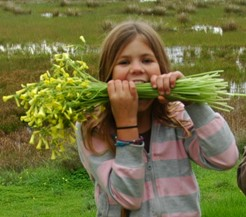
Photo credit: Badjonni (Creative Commons – Flickr)

THE DANGERS OF GARLON
Garlon 4 Ultra is a herbicide that the San Francisco Department of the Environment (abbreviated SF Environment) has declared a Tier I pesticide. SF Environment has a three Tier system hazard rating system, with Tier III being “Least Hazardous,” Tier II being More Hazardous, and Tier I being Most Hazardous. Though pesticides are sometimes moved between Tiers, Garlon has always been Tier I at least since 2008 when we started following pesticide use in our parks. It’s been flagged as “HIGH PRIORITY TO FIND AN ALTERNATIVE” for as long.
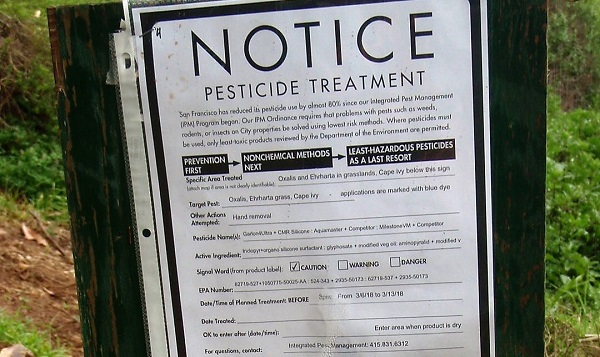
Garlon, Aquamaster, Milestone on Mt Davidson. March 2018

This article is based on one published on the SutroForest.com website in 2010, and is used with permission. It has been updated as far as we could; there is limited non-corporate research on triclopyr (the active ingredient in Garlon). The companies making these products don’t always identify or publicize their dangers. In 2003, Dow was fined for misleading the public about the danger of one of its products. More recently, Monsanto may have interfered with the Environmental Protection Agency’s assessment of Roundup. The main source of information is the chapter on Triclopyr in the Marin Municipal Water District Report on herbicides. (You can read that here as a PDF: Chap4_Triclopyr_8_27_08 . It’s technically written. Here is another paper that is more accessible for the layperson: Caroline Cox Triclopyr 2000 )
Usually, when looking at herbicides, researchers start by looking at Acute Toxicity – how much would it take to kill or injure you immediately. Separately, they look at Chronic Toxicity – a longer-term impact. What should also be followed, but often isn’t, is the long-term effects of low-level exposure. This is an issue with Garlon.
What stands out when attempting to research Garlon is how much is not known, particularly about the effects of repeated low-level exposure. There simply isn’t that much research out there, and few human studies. “Although triclopyr has been registered in the US since 1979, there are still very few studies on triclopyr that are not part of the EPA registration process.” Most of the research that exists is on Garlon 4. What is used on Twin Peaks is Garlon 4 Ultra. It’s similar but isn’t mixed in kerosene. It’s mixed in a less flammable but apparently equally toxic methylated seed oil.
What is known makes uncomfortable reading.
- Triclopyr is poisonous enough that it can be used to commit suicide. There’s a paper in French about the effects of triclopyr and another chemical, fluoxypyr. The “Google Translate” version of its conclusion: These results are consistent with ingestion of potentially fatal triclopyr and fluroxypyr. To our knowledge, no blood concentration has been described so far in a context of voluntary ingestion for fluroxypyr, however a case has already been described for triclopyr of the same order of magnitude.
- Garlon “causes severe birth defects in rats at relatively low levels of exposure.” The rats were born with brains outside their skulls, or without eyelids. “Maternal toxicity was high” and exposed rats also had more failed pregnancies.
- Rat and dog studies showed damage to the kidneys, the liver, and the blood. It’s insidious, because there’s no immediate effect that’s apparent. If someone’s being poisoned, they wouldn’t even know it. In a study on six Shetland ponies, high doses killed two ponies in a week, and two others were destroyed.
- About 1-2% of Garlon falling on human skin is absorbed within a day. For rodents, its absorbed twelve times as fast. Too bad for the gophers…
- It isn’t considered a carcinogen under today’s more lenient guidelines, but would have been one under the stricter 1986 guidelines.
- Dogs may be particularly vulnerable; their kidneys may not be able to handle Garlon as well as rats or humans. “The pharmacokinetics of triclopyr is very different in the dog, which is unique in its limited capacity to clear weak acids from the blood and excrete them in the urine.” Dow Chemical objected when EPA said that decreased red-dye excretion was an adverse effect, so now it’s just listed as an “effect.”
- There was insufficient information about Garlon’s potential effect on the immune system, or as an endocrine disruptor.
- It very probably alters soil biology. “There is little information on the toxicity of triclopyr to terrestrial microorganisms. Garlon 4 can inhibit growth in the mycorrhizal fungi…” (These are funguses in the soil that help plant nutrition.) No one knows what it does to soil microbes, because it hasn’t been studied.
- It’s particularly dangerous to aquatic creatures: fish (particularly salmon); invertebrates; and aquatic plants.
It doesn’t generally kill adult honeybees, but there are no studies of other insects. [ETA: Some studies show slight “acute toxicity” to honeybees.] - Garlon can persist in dead vegetation for up to two years.
Given all the information we do have on this chemical (and all the information we don’t have ) we have to question why native plant restoration is worth spraying poisons on some of the highest points in our city. Garlon must be used when the weather is wet; if the plants don’t have water, they will not grow and the chemical won’t work. But the runoff from these hills is enormous during the rain – it washes down in rivulets and streams, and it will end in the reservoirs, the groundwater, and the bay.
SFRPD has made strides since the earlier version of this article was published in 2010. At the time, Garlon was being widely used for a lot of purposes. In the last two years, NRD was the only user of Garlon in our parks.

And the only purpose for which they use it is to spray oxalis, the yellow-blooming flower than heralds spring in San Francisco. So Garlon us is down to the war on oxalis, which we have written about before.
See: Five Reasons it’s Okay to Love Oxalis and Stop Poisoning It
See: Garlon v Oxalis in Ten Easy Slides
If NRD were to declare an end to this war – it would have the best possible “ALTERNATIVE” – the Natural solution.
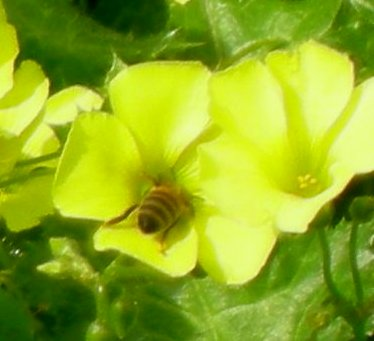

Honeybee in oxalis flower