


By Nanette Asimov,Higher Education ReporterJune 4, 2024 (SFChronicle.com)
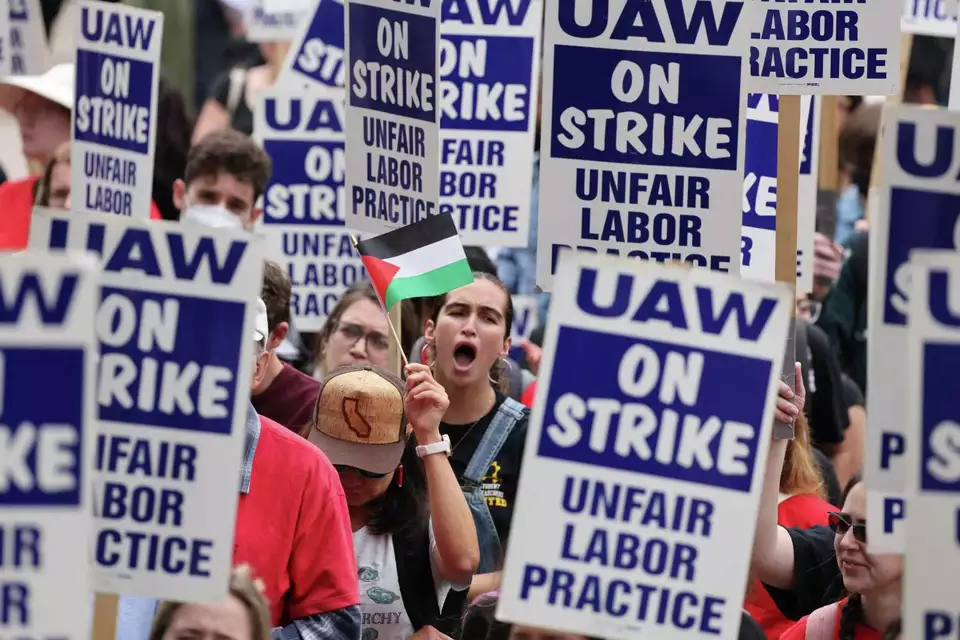
The University of California has sued its UAW-backed graduate students’ union to stop the “illegal strike” it says is crippling campuses ahead of finals, while a state labor board gave ground to the students.Brian van der Brug/TNS
Stung by a state labor board’s refusal — twice — to halt an expanding strike by the University of California’s student workforce, UC is now asking a judge to step in and stop the strike by declaring it illegal.
UC officials sued the students’ union, the United Auto Workers Local 4811, on Monday in Orange County Superior Court, saying the growing work stoppage violates the “no-strike” provisions in the union’s labor contract with UC and will cause “irreparable harm” to the university if it’s allowed to continue.
UC filed the suit on the same day the state’s Public Employment Relations Board. or PERB, denied the university’s request to halt the strikes. It was the second time the state agency found that UC had not met the legal grounds necessary for an injunction. But in its lawsuit, UC said the reason the agency denied UC’s requests was not because the university was wrong, but because the agency had no power to decide if the union had breached its contract with UC.
The union represents about 48,000 graduate students who do most teaching, research and grading at UC. Thousands of them have been walking off the job, campus by campus, since May 20.
Student workers are striking at six campuses so far: Santa Cruz, Davis, Los Angeles, Santa Barbara, San Diego and Irvine. They want to compel UC to drop disciplinary measures against an unknown number of student workers who participated in pro-Palestinian protests last month.
In its lawsuit, UC said the strikers “have refused to teach classes, lead discussion sections, conduct research, or otherwise refuse to perform their job duties.” The suit complained that picketers have blocked campus roadways and, at UCLA, “stormed and barricaded themselves into buildings.”
“Through its unlawful strike activity, UAW is causing irreparable injury by interfering with the university’s ability to conduct its business and to provide education and community services,” UC told the court and asked for a temporary restraining order to stop it.
For its part, the union argues it’s UC that is violating the contract.
ADVERTISEMENT
Article continues below this ad
Union officials cite violence last month at UCLA, UC Irvine and UC San Diego, where police arrested hundreds of student protesters demonstrating against Israel’s war in Gaza. UC’s Office of the President is also investigating what happened at UCLA on May 1, when officials waited hours to intervene after a separate group attacked an encampment with heavy objects and fireworks.
The union says these events, and continuing disciplinary actions by UC campuses against student workers, have created an unsafe work environment for them.
As for the lawsuit, “UC continues to shirk accountability for the violence it has caused and allowed,” said Rafael Jaime, the union’s president. “UC should respect the law, return to mediation, and resolve their serious unfair labor practices instead of continuing to insist that the rules do not apply to it.”
Both sides have accused the other of committing unfair labor practices and have PERB to decide who is right.
On Monday, PERB determined that the union’s allegations “could demonstrate that UC violated state law,” said Felix De La Torre, the agency’s top lawyer.
The next step will be a hearing where the union will have a chance to present its evidence.
Reach Nanette Asimov: nasimov@sfchronicle.com; Twitter: @NanetteAsimov
June 4, 2024
Nanette Asimov
HIGHER EDUCATION REPORTER
Nanette covers California’s public universities – the University of California and California State University – as well as community colleges and private universities. She’s written about sexual misconduct at UC and Stanford, the precarious state of accreditation at City College of San Francisco, and what happens when the UC Berkeley student government discovers a gay rights opponent in its midst. She has exposed a private art college where students rack up massive levels of debt (one student’s topped $400k), and covered audits peering into UC finances, education lawsuits and countless student protests.
But writing about higher education also means getting a look at the brainy creations of students and faculty: Robotic suits that help paralyzed people walk. Online collections of folk songs going back hundreds of years. And innovations touching on everything from virtual reality to baseball.
Nanette is also covering the COVID-19 pandemic and served as health editor during the first six months of the crisis, which quickly ended her brief tenure as interim investigations editor.
Previously, Nanette covered K-12 education. Her stories led to changes in charter school laws, prompted a ban on Scientology in California public schools, and exposed cheating and censorship in testing.
A past president of the Society of Professional Journalists’ Northern California chapter, Nanette has a master’s degree in journalism from Columbia University and a B.A. in sociology from Queens College. She speaks English and Spanish.


