By Sam Whiting,ReporterJuly 25, 2024 (SFChronicle.com)
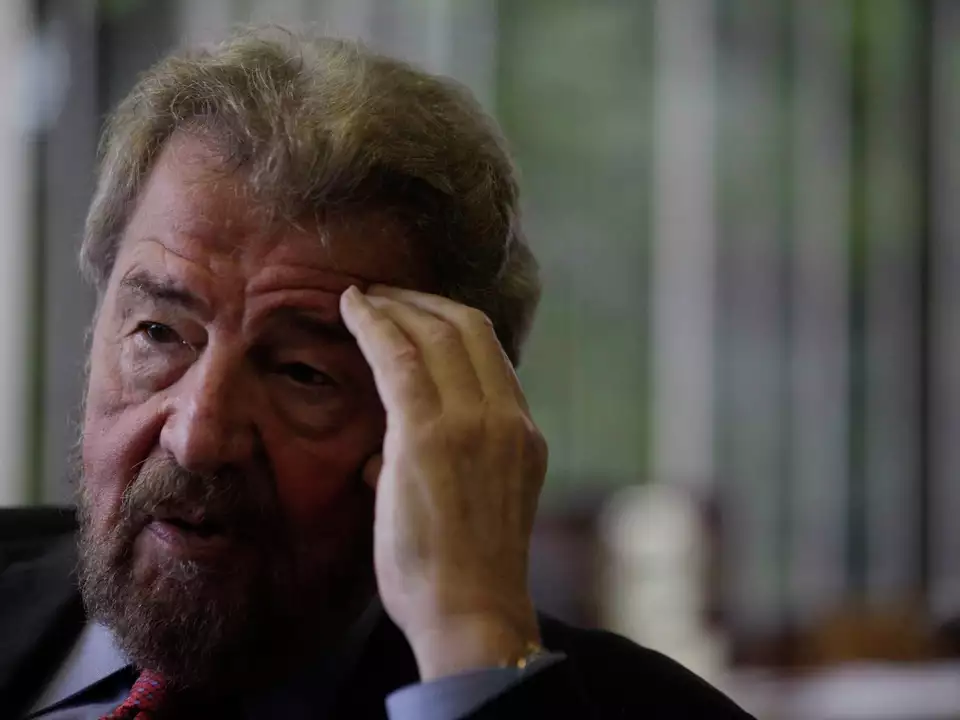
San Francisco State University President Robert Corrigan in his campus office on March 14, 2012. His 23-year tenure at S.F. State was marked by deepening ties between the campus and downtown. Corrigan died July 5 at the age of 89.Lea Suzuki/The Chronicle
When San Francisco State University President Robert Corrigan took a call inviting him to become chair of the San Francisco Chamber of Commerce, the expected answer was no. Academics are thought to be too dignified to chair commercial cheerleading organizations.
But Corrigan said yes, to everyone’s surprise, especially Chamber President and CEO Lee Blitch. There had never been an academic who served as chair of the chamber but Corrigan not only agreed to the volunteer position, he was so good at it that he agreed to a second one-year term.
As it turned out, Corrigan had a philosophy that the faculty members at urban universities should be part of their city — and serving as chair of the chamber was leading by example. “The word ‘no’ was not in Bob’s vocabulary,” said Blitch, now retired. “If I invited him to a meeting to add to its stature, he would always attend.”
Corrigan served as President of S.F. State for 23 years — from 1989 to 2012 — the longest tenure since what was originally San Francisco Normal School and later San Francisco State College, became a university in 1972. Though the campus is built on sand dunes in the far southwest corner of the city, near the Daly City line, Corrigan linked it as never before to the central core.
Corrigan opened a satellite campus in the San Francisco Centre shopping mall on Market Street and made a point of being downtown at least once a week when he had a standing date to meet San Francisco State alum Willie Brown for breakfast at Caffe Greco in North Beach.
“No other higher educational institution has had the impact that San Francisco State under Bob had on the city,” said Brown. “Keeping the Giants here, keeping the 49ers here, Bob had something to do with all of that. More than anything else, he was constantly in contact with the decision makers of this city.”
Corrigan died July 5 at the longtime home he shared with his wife, arts patron Joyce Mobley Corrigan, near the S.F. State campus. Corrigan had spent the last few years in a memory care facility for treatment of dementia, said his stepdaughter Erika Mobley of Burlingame. He was 89.
Among the ideas Corrigan said “yes” to was a program to encourage students toward careers in government service by giving academic credit for internships through a curriculum named the Willie Brown Jr. Institute on Politics & Public Service. The impact of this program is that some 600 alumni now have jobs with the City and County of San Francisco.
Most importantly he said “yes” to diversifying the faculty at State. During his presidency, 1,000 tenure-track faculty were hired, with 48% of them women and 34% minorities, a dramatic increase in both categories.
One of those who benefited was Robert Keith Collins, who was hired by Corrigan in 2006, as an assistant professor of American Indian Studies.
“Bob created an incredible environment for communication, which was really exciting,” said Collins, who was granted tenure in 2012. “When we went through a budget crisis, he came out of his office and out of the administration building to have campus-wide conversations about it. There was not a whole lot that he could do about it, but at least he allowed for conversations between the administration, faculty, staff and students so that we could get through it together.”
Robert Anthony Corrigan was born April 21, 1935, in New London, Conn. His parents, Anthony Corrigan and Rose Jengo, were first generation Irish American and Italian American. Anthony worked in a foundry and Rose was head lunch cook for the New London school district.
Bobby, as he was known, was recognized early on as an academic standout, and became the first family member in three generations to earn a high school degree, at Classical High School in Springfield, Mass., in 1953. He attended Brown University in Providence, R.I., on an academic scholarship, supplemented by a job in a bookstore.
A member of Kappa Sigma fraternity, he majored in American civilization and was captain of the tennis team. Brown was still all male at that point, and Corrigan met Geraldine Brisson, a student at the women’s affiliate, Pembroke College, at a freshman mixer. They were married in 1956 when both were still undergrads.
After graduating in 1957, he enrolled at the University of Pennsylvania where he earned his master’s degree in 1959 and Ph.D. in 1967, both in American civilization, after defending his thesis on American poet Ezra Pound. His graduate education was interrupted when he spent a few years in Sweden on a Fulbright scholarship.
His first academic job was at the University of Iowa, where he was hired as an associate professor of American studies. He also taught English. In 1968, he was asked by administrators to create a program in Afro-American studies.
“As far back as I can remember, central to his being was civil rights,” said John Corrigan, one of his two sons. “I can remember him coming home with tears in his eyes from being tear-gassed at campus protests. He was somebody who was always trying to facilitate at a very volatile time.”
Ten years later, Corrigan was divorced and a provost at the University of Maryland when he married Joyce Mobley, an English and drama professor who had been involved in a program to increase Black faculty representation at the University of Iowa. Married on Super Bowl Sunday 1979, they moved east when Corrigan was appointed chancellor at the University of Massachusetts Boston.
While there, he first became involved in connecting his university to civic projects by enthusiastically supporting plans to locate the John F. Kennedy Presidential Library and Museum at the UMass Boston campus. It has since become a major tourist attraction.
“Bob was a pioneer in the creation of the public urban research university, making UMass Boston one of the most prominent institutions of its kind,” said Charles Desmond, vice chancellor of UMass Boston.
Corrigan arrived as the 12th president of San Francisco State long after the tumult of the 1960s and just in time for the Loma Prieta Earthquake of 1989, which was also the 90th anniversary of the school. The ’90s were not like the ’60s at State, when there was always a battle to be fought, often on a national stage, but it wasn’t the placid 1950s either.
He had been on campus six years in 1994 when he ordered a newly commissioned mural of Malcolm X painted over because it featured Stars of David superimposed with dollar signs and skulls. Angry students booed him. Then, in a pre-dawn raid, they cleared the whitewash. Corrigan had it covered up again under protection of 80 police in riot gear.
To keep the mural would mean “we tolerate intolerance; we are silent in the face of bigotry,” Corrigan said at the time.
He was always willing to get out and negotiate, even when warned to stay in his office during protests over tuition increases and later the Occupy Movement.
“It just seemed natural that a president would respond to something that was deeply felt by the students,” Corrigan told the Chronicle’s higher education reporter Nanette Asimov. “I think one of the big issues in higher education is that we tend to be much more risk averse than we need to be.”
He was willing to risk an advertising campaign in the Chronicle of Higher Education for what has always been known as a commuter school. Called the San Francisco State of Mind, it helped increase the endowment tenfold, to $50 million.
“San Francisco State is a much more important and high-quality institution than most people realize,” Roberta Achtenberg, a former CSU trustee and San Francisco supervisor said at the time of his retirement. “Bob has brought a high level of intellectual distinction to the university. It contributes enormously to the civic health of the city, and to the economic well-being of the region.”
As president, Corrigan approved honorary degrees presented at graduation to Willie Mays, his favorite ballplayer, and Jimmy Cobb, who played drums on the Miles Davis classic “Kind of Blue.”
For nearly 35 years the Corrigans lived in the Forest Hill neighborhood west of Twin Peaks, a 5-minute drive from campus. In retirement his commute increased because he took an office at the Westfield mall campus. As president emeritus, his desk was there but his library at home, 8,000 books divided into sections, spread throughout every room in the house, in floor to ceiling bookcases. The Ezra Pound section alone is about 1,000 books, said Mobley, whose own kids get their class books there for Burlingame High School.
Joyce Corrigan, who served on the boards of both the San Francisco Symphony and the San Francisco Opera, is still living in the home in Forest Hill and has not touched the library.
“He was always about books and had a passion for learning that was infectious,’’ said Mobley, who majored in American studies, her father’s specialty, at Yale. “The books live on.”
Reach Sam Whiting: swhiting@sfchronicle.com
July 25, 2024
REPORTER
Sam Whiting has been a staff writer at The San Francisco Chronicle since 1988. He started as a feature writer in the People section, which was anchored by Herb Caen’s column, and has written about people ever since. He is a general assignment reporter with a focus on writing feature-length obituaries. He lives in San Francisco and walks three miles a day on the steep city streets.