


- By Adam Shanks | Examiner staff writer |
- Oct 7, 2024 Updated 2 hrs ago (SFExaminer.com)
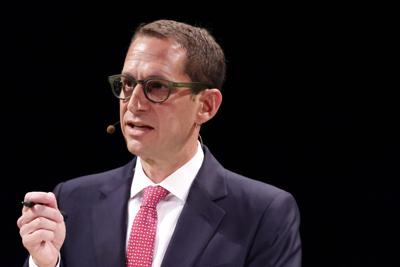
His opponents scoff at him.
How could a novice, a rookie, think he can waltz into San Francisco City Hall and manage a nearly $16 billion operation with more than 20,000 employees?
But that’s exactly Daniel Lurie’s campaign pitch, and if he’s successful, he’d be accomplishing a rare feat in American politics.
Lurie, an heir to the Levi Strauss fortune and founder of anti-poverty nonprofit Tipping Point, has built his entire candidacy around his utter lack of experience working inside city government, and his record as a nonprofit leader outside of it.
He has used the phrase “City Hall insiders” so much to describe his opponents on the debate stage, in campaign ads and throughout stump speeches that it might be permanently etched in San Franciscans’ minds by Nov. 5.
With the mayor and Board of Supervisors receiving consistently poor approval ratings, Lurie launched his campaign on a fundamental premise: offering an alternative. But will voters take him up on it? Or will they favor one of the “insiders,” who include incumbent Mayor London Breed, Board of Supervisors President Aaron Peskin, former interim Mayor Mark Farrell, and Supervisor Ahsha Safai?
Lurie isn’t a complete unknown. His nonprofit Tipping Point has received steady headlines for its efforts to combat poverty and homelessness in the Bay Area, and his family’s roots in San Francisco obviously run deep.
At debates, Lurie’s opponents have cast him as unfit for the position, with Breed going as far as to call him “dangerous.”
And Lurie’s campaign stresses that he’s not completely unfamiliar with the confines of City government. It points to his collaboration with city leaders to launch the now-controversial housing project at 833 Bryant St. while leading Tipping Point, as well his work to lead San Francisco’s bid to host the Super Bowl in 2016.
There’s reason to believe that American voters, if not San Franciscan, have become increasingly willing to elect leaders without prior political experience. But, at least in recent history, there are few examples of major American cities electing mayors without a whiff of prior political experience.
How Donna Deegan broke the big-city norm
If Lurie is elected, there would only be one city larger than San Francisco that is also led by a mayor without previous experience — Jacksonville, Florida.
There, Mayor Donna Deegan triumphed in her bid for mayor despite having previously — and badly — lost a run for the House of Representatives in 2020. Deegan, a former television news anchor who had never previously served in government, pitched herself as a unifying force in Jacksonville politics.
Like Lurie, Deegan also built a public profile through her leadership of a nonprofit organization. A breast cancer survivor, Deegan launched a nonprofit called The DONNA Foundation to aid people experiencing breast cancer and their families, as well as research into treatment.
But Deegan benefited from at least two attributes that Lurie does not have, including high name recognition due to her long career in television news. To make up for this deficit, Lurie’s campaign and an independent expenditure committee supporting his candidacy have spent heavily on billboards, campaign mailers and television ads to improve his name recognition and introduce him to voters who were previously unaware of him.
Deegan also had the support of national Democrats, who were eager to hand Republicans and Florida Gov. Ron DeSantis — who had endorsed Deegan’s opponent — a stinging loss. Lurie, and all of his opponents, are all Democrats. The San Francisco Democratic Party has endorsed his opponent and the incumbent, Breed.
What can be learned from Michael Bloomberg
In terms of the partisan split of his city, Lurie’s bid may be more akin to that of former New York Mayor Michael Bloomberg.
Bloomberg also came into politics promising an outside perspective, touting his voluminous experience in the private sector before he won his first term in 2001, replacing outgoing Mayor Rudolph Giuliani.
Unlike Lurie, Bloomberg nimbly changed parties to run as a Republican, avoiding the all-out brawl that was the Democratic primary. Unlike San Francisco, New York has partisan mayoral elections and already had precedent for electing a Republican mayor.
That’s not to say that it was a cheap race for the billionaire. Bloomberg spent $69 million on the race, or about $122 million in today’s dollars. Democrat Mark Green — whose campaign against Bloomberg included claims that the latter was too inexperienced to keep the city safe after the Sept. 11 terrorist attacks — spent about $16.5 million.
Lurie is heavily self-funding his campaign, but not nearly to the same degree that Bloomberg did in real dollars. However, he is currently outspending his closest opponent by a margin of nearly 3-to-1.
To date, Lurie has donated $6.3 million to his mayoral bid. His mother, Mimi Haas, donated $1 million to the independent expenditure committee backing his election, which has also been propped up by support from his family and friends.
However, Bloomberg’s failed 2020 presidential campaign, on which he dropped more than $1 billion before flaming out in a matter of months, also proved that a financial advantage isn’t everything.
The 2020 presidential run also cast a new light on his tenure as mayor. New Yorkers obviously appreciated Bloomberg’s leadership enough to reelect him, twice. But as he left office after three terms in 2013, New Yorkers were split on his record in office, according to a poll conducted at the time.
But by then, any initial hesitation around his lack of prior experience in government had long since faded into memory.
Inexperienced Jeff Brown lost a primary
Perhaps a more apt comparison than Bloomberg, in terms of self-financing, would be Jeff Brown, a grocery-store magnate who ran a failed bid for mayor in Philadelphia last year. Brown and a PAC supporting him spent millions of dollars before the Democratic primary, but he faced financial competition from another wealthy candidate, Allan Domb, who was a real estate developer who had previously served on the Philadelphia City Council.
Brown was also dogged by a scandal involving alleged illegal coordination between the super PAC supporting his candidacy and his campaign, which is prohibited. (The Philadelphia Board of Ethics sued the super PAC tied to Brown, but the case was dismissed by a judge).
In San Francisco, it has been Farrell, not Lurie, who has been accused of improper use of campaign funds. (Farrell has denied impropriety and repeatedly asserted that his lawyers have signed off on the use of his campaign funds).
Lurie, by contrast, has painted himself as above the fray and tried to seize on allegations of corruption against his opponents.
It’s a message he’s taken to the airwaves, running an advertising campaign against Farrell that quickly notes Farrell’s 2015 fine from the Ethics Commission for improper campaign finance activity in his 2010 bid for the Board of Supervisors.
The ad is just a piece of more than $13 million Lurie and his supporters have spent on the election thus far.
Rick Caruso’s spending fell short
In Los Angeles, billionaire Rick Caruso lost a bid for mayor in 2022 despite spending more than $100 million of his own money on the race. Like Caruso, Lurie has heavily invested his own money into his own candidacy, but not nearly to the same extent.
Lurie and Caruso are fundamentally different in other ways. The latter had been a Republican before switching to the Democratic Party in the run-up to the election. Lurie is a Democrat, vying against a field of other Democrats, in a city that is overwhelmingly Democratic.


