


- By Adam Shanks | Examiner staff writer |
- Oct 7, 2024 Updated 23 hrs ago (SFExaminer.com
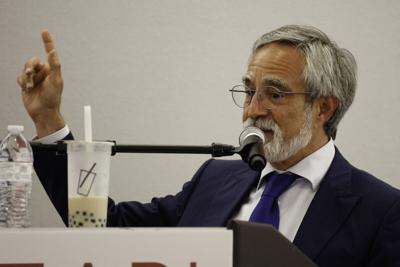
Mayoral candidate and Board of Supervisors President Aaron Peskin might run afoul of his progressive base by opposing a November ballot measure that would permanently close a portion of Great Highway to cars.
Peskin, considered a stalwart progressive, joins two moderate mayoral candidates in standing opposed to Proposition K.
The measure, endorsed by incumbent Mayor London Breed, would end the current compromise that allows cars on Great Highway between Lincoln Way and Sloat Boulevard from Monday through Friday, but closes it to motorists and gives pedestrians free rein on the weekends.
Prop. K has quickly become divisive and could have implications for a mayor’s race that has seen Breed emphasize her bona fides as an urbanist, housing-first mayor against candidates offering San Franciscans varying levels of assurance that their neighborhoods need not drastically change.
In an interview with The Examiner, Peskin rattled off his resume of “bread-and-butter progressive issues,” such as support for the expansion of rent control and funding for affordable housing and public transit.
He said he based his Prop. K opposition not on the merit of a car-free Great Highway, but how it made its way to the ballot. It was placed there directly by five members of the Board of Supervisors, including Sunset district Supervisor Joel Engardio, who preferred to leave the issue to voters rather than allow the Board of Supervisors to determine Great Highway’s fate by a vote of its own.
“Putting this on the ballot was in and of itself an abdication of mature political discussion about options and alternatives and bringing people together in a very divisive time locally and nationally,” Peskin said. “I feel like had this not gone on the ballot, that we could’ve used this as an opportunity to bring people together.”
Peskin, who has served four terms on the Board of Supervisors, is in a political pickle. He has consistently polled in fourth place among the major candidates and suffers from high disapproval ratings. Peskin needs to be able to count on his base in November, but he must also court support beyond progressive die-hards in order to have any chance of handing progressives their first mayoral victory in 30 years.
Breed has endorsed Prop. K, as has Supervisor Ahsha Safai, another mayoral hopeful. But fellow candidates Daniel Lurie, the Levi Strauss heir and antipoverty nonprofit founder, and former interim Mayor Mark Farrell have opposed it.

Prop. K boasts a bevy of endorsements from progressive organizations and politicians, including Democratic Socialist Supervisor Dean Preston and the Harvey Milk LGBTQ Democratic Club.
Aditya Bhumbla, an organizer with the group Safe Street Rebel, described Peskin’s stance as “disappointing.” Safe Street Rebel was founded when The City reopened Great Highway to cars in 2021 after its full closure when the COVID-19 pandemic arrived in 2020.
“I don’t love a lot of Breed’s policies, and I want to be able to vote for Peskin,” Bhumbla said. “But now, no matter what, I’m making a moral compromise, and that sucks.”
The 2022 election demonstrated that progressive voters and politicians have an affinity for car-free spaces. According to election data, precincts that opposed the June 2022 recall of progressive District Attorney Chesa Boudin were more likely that November to support Proposition J, which permanently enshrined John F. Kennedy Drive in Golden Gate Park as a car-free space.
But Great Highway is used primarily by commuters, not park visitors, Prop. K opponents have argued. Richmond district Supervisor Connie Chan, who has come out against the measure, said at a recent debate that “everybody knows the Richmond is really known as the second Chinatown.” She lamented that Prop. K would cut off businesses in the Richmond from customers in the Sunset who might opt to travel elsewhere if the Great Highway is closed to cars.
Peskin and his supporters describe his stance as ideologically consistent. He also opposed Prop. J in 2022.
Peskin’s supporters paint him as defending the working class — such as Richmond district motorists who use Great Highway to get to points south — from the existential changes to San Francisco sought by its well-off newcomers.
EX // TOP STORIES
Analysis: City Hall ‘outsider’ Lurie attempts rare feat in American politics
The self-financing mayoral candidate is betting big on his own candidacy, despite a lack of political experience
How to stay cool in The City during fall heat wave
Emergency-management officials advise residents to check in on their elderly or less-mobile relatives and to stay hydrated and cool through this weekend
Almost 400 affordable homes slated for aging DMV site in Panhandle
In the latest effort to boost affordable housing, city and state officials have come up with a plan to redevelop the DMV office in the Panhandle
“There’s a real anger at the dynamic of a posse of wannabe urban planners riding around on their $5,000 10-speeds, demonizing Chinese grandmas for having the audacity of needing to drive their grandkids to school,” said Eric Jaye, a Peskin ally and a consultant working for a political committee formed by labor groups. “There’s an absolute class dynamic at play here.”
To some extent, that dynamic is evident in the money pouring into the measure, which has included pro-Prop. K contributions from well-heeled tech executives.
Michael Howley, another Safe Street Rebel organizer, pointed to data indicating that people with higher incomes are more likely to own cars.
“[If] you were really concerned about class issues and equity, you would be concerned about non-car-oriented transportation systems,” Howley said.
Todd David, a political consultant working for the Prop. K campaign, countered that it’s a generational issue, not a class issue.
“It is straight-up age. Younger people support it,” David said. “To me, this falls into ‘change is hard,’ and as one gets older, change becomes even harder.”
“But I think that my expectation on this is that it’s going to pass, and when the change happens, two or three years down the road, people will go, ‘Oh this wasn’t so bad,’” he said.
Jaye said polling has shown the measure is deeply unpopular among Richmond residents and citywide among Asian Americans. Both groups could be key to November’s election results.
But David said he believes younger progressives could be lured to vote for Breed — whom he supports — because she is the only candidate aside from Safai supporting both Prop. K and Prop. L, which would tax rideshare companies to fund public transit.
Polling hasn’t played a part in Peskin’s own decision, he said.
“It wasn’t just about volume or looking at a poll, but listening to people’s reasoning and arguments that got me to the conclusions that there was a much better way of going about this,” Peskin said.
Ultimately, Peskin’s backers said they believe that progressives won’t ditch him because of his Prop K stance.
“I could see some young progressives who are car-free-space people not liking this,” Jaye said. “But, on the balance, if you look at Peskin’s broader work, he remains the clear choice. The noise is coming from the elites who are not progressive.”
Peskin said he had a campaign event on Great Highway with progressives who support Prop. K.
“We differ on this issue, and they respected where I was coming from,” Peskin said.
This story was corrected on Oct. 7, 2024, to indicate that Supervisor Aaron Peskin voted against legislation to maintain John F. Kennedy Drive as a permanently car-free space in 2022, not the ballot measure that codified that decision later that year.


