by Jonah Raskin on February 18, 2025 (BeyondChron.org)
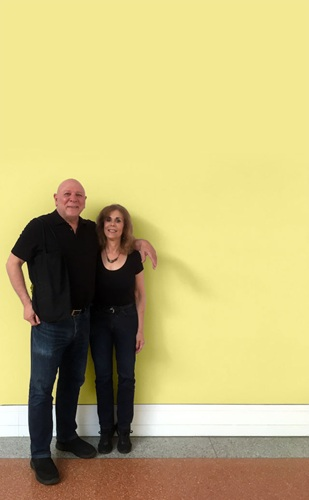
Estelle and Jerry Cimino
The New Counterculture Museum
“History is more or less bunk,” automaker Henry Ford famously said. He added “Live in the present.” Easy for him to say with his assembly line cranking out a new car every twelve hours. Estelle and Jerry Cimino have a beef with Mr Ford.
They are the founders and owners of the Beat Museum in North Beach which celebrates the achievements of Jack Kerouac, Allen Ginsberg, William Burroughs— depicted in the new movie Queer with Daniel Craig as the infamous author— and Lawrence Ferlinghetti who founded City Lights Bookstore and Publishing Company on Columbus Avenue catty corner from the Museum.
Sometime this Spring—the date has not yet been fixed— the Ciminos will open the “Counterculture Museum” on the ground floor of a 4,000 foot space in a well-kept building on the corner of Haight and Ashbury, once the heart of hippie hegemony.
No city is more deserving of a counterculture museum than the city that gave birth to the Beats and the hippies, and now especially with the closing of the San Francisco Historical Society in a city awash in history. Indeed, what New York’s Greenwich Village was to 1920s bohemians, and San Francisco’s North Beach was to 1950s Beats, the Haight was to 1960s hippies. The dot comers arrived in the 1990s, and triggered a boom followed by a bust.
From the outside, Estelle and Jerry Cimino don’t appear to be members of any counterculture, though they both insist that the counterculture of the 1960s respected no boundaries and touched the lives of Bay Area denizens, from the Bay to the Breakers and from Sausalito to San Jose.
“I was a history major in college back East,” Jerry says. “After I graduated I was a good corporate soldier at IBM for 15 years and American Express for ten.“ Born a Catholic and raised in the church he turned to Ginsberg’s Howl and Jack Kerouac’s On the Road for spiritual nourishment. The assassination of JFK told him as it did many boomers and their parents that “American innocence was over.”
Estelle grew up in Silver Spring, Maryland and was “too young for the Sixties thing.” The executive director of the Counterculture Museum, and its heart and soul, she says, “I want our space and our exhibits to make people more conscious than they are of contemporary issues, and persuade them to rise up for something they believe in – justice, equality, peace, clean air and clean water— not to protest against anything.”
She adds, “We seem to be going backward, which makes it doubly important to educate young people about the past so they understand that positive changes can happen now just as they did in the Sixties.”
There’s enough history in the Haight for at least two countercultural museums. Once a Black neighborhood with stately Victorians, it became a destination for kids who ran away from the suburbs, came in search of sex, drugs, and rock ‘n’ roll and found a bit of paradise until it crashed and burned all around them.
Stannous Fluoride has lived in the Haight for nearly five decades and doesn’t plan to leave the neighborhood he loves.
A few times a month, he offers an informative and entertaining two & 1/2 hour walking tour and “nostalgia trip” to both tourists and locals that begins at Waller and Stanyan and skirts the sidewalk with the names of countercultural luminaires, including Jerry Garcia, Timothy Leary, Allen Ginsberg, Bill Graham, Jack Kerouac, Peter Coyote, Wavy Gravy, Neal Cassady, Robin Williams and Dr. David E. Smith, a UC Berkeley graduate and the founder of the Haight Ashbury Free Medical Clinic which helped save the lives of addicts.
Fluoride suggests that the counterculture museum “should have a mix of stuff about the Diggers, the Panthers, and the music scene, including jazz.” He adds, “Hippies originally came to the Haight because it offered jazz clubs and because it was a gateway to Golden Gate Park.”
Jerry and Estelle will feature issues of The Oracle, the preeminent 1960s psychedelic underground newspaper, edited, published and distributed in the Haight and far beyond its boundaries, from September 1966 to February 1968. At its peak the press run for The Oracle was more than 125,000 copies. Issue number seven featured Alan Watts, Allen Ginsberg and Gary Snyder arguing, “Whether to drop out or take over?” Indeed, that was the question of the day. The Ciminos can’t afford to buy and showcase one of Jerry Garcia’s guitars, made by famed luthier, Doug Irwin. The front door at 1485 Haight isn’t wide enough to allow a VW camper, the quintessential hippie vehicle, to enter the space. But there’s room for hundreds of artifacts from the hippie past including rolling papers, roach clips, “The Pill,” buttons that say “Make Love Not War,” and jeans with colorful patches as well as posters and newspapers from the Sixties.
Estelle Cimino says, “By bringing history to life, the museum hopes to strengthen the community, enrich the cultural fabric of the Haight and support local merchants.” She adds, “It will draw visitors eager to experience the authentic, enduring experience of the counterculture.”
Don’t be surprised when she and her husband wear flowers in their hair for the grand opening.