




Read Mission Local often?
Help grow our newsroom, joining the hundreds of San Franciscans who support us by giving below.
Michael Jordan and Atticus Finch are rarely quoted in tandem. But their wisdom is immortalized side-by-side on a wall of the community courtroom at 575 Polk St. in the Tenderloin.
“I’ve failed over and over and over again in my life. And that is why I succeed,” reads one poster quoting the NBA star.
“Before I can live with other folks, I’ve got to live with myself,” reads another, quoting To Kill a Mockingbird’s fictional defense attorney.
The thoughts encapsulate the Community Treatment Court, one of the city’s handful of alternative courts for people who commit misdemeanors and nonviolent felonies.

Want the latest on the Mission and San Francisco? Sign up for our free daily newsletter below.Sign up
San Francisco has 14 alternative courts; drug, mental health, and young adult court are a few of them. But it has just one court for crimes that occur in a specific part of the city; the Community Treatment Court deals with misdemeanors and nonviolent felonies committed in Tenderloin, SoMa, Union Square and Civic Center. For the last 16 years, eligible defendants who complete a treatment plan through this court have had their criminal records cleared.
Court begins at 2 p.m. sharp. This was seared into the memory of all attendees on a recent Tuesday in February, when visitors huddling in the doorway of the grey Polk Street building were pelted by almost horizontal sheets of rain as they waited for the doors to open. No matter; men in soggy black parkas grinned as they dapped up others they recognized.
That familiarity is different from the traditional criminal justice system, where a single appearance before a judge can upend everything. Here, defendants begin months-long treatment programs, returning to court every few weeks for check-ins.
Day-to-day progress is measured in treats, gift cards and understated camaraderie.
Some brave the rain, others are unreachable
Minutes after the doors opened, the courtrooms’ rows of folding seats filled. The black linoleum floor glistened with damp footprints but, by some magic, the space smelled like vanilla rather than mildew.
San Francisco Superior Court Judge Michael Begert — who was, in the March 2024 election, unsuccessfully targeted by moneyed tough-on-crime groups — began calling cases and greeting newcomers. “You look better in green,” he told one man who had been recently released from jail. “I’m glad you made it here. That’s very hard for many people. It gets easier.”
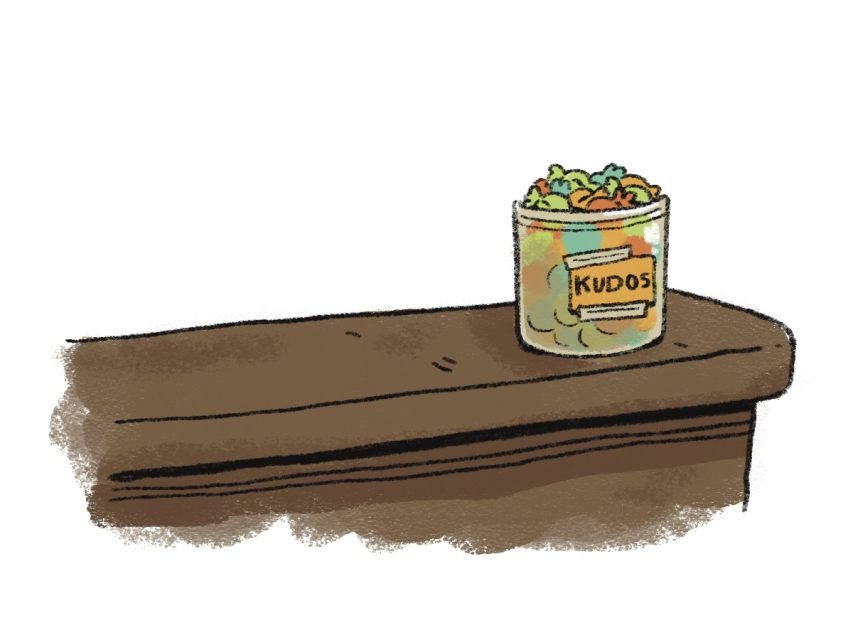
Instead of making rulings from a dias, Judge Begert sat at a large table a few feet away from the public defenders and their clients, separated by only a short wooden partition with a plastic bin of candy on top labeled “kudos.” The deputy district attorney sat at the other end of the table, saying little.
Several newcomers were sent upstairs to the Community Justice Center’s social services wing, where clinical professionals from the Department of Public Health evaluate what underlying problems may have brought a defendant into the justice system.
Based on this evaluation, they help connect them to substance use, housing, employment, or healthcare services, and determine when they are eligible to graduate. By design, this varies from person to person, said Melanie Kushnir-Pappalardo, the director of San Francisco’s collaborative courts.
There is no finite amount of time a defendant must be in treatment. Similarly, the amount of times they must appear before the court for a check-in varies depending on their progress.
Over the next two hours, the room slowly emptied of defendants, who approached the stand in varying degrees of weather-appropriate attire.
One woman wore Adidas slides with threadbare yellow socks. Another arrived late in soaked-through Ugg boots. Judge Begert told her to stay safe. “You too,” she responded.
On several occasions, a defendant failed to show up. Some had left their attorney with an explanation: A broken phone, an unforeseen hospital visit, too much rain. Others were unreachable. Whether or not they would be allowed to continue would depend on how much progress they had been making.

Under new DA, referrals to collaborative courts fall
In 2024, 119 defendants were deferred to the community court, Kushnir-Pappalardo said. 23 graduated, and 45 are still participating this year. She did not have information on the outcomes of the 41 people who failed to complete the program, but noted that those arrested for minor infractions might have already served the amount of time they would have in jail.
This is a dramatic decrease from 2020, when the court saw an average of 777 cases and 216 clients per month, mostly on drug or theft charges. According to the most recent available Community Justice Center report, more than 12,000 defendants were involved in the court between 2009 and 2020, completing more than 12,000 hours of community service.
At publication time, the court did not have up-to-date data on the program’s overall graduation and recidivism rates. However, a 2022 study by the California Policy Lab found, more broadly, that people referred to San Francisco’s diversion programs were less likely to be rearrested and convicted than those processed through the traditional court system.
“You never know, when you touch somebody, whether you’ve made a difference,” said one defense attorney who has practiced in San Francisco’s alternative courts for years. “Oftentimes you haven’t, but sometimes you have.”
Even if the defendant’s life doesn’t dramatically change after the program, the attorney added, there’s always the hope that having their parents in treatment instead of jail will leave their children better off: “Incrementally, over a period of decades, it’s going to help a lot.”
The Community Justice Center’s beginnings were controversial. A pet project of then-mayor Gavin Newsom, it was approved without any funding for public defenders to staff it.
In recent years, the number of referrals to collaborative courts has dropped. District Attorney Brooke Jenkins “regularly refuses” to agree to the diversion of defendants unless they enter a guilty plea, former judge Anthony Kline wrote in an op-ed for the Chronicle. Attorneys who think they could get a better outcome in traditional criminal court without having to enter a guilty plea are unlikely to recommend one of the collaborative courts, even if their client could benefit from it, several legal professionals told Mission Local.
Alex, one of the defendants that Tuesday, described her treatment plan as her only “chance and opportunity to better my life.”
When it was her turn to appear before Judge Begert, she stepped forward suppressing a smile. “You seem like you’re in a good mood,” the judge said.
Indeed; Alex had set a goal of saving every gift card she received from her treatment program for a clean drug test, until she could afford shoes for herself, her 16-year-old daughter, and her seven-year-old son. After 15 tests, she later recalled, she had $223.
As she nodded, her son sat in the audience, blushing. “We are very proud of your mom,” Judge Begert said to him. Turning to face Alex, he noted that it seemed she had “all the motivation in the world.”
She clarified that the young “sneakerhead” had not been permitted to wear his new white shoes in the storm.

In addiction together, in jail together, in court together
Six months ago, Alex said, she was addicted to crystal meth, living on the streets, and to survive, “committing crimes without a care.” She met her boyfriend while “looking for someone to go out stealing with.” He was addicted to fentanyl.
They bonded over wanting to get clean, Alex said. They just needed the money to do it.
To that end, they broke into a house to steal, not realizing it was the home of a retired judge. Both were arrested. Alex’s boyfriend had a chance to “throw her under the bus” and take a deal, but refused. According to Alex, he told his lawyer: “Whatever she’s getting, I’m getting too.”
Alex spent three and a half months in jail. She was looking at more than three years in federal prison; even her attorney warned her that her chances of getting out or accepted to an alternative program were “very slim.”
But a psychiatrist said that Alex was eligible for mental health diversion, a program that allows people with diagnosed disorders to participate in a treatment program for up to two years in lieu of criminal prosecution. Over the district attorney’s objection, a judge referred Alex to community court.
If her clinicians determine that she has successfully recovered from addiction, her charges will be dropped. One mistake, however, and she goes straight back to jail, no questions asked.
Alex spent the first three months of the program in in-patient treatment. Most of her activities, she said, revolved around attending group classes with other recovering addicts. They discussed self-esteem, met with counselors, and practiced dialectical behavioral therapy.
It was often boring, Alex said. But she “had too much to lose.”
For the last three months, Alex has been in outpatient treatment. She still attends weekly group meetings, drug tests, and counselor sessions provided by a San Francisco healthcare nonprofit, but she now lives with her mother and two children.
Her motivation, she said, comes from relationships, big and small.
She knows few details about the other people in her program, but their shared struggles have silently bonded them. “We’re all just rooting for each other,” she said, greeting familiar faces who walked by with a hug and a smile.
Her unconventional romance didn’t hurt, either.
“We were in addiction together, and then we went to jail together, and then we went to program together,” Alex said of her boyfriend. “So he was always by my side and he was very supportive.”
Then, there’s her family.
Alex said she’s been rebuilding her “broken relationship” with her mother, who gained custody of Alex’s son and daughter when she was at “rock bottom.” Now, she said with a small smile, the kids call to ask when she’s coming home. When she completes community court, Alex said she wants to open a mother-daughter business where she can use the hair braiding skills she learned in jail.
At her check-in, Judge Begert advanced Alex to “phase two” of her treatment program. As a reward, she selected two $10 gift cards from CVS. She said she was unsure how long it would take to graduate, but was taking it one baby step at a time.
“It makes me feel like I’m worthy,” said Alex, of the praise she received from Judge Begert. “The way he talks … I think he’s a genuine, just awesome person.”
“I feel like drug court really has changed my life for the better,” she added. “And I am grateful.”
Alex, her son, and her boyfriend left court together. There was no formal celebration; it was pouring. They did, however, go straight to CVS. Alex treated her son to whatever he wanted, which was Oreo Cakesters and Gatorade — the yellow one.
LATEST NEWS

Video: Favorite things to do in S.F.

Limón on South Van Ness is out, Brasa Bros is in: Same owners deliver ‘fast casual’ dining

Korean couple retires, passes the bouquet at 45-year-old flower shop
Support the Mission Local team

We’re a small, independent, nonprofit newsroom that works hard to bring you news you can’t get elsewhere.
ABIGAIL VÂN NEELY
Abigail covers criminal justice, accountability, and behavioral health. She’s originally from New York City, where she was a youth advocate and watched hundreds of arraignments. Now, she enjoys foggy San Francisco mornings with her cat, Sally Carrera. (Yes, the shelter did in fact name the cat after the Porsche from the animated movie Cars.)More by Abigail Vân Neely


