SF supe wants to make Central Subway better — and maybe longer
- By Adam Shanks | Examiner staff writer
- Jul 9, 2025 Updated Jul 10, 2025

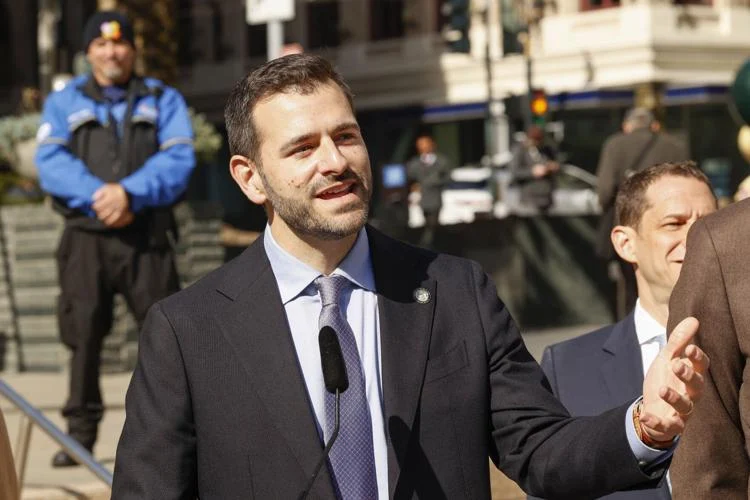
San Francisco Supervisor Danny Sauter wants The City to explore a possible extension of the Central Subway.
Sauter called Tuesday for a hearing to discuss the current functionality and potential future of the subway, which fully opened in 2023 and runs between Fourth and Brannan streets and Chinatown.
Despite lower-than-projected initial ridership numbers, an unstable economic climate and a local public transit agency facing a fiscal cliff, Sauter sees value in at least contemplating a future in which the Central Subway extends beyond Rose Pak Station.
“It’s now time to examine what is working, where we’ve fallen short, and what’s next,” Sauter said at Tuesday’s Board of Supervisors meeting.
The call to explore a Central Subway extension comes as the San Francisco Municipal Transportation Agency, among other transit agencies in the Bay Area, is scrambling to avoid financial calamity. Sauter said he is embarking on the endeavor fully aware of the financial crisis and tentative regional plans for a 2026 ballot measure that would fund public transit through a sales tax.
“It’s one thing to go out to voters and talk about operations and upkeep of an existing service and line, it’s another thing to go out and sell a vision that we can expand transit, and there are ambitious projects on the horizon,” Sauter told The Examiner on Wednesday. “I think voters want to see that too.”
The Central Subway, which serves the T-Third Muni Metro line, was plagued by cost overruns and deadline extensions. It was originally expected to open in 2018, but didn’t accept its first passengers until late 2022. Costs were pegged at $1.3 billion in 2007, but that figure ballooned to about $2 billion by the time the ribbon was finally cut. Maintenance issues have persisted — it was closed from Feb. 26 through March 14 this year to address water leaks at Rose Pak Station.
But Sauter, whose district includes Chinatown and North Beach, pointed to reasons for optimism.
April and May saw the highest T-Third line ridership numbers since completion of the project, he said, and there has been a 15% growth in ridership in 2025 compared to 2024 — excluding the weeks it was shut down for repairs.

Sauter hopes the hearing will focus on short-term improvements that can be made to the T-Third line, which runs underground from Rose Pak Station in Chinatown, through Union Square/Market Street Station, and continues to Yerba Buena/Moscone Station before surfacing above ground at Fourth and Brannan and continuing down Third Street toward its terminus in Sunnydale.
In addition to addressing above-ground bottlenecks on the T-Third line, Sauter also hopes to learn about the plan for filling retail kiosks at the stations in Union Square and in Chinatown. He also plans to dig into the need for frequent repairs to elevators and escalators in Rose Pak Station, which rests deep below ground.
The number of local tech workers let go in mass layoffs fell 37% in the most recent yearlong period, according to the latest data
“There’s definitely frustrations,” Sauter said. “I hear from a lot of members of the Chinatown community that when those elevators are down or escalators are down it just spoils the entire transit experience.”
Existing problems have not dampened enthusiasm for the subway’s extension. Almost as soon as the Central Subway opened, public transit advocates called for extension to North Beach, which has been studied for more than a decade.
The subway already serves some of The City’s most densely populated neighborhoods and would continue to do so if extended into North Beach, which has relatively lower rates of vehicle ownership.
Sauter was inspired by an op-ed published in Streetsblog San Francisco by Tommy Laguana, a 16-year-old student at the Jewish Community High School of the Bay. Laguna wrote that two currently unused tunnels, bored during the Central Subway’s construction, could provide a path for subway development to North Beach.
“Tunneling is among the most strenuous parts of underground railway construction, so the existence of the tunnels from Chinatown to North Beach would greatly reduce the difficulty and price of moving forward with the Central Subway Phase 3 extension,” Laguana wrote.
Beyond North Beach, the subway could reach Fisherman’s Wharf.
Sauter said newer San Franciscans may not even realize tunnels already extend to North Beach. There are also longtime constituents in his district who live in North Beach and near Fisherman’s Wharf who were contemplated as part of the Central Subway project, but ultimately were left out.
“I think they deserve to know if this project is still being worked on, [and] what the prospects look like for extending it,” Sauter said.
Sauter noted that a 2014 city study found that a two-station extension of the subway to Fisherman’s Wharf could expand its ridership by 55%. He also argued that such a project could be a contender for federal funding if and when the opportunity arises.
“We’re always going to find reasons or excuses to put off the big project, and if you keep doing that, all of a sudden you look up, it’s been 10 or 15 years,” Sauter said.
The hearing will likely be held later this fall.