


By Scott Ostler, Sports Columnist Jan 28, 2026 (SFChronicle.com)
Gift Article
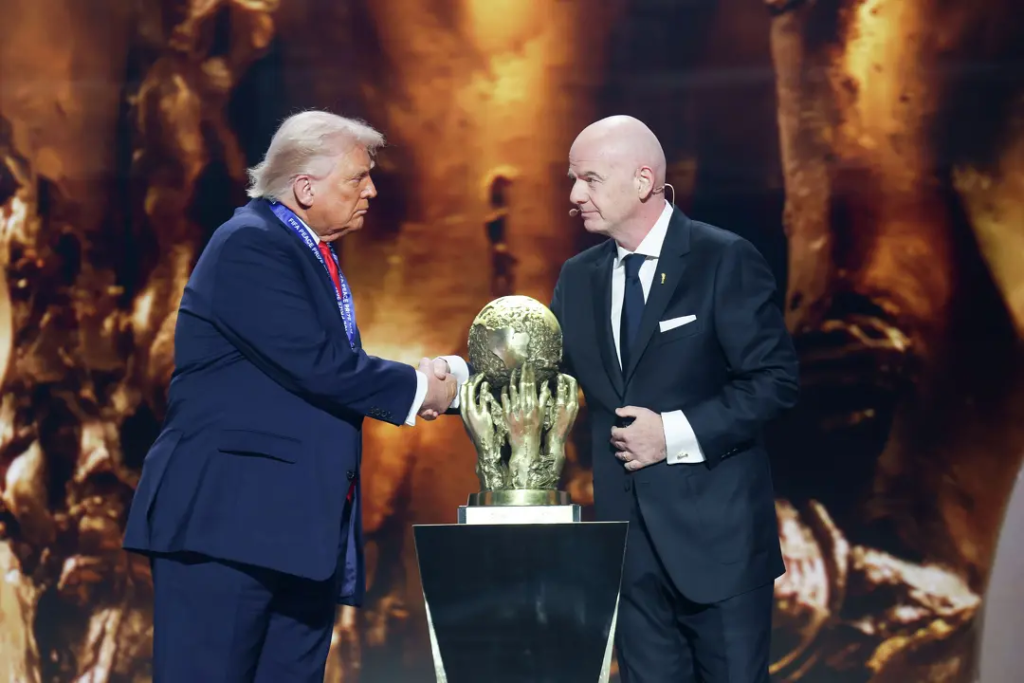
President Donald Trump greets FIFA President Gianni Infantino during the FIFA World Cup 2026 draw at John F. Kennedy Center for the Performing Arts in Washington on Dec. 5.Tasos Katopodis – FIFA/FIFA via Getty Images
When President Donald Trump humbly accepted the coveted FIFA Peace Prize, little did he know that his greatest peacemaking challenge lies ahead: saving this summer’s World Cup from chaos created by the old peacemeister himself.
The plan is for 11 U.S. cities, including San Francisco/Santa Clara, to host 78 of the World Cup’s 104 matches.
That’s the plan. However, there is a growing worldwide movement to poop the American party via boycotts by fans and players.
The Bay Area will have a say in that business. The Super Bowl will be held in Santa Clara a week from Sunday, and the fun is already starting. A thousand cool events are planned and tens of thousands of fans will be coming to America’s biggest party.
If all goes well, that might take some of the steam out of the boycott movement. If there are problems — and Minneapolis knows what we’re talking about — the world will take an even harder look at coming to America for the World Cup this summer.
Already there are worrisome elements. ICE has promised to be on hand for this Super Bowl. We’ve saved their agents a lot of trouble, since most of the car windows in San Francisco have already been shattered.
ICE was at the last Super Bowl in Santa Clara, but busied itself mostly with driving out the sellers of non-licensed Super Bowl T-shirts. This time ICE’s presence has a different feel, having been first announced in reaction to the news that ICE-wary Bad Bunny would headline the halftime entertainment.
Any ICE-related clashes or unrest surrounding the Super Bowl will be fuel for the boycott-the-World Cup bandwagon, which is already chugging along nicely.
A Swiss attorney named Mark Pieth, who led an investigation of FIFA corruption a decade ago, said in a newspaper interview, “If we consider everything we’ve discussed, there’s only one piece of advice for fans: Stay away from the USA! You’ll see it better on TV anyway. And upon arrival, fans should expect that if they don’t please the officials, they’ll be put straight on the next flight home, if they’re lucky.”
Sepp Blatter, the former FIFA president, wrote on social media, “I think Mark Pieth is right to question this World Cup.”
Other sports and political leaders in many countries are piping up, urging fans, players and teams to boycott. What’s their beef? They select from the menu that includes Trump’s attempts to take Greenland, his punitive tariffs, his destabilization of the world’s politics, and the aggressive and deadly immigration roundup that has come to a head in Minneapolis.
The FIFA Peace Prize winner himself kicked off the boycott. In December, Trump announced an expansion of his travel ban that would shut out many fans from Senegal and Ivory Coast. Also disinvited to the party by Trump bans: fans from Iran and Haiti, whose teams qualified for the Cup.
Those empty seats at American venues could easily be filled, but there are increased calls for boycotts by players and teams.
“I really wonder when the time will be to think and talk about this (a boycott) concretely,” said Oke Göttlich, a German soccer federation executive, in a newspaper interview. “For me, that time has definitely come.”
If a boycott would adversely affect players, Göttlich said, “The life of a professional player is not worth more than the lives of countless people in various regions who are being directly or indirectly attacked or threatened by the World Cup host.” (The German federation’s president, Bernd Neuendorf, was quick to dismiss Göttlich’s call for a boycott as coming from a lone representative, the Athletic reported.)
Adding to the mix, Trump has threatened to move World Cup games from any U.S. host cities where games would pose safety concerns, seemingly aiming his threat at cities with Democratic mayors and what he calls “crime problems.” And Trump has a very sensitive crime-problem meter, having declared that Los Angeles and Portland were burning to the ground after a couple of Waymos went up in flames.
Also, we know how Trump feels about Gov. Gavin Newsom. And vice versa.
So fans and teams heading to America for the Cup will be playing Trump roulette. Will the games be rerouted to other cities? Will fans who look, you know, different, or who step out of line in any way, be subject to unpleasant scrutiny? Will action by ICE or other federal agents turn a soccer match into a war zone?
Beyond the logistics, there are moral issues. South African politician Julius Malema likened a potential boycott to what his country experienced during apartheid, when it was widely boycotted by other nations and groups for violating human rights and international law.
“We cannot sit back and allow a person to destabilize the world, and it becomes business as usual,” Malema said. “That is an act of cowardice.”
After all the political rhetoric, the potential boycotters and everyone planning to come to America this summer for the World Cup will be watching how the Super Bowl unfolds in Santa Clara with great interest.
Trump himself has said he won’t attend the game, because it’s just too darn far for him to travel. He has also expressed disgust with the NFL’s choice in musical entertainment at the Super Bowl — Bad Bunny and Green Day, neither of whom are on Trump’s DJ playlist.
It’s hard to imagine Trump blowing off the chance to be the headliner at America’s biggest party. He sees himself as a major mover and shaker in the sports world. He once tried to buy an NFL team, and he is demanding that the Washington Commanders’ new stadium be named after him.
Whether Trump attends the Super Bowl, his presence will be felt.
He will be watching, and so will the world.
Jan 28, 2026
Sports Columnist
Scott Ostler has been a sports columnist at the San Francisco Chronicle since 1991. He has covered five Olympics for The Chronicle, as well as one soccer World Cup and numerous World Series, Super Bowls and NBA Finals.
Though he started in sports and is there now, Scott took a couple of side trips into the real world for The Chronicle. For three years he wrote a daily around-town column, and for one year, while still in sports, he wrote a weekly humorous commentary column.
He has authored several books and written for many national publications. Scott has been voted California Sportswriter of the Year 13 times, including six times while at The Chronicle. He moved to the Bay Area from Southern California, where he worked for the Los Angeles Times, the National Sports Daily and the Long Beach Press-Telegram.


