


By Anabel Sosa, Senior California Politics Reporter (SFGate.com)
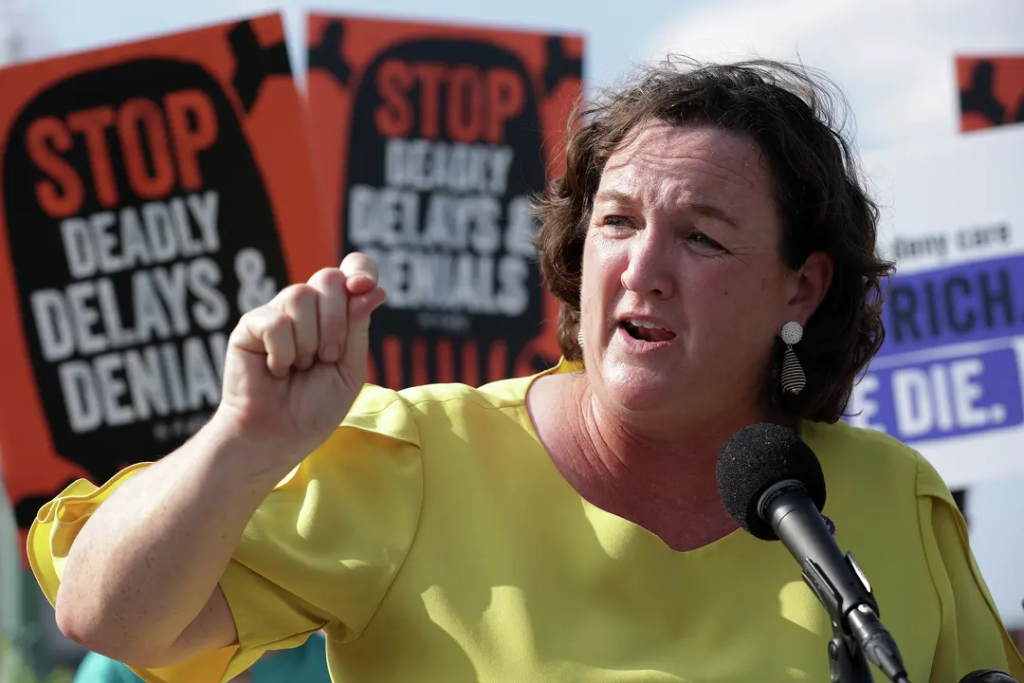
FILE: U.S. Rep. Katie Porter speaks during a news conference in Washington, DC. Porter, a Democrat and former U.S. congressmember, is running for governor of California.Alex Wong/Getty Images
Five candidates for governor of California are in a tie at the top, according to a new poll from the Public Policy Institute of California.
After the weekend’s state Democratic Party convention ended without any official candidate endorsement, it left some questions around who the Democratic front-runner is. The latest poll about the race reflects a similar confusion.
“Right now, there is no clear favorite,” Mark Baldassare, the lead pollster at PPIC, told SFGATE in a phone call.
The most surprising change is that voter support for Katie Porter, a Democrat and former U.S. congressmember, has resurged after her numbers began to drop in the polls. She now is the top polling Democrat, with 13% of likely support, according to PPIC’s findings.
“California voters are fired up to elect a progressive candidate who will deliver single payer health care, stand up to Donald Trump, billionaires, and special interests, and tackle California’s cost crisis,” said Peter Opitz, a campaign spokesperson, in a statement to SFGATE about the new poll.
PPIC surveyed only likely voters in California about the governor’s race. Republican Steve Hilton, a British-born former Fox News contributor, remains the top choice overall, with 14% of likely support. Hilton was once virtually unknown in California — and to many, is still an unknown name. He is just one percentage point ahead of Porter.
Chad Bianco, a Republican and Riverside County sheriff, is in the third spot with 12%; Rep. Eric Swalwell, a Democrat, is in fourth with 11%; and trailing behind in fifth is billionaire Tom Steyer, a Democrat, with 10%.
Baldassare, who has been conducting surveys since 1998, said he attributes Porter’s lead to voters who are thinking about “what they knew” and “what they know now” about candidates.
While Porter doesn’t currently hold public office, he said he thinks voters are aware she was in Congress and formerly ran for U.S. Senate, which gives her credibility and name recognition.
He also said the two Republican candidates are in the lead because Republican voters are picking only between those two candidates, whereas Democrats have a larger pool to pick from. Baldassare said the next PPIC poll, expected in the spring, will paint a much clearer picture because presumably the candidate pool will have winnowed.
Baldassare said that the most notable difference in these returns compared with their last poll in November is that Swalwell and Steyer had not announced their bids at that time and therefore were not accounted for. This week’s release is the first from PPIC to include the two of them, although Baldassare also pointed out that this survey was done right around the time Matt Mahan, the mayor of San Jose, jumped into the race.
“This is somebody who is in elected office now and will have resources, apparently, to get known as Steyer has,” Baldassare said. “I will be looking for our next poll to see where Matt Mahan fits into this.”
Mahan announced his bid at the end of January, and within a week, he had raised $7 million for his campaign. That money largely came from the tech industry, as Mahan has quickly emerged as the favorite of that powerful and deep-pocketed group. A separate political committee funded by some Silicon Valley execs paid for a Super Bowl ad for Mahan.
Steyer, who has used $40 million of his own money to fund his campaign, continues to climb in the polls. When he announced his bid in mid-November, he had 4% support, according to Emerson College. Last week in the same poll, he rose to 9%; in the PPIC poll, he has now made it to the double digits. Swalwell, on the other hand, who was leading in the Emerson Poll with 12% support in December and 14% in February, is down a few percentage points in the PPIC poll.
Another important factor to consider, Baldassare pointed out, is the support that some of the candidates have from voters who are not registered to a party –– also known as no party preference, or NPPs. Porter has support from 15% of NPPs, Hilton has 11%, and Steyer 11%. And 16% are undecided.
The PPIC poll surveyed just over 1,000 likely voters in California from Feb. 3 to Feb. 11. The responses were collected online in both English and Spanish. The margin of error for the results among likely voters is 3.9 percentage points.
More Politics
— California city freezes rent for all of 2026. It could be permanent.
— Marin Republicans say ‘dead’ people are voting. The county says they’re alive.
— Google’s Sergey Brin and other tech elite have a new favorite to replace Newsom
— High-speed rail chief arrested hours after governor’s press conference
Feb 26, 2026
Senior California Politics Reporter
Anabel Sosa is the senior California politics reporter at SFGATE. She previously covered the statehouse and elections for the Los Angeles Times. She has a master’s degree in investigative journalism from UC Berkeley. You can reach her at anabel.sosa@sfgate.com.