By Laura Waxmann, Staff Writer April 9, 2026 (SFChronicle.com)
Gift Article
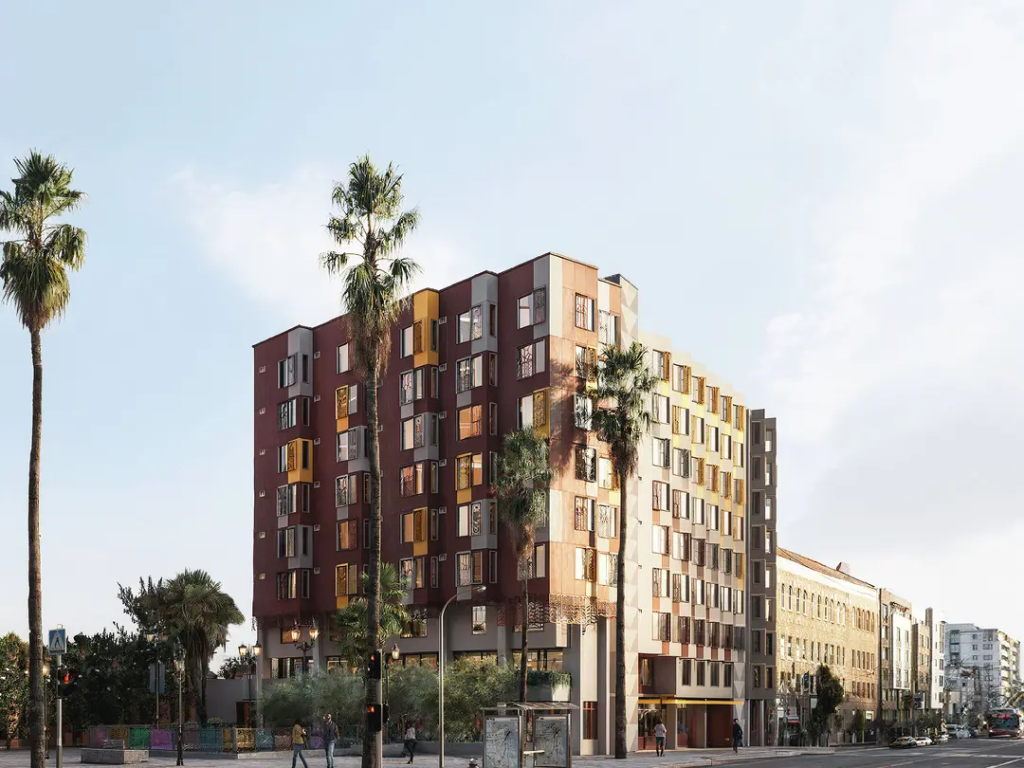
A rendering of the nine-story building that is under construction as part of the Marvel in the Mission project in San Francisco.MEDA
As commuters stream through the 16th Street Mission BART Station, a familiar corner has given way to change: A decades-old building that stood behind the station is gone, its absence marked by a construction fence. Behind it, work is underway on a 136-unit development that will reshape the Mission District transit hub into a model for supportive housing.
The official groundbreaking ceremony for what will be a nine-story building — the first of three planned as part of the larger “La Maravilla,” or the Marvel in the Mission project — is scheduled for later this month, but site work has already begun at 1979 Mission St.
Co-developed by Mission Housing Development Corp. and the Mission Economic Development Agency (MEDA), the project will place 382 affordable homes at the northeast corner of 16th and Mission streets, a majority of which will be housing for families. The first building to rise will pair affordable housing with on-site services to help formerly homeless residents maintain housing stability.
Reaching this stage has been a long journey. The site, once infamous for a stalled market-rate project proposed at the peak of the city’s housing boom, languished for years amid community opposition and financing challenges. After years of planning, public-private collaboration, and sustained advocacy, the Marvel is moving forward at a time when debates over permanent supportive housing are intensifying.
“It’s more thankless than ever to be an affordable housing or permanent supportive housing developer — locally, state, federal, you name it — and it’s harder to get financing for these projects than it’s ever been in the history of our industry,” said Mission Housing Executive Director Sam Moss, adding that he is still in disbelief that the team has “physically broken ground.”
“I pinch myself when I walk by at least once a day to see it. It was one of the hardest closings in history,” Moss said. “Everyone worked really hard the last three months of 2025 and pulled off a not very small miracle, and closed all the funding that was needed. Now there’s a tangible building coming out of the ground that represents going on two decades of organizing and difficult work.”
The Mayor’s Office of Housing and Community Development contributed $61 million in funding to the project. The Marvel is also backed by Merritt Community Capital Corporation and the Western Alliance Bank. Five Star Bank, which expanded to the city just a few years ago, has committed $10 million to the project through a low-income housing tax credit investment.
“While it’s our first investment here in the Bay Area, this type, it will likely not be our last, and it’s really part of our larger strategy to really partner with these mission driven developers,” said Five Star Bank Executive Vice President DJ Kurtze, who added that he serves on the board for Hamilton Families, a local nonprofit with a goal to “end family homelessness in San Francisco.”
“I see a lot of the issues from a different perspective,” Kurtze said. “It makes a lot of sense for a bank to invest in something like this as well, when you weigh all the other benefits to the community.”
Western Alliance Bank’s Mieke Holkeboer, Director of Affordable Housing Finance, said the investor is “committed to supporting projects that contribute to housing stability, neighborhood vitality, and inclusive economic growth.”
“Projects that demonstrate clear community benefit, sound fundamentals, and alignment with local stakeholders are where we see the greatest opportunity to make a meaningful and lasting impact,” Holkeboer said.
Financing challenges are just one of the headwinds facing the affordable housing industry. In recent months, City Hall has announced efforts to reshape San Francisco’s approach to homelessness and supportive housing, with sharp discussions among advocates and policymakers over how these types of buildings should operate, challenging the city’s traditional Housing First model.
Moss said these developments have increased the pressures that affordable housing developers like Mission Housing and MEDA face to “build something that’s properly managed and has the necessary operating funds to take care of 136 of what are most likely to be some of the most acute formerly homeless individuals in the city.”
“It is a lot harder to run these buildings than to physically build them,” he said, adding that the Marvel will be one of the first “100% funded” affordable housing buildings to come online in recent years. “We want to not only build one of the best permanent supportive housing buildings — we want to run it so that it stays nice and the surrounding neighborhood benefits as well.”
Marcia Contreras, Mission Housing’s deputy executive director, said that “bringing the right partners to the table” and understanding the population that is served is key.
“We also serve many single room occupancy hotels throughout the corridor, so we have experience,” she said.
While the debate over how to house and care for the city’s formerly homeless population persists in City Hall, Mayor Daniel Lurie said that he is supportive of projects like the Marvel.
“Our administration is working to deliver more affordable housing so the next generation of San Franciscans can raise their families in the city they love,” Lurie said in a statement. “This project will provide stability for residents while strengthening the Mission community and delivering the affordable homes that San Franciscans have long needed.”
April 9, 2026
Reporter
Laura Waxmann covers the business community with a focus on commercial real estate, development, retail and the future of San Francisco’s downtown. Prior to joining The Chronicle in 2023, she reported on San Francisco’s changing real estate and economic landscape in the wake of the COVID-19 pandemic for the San Francisco Business Times.
Waxmann was born and raised in Frankfurt, Germany, but has called San Francisco home since 2007. She’s reported on a variety of topics including housing, homelessness, education and local politics for the San Francisco Examiner, Mission Local and El Tecolote.