- by Matthew S. Bajko, Assistant Editor
- Monday, May 11, 2026 (ebar.com)
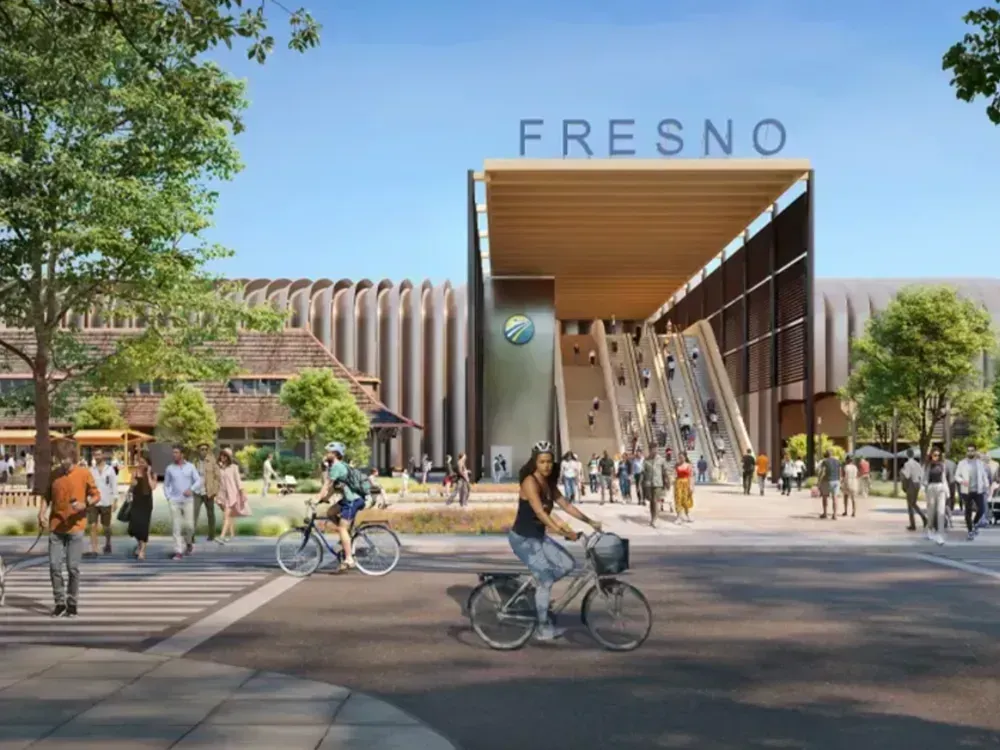
A rendering shows the Fresno Station for the state’s high-speed rail project. It would reconnect downtown and Chinatown via an elevated pedestrian crossing. Image: Courtesy ARUP
A massive headache that awaits California’s next governor, and their successor in either 2031 or 2035, is seeing the state’s long promised and bedeviled high-speed rail project come to fruition. First proposed three decades ago, the initial segment to go into operation is now estimated to open in 2032 at the earliest.
Even then, it will be a shortened route providing service solely in the Central Valley between Merced and Bakersfield. Extensions to Gilroy in the Bay Area and Palmdale north of Los Angeles have a target date of 2038, with costs estimated between $87 to $91 billion depending on if the Merced station is included or not.
Eventually, the system is supposed to run from San Francisco and Sacramento in Northern California all the way south to Anaheim near the Disneyland resort and San Diego. The Bay Area terminus has long been planned to be inside the Salesforce Transit Center, which will require burrowing a tunnel through San Francisco’s South of Market neighborhood in order to get trains to the downtown transportation hub.
When he first took office in 2019, Governor Gavin Newsom scaled back funding for the project, which led to the focus being on the 171 miles currently under design and construction in the Central Valley. Earlier this year he heralded it generating 16,400 well paid jobs, 70% of which went to local residents.
Of the 494-mile San Francisco to Los Angeles/Anaheim segment, 463 miles are now fully environmentally cleared and construction-ready. State leaders have also committed $1 billion from California’s Cap-and-Invest program to the high-speed rail project through 2045.
“California is building the nation’s first high-speed rail system, and we’re proving it can be done. We’re laying the foundation for cleaner, faster, and more connected transportation while investing in communities and creating good-paying jobs. California isn’t waiting for the future. We’re building it,” Newsom had touted in February.
Nonetheless, concerns about the state’s ability to complete the project remain. A report in March from the Legislative Analyst’s Office flagged that “staying on budget may be difficult, particularly given the history of the project, its size and complexity, uncertainty regarding federal tariffs and other policies, and the relatively small contingency amount assumed in the project budget.”
The project has long garnered support from LGBTQ transit officials, elected leaders, and those supportive of public transportation. Among them is lesbian Fresno City Councilmember Annalisa Perea, whose city is set to have a high-speed rail station.
“I am a big supporter of the California high speed rail project,” Perea, now running for a state Assembly seat this year, told the Bay Area Reporter last summer.
Friday Newsom named his former chief of staff when he was San Francisco’s mayor, Steve Kawa, a gay man who now lives in Cloverdale, to the California High Speed Rail Authority Board of Directors. He also named to the oversight body for the authority San Francisco resident Jason Elliott, another chief of staff to several of the city’s mayors who served as Newsom’s deputy chief of staff in his gubernatorial office.
As part of its questionnaire the B.A.R. sent the candidates running to succeed Newsom, as the Democratic leader is termed out come early 2027, one question inquired if they would support the high-speed rail project. Among the remaining Democratic contenders in the race who returned it, former congressmember Katie Porter of Orange County and San Jose Mayor Matt Mahan both told the B.A.R. it is too late for the Golden State to abandon it.
“I’ve always said: I’d like to spend more time riding high speed rail than building it. I am going to take a fresh look at this project when I become governor and figure out what the pathway forward is,” replied Porter. “I am going to push hard to get it done, but I also understand the reality that the project is over budget and behind schedule. Without support from the federal government, we need to explore new funding sources to support the project.”
She added that, “I’m encouraged by other developments in the state, like the Brightline high speed rail project in Southern California. We should be looking at other partnerships, financing opportunities, and innovative ways to deliver high speed rail to all of our cities and residents.” (That privately managed project aims to build a 218-mile passenger rail service between Las Vegas and Rancho Cucamonga, California.)
Mahan told the B.A.R. that, “High speed rail is an example of everything that has gone wrong when it comes to building in California. It has taken too long, cost too much, and frankly we are right to not trust that this will ever get done using the current plan. But the answer isn’t to walk away – it’s to make it work. We have to start treating it like a delivery project. That means better governance and planning, tighter oversight, cost discipline, and creating realistic benchmarks so we can show that we are actually able to finish what we start before asking taxpayers to commit more resources.”
The other top two polling Democrats in the race have voiced support for the project. At a gubernatorial debate hosted by two California Fox affiliates earlier this year, former congressman and state attorney general Xavier Becerra noted, “Japan has it. Europe has it. China has it. We’re going to have it too. We’re just going to do it smart. We’re not going to have these cost overruns. And we’re going to make sure it runs efficiently because Californians need to have access to high-speed rail.”
Billionaire-turned-politico Tom Steyer replied, “Who isn’t for high-speed public transportation? But we can’t pay any price for it.”
The lone Republican at the event, former Fox News host Steve Hilton, denounced the project.
“They’re not even talking about completing it for another decade or so. No of course not. We can’t send good after bad. We have to invest that money in real things that help families,” he said.
Fellow GOP candidate Riverside County Sheriff Chad Bianco also opposes the project. In a Facebook post last June he criticized it for being “years behind schedule and tens of billions over budget – all for a train nobody will ever ride. Instead of wasting even more of your money on this, let’s spend infrastructure dollars on things we actually need more of – like water storage!”
Lt. gov contenders vow support
No matter if Newsom’s successor serves one four-year term or eight years as governor before being termed out themselves, the high-speed rail project will be a concern for the leader of the Golden States for decades to come. With the state’s lieutenant governor positioned to launch a gubernatorial campaign of their own, the B.A.R. also asked the 2026 candidates seeking the top two elected statewide position where they stand on high-speed rail.
(The Democratic incumbent, Lieutenant Governor Eleni Kounalakis, is term-limited from running again this year. She had launched a bid to become governor but then pivoted to run for election as the next state treasurer.)
Two of the Democrats in the race returned the B.A.R.’s questionnaire. Gay former Sausalito city councilmember Janelle Kellman supports high-speed rail but cautioned “we need to get disciplined about delivery, governance, and value. California needs modern, low-carbon mobility, and high-speed rail can be part of that future. But the project must be managed as a major public works program: clear milestones, credible cost control, practical timelines and accountability for service providers.”
In light of the Trump administration clawing back more than $4 billion in federal funding for it, Kellman called for “a diversified strategy” when it comes to funding high-speed rail.
The state still needs to “aggressively compete for federal infrastructure dollars where available and keep applying for grants even if prior funding was pulled,” replied Kellman, adding it also needs to “protect and optimize existing dedicated state funding streams (including climate-related transportation funds where legally appropriate).”
She also plugged “value capture and station-area development partnerships so that communities that benefit can help fund delivery,” in addition to “private capital participation only where risk is appropriately allocated and governance is transparent.”
Former Stockton mayor Michael Tubbs, who went on to advise Newsom on poverty issues, told the B.A.R. that having high-speed rail connecting California’s different regions “would bolster the economy and uplift communities. Much like with the billionaire’s tax and how we find funds to address the housing crisis, we need to find creative ways to raise revenue––whether through closing things like the ‘Walmart loophole’ or split-roll proposals like Prop 15.”
He was referring to the one-time 5% billionaires’ tax being eyed for the November 3 statewide ballot and how large corporations cut their employees’ wages and hours so they are not required to pay for their health care as mandated by the federal Affordable Care Act. Proposition 15 was a failed 2020 statewide ballot measure that would have taxed commercial or industrial properties based on their current market value rather than their purchase price.
“From the Lt. Governor’s office, I’m most interested in exploring how we can use land leasing on public lands to unlock revenue for the state while also building much needed affordable housing,” Tubbs added.
Keep abreast of the latest LGBTQ political news by following the Political Notebook on Threads @ https://www.threads.net/@matthewbajko and on Bluesky @ https://bsky.app/profile/politicalnotes.bsky.social .
Got a tip on LGBTQ politics? Call Matthew S. Bajko at (415) 829-8836 or email m.bajko@ebar.com .