


- By Ali Wunderman | Special to The Examiner
- Jul 1, 2026 (SFExaminer.com)
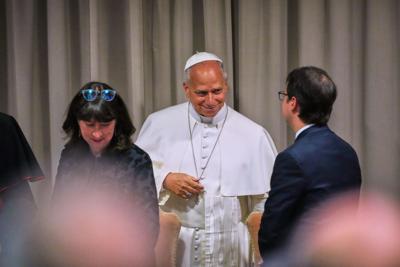
On the morning of May 25, Pope Leo XIV released “Magnifica humanitas: On Safeguarding the Human Person in the Time of Artificial Intelligence,” his sweeping first encyclical.
By 5 a.m., Dr. Mark Shiffman, a professor of philosophy at Saint Patrick’s Seminary in Menlo Park and the founding director of the Institute for Philosophy, Technology, and Politics, was already awake and reading it.
In San Francisco, he wasn’t alone. I’ve spent the last month in conversation about this document and the questions swirling around it — most notably, what AI means for our humanity.
What I’ve found is a faith community that was already deep in this discussion before the encyclical landed — and a city with a particular reason to take it seriously.
San Francisco has always been a city of believers. It was built around missions, shaped by parishes, its hills dotted with steeples. It attracted the optimistic toting nothing more than gold pans and hope.
Eventually, tech became the dominant faith, with its own missionaries and orthodoxies — and its own conviction that this time, we’ve found the thing that will save us.
Now the actual Catholic Church has something to say about that — and people here are listening differently than they might anywhere else.
Eleven of the country’s top 20 AI companies are headquartered in The City. The people building this technology drop their kids off at our preschools, drive our streets, fill our pews. When the Pope speaks about AI, San Francisco is the room where it’s happening.
“This is a unifying issue where we have this responsibility to speak out because we are talking about the nature of humanity,” said Michael Pappas, the executive director of the San Francisco Interfaith Council.
What’s striking, when talking to faith leaders across traditions, is how long they’ve already been having this conversation.
Rabbi Sarah Parris of Congregation Emanu-El preached about AI at High Holidays three years ago. Her commute to temple along Stanyan, regularly snarled by Cruise vehicles navigating their training routes, had become its own philosophical provocation. What does it mean to share a road with something that drives “perfectly,” yet somehow wrong?
Now she’s planning a full conference at Emanu-El in January: sessions on AI and Jewish ethics, AI and medicine, and AI and online antisemitism, with space built in for congregants who work in tech to actually talk to each other.
“No single person can answer these ethical questions,” Parris told me. “It is only by being in conversation and in community, with the right ethical text in front of you, that progress can be made.”
That’s what the encyclical clarified, even for those already engaged. Shiffman described it as giving people a map. Before “Magnifica Humanitas,” graduate students wanting to explore the implications of AI on warfare couldn’t find their footing.
“Now people know: Of I want to address this question, I’m either agreeing with this or disagreeing with this, or pushing it forward,” he said.
Ex // Top Stories
Trio of SF health clinics facing closure due to city’s budget cuts
Three facilities that serve youths and seniors are slated for closure if the proposed budget is finalized
Eight events to commemorate American independence for the Fourth of July
In honor of the country’s 250th anniversary, The City will launch fireworks from the Golden Gate Bridge, host block parties and stage a two-day jazz festival
Monthlong SF film series is a showcase of African diaspora
Taking place across two art museums, “Limitless” will bring guest speakers to The City for engaging conversations
That guidance from the Vatican is welcomed by teachers having to adapt quickly to how AI is shaping young minds. Sharon McCarthy Allen, the principal at St. Stephen School, described AI as a blessing and a curse.
“We have to be sure that we are upholding the dignity of each human being, specifically when it comes to our children and educating them,” she said. “AI is not going to help them with critical-thinking skills. We don’t want AI to take away their creativity.”
Not everyone in the pews is on board with that framing. At a tech industry party in the weeks after the encyclical’s release, I found myself in conversation with a practicing Catholic who works in AI, someone whose faith and professional life sit in direct proximity to everything the Pope was writing about.
His read: Leo got it wrong. AI, he told me emphatically, is going to solve everything. Suffering itself would become optional.
I asked whether he’d read Aldous Huxley’s “Brave New World.” He had not.
It felt like a parable of the moment — the gap between the people building this technology and the centuries of moral philosophy that exist specifically to ask what we lose when we eliminate struggle, imperfection and the friction of being human.
That question is exactly what Shiffman and his colleagues are trained for, and what Parris explored in her 2023 sermon, drawing on Jewish tradition’s insight that imperfection isn’t a bug in the human design, it’s a feature.
“There is value in the learning, growing, and changing that we all do each day,” she said during the sermon.
At the Vatican ceremony, Anthropic co-founder Chris Olah made a striking admission: that AI labs, including his own, operate inside incentives that sometimes conflict with doing the right thing.
“No matter how sincerely any of us intend to do the right thing — and I believe many of us do — we will always be influenced by those incentives,” he said.
He invited external moral pressure — voices the market can’t bend.
San Francisco’s faith communities are volunteering for exactly that. Sometimes this city ships things before they’re fully baked. The implications of AI, however, might be too consequential to accommodate that startup worldview.
“The question isn’t about what AI takes away from humanity by doing it better than we do,” Parris said in 2023. “The question is about how we can continue to be who we are alongside AI.”
Fourth-generation San Franciscan Ali Wunderman is an award-winning travel, food and culture writer. She lives in Nob Hill with her two rescue dogs and can often be found at John’s Grill enjoying a dirty martini.