


- Shane Goldmacher | © 2025 The New York Times Company
- Aug 6, 2026 (SFExaminer.com)
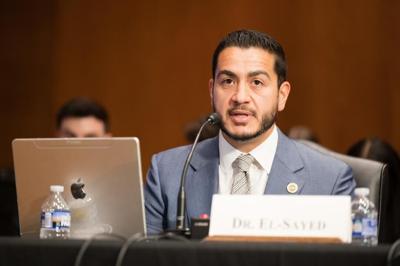
The embattled establishment of the Democratic Party searched furiously for a political reset after Dr. Abdul El-Sayed’s progressive victory in Michigan handed the party’s long-dominant moderate wing its most painful defeat of the year.
Some strategists urgently pressed to adopt a sharper edge to tap into the fury among Democratic voters that was felling its centrist candidates. Others wanted to attack democratic socialism, undercutting a budding movement now set to have far more than a toehold in the next Congress. Yet another young democratic socialist ousted an incumbent member of Congress in Detroit on Tuesday.
“We are preparing for the next war that is coming,” said Jonathan Cowan, the president of Third Way, a leading centrist Democratic group, revealing to The New York Times a new $15 million effort between now and 2028 to discredit democratic socialism.
El-Sayed’s win was not the blowout that some preelection polls had predicted. But his narrow nomination in one of the country’s signature swing states still represented a critical moment for the party’s middle, which had previously sought to cast the far left’s successes as contained within the country’s most urban and liberal corridors.
Their fear: El-Sayed was paving a path for a progressive to seize the party’s presidential nomination in 2028 — and then go on to lose the general election.
“It is deeply troubling to see radical, far-left candidates winning in places that are potentially presidential swing states,” Cowan added.
Most party leaders — from Gov. Gretchen Whitmer of Michigan to Sen. Chuck Schumer of New York to former Vice President Kamala Harris — quickly embraced El-Sayed’s Senate candidacy, given the stakes of the Michigan seat at the play. But some moderates see the emerging left as a danger.
The fact that Democrats recently put Michigan in the early lineup of presidential nominating states — a race just 18 months away — only heightened the significance of El-Sayed’s victory.
For now, the next big test is only a week away. In Wisconsin, Francesca Hong, a democratic socialist and state Assembly member representing the progressive hotbed of Madison, has emerged as the party’s front-runner for governor in another key battleground race.
Cowan said the $15 million his group would spend through 2028 was not directed at individual candidates. Instead, the group plans to target the Democratic Socialists of America movement, which he believes poses a “mortal danger” for Democrats.
He said the effort would include opposition research into DSA, polling, social media programs and educating Democratic activists and leaders. It would target both proud democratic socialists and those such as El-Sayed, whom he derided as performing the “DSA dodge” — flirting with democratic socialists enough to get their organizing power and support while remaining distant enough to avoid the explicit label.
How this discrediting campaign will affect the current midterm cycle — potentially undercutting Democratic nominees in swing-state races and undermining the party’s chances of retaking Congress — remains unclear.
Centrist Democrats say their purpose is to make progressives understand the risks of some of the more radical planks of the official DSA platform: defunding the “Department of War,” taking “steps toward fully abolishing the police and prison system,” enacting “reparations” and establishing a 32-hour workweek.
“The upside of being associated with more extreme movements is you get attention and real and perceived energy and outsider status,” said Liam Kerr, the co-founder of another centrist group called Welcome PAC.
Kerr said that the far left was currently receiving all of those benefits without “the baggage” of particular positions — a dynamic he hoped would shift with added attention.
On Wednesday, one progressive Democrat who won his party’s House nomination distanced himself from the DSA. Will Lawrence, a co-founder of the Sunrise Movement who defeated two more moderate Democratic rivals in Michigan on Tuesday, said he allowed his DSA membership to lapse in the last month. Lawrence, 35, now faces a Republican incumbent, Rep. Tom Barrett, in one of the country’s premier battleground districts.
Whatever comes next, El-Sayed’s triumph was a watershed moment for the progressive movement, a statewide success in Middle America that could not easily be dismissed. This was not Zohran Mamdani’s win over Andrew Cuomo in New York City, or a congressional primary win in Manhattan, Brooklyn, Philadelphia or Denver.
After all, the party establishment had the one-on-one race it had wanted against El-Sayed. The state’s Democratic governor delivered a late endorsement of Rep. Haley Stevens, the moderate alternative. And Stevens enjoyed a gargantuan advertising advantage that swelled into the tens of millions of dollars.
More than $32 million of that money came from a super political action committee linked to the American Israel Public Affairs Committee, which signaled that it would continue opposing El-Sayed through the fall.
El-Sayed has made running against AIPAC a centerpiece of his candidacy. On MS NOW on Wednesday, he said the links between Israel and Prime Minister Benjamin Netanyahu were “inextricable.”
“Netanyahu is a big reason why they’ve gotten so aggressive and, frankly, so bloodthirsty under his reign,” El-Sayed said.
Ex // Top Stories
St. Anthony’s annual back-to-school event serves hundreds of families
This year marks the 11th year that the organization has gathered supplies and clothes for elementary-school to high-school-aged children of low-income families
Pelosi slams Wiener chatbot mimicking opponent as sexist, racially problematic
Supervisor Connie Chan’s camp says the AI-driven website delivered ugly answers; frontrunner in congressional race accuses her side of flooding it with ‘malicious questions’
SF health clinics brace for fallout from federal cuts to Medicaid
They worry about how cuts to the social safety net and changes to enrollment for undocumented immigrants will affect the most vulnerable patients
Progressives have not won every race this year. On Tuesday, Cori Bush, a left-wing former member of Congress, lost badly in her bid to win back her old seat.
But they have won convincingly in enough places — including Graham Platner’s Senate nomination in Maine before his withdrawal — to put the party’s establishment on its heels.
“The Democratic Party is now Blockbuster,” Van Jones, the Democratic commentator and former Obama administration official, said on CNN on Tuesday. “These kids are Netflix.”
Colin Mortimer, the director of the centrist Center for New Liberalism, said that moderates needed to stop tempering their tone to appeal to voters sick of the status quo.
“It seems to me a lot of energy is on the left, but the big energy we are seeing from the base of the Democratic Party is just a rejection of the establishment and a rejection of incumbents,” Mortimer said.
He pointed to some upcoming races as key tests where it was younger center-left candidates doing the challenging of older incumbents, including the bid of Rep. Seth Moulton, a moderate, to unseat Sen. Ed Markey in Massachusetts, as well as Luke Bronin’s challenge to Rep. John Larson of Connecticut.
Maurice Mitchell, the national director of the progressive Working Families Party, sharply disagreed.
“They’re missing the plot,” Mitchell, who spent the last week campaigning in Michigan, said in an interview. “There is a populist insurgency taking place in this country.”
Moderates, he said, were misreading the room if they did not believe voters were animated by specific ideas as much as tenor. “I can tell you what they’re missing,” he said. “They’re missing a point of view.”
Or as Hasan Piker, the lightning rod live-streamer who campaigned in Michigan with El-Sayed, said in a text message Wednesday, “70 million dollars worth of smears couldn’t make up for a lack vision demonstrated by the establishment dems.”
With a signature fitted V-neck black T-shirt, El-Sayed built his successful campaign with a call-and-response set of catchphrases that captured the scope of his ambitions: “Money out of … politics. Money in your … pocket. Medicare for … all.”
Some Democratic strategists hoped he would focus, in particular, on the second of the three in the coming months, as polls show that voters are ready to punish President Donald Trump and his party for failing to bring down costs.
Republicans appeared most eager to frame the race around crime, linking El-Sayed to past movements and comments about defunding the police or prisons. Chris Gustafson, a spokesperson for the top Senate Republican super PAC, previewed that line of attack, calling El-Sayed “a dangerous threat to the safety and freedoms of every American.”
The contours and coalitions of the Stevens-El-Sayed primary are likely to provide a road map for progressives who decide to run for president. El-Sayed campaigned with Sen. Bernie Sanders and Rep. Alexandria Ocasio-Cortez — and featured them both prominently in his closing ad.
The Senate primary was not the first time that Michigan opted for a left-wing candidate in a marquee contest. In 2016, the state delivered an upset win for Sanders in his presidential primary against Hillary Clinton, who went on to lose Michigan that November to Trump.
The Michigan Senate race of 2026 was already a must-win for Democrats if they hope to wrest control of the Senate from Republicans this fall. At the same time, for Schumer, El-Sayed would add to the ranks of Democrats opposed to him as a leader.
It is also a must-win for progressives aspiring to prove they can succeed not just in primaries but also in crucial and competitive general elections.
For now, the party’s moderate wing was hoping to learn lessons after a painful defeat.
“Necessity is the mother of invention,” Kerr said. “It’s a tough but necessary time.”
This article originally appeared in The New York Times.


