


By Sara DiNatale, Ko Lyn Cheang, Staff Writers
Gift Article (SFChronicle.com)
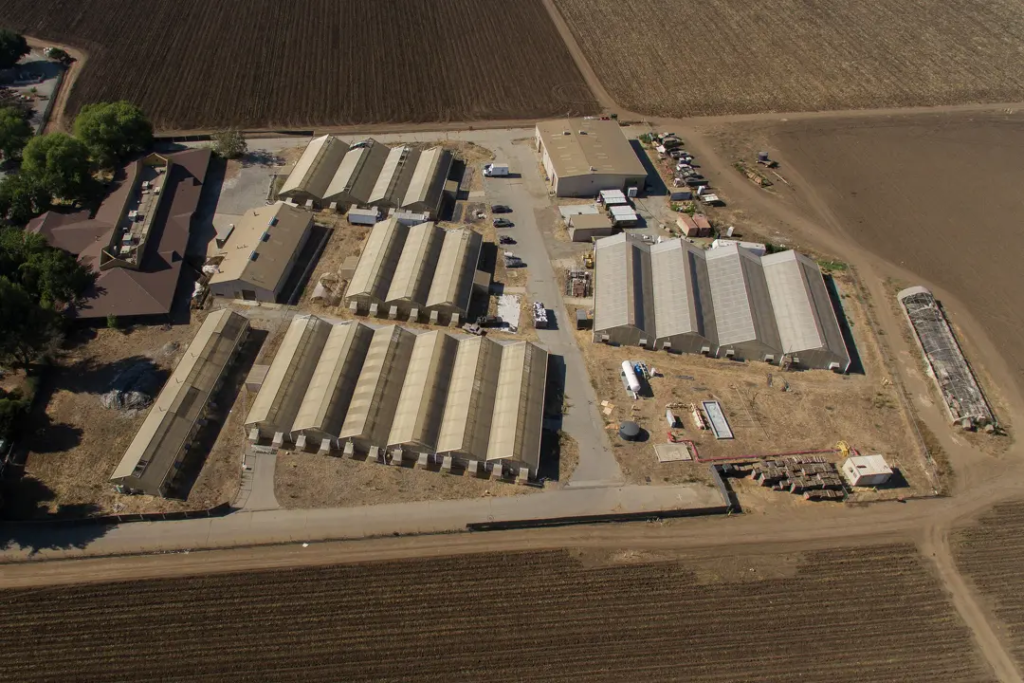
Santa Clara County and the state filed a lawsuit in federal court to block a proposed 26-acre Immigration and Customs Enforcement detention facility outside of Gilroy.Godofredo A. Vásquez/For the S.F. Chronicle
Public meetings packed with fearful residents and anti-ICE advocates. Highway bridges transformed into protest sites. Small-town mayors fielding questions about the limits of federal power.
This summer, these scenes played out in the Bay Area city of Gilroy, the state’s garlic capital, and farther south in the Mojave Desert town of California City (Kern County), as the rural localities grappled with how to effectively oppose immigration detention centers imposed on their communities.
The communities have transformed into battlegrounds against the Trump administration’s planned multibillion-dollar detention center network expansion, a linchpin of its campaign to deport millions of immigrants without permanent legal status living in the United States.
Both communities are struggling with the question of what, if anything, residents can do to stop a detention center in their backyard.
Gilroy, a small, majority-Latino town about 30 miles south of San Jose, has a long history of agriculture sustained by immigrant workers, Mayor Greg Bozzo said. Santa Clara County’s residents are already fearful amid actions by Immigration and Customs Enforcement. Bozzo said that fear would deepen if a federal lockup opened nearby.
“We want the city of Gilroy to know every one of their elected leaders is opposed to the detention center,” Bozzo said.
Santa Clara County and the state filed a lawsuit in federal court to block the facility, which sits just outside Gilroy’s jurisdiction on unincorporated county land.
The lawsuit, filed on June 10, argues the federal government violated a slew of environmental laws and administrative procedures when it began building the facility for 150 detainees on Holslaw Road. The federal government voluntarily halted construction until a September hearing.
The Department of Homeland Security told the Chronicle it has no new detention centers planned at the Gilroy location, despite acknowledging in court papers it had been doing construction at the location.
“Every day, DHS is conducting law enforcement activities across the country to keep Americans safe,” said the spokesperson, who declined to provide a name. “It should not come as news that ICE will be making arrests in states across the U.S. and is actively working to expand detention space.”
The lawsuit argues that DHS violated state and federal laws when it began construction. Santa Clara County Counsel Tony LoPresti said he believed there was solid legal basis for their arguments.
That said, the federal government is generally exempt from local laws, including zoning, by the U.S. Constitution’s supremacy clause, which asserts that federal law trumps local laws when the two are at odds.
“The biggest challenge is that states and localities’ ability to regulate the federal government is limited,” said Rick Su, a law professor at the University of North Carolina at Chapel Hill School of Law specializing in the intersection between cities and federal immigration. “Especially with regard to something that is within the core (federal) government powers, it’s traditionally understood that states and localities cannot regulate them, cannot stop them, cannot block them.”
But across the country, successful challenges to new detention centers have alleged violations of federal law, Su said. In Maryland, for example, the attorney general sued to halt a new immigration detention center, saying the feds violated the National Environmental Policy Act. In April, a federal judge temporarily blocked the project, which involved converting a large warehouse.
The lawsuit over the site near Gilroy alleges a violation of the same law, among others.
It also argues that under the California Land Conservation Act of 1965, the county and landowner entered into an agreement designating it exclusively for agricultural use in exchange for tax benefits. As a tenant of the property, the lawsuit argues, the federal government is subject to those restrictions. The plaintiffs are asking the court to permanently block the federal government from constructing an immigration detention facility at the site.
Unlike the lawsuit over the Gilroy site, the lawsuit over the California City Detention Facility doesn’t involve suing the federal government. The target of the California City facility lawsuit is the private prison company contracted by the federal government to operate the site and the city that approved the project.
The nonprofit Dignity Not Detention Coalition and an anonymous man detained there since September are suing CoreCivic, one of the nation’s largest immigration detention operators, and California City itself, alleging they failed to follow proper permitting procedures and violated a California law passed in 2017 that limits the circumstances in which cities can enter into contracts with private detention operators.
The California City lawsuit argues that CoreCivic is subject to local and state laws, especially because the contract it signed with the Department of Homeland Security explicitly stated it would be.
The facility, built in 1999, had been operated by CoreCivic as a state and federal prison for years until 2024, when the California Department of Corrections and Rehabilitation decided not to renew its lease with the company. After President Donald Trump took office last year, it was converted into a detention facility and began holding immigrants in August.
The lawsuit argues the company did not obtain the proper city approvals, including a permit and business license, before detaining immigrants.
In a statement, CoreCivic said it doesn’t comment on pending litigation. The company’s attorney, Dan Struck, has said during city meetings that the California City facility can operate today under the same conditional use permit the company obtained when it ran a state prison at the site.
The city quietly granted CoreCivic the business license in February. The plaintiffs appealed the decision, but California City’s planning commission rejected it before a packed room of protesters in June. A second appeal is pending before the City Council.
Joseph Petta, an attorney representing the plaintiffs, said he is confident in their legal arguments, but acknowledged it won’t be an “easy fight.”
Petta argued that private operators of federal detention facilities are still subject to state and local laws. He pointed to a case in which the 9th U.S. Circuit Court of Appeals found that Washington state health and safety requirements applied to the Tacoma, Wash., immigration detention center run by a private contractor. In another case, decided in January 2025, judges found that GEO Group violated Washington’s minimum wage laws by paying detainees $1 a day for labor.
The Trump administration last month purchased two private prisons it was already contracting with to house immigrants, including the California City facility. Petta said he did not think the federal government’s purchase of the land diminished the lawsuit, because CoreCivic is still the operator of the facility.
In recent earnings calls, however, CoreCivic and GEO Group both told investors the federal government’s purchase of their properties could strengthen their legal position.
GEO Group CEO George C. Zoley said the federal government’s ownership “will provide stronger credibility” in arguments over the supremacy clause, and “that these are federal facilities carrying out the congressional priorities of immigration programs … and that states can only have very limited involvement.”
Local elected officials want to make sure that if the federal government plans to open detention facilities in other parts of California or expand existing ones, cities and counties have tools to fight them.
Earlier this month, Rep. Sam Liccardo, D-San Jose, shared a step-by-step guide designed to help local governments create new ordinances intended to insulate them from ICE and the federal government. Liccardo said local codes that strengthen health and safety zoning requirements could help deter detention center conversions and expansions.
“Experience has taught us that putting the head in the sand is not a successful strategy for deterring authoritarian aggressions,” he said.
These ordinances are modeled after a law passed in Tacoma in 2018 in response to environmental hazards and public safety concerns posed by an ICE processing center, and effectively prevented an existing facility from expanding. GEO Group, the private contractor that operated the center, sued over the ordinance, but a federal judge determined Tacoma leaders were acting within their authority to regulate residents’ health and safety.
“The courts are going to be at the middle of this,” Liccardo said.
Beyond lawsuits are the public pressure campaigns that advocates are pressing in both areas of the state.
Su, the North Carolina law professor, said the most successful pushback against detention centers he’s seen has come through public protest, not the courts.
“The law might not be in their favor, but half of these battles are not won by law,” Su said. “Half of these battles are political opposition.”
He pointed to Social City, Ga., where the federal government called off plans to convert a massive warehouse into a detention center after widespread pushback from the majority-Republican city. The local government argued such a facility would severely strain the city’s utilities and emergency response system. It would have held up to 10,000 immigrants, almost twice the city’s population.
That resistance has inspired local advocates.
“I do believe we could win,” said Rebeca Armendariz, a fourth-generation Gilroy resident who is leading the ICE Out of Gilroy coalition. “The amount of community pressure is lending to this hope that drives us, that compels us to keep doing action after action to keep it in the public eye.”
Armendariz recalled pulling into a Gilroy home’s driveway in July just as armed immigration agents who’d come in souped-up cars with tinted windows handcuffed a father in front of his three daughters. Armendariz was called to the home as a volunteer with a Santa Clara County group that provides rapid response services to people detained by ICE and their families.
“It was just so incredibly painful to experience their pain,” she said.
To keep the pressure on, her group organized a 2-mile protest walk to the site of the proposed Gilroy detention center. On July 3, one of the busiest travel days, she and other protesters hung anti-detention banners over freeways in 30 locations across Monterey, San Mateo and Santa Clara counties.
“We’re a small town,” she said. “There’s a lot of learning that our community has to do and a lot of organizing we have to do.”
Similarly, advocates have organized vigils, protests and marches in California City opposing the facility and the reports of medical neglect endured by detainees since it opened.
On a sunny day in late July, dozens of protesters gathered in San Jose’s Japantown alongside elected officials to celebrate the construction pause on the Gilroy facility.
One was Susan Hayase, a third-generation Japanese American whose parents, aunts and uncles were all incarcerated during World War II under the government’s mass detention of people of Japanese descent.
During the first Trump administration, she started San Jose Nikkei Resisters to oppose what she considered racist immigration policies.
When she learned about the Gilroy site, she was alarmed. But she also was determined.
“The struggle we’re in now is very complex, it’s daunting,” she said. “There’s no one thing that’s going to do it. We have to organize communities to be ready to do different things at different times because this is going to be a prolonged struggle.”
Aug 16, 2026
Staff writer
Sara DiNatale covers politics and the Trump administration’s impact on the Bay Area. She joined the Chronicle in 2025, after a decade reporting across the southern U.S. for the San Antonio Express-News, the Tampa Bay Times and Mississippi Today. DiNatale was the recipient of a 2024 George Polk Award for her investigation on the Texas residential solar industry, which led Texas to adopt new state laws to regulate bad actors and scammers. She’s a graduate of the University at Buffalo and a native of Western New York.
How to reach Sara
To provide story tips or feedback email sara.dinatale@sfchronicle.com or message her on Signal at @dinatale.70.
Reporter
Ko Lyn is a reporter on the metro team covering Asian American and Pacific Islander communities and immigration for the Chronicle, which she joined in January 2024. She previously covered housing and city government for the Indianapolis Star, and her work, including reporting on jail deaths and immigration detention, has been recognized by the Investigative Reporters and Editors Awards, the Goldsmith Prize, the Sidney Awards, the San Francisco Press Club’s Greater Bay Area Journalism Awards and the Connecticut and Indiana Societies for Professional Journalists. She’s a graduate of Yale College and speaks Mandarin.
How to reach Ko Lyn
To provide story tips or feedback, email kolyn.cheang@sfchronicle.com or contact her on Signal or her cell phone at 415-961-7047.